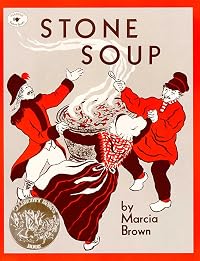
Stone Soup: An Old Tale
by Marcia Brown
On This Page
Description
When three hungry soldiers come to a town where all the food has been hidden, they set out to make soup of water and stones, and all the town enjoys a feast.Tags
Recommendations


Member Reviews
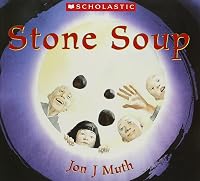
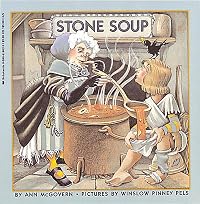
Although there seem to be any number of picture-books involving soup made with stones - Jon J. Muth's recent Stone Soup, for instance - this retelling of the traditional French variant of the tale is the one I grew up with, and it holds a special place in my heart! The story of three hungry soldiers, who, returning home from "the wars," find themselves in a village determined not to feed them, it is part trickster tale, part fable. Young readers will enjoy following the soldiers' ingenious method of procuring dinner, while also learning that resources go further, and produce a deeper sense of enjoyment, when they are shared.
Originally published in 1947, Stone Soup was was chosen as a Caldecott Honor Book, and it's not difficult to see show more why! Bold illustrations, colored in black and orange, perfectly capture the droll humor of the story. These soldiers know what they're about, and - looking at Marcia Brown's artwork - so does the reader. Highly recommended, to young folklore lovers, and to those who appreciate a somewhat vintage illustration style! show less
Originally published in 1947, Stone Soup was was chosen as a Caldecott Honor Book, and it's not difficult to see show more why! Bold illustrations, colored in black and orange, perfectly capture the droll humor of the story. These soldiers know what they're about, and - looking at Marcia Brown's artwork - so does the reader. Highly recommended, to young folklore lovers, and to those who appreciate a somewhat vintage illustration style! show less
As someone who generally likes lushly coloured illustrations, I did not really expect to enjoy the illustrations of this version of the popular Stone Soup folktale. However, the illustrations are really quite wonderful (attention to detail, captured movement, wonderful expressions), and the simple combination of white, black, grey and orange shades works surprisingly well.
The illustrations notwithstanding, I am also very pleasantly surprised by the story itself. Marcia Brown's version of the tale clearly shows that the peasants do not simply fear strangers in general, they specifically fear strangers who are soldiers. When one then realises that historically, soldiers not only had the reputation of demanding and taking any type of show more supplies they might need/want without generally much thought of the needs and requirements of civilians, but that soldiers also often had both official and unofficial written guarantees permitting them to take any available and desired provisions from the towns, villages and cities through which they were passing (and without compensation), it is somewhat understandable that the villagers are at first rather suspicious of the soldiers and keep their food stores hidden. They might not want to share, and might even be a bit xenophobic, but first and foremost, the villagers are afraid of losing most, if not all of their stored foodstuff to the soldiers (and they could obviously not know in advance that the soldiers are, in fact, friendly).
In the end, the three soldiers manage to get the food they require neither by resorting to violence and threats nor do they simply search for the hidden provisions and take what they want, but by being able to entice the village to share what they have. The communal feast of stone soup not only celebrates sharing, it also celebrates community, friendship and the fact that one can achieve more by using one's wits. And above all, the soldiers are not only able to stay their hunger, the village is left with a much more positive impression regarding not only strangers, but soldiers in particular.
On a textual level the unhurried, almost caressing pace and tone of the narrative mirrors the slow, deliberate cooking process of the soup, creating an atmosphere of calm, but also one of joyous, curious anticipation. And the fact that all of the villagers have personal names (the villagers, not the three soldiers), that they are not simply anonymous entities, both personalises the narrative and allows for speculation and possible expansion. Thus, if I were reading this story aloud to a child (or a group of children), I might engage my audience by asking who of the villagers thinks that their grain needs to be hidden (Vincent and Marie), and why they might believe this. All in all, a very engaging (and at times thought-provoking) picture book, Marcia Brown's Stone Soup has stood the test of time and is still to be highly recommended. show less
The illustrations notwithstanding, I am also very pleasantly surprised by the story itself. Marcia Brown's version of the tale clearly shows that the peasants do not simply fear strangers in general, they specifically fear strangers who are soldiers. When one then realises that historically, soldiers not only had the reputation of demanding and taking any type of show more supplies they might need/want without generally much thought of the needs and requirements of civilians, but that soldiers also often had both official and unofficial written guarantees permitting them to take any available and desired provisions from the towns, villages and cities through which they were passing (and without compensation), it is somewhat understandable that the villagers are at first rather suspicious of the soldiers and keep their food stores hidden. They might not want to share, and might even be a bit xenophobic, but first and foremost, the villagers are afraid of losing most, if not all of their stored foodstuff to the soldiers (and they could obviously not know in advance that the soldiers are, in fact, friendly).
In the end, the three soldiers manage to get the food they require neither by resorting to violence and threats nor do they simply search for the hidden provisions and take what they want, but by being able to entice the village to share what they have. The communal feast of stone soup not only celebrates sharing, it also celebrates community, friendship and the fact that one can achieve more by using one's wits. And above all, the soldiers are not only able to stay their hunger, the village is left with a much more positive impression regarding not only strangers, but soldiers in particular.
On a textual level the unhurried, almost caressing pace and tone of the narrative mirrors the slow, deliberate cooking process of the soup, creating an atmosphere of calm, but also one of joyous, curious anticipation. And the fact that all of the villagers have personal names (the villagers, not the three soldiers), that they are not simply anonymous entities, both personalises the narrative and allows for speculation and possible expansion. Thus, if I were reading this story aloud to a child (or a group of children), I might engage my audience by asking who of the villagers thinks that their grain needs to be hidden (Vincent and Marie), and why they might believe this. All in all, a very engaging (and at times thought-provoking) picture book, Marcia Brown's Stone Soup has stood the test of time and is still to be highly recommended. show less
It's funny how a single story changes with the telling. These days the classic tale of how to make stone soup has been told in a myriad of different tellings and versions. But if you harken back a little to Marci Brown's 1947 concoction, you see clearly that the story can be a little more sardonic than its alternate versions. In this tale, villagers are tricked out of their greed and fear into sharing and enjoying life with their neighbors. And it's all thanks to a soup that doesn't even exist.
I have burned through three different editions of Stone Soup, not liking each one (one had ugly weird illustrations, one was too sappy and rhyming, one was too modern and snotty) until I decided to try out the classic, Caldecott Honor version.
WHAT a change. THESE are the classic illustrations most of us grew up with. THESE are the soldiers and the peasants we read about. THIS is the story I'm keeping for my nieces. The telling isn't too clever, or too silly, or too watered-down, or too grown-up. The illustrations are neither too slick or too consciously old-fashioned. (Sheesh, I feel like I'm reviewing Goldilocks here!) I love it, love it, love it!
Please remember that this is a bit of a lengthy book for the smaller kids.
WHAT a change. THESE are the classic illustrations most of us grew up with. THESE are the soldiers and the peasants we read about. THIS is the story I'm keeping for my nieces. The telling isn't too clever, or too silly, or too watered-down, or too grown-up. The illustrations are neither too slick or too consciously old-fashioned. (Sheesh, I feel like I'm reviewing Goldilocks here!) I love it, love it, love it!
Please remember that this is a bit of a lengthy book for the smaller kids.
Through wonderful literation and well placed illustrations; Marcia Brown has taken the old fable, "Stone Soup" and turned into a feast for all to enjoy! The story begins with three very hungry soldiers marching home from war. As the weary, war-torn villagers see them approaching, they make a concerted effort to conceal all of their food by hiding it in the most unlikely places. However, the very resourceful soldiers do not let a few greedy townies keep them from a much deserved meal that is "fit for a king". The cunning soldiers realize that there is more than one way to skin a cat. They start by putting stones into a large pot of water. They tell the town’s people they will be happy to share with them but it would be so much nicer if show more they had this ingredient or that. The villagers become so involved with the making of the soup that by the time all is said and done, they have made a meal that is “fitting for a king”. What a very clever way of getting stiff-necked people to cooperate!
I find it interesting that such subdued colors can hold the interest of children. In many picture books, like "The Hungry Caterpillar"" bright colors have kept young students at edge of their seats for the entire book. Marcia Brown has used well placed illustrations to show commotion and the emotions of the villagers that holds the reader’s attention. Well placed angulation and lines are evenly spaced across an entire page allowing the reader to feel like they are participating in putting this feast together!
There are so many activities that can be added to this story. I would begin by taking advantage of the wonderful illustrations that she has made. The children can count the different ingredients as they come out of their hiding places. For instance she talks about someone getting three heads of cabbage but they actually brought out nine heads. That instantly becomes a math problem of nine minus three. For Language arts we can identify what letter each ingredient begins with. We can also have a social studies lesson by identifying which war has happened and identify on a map what part of the world that it has taken place in. The most obvious lesson would be talking about our behavior: honesty, friendship, cooperation. I believe there are a plethora of lesson plans possible with this one story. What a feast indeed! show less
I find it interesting that such subdued colors can hold the interest of children. In many picture books, like "The Hungry Caterpillar"" bright colors have kept young students at edge of their seats for the entire book. Marcia Brown has used well placed illustrations to show commotion and the emotions of the villagers that holds the reader’s attention. Well placed angulation and lines are evenly spaced across an entire page allowing the reader to feel like they are participating in putting this feast together!
There are so many activities that can be added to this story. I would begin by taking advantage of the wonderful illustrations that she has made. The children can count the different ingredients as they come out of their hiding places. For instance she talks about someone getting three heads of cabbage but they actually brought out nine heads. That instantly becomes a math problem of nine minus three. For Language arts we can identify what letter each ingredient begins with. We can also have a social studies lesson by identifying which war has happened and identify on a map what part of the world that it has taken place in. The most obvious lesson would be talking about our behavior: honesty, friendship, cooperation. I believe there are a plethora of lesson plans possible with this one story. What a feast indeed! show less
Revisiting a childhood favourite after quite a few decades, it's a lot meaner than I remembered, with uncomfortable hostility between the soldiers and the peasants.
Still, a great story, with classic illustrations, and the best lesson for when you open the refrigerator and "there's nothing to eat."
Still, a great story, with classic illustrations, and the best lesson for when you open the refrigerator and "there's nothing to eat."
Three soldiers come into a small village seeking food and shelter, but everyone says there is no food or place for them to stay. The soldiers say they will make "stone soup" out in the town square instead, intriguing the villagers with this mysterious dish. As they lament the lack of carrot, meat, barley, etc. in the soup, the villagers suddenly recall having a small amount of said ingredient to add to the pot. By the end of the evening, a large feast is shared by villagers and soldiers alike!
Once again, I find myself having to say how I'm not really a huge fan of traditional fairy tales/fables. I can't exactly place my finger on why, but this story did little for me. Others have commented on how it's ultimately a story about sharing, show more although it seems to be more one of trickery, and about the soldiers' resilience (although that could be argued that it's the mighty strong-arming the weak, as usual). Whatever it is, it's not a story that particularly resonates with me. My 6-year-old niece also walked away from this title halfway through reading it, which is highly unusual for her.
The award-winning illustrations are in a style I typically like -- black and white drawings with splashes of one color only (in this case red). The red does add liveliness to the pictures, but something about the illustrations feels very old and dated (beyond just the historic setting). Overall, I wasn't particularly impressed with this book, even though I know it is generally considered a classic of children's literature. It just wasn't my cup of tea. show less
Once again, I find myself having to say how I'm not really a huge fan of traditional fairy tales/fables. I can't exactly place my finger on why, but this story did little for me. Others have commented on how it's ultimately a story about sharing, show more although it seems to be more one of trickery, and about the soldiers' resilience (although that could be argued that it's the mighty strong-arming the weak, as usual). Whatever it is, it's not a story that particularly resonates with me. My 6-year-old niece also walked away from this title halfway through reading it, which is highly unusual for her.
The award-winning illustrations are in a style I typically like -- black and white drawings with splashes of one color only (in this case red). The red does add liveliness to the pictures, but something about the illustrations feels very old and dated (beyond just the historic setting). Overall, I wasn't particularly impressed with this book, even though I know it is generally considered a classic of children's literature. It just wasn't my cup of tea. show less
Members
- Recently Added By
Lists

Favorite Childhood Books
1,651 works; 519 members
1001 Children's Books You Must Read Before You Grow Up
774 works; 100 members

Caldecott Honor Books
296 works; 23 members

Mensa for Kids Excellence in Reading Award Program (Grades K-3)
64 works; 6 members

Childhood Favorites
427 works; 24 members
Honey For a Child's Heart
1,152 works; 25 members

Brightly Beaming Curriculum Books
281 works; 8 members
Ambleside Books
459 works; 18 members

Sense of taste (recc titles)
15 works; 2 members

CCE 1000 Good Books List
1,033 works; 12 members

Food Fiction
24 works; 7 members

SYES Library Wishlist
1,080 works; 4 members

A Smorgasbord of Culinary Fiction
221 works; 94 members

Beautiful Feet Books
304 works; 7 members

Early Picture Books
467 works; 9 members

Children's Picture Books
188 works; 1 member

Books We Loved As Children
610 works; 254 members
Children's Literature 1900 - 1950 in order
413 works; 8 members

The Peaceful Preschool Curriculum
58 works; 1 member
Author Information

23+ Works 8,864 Members
Awards and Honors
Work Relationships
Has as a student's study guide
Has as a teacher's guide
Common Knowledge
- Canonical title
- Stone Soup: An Old Tale
- Alternate titles
- Une Drole de Soupe... A French version of the story.
- Original publication date
- 1947
- People/Characters
- Three soldiers and the village people
- Dedication
- To my mother and father
- First words
- Three soldiers trudged down a road in a strange country.
- Quotations
- "Such a soup! How good it smelled! Truly fit for a king. But then the peasants asked themselves, 'Would not such a soup require bread-and a roast-and cider?"
- Last words
- (Click to show. Warning: May contain spoilers.)Oh, it's all in knowing how, said the soldiers, and off they went down the road.
- Original language
- English
Classifications
Statistics
- Members
- 4,611
- Popularity
- 3,158
- Reviews
- 165
- Rating
- (4.04)
- Languages
- English, French, Spanish
- Media
- Paper, Audiobook, Ebook
- ISBNs
- 59
- UPCs
- 1
- ASINs
- 28