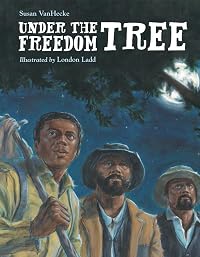
Under the Freedom Tree
by Susan VanHecke
On This Page
Description
One night in 1861, three escaped slaves made their way from the Confederate line to a Union-held fort. The runaways were declared "contraband of war" and granted protection. As word spread, thousands of runaway slaves poured into the fort, seeking their freedom. These "contrabands" made a home for themselves, building the first African American community in the country. In 1863, they bore witness to one of the first readings of the Emancipation Proclamation in the South, beneath the show more sheltering branches of the tree now known as Emancipation Oak. show lessTags
Recommendations



Member Reviews
This is an historical fiction, poetry picture book I think is more appropriate for older grades. Because of the content of slavery, a more mature concept, and also the formatting of the poems I think may be hard to understand has a younger reader. I believe this is more suitable for perhaps 4th or 5th grade. I think this was great story depicting the slaves’ journey towards freedom and had great symbolism of the oak tree, but I do think it could be difficult to understand. I don’t think this would be a great book to read aloud, I feel like the poetry didn’t really have a traditional, “story-telling” format, it focused more the sound words and repetition of descriptors, which is great when analyzing poetry but it would be show more choppy to read aloud to the class. But this is a great example of poetry, and could be great for a student to read and analyze individually, I know I had to reread some parts to clarify the plot. But overall I do think this is a useful book depicting beautiful poetry techniques, and portraying the central message of the importance of freedom and independence. show less
One night in 1861, three escaped slaves made their way from the Confederate line to a Union-held fort. The runaways were declared "contraband of war" and granted protection. As word spread, thousands of runaway slaves poured into the fort, seeking their freedom. These "contraband" made a home for themselves, building the first African American community in the country. In 1863, they bore witness to one of the first readings of the Emancipation Proclamation in the South - beneath the sheltering branches of the tree now known as Emancipation Oak.
This is a wonderful book that teaches children the importance of the Emancipation Proclamation and what slavery was. Although it is not historically accurate, it does show the importance of what show more the slaves went through to gain their freedom. It also shows the importance of what the Emancipation Proclamation did.
I love this book. I think the pictures and the message the book sends is important. It starts teaching children at a young age about an important topic in American history. It is simple enough for older children to understand and be able to ask questions. Wonderful book. show less
This is a wonderful book that teaches children the importance of the Emancipation Proclamation and what slavery was. Although it is not historically accurate, it does show the importance of what show more the slaves went through to gain their freedom. It also shows the importance of what the Emancipation Proclamation did.
I love this book. I think the pictures and the message the book sends is important. It starts teaching children at a young age about an important topic in American history. It is simple enough for older children to understand and be able to ask questions. Wonderful book. show less
Summary: "Under the Freedom Tree" is a free-verse narrative that tells the true story of the Civil War's first contrabands. Three men, Frank, James, and Shepard escaped the Confederate line one night in 1861 and rowed across the harbor to a Union-held fort. Instead of returning the men back to their master, the union claimed them as "enemy property" in order to protect them. These men opened the door for countless others to escape to the fort. All the contrabands soon built a community and helped the North win the war until the day that slavery was abolished, where they all celebrated under a tree, now known as the "Emancipation Oak."
Review: The central message of this story is Frank, James, and Shepard were three slaves that took a show more courageous step towards building a better life for themselves which, as a result, opened a door for many other slaves to become protected by the Union until slavery ended. The book says "But here at Slabtown, here at the Camp, they are not what they once were. Slabtown is their town, so too the Camp." This quote reiterated the brave step those three men took towards freedom. The work was still hard and their living conditions were not great but it was better than before, as a slave, because they now had a home.
I liked how the story was written in poetry and how the book showcased everyone's dialects. For example, the book discussed the community of Slabtown and how missionaries would visit where they said "Worship God, sing praises, and pray. We shall teach your children." The book immersed me into the culture of that time because iti used their dialects and explained what they did at the Camp. show less
Review: The central message of this story is Frank, James, and Shepard were three slaves that took a show more courageous step towards building a better life for themselves which, as a result, opened a door for many other slaves to become protected by the Union until slavery ended. The book says "But here at Slabtown, here at the Camp, they are not what they once were. Slabtown is their town, so too the Camp." This quote reiterated the brave step those three men took towards freedom. The work was still hard and their living conditions were not great but it was better than before, as a slave, because they now had a home.
I liked how the story was written in poetry and how the book showcased everyone's dialects. For example, the book discussed the community of Slabtown and how missionaries would visit where they said "Worship God, sing praises, and pray. We shall teach your children." The book immersed me into the culture of that time because iti used their dialects and explained what they did at the Camp. show less
This book is a good way to teach children about an important time in our nation's history when slaves were set free. It may not be very easy to follow for very young children as a lot of the words went over their head when I read to them. However, they did ask a lot of questions and were interested in knowing exactly what was going on. Since the freedom tree was focused on throughout the entire book, a nice extension activity for this book in the classroom may be to have children draw their own version of the freedom tree with happy people reading the Emancipation Proclamation or even a coloring sheet with that.
Personal response: told in free verse, every word is powerful and helps the reader understand the emotions and power behind this story. The illustrations are a nice accompaniment to the text.
Curricular connections: Many--use in writing lessons on word choice and repetition of sound in poetry. Use in a study of Civil war history and the history of slavery.
Curricular connections: Many--use in writing lessons on word choice and repetition of sound in poetry. Use in a study of Civil war history and the history of slavery.
I listened to this book while traveling. It is a historical fiction book about the Freedom Tree in 1861 and the Lincoln's Emancipation Proclamation. The book was described to be written in taut free verse and tells the little known story of the first contraband camp of the Civil War (Overdrive, Spokane Public Library) I would really like to have read the print book to see the illustrations and how the book is written. (Listening I could not tell that it was done as poetry.)
There is a lot of history in this book and would be wonderful to share with students studying the Civil War.
There is a lot of history in this book and would be wonderful to share with students studying the Civil War.
Three enslaved men make a daring escape. These verses exemplify the impact of historical events on the lives of individuals. Based on true events, the book connects history to the distinguished landmark of Virginia’s Emancipation Oak. Author’s Note, Bibliography.
Members
- Recently Added By
Author Information
12 Works 568 Members
Awards and Honors
Classifications
Statistics
- Members
- 77
- Popularity
- 410,605
- Reviews
- 8
- Rating
- (4.00)
- Languages
- English
- Media
- Paper, Audiobook, Ebook
- ISBNs
- 14