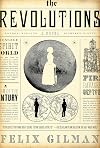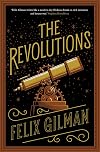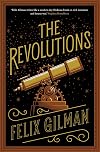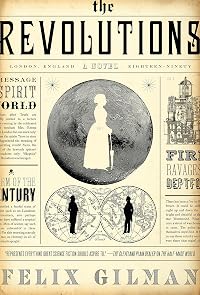
The Revolutions: A Novel
by Felix Gilman 
On This Page
Description
"In 1893, young journalist Arthur Shaw is at work ... when the Great Storm hits London, wreaking unprecedented damage. In its aftermath, Arthur's newspaper closes, owing him money, and all his debts come due at once ... At one of [his fiancée Josephine's occult society] meetings, Arthur is given a job lead for what seems to be accounting work, but at a salary many times what any clerk could expect. The work is long and peculiar, as the workers spend all day performing unnerving calculations show more that make them hallucinate or even go mad, but the money is compelling. Things are beginning to look up when the perils of dabbling in the esoteric suddenly come to a head: a war breaks out between competing magical societies"--Dust jacket flap. show lessTags
Recommendations










Member Reviews
Arthur Shaw is not the most interesting man in the not-quite-historical Victorian London of Felix Gilman’s The Revolutions. That’s a problem, since he’s one of the main characters in the book. Thankfully, Shaw’s very mundanity – he needs a job and is willing to do just about anything for money – leads him into something very interesting indeed.
Oh, and there’s his fiancé, Josephine, who makes for a considerably more interesting companion.
This London is one where the kind of quasi-scientific spiritualism that was popular in our reality was not just popular, it was actually true. In particular, Arthur and Josephine find themselves bound up in a group trying to astral project to other planets, particularly Mars. Doing this show more requires not only the right people (sort of – the group gets less selective as things progress), but massive calculations produced by a massive machine with countless human parts. Babbage’s engine writ large.
The book takes a while to set all this up, which is either fascinating world building (for me) or dull sluggishness (for others). Things really kick into high gear when one of the astral flights is interrupted by Arthur, leaving Josephine trapped – in spiritual, if not physical form – on one of the moons of Mars.
What Gilman does next is a clever sleight of hand. The book focuses on Arthur for a bit and how he and the rest of the society plan to get Josephine back. Just when you think she might be nothing more than a damsel in need of rescue, the POV shifts and we’re treated to Josephine’s lengthy observation of (and, eventually, interactions with) the Martians and their society. This is the best part of the book, harkening back to the days of science fiction before science itself killed off the chance of finding life on Mars. Reminds me of some of the more esoteric parts of The Martian Chronicles.
Naturally, a rescue mission is mounted and while it has its own charms as an adventure story, it can’t match the peak that is Josephine’s experience with the truly alien. But all stories must end and I’d be lying if I said that the ending ruined all that came before.
So Arthur might be kind of dull. Don’t let that put you off. He’ll lead you into some very neat places.
www.jdbyrne.net show less
Oh, and there’s his fiancé, Josephine, who makes for a considerably more interesting companion.
This London is one where the kind of quasi-scientific spiritualism that was popular in our reality was not just popular, it was actually true. In particular, Arthur and Josephine find themselves bound up in a group trying to astral project to other planets, particularly Mars. Doing this show more requires not only the right people (sort of – the group gets less selective as things progress), but massive calculations produced by a massive machine with countless human parts. Babbage’s engine writ large.
The book takes a while to set all this up, which is either fascinating world building (for me) or dull sluggishness (for others). Things really kick into high gear when one of the astral flights is interrupted by Arthur, leaving Josephine trapped – in spiritual, if not physical form – on one of the moons of Mars.
What Gilman does next is a clever sleight of hand. The book focuses on Arthur for a bit and how he and the rest of the society plan to get Josephine back. Just when you think she might be nothing more than a damsel in need of rescue, the POV shifts and we’re treated to Josephine’s lengthy observation of (and, eventually, interactions with) the Martians and their society. This is the best part of the book, harkening back to the days of science fiction before science itself killed off the chance of finding life on Mars. Reminds me of some of the more esoteric parts of The Martian Chronicles.
Naturally, a rescue mission is mounted and while it has its own charms as an adventure story, it can’t match the peak that is Josephine’s experience with the truly alien. But all stories must end and I’d be lying if I said that the ending ruined all that came before.
So Arthur might be kind of dull. Don’t let that put you off. He’ll lead you into some very neat places.
www.jdbyrne.net show less
After reading almost a 100 pages, I’ve given up on Gilman. I took up the book in the first place, because I do enjoy Victorian detective stories—including Lovecraft and Hodgson—but this book, and a few others, are just too depressing for me. No matter how broke the protagonists are, the antagonists are too seedy and malevolent to be accepted as a source of any kind of needy funds. The moment anyone—especially the hero and heroine—starts descending, both physically and emotionally, into degraded, if not degenerate, states I stop reading.
Maybe it’s a matter of “type” of evil: breaking the 10 Commandments is one level of evil (although I kind of think of those trespasses as “just” sins), where “evil”, for me, means show more something disgustingly sick…like intentionally twisting someone’s emotional state into total degradation. This book has that flavor for me and there are too many more uplifting tales of fantasy and science fiction for me to waste my time on anything the promises to be less so.
Meanwhile, I’ve read some of the other reviews and I accept that I may be crediting Gilman with more depravity than is actually there. But my sentiments remain: if the story doesn’t promise more than depravity, don’t waste time on it. show less
Maybe it’s a matter of “type” of evil: breaking the 10 Commandments is one level of evil (although I kind of think of those trespasses as “just” sins), where “evil”, for me, means show more something disgustingly sick…like intentionally twisting someone’s emotional state into total degradation. This book has that flavor for me and there are too many more uplifting tales of fantasy and science fiction for me to waste my time on anything the promises to be less so.
Meanwhile, I’ve read some of the other reviews and I accept that I may be crediting Gilman with more depravity than is actually there. But my sentiments remain: if the story doesn’t promise more than depravity, don’t waste time on it. show less
Late 19th century spiritual travel to Mars in doubtful company. Nobody has any fun. The Martians are kind of interesting, but they don't have much fun either and all of the landscapes tend toward dreary at best. I do wonder why he bothered with this and I can't recommend anyone else should.
I loved the beginning ...the hints of supernatural presence and powerful, magical enemies that are watching...the world within the world. I found Podmore and his minions creepy and unique, and I especially loved the magical duel in The Savoy. It was brilliant and creative and wonderful! But ... I found the second half, especially the last third of the book really dragged for me. I feel like it kind of lost it's way and became tedious and unfocused, and the main focus shifted so much away from all the mysterious and creepy things I enjoyed in the first part of the book that I found it hard to maintain interest. It just dragged for me, and I didn't really like how it all wrapped up.
This book really had a lot going for it, the setting was really engrossing, the main character was adorable, if a bit flat, and it throws fun ideas out at you left and right. This is the sort of book that influences all your thoughts as you are reading it, bits of victorian occultism and martian life getting mixed into my internal monologue.
In terms of what it lacked, coherence. The author tries to add a bit of grandeur to what is essentially a rather small story and ends up with characters who don't really matter. Ideas are often floated, made tantalizing and then never fully explored. Finally, the end of the book really let me down, some characters were just not given the ends they deserved, and really became flat in the last 50 pages show more or so.
This has been a slow reading year for me, and this was the perfect book to help me pick my Kindle back up, it grabbed me completely, and had me thinking about it every minute of the day when I wasn't reading it. I just wish there had been a tiny bit more to think about while reading it. show less
In terms of what it lacked, coherence. The author tries to add a bit of grandeur to what is essentially a rather small story and ends up with characters who don't really matter. Ideas are often floated, made tantalizing and then never fully explored. Finally, the end of the book really let me down, some characters were just not given the ends they deserved, and really became flat in the last 50 pages show more or so.
This has been a slow reading year for me, and this was the perfect book to help me pick my Kindle back up, it grabbed me completely, and had me thinking about it every minute of the day when I wasn't reading it. I just wish there had been a tiny bit more to think about while reading it. show less
The Revolutions has a slow start, a rousing middle, and a tremendously disappointing end. At its best it's reminiscent of Tim Powers, but never quite rises to that level, and ultimately it feels like two or three different stories awkwardly jammed together.
Mixed up, fantastical, story woven through other story. Not sure how I feel about it now, but I was gripped throughout unable to imagine what new strangeness could come next.
Members
- Recently Added By
Author Information

7+ Works 1,779 Members
Felix Gilman is a LibraryThing Author, an author who lists their personal library on LibraryThing.
Common Knowledge
- Original publication date
- 2014-04-01
Classifications
Statistics
- Members
- 222
- Popularity
- 147,293
- Reviews
- 9
- Rating
- (3.60)
- Languages
- English
- Media
- Paper, Audiobook, Ebook
- ISBNs
- 4
- ASINs
- 3