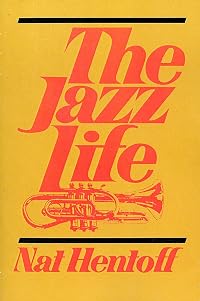
The Jazz Life
by Nat Hentoff
On This Page
Description
The last few years have witnessed an enormous resurgence in the popularity of jazz, after some lean times in the sixties when many potential jazz fans turned to rock. Now the pendulum is on the backswing, and vintage and modern jazz as well as "jazz rock" are attracting huge new audiences. One factor involved in the comeback of jazz among blacks and whites alike is the rise of black consciousness, with its search for roots in the American experience. Nat Hentoff's The Jazz Life explores the show more social, economic, and psychological elements that make up the context of modern jazz. Among the jazz greats whose lives and work are discussed are Count Basie, Charles Mingus, John Lewis, Miles Davis, Thelonius Monk, and Ornette Coleman. Written with intelligence, passion, and wit, this jazz classic is of immense importance to anyone wanting a better understanding of the jazz--or indeed our American life. show lessTags
Recommendations

























Member Reviews
While inevitably much of this book is dated - it was written in 1961, as jazz was reaching a crest - that's also one of its strengths. Hentoff's account of the 1960 Newport Jazz Festival riots is fresh and indignant; his peek at recording dates by Louis Armstrong and Miles Davis (for Sketches of Spain!) are fascinating; and though his profiles of Mingus and Davis don't reveal any surprises, the ones for Count Basie, John Lewis, and Ornette Coleman are engrossing. It's too bad that the prediction he made in the new introduction from the 70s that rock n' roll fans would turn to jazz in disillusionment never came to happen.
Ratings
Members
- Recently Added By
Lists

JAZZZZ
87 works; 1 member
Author Information

52+ Works 1,980 Members
Nathan Irving Hentoff was born in Boston, Massachusetts on June 10, 1925. He graduated from Northeastern University in 1946. After several years with a Boston radio station, he moved to New York in 1953 and covered jazz for Down Beat until 1957. In 1958, he was a founding editor of The Jazz Review that lasted until 1961. He wrote for The New show more Yorker from 1960 to 1986, for The Washington Post from 1984 to 2000, and for The Village Voice from 1958 to 2009. During his freelance career, his work appeared in Esquire, Harper's, Commonweal, The Reporter, Playboy, The New York Herald Tribune, Jewish World Review, The Wall Street Journal, and The Washington Times. In 1995, he received the National Press Foundation's award for lifetime achievement in contributions to journalism. He wrote more than 35 books during his lifetime. His nonfiction works included The Jazz Life, Peace Agitator: The Story of A. J. Muste, The New Equality, Living the Bill of Rights, and Free Speech for Me - but Not for Thee: How the American Left and Right Relentlessly Censor Each Other. He wrote several memoirs including Boston Boy and Speaking Freely. In 1955, he co-edited with Nat Shapiro Hear Me Talkin' to Ya: The Story of Jazz as Told by the Men Who Made It. His young adult novels included Jazz Country, This School Is Driving Me Crazy, Does This School Have Capital Punishment?, and The Day They Came to Arrest the Book. He died on January 7, 2017 at the age of 91. (Bowker Author Biography) show less
Classifications
- Genres
- Music, Nonfiction, Biography & Memoir, History, General Nonfiction
- DDC/MDS
- 785.4 — Arts & recreation Music Ensembles with only one instrument per part [formerly: instrumental ensembles and their music] Ensembles without keyboard {formerly: Music for small ensembles}
- LCC
- ML3561 .J3 .H45 — Music Literature on music Literature on music History and criticism Folk, national, and ethnic music
- BISAC
Statistics
- Members
- 58
- Popularity
- 531,511
- Reviews
- 1
- Rating
- (4.33)
- Languages
- English, French
- Media
- Paper
- ISBNs
- 4
- ASINs
- 5