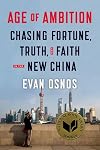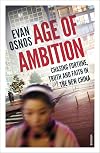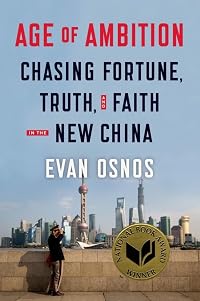
Age of Ambition: Chasing Fortune, Truth, and Faith in the New China
by Evan Osnos
On This Page
Description
"A vibrant, colorful, and revelatory inner history of China during a moment of profound transformation From abroad, we often see China as a caricature: a nation of pragmatic plutocrats and ruthlessly dedicated students destined to rule the global economy--or an addled Goliath, riddled with corruption and on the edge of stagnation. What we don't see is how both powerful and ordinary people are remaking their lives as their country dramatically changes. As the Beijing correspondent for The New show more Yorker, Evan Osnos was on the ground in China for years, witness to profound political, economic, and cultural upheaval. In Age of Ambition, he describes the greatest collision taking place in that country: the clash between the rise of the individual and the Communist Party's struggle to retain control. He asks probing questions: Why does a government with more success lifting people from poverty than any civilization in history choose to put strict restraints on freedom of expression? Why do millions of young Chinese professionals--fluent in English and devoted to Western pop culture--consider themselves "angry youth," dedicated to resisting the West's influence? How are Chinese from all strata finding meaning after two decades of the relentless pursuit of wealth? Writing with great narrative verve and a keen sense of irony, Osnos follows the moving stories of everyday people and reveals life in the new China to be a battleground between aspiration and authoritarianism, in which only one can prevail"-- "A vibrant, colorful, and revelatory inner history of China during a moment of profound transformation"-- show lessTags
Recommendations




Member Reviews
Really interesting book about aspiration, power, and truth in modern China, where advertising and shopping are relatively new and entertaining practices and where there are four aspiring college students for every place in a college, despite the fact that the number of colleges doubled in ten years. A lot of the book is about censorship: there is an estimated one propaganda officer for every one hundred Chinese citizens. People are aware of the censorship, so (as Zeynep Tufceki has also explored), the most useful workers try to diffuse protest by adding chaff, from jokes to ads, into discussions of fraught public issues. One result of the censorship: the “most successful film ever made about two of China’s national symbols, kung fu show more and pandas, had to be made by a foreign studio (DreamWorks), because no Chinese filmmaker would ever have been allowed to have fun with such solemn subjects.”
A lot of the book is also, and not unrelatedly, about corruption, which Osnos deems less visible than in other developing countries because it’s not a matter of small bribes sought by customs officers or street cops—but if you want good education or treatment at a public hospital, that’s another matter. And China’s great infrastructure projects have been the source of billions of dollars’ worth of theft. Instead of a hierarchical patronage system, corruption is anarchic—people grabbing what they can get. To deal with this, Beijing sometimes punishes local officials, but it also bans discussions of powerful officials’ wealth and briefly tried to ban companies from using the word “luxury” in names or ads. The result of censorship plus corruption has been pervasive distrust, including distrust of actually public-minded actions. show less
A lot of the book is also, and not unrelatedly, about corruption, which Osnos deems less visible than in other developing countries because it’s not a matter of small bribes sought by customs officers or street cops—but if you want good education or treatment at a public hospital, that’s another matter. And China’s great infrastructure projects have been the source of billions of dollars’ worth of theft. Instead of a hierarchical patronage system, corruption is anarchic—people grabbing what they can get. To deal with this, Beijing sometimes punishes local officials, but it also bans discussions of powerful officials’ wealth and briefly tried to ban companies from using the word “luxury” in names or ads. The result of censorship plus corruption has been pervasive distrust, including distrust of actually public-minded actions. show less
Often, you'll find books on modern China (PRC era) that are remarkably informative, cover all the bases, cite all sources, and do a tremendous job. These will undoubtedly be followed by at least a couple online commentators saying it paints China in a poor light, or is a bad interpretation of how China *really* is, or (the most common refrain) that Westerners simply don't understand China.
'Age of Ambition' by Evan Osnos is unique and much-needed in the way it bridges a Western style of research and reporting with an author who spent a material part of his life living in, and becoming part of, China and its culture. Dismissive comments that this author is one of many that don't understand China hold no water here - Osnos draws on an show more extensive and thoroughly researched Rolodex of figures from all parts of the Chinese political spectrum, from a Taiwanese soldier who defected to the PRC (instead of the other way around) to the late Nobel Laureate activist Liu Xiaobo, and a host of characters in between, both nationalist and dissident in ideology.
Evan Osnos' reporting style is engaging and thorough, and by the end of the book you are able to look back and see all of these individuals as part of a web that symbolizes modern-day China: full of contradictions, heavy-handed and corrupt at the top but with a wealth of ambitious, intelligent, knowledge-thirsting people at the bottom. It is critical to differentiate the two: by getting lost in the incorrect mindset of 'China vs. USA', one ignores the fact that the PRC is 'authoritarianism with Chinese characteristics' - a country where most headlines are driven by the elite because the lower classes are being obsessively suppressed and censored.
And that brings me to what I found to be the most important point from this book: Evan shows the human side of Chinese people beyond Xi Jinping & Friends. He illustrates those who love China but want the freedom to learn and express themselves; he interviews dissidents-in-exile who are simply sad for how their country is led; and he examines families, college students, and entrepreneurs who feel caught in the middle of an absurdist Mao-cult-of-personality-type Xi administration and activists who want the whole system overthrown. Most writers give this middle group little attention (since they grab few headlines), but it's this middle group of people who form the great majority of China's population. One can easily find similarities in today's American political culture, caught between left and right wings.
Five stars for one of the best books on China I have ever read. To truly understand China and its people beyond the headlines, warmongering and brinkmanship, you need to read this book. show less
'Age of Ambition' by Evan Osnos is unique and much-needed in the way it bridges a Western style of research and reporting with an author who spent a material part of his life living in, and becoming part of, China and its culture. Dismissive comments that this author is one of many that don't understand China hold no water here - Osnos draws on an show more extensive and thoroughly researched Rolodex of figures from all parts of the Chinese political spectrum, from a Taiwanese soldier who defected to the PRC (instead of the other way around) to the late Nobel Laureate activist Liu Xiaobo, and a host of characters in between, both nationalist and dissident in ideology.
Evan Osnos' reporting style is engaging and thorough, and by the end of the book you are able to look back and see all of these individuals as part of a web that symbolizes modern-day China: full of contradictions, heavy-handed and corrupt at the top but with a wealth of ambitious, intelligent, knowledge-thirsting people at the bottom. It is critical to differentiate the two: by getting lost in the incorrect mindset of 'China vs. USA', one ignores the fact that the PRC is 'authoritarianism with Chinese characteristics' - a country where most headlines are driven by the elite because the lower classes are being obsessively suppressed and censored.
And that brings me to what I found to be the most important point from this book: Evan shows the human side of Chinese people beyond Xi Jinping & Friends. He illustrates those who love China but want the freedom to learn and express themselves; he interviews dissidents-in-exile who are simply sad for how their country is led; and he examines families, college students, and entrepreneurs who feel caught in the middle of an absurdist Mao-cult-of-personality-type Xi administration and activists who want the whole system overthrown. Most writers give this middle group little attention (since they grab few headlines), but it's this middle group of people who form the great majority of China's population. One can easily find similarities in today's American political culture, caught between left and right wings.
Five stars for one of the best books on China I have ever read. To truly understand China and its people beyond the headlines, warmongering and brinkmanship, you need to read this book. show less
Author Osnos' theme is expressed right up front on page 5: "The Party no longer promises equality or an end to toil. It promises only prosperity, pride and strength." The remainder of the book elaborates upon this theme chronicling historically how China's Communist Party evolved to this point in order to stay in power, telling the stories of a variety of individuals who have bought into this scenario (or not), or who have remained constant in their desire for a more democratic society (or not), etc. "This book is an account of the collision of two forces: aspiration and authoritarianism" (p. 7).
"In 1978, the average Chinese income was $200; by 2014, it was $6,000" (p. 4). The success of those early achievers--those who responded show more quickly to Deng Xiaoping's carrot held out by the Party in return for the peoples' submission--has stirred a desire for success and wealth that Osnos compares to that seen in America's Gilded Age when every man "had his dream". In short, as the book unfolds, one finds oneself reading the story of how the Party offers "its people a bargain: prosperity in exchange for loyalty" (p. 34).
But does the Party hold up its side--does it ensure all forms of prosperity--including mental and physical health? As Osnos recites disaster after disaster and shortfall after shortfall (collapsing schools, tainted food products, incompetencies, graft, fraud, embezzlement) it appears that not all aspects of the three traditional Chinese desires (FuLuShou - Happiness, Wealth/Power, and Longevity) are being addressed.
The individuals that Osnos met, interviewed, and analyzes are amongst the best chapters and I found myself intrigued by many of the insider stories surrounding those names we only know through the media--Ai Weiwei, Hu Shuli, Lin Yifu, Liu Xiaobo, Gao Zhisheng, Han Han, Chen Guangcheng, etc. The mixture itself is fascinating--from heroes to gods with clay feet (and that choice is often left to the reader to decide).
And although a China-watcher for many years, Osnos revealed a number of aspects of today's China that had slipped by me--expressions such as a "chicken talking to a duck" or "maguan" ("to buy a government promotion"), or the story of the grass mud horse & river crab. Such examples brought home the truth of many of his points. And as a historian, I was especially pleased to see the weaving in of some of history's sharper images--for example, how the 14C Emperor and founder of the Ming Dynasty (Zhu Yuanzhang=Emperor Hongwu) "ordered thieving officials to be executed, skinned, and stuffed with straw so that their carcasses might be propped up like mannequins for visitors" (p. 249).
And what reader wouldn't love the story of Osnos' trip to Europe with a Chinese tour group? I found myself laughing out loud at how perfectly Osnos captured the scenes.
Age of Ambition is definitely a book to read if you're at all interested in modern China and want to decipher what we see and hear in today's media--both Chinese and foreign, sympathetic and not-so sympathetic. I added this book to my "armchair travel" list because in many ways it reflects the best of the genre in the footsteps of Paul Theroux. It was when it lost that sharpness that I found myself skimming ahead a few pages here and there, only to be caught back up in the storyline on the next page. show less
"In 1978, the average Chinese income was $200; by 2014, it was $6,000" (p. 4). The success of those early achievers--those who responded show more quickly to Deng Xiaoping's carrot held out by the Party in return for the peoples' submission--has stirred a desire for success and wealth that Osnos compares to that seen in America's Gilded Age when every man "had his dream". In short, as the book unfolds, one finds oneself reading the story of how the Party offers "its people a bargain: prosperity in exchange for loyalty" (p. 34).
But does the Party hold up its side--does it ensure all forms of prosperity--including mental and physical health? As Osnos recites disaster after disaster and shortfall after shortfall (collapsing schools, tainted food products, incompetencies, graft, fraud, embezzlement) it appears that not all aspects of the three traditional Chinese desires (FuLuShou - Happiness, Wealth/Power, and Longevity) are being addressed.
The individuals that Osnos met, interviewed, and analyzes are amongst the best chapters and I found myself intrigued by many of the insider stories surrounding those names we only know through the media--Ai Weiwei, Hu Shuli, Lin Yifu, Liu Xiaobo, Gao Zhisheng, Han Han, Chen Guangcheng, etc. The mixture itself is fascinating--from heroes to gods with clay feet (and that choice is often left to the reader to decide).
And although a China-watcher for many years, Osnos revealed a number of aspects of today's China that had slipped by me--expressions such as a "chicken talking to a duck" or "maguan" ("to buy a government promotion"), or the story of the grass mud horse & river crab. Such examples brought home the truth of many of his points. And as a historian, I was especially pleased to see the weaving in of some of history's sharper images--for example, how the 14C Emperor and founder of the Ming Dynasty (Zhu Yuanzhang=Emperor Hongwu) "ordered thieving officials to be executed, skinned, and stuffed with straw so that their carcasses might be propped up like mannequins for visitors" (p. 249).
And what reader wouldn't love the story of Osnos' trip to Europe with a Chinese tour group? I found myself laughing out loud at how perfectly Osnos captured the scenes.
Age of Ambition is definitely a book to read if you're at all interested in modern China and want to decipher what we see and hear in today's media--both Chinese and foreign, sympathetic and not-so sympathetic. I added this book to my "armchair travel" list because in many ways it reflects the best of the genre in the footsteps of Paul Theroux. It was when it lost that sharpness that I found myself skimming ahead a few pages here and there, only to be caught back up in the storyline on the next page. show less
A great book. I read the New Yorker regularly and some of this material was included in some stories, but it doesn't
matter because the tales are worth repeating. China is royally screwed; they have allowed people to get rich, but the entire country is as crooked as can be. There is more corruption in China than you can believe and it starts at the top. That is how they did it, because everybody is on the take, and so they steal and grow their way to success,.
matter because the tales are worth repeating. China is royally screwed; they have allowed people to get rich, but the entire country is as crooked as can be. There is more corruption in China than you can believe and it starts at the top. That is how they did it, because everybody is on the take, and so they steal and grow their way to success,.
This is illuminating and alarming book looks at where China finds itself today, after thirty years of what may the the most extraordinary sustained growth that any country has ever experienced. That is a very different place from the past, and a place where the future is very unclear. Osnos presents the way people are reacting to this through a series of vignettes, relying on a set of people he spoke with often. The impression is kaleidoscopic. As Osnos repeatedly makes clear, the super-rapid pace of social change has had many different effects, depending on who you are, what you want, and where in the system you find yourself. The overall impression he leaves is one of uncertainty: he does not pretend to know where China will go next show more (if indeed there is one "China", and if indeed it goes in one direction). A fascinating read. show less
This afternoon on the Internet I saw the launch of China’s second super aircraft carrier, a massive, beautiful beast. It put me in mind of the lessons of Great Leap Liu, a character in Evan Osnos’ book who built China’s massive high speed railways in record time before being fingered as one of China’s most corrupt public officials.
I look at the picture of that aircraft carrier and wonder what the size of the graft is that lurks beneath the hull of that mega-monster ship.
Because China today as when Evan Osnos wrote this book some years ago is still mired in the privilege of the elites and huge corruption even as its storied growth slows to mere epic levels.
Osnos’ book tries but in my opinion does not quite convey the show more entrepreneurial zest of 21st century China, nor the massive political capital the authoritarian regime has created in a mere two generations.
Rather he focuses on it’s soft underbelly and insecurities.
When I think of my own country Canada I see three centuries of scraping the countryside of its treasures and negligible influence on the world stage.
What few people will acknowledge today is that Mao’s slaughter of millions in China due to incompetent gov’t set the stage for a massive comeback using virtually slave labour to rob the West of its wealth under its own nose.
Nixon played the “China card” to push the Soviet Union into irrelevance not realizing that unleashing the Asian tiger would also be America’s undoing.
Osnos seems to think that the Chinese state needs a better rudder than the Communist Leadership can offer now or ever, and he may have a point.
When I think of a state with so many cities of 20 million or more souls, enormous environmental challenges, the aging workforce, the imperative for growth, I can barely comprehend the pressures on this government. show less
I look at the picture of that aircraft carrier and wonder what the size of the graft is that lurks beneath the hull of that mega-monster ship.
Because China today as when Evan Osnos wrote this book some years ago is still mired in the privilege of the elites and huge corruption even as its storied growth slows to mere epic levels.
Osnos’ book tries but in my opinion does not quite convey the show more entrepreneurial zest of 21st century China, nor the massive political capital the authoritarian regime has created in a mere two generations.
Rather he focuses on it’s soft underbelly and insecurities.
When I think of my own country Canada I see three centuries of scraping the countryside of its treasures and negligible influence on the world stage.
What few people will acknowledge today is that Mao’s slaughter of millions in China due to incompetent gov’t set the stage for a massive comeback using virtually slave labour to rob the West of its wealth under its own nose.
Nixon played the “China card” to push the Soviet Union into irrelevance not realizing that unleashing the Asian tiger would also be America’s undoing.
Osnos seems to think that the Chinese state needs a better rudder than the Communist Leadership can offer now or ever, and he may have a point.
When I think of a state with so many cities of 20 million or more souls, enormous environmental challenges, the aging workforce, the imperative for growth, I can barely comprehend the pressures on this government. show less
Age of Ambition looks at different aspects of modern Chinese culture - religion, sex, art, etc - through the lens of a number of famous people and incidents in recent Chinese history and shows changes underway. The common theme is that China is becoming more individualistic through personal ambition. The author is American but has lived in China for a while as a writer for the New Yorker and others. The book is long and generous but of course he has his entire corpus to draw on and therein is a problem because it sometimes feels scatter-shot jumping around back and forth. I had trouble following at times. There is a lot of good info here, I was particularly struck by how corrupt China is. Since there is no democracy and no elections, show more corruption doesn't occur by buying off voters and elected officials, instead corruption happens when people buy jobs and position through bribes, which is widespread. This goes up the food chain with the bribes getting progressively bigger until the very top party members have become among the richest people in the country. It's a simple system, very different from our own, but one in which the plutocrats at the top have a strong interest in maintaining while most people will never have an opportunity to get ahead. Thus there is a deep contradiction in this "age of ambition" that seems unsustainable. Overall a good book glad I read it. show less
Members
- Recently Added By
Lists

Obama Reads
181 works; 3 members

National Book Award Finalists 2014
20 works; 16 members

Books Read in 2016
4,666 works; 199 members

Books recommended by Barack Obama
295 works; 29 members

National Book Award winners
65 works; 11 members

Books Read in 2020
4,379 works; 124 members

The China Project Book List
100 works; 2 members
Author Information

8+ Works 1,224 Members
Evan L.R. Osnos was born on December 24, 1976 in London. He has been a staff writer at The New Yorker since 2008, best known for his coverage of China. He graduated magna cum laude from Harvard in 1998. In the summer of 1999, Osnos joined the Chicago Tribune as a metro reporter, and, later, a national and foreign correspondent. He was based in New show more York at the time of the September 11 attacks. In 2002, he was assigned to the Middle East, where he covered the Iraq War and reported from Egypt, Saudi Arabia, Syria, Iran, and elsewhere. In 2005, he became the China correspondent. In 2008, he was part of a Chicago Tribune team that won the 2008 Pulitzer Prize for Investigative Reporting. Osnos joined The New Yorker in September 2008 and served as the magazine¿s China Correspondent until 2013. Osnos has contributed to the NPR radio show This American Life and the PBS television show Frontline. He has received two awards from the Overseas Press Club and the Osborn Elliott Prize for excellence in journalism from the Asia Society. Age of Ambition: Chasing Fortune, Truth, and Faith in the New China (2014), Osnos' first book, follows the lives of individuals swept up in China's "radical transformation. He was a finalist for the 2015 Pulitzer Prize in General Nonfiction with - Age of Ambition: Chasing Fortune, Truth, and Faith in the New China. (Bowker Author Biography) show less
Some Editions
Awards and Honors
Awards
Distinctions
Common Knowledge
- Original title
- Age of Ambition
- Original publication date
- 2014
- People/Characters
- Tang Jie; Mao Zedong; Liu Xiaobo; Liu Zhijun; Lin Yifu; Deng Xiaoping (show all 10); Chen Guangcheng; Ai Weiwei; Han Han; Gong Hainan
- Important places
- China; Beijing, China; Macau
Classifications
Statistics
- Members
- 701
- Popularity
- 40,860
- Reviews
- 24
- Rating
- (4.00)
- Languages
- 8 — Chinese, Dutch, English, Estonian, German, Portuguese, Russian, Spanish
- Media
- Paper, Audiobook, Ebook
- ISBNs
- 21
- ASINs
- 9