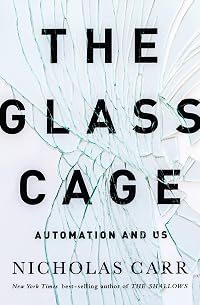
The Glass Cage: Automation and Us
by Nicholas Carr
On This Page
Description
In The Glass Cage, best-selling author Nicholas Carr digs behind the headlines about factory robots and self-driving cars, wearable computers and digitized medicine, as he explores the hidden costs of granting software dominion over our work and our leisure and reveals something we already suspect: shifting our attention to computer screens can leave us disengaged and discontented.Tags
Recommendations




Member Reviews
A moving, lyrical and rather beautiful meditation on the future of automation and the future of humanity. Nicholas Carr has some serious points to make about how automation, efficient and superficially advantageous as it is, can not only diminish our skills but our fundamental abilities and ultimately our sense of worth. This is not some anti-diluvian, Luddite tract (although Carr has a lot of respect for the Luddites) rather a plea for the human not to be removed entirely from the machine and the algorhthym. Carr has some frankly frightening examples from the world of aviation of how pilots now have so little flying to do (often less than 5 minutes per flight) that they are paying less attention and risk losing their skills. He is show more surely right when he points out that habitual use of GPS and digital maps changes the way we interact with our environment, reducing the world between our front door and our "destination" to meaningless public space. It can never again really be about "the journey". He is right that our mobile devices, constantly demanding our attention with their pings and beeps, prevent us from attaining immersion or flow in any activity. In short, we need human centric innovation and automation
Very well worth reading show less
Very well worth reading show less
The author looks at the role of automation in our world, and how it is changing the condition of being human. Some ways might be for the better, he argues, but in all, we are ceding a lot to machines that humans are actually better at, and we are losing vital skills. In addition, it may not always be the best choice to have super fast, super efficient decision making, and he discusses the situations where that might not be as desirable as we think. The final chapter deals with the issue of morals, and how we build in algorithms to help automatons make moral decisions without having an active conscience. Well written, cogent, and well researched. One of my main complaints is that the book acts as though there is nothing that could change show more the forward progress of technology, that could knock out the systems, and leave us facing a less technological future without the skills we need to do it, even though there are several feasible scenarios by which that could happen, either temporarily or permanently. Other than that, a must read for educators, CEOs, and anyone else who lives and breathes in the world. show less
Did you know that automation makes us dumber? We use search engines and autopilots and other machines instead of learning for ourselves, or practicing skills like flying by hand that deteriorate quickly. Automation may also lead to fewer jobs, though that is hotly contested and unclear. Carr raises important concerns—humans may be quite unsuited to the “monitor and jump in to react when something that doesn’t fit into the programming occurs” role, an argument he supports well with respect to flying and driving—but it’s coupled with really unpersuasive claims about the inadequacy of the digital. For example, he quotes architects who claim that architects will never have the same emotional connection, vital to art, with show more buildings designed on CAD systems rather than drawn on paper. I believe that architects who learned to draw on paper may never be able to fully integrate CAD systems into their processes, but humans are emotion-making dynamos, and I fully expect architects who grow up with CAD systems to cathect without difficulty. Near the end we get a bit of “the solution to the machine is in the machine,” with better-designed programs that force humans out of the ill-suited monitor role and into more participatory roles, and design programs that work more organically, but I was expecting a bit more about simulation. As I understand it, one of the big things simulations can do is give pilots practice—yes, the skies are too crowded for a lot of flying by hand, but you can keep skills from deteriorating by practice in simulators. Also, yes, I’m sure GPS causes deterioration in many people’s navigation skills, but I never had those skills, so it’s only a benefit for me—something he spends a little but not much time acknowledging. show less
'De glazen kooi' is het derde boek van [a:Nicholas Carr|151353|Nicholas Carr|https://d.gr-assets.com/authors/1403967896p2/151353.jpg] dat ik gelezen heb. Voorheen heb ik [b:The Shallows: What the Internet Is Doing to Our Brains|9778945|The Shallows What the Internet Is Doing to Our Brains|Nicholas Carr|https://d.gr-assets.com/books/1349066787s/9778945.jpg|7205526] (zie mijn recensie hier) en [b:The Big Switch: Rewiring the World, from Edison to Google|16241165|The Big Switch Rewiring the World, from Edison to Google|Nicholas Carr|https://d.gr-assets.com/books/1367516473s/16241165.jpg|1141344] (zie mijn recensie hier) gelezen.
Ook nu bespreekt Carr de invloed van technologie, en vooral automatisering in dit geval, op ons dagelijks denken, show more doen en laten. En het is wel duidelijk dat technologie overal aanwezig is: in de wagen, op het werk, in de huizen, in elektronische toestellen, enz. Je kan het zo gek niet bedenken of het bestaat. En er is ook veel waaraan we zodanig gewend zijn, dat we niet meer beseffen dat het er is.
Carr heeft het over automatisering van het transport/vervoer. Vliegtuigen zitten vol elektronica, die ervoor zorgt dat alles vlot en veilig verloopt. De piloten kunnen soms wel tussenkomen, maar eigenlijk is dit minder en minder de bedoeling. Als er dan eens iets gebeurt, en de piloot maakt een verkeerd manoeuvre, kan dat kwalijke gevolgen hebben. Vooral omdat door automatisering je aangeleerde technieken verleert, vergeet, omdat middels technologie veel zaken kunnen geregeld worden. Idem met auto's: je verlaat je, onbewust of bewust, op de technologie. Maar als je dan moet ingrijpen, ben je het niet gewoon en kan je te bruusk of te laat reageren, waardoor het faliekant kan aflopen. M.a.w., er wordt een vals gevoel van veiligheid gecreëerd. Daardoor, aldus Carr, willen we ook minder weten over de werking van dit alles. Als het maar werkt. En dat geldt ook voor andere domeinen. Echter, o.a. Google en Mercedes zijn blijkbaar bezig met volautomatische auto's, waardoor de menselijke factor sterk verminderd wordt.
Automatisering op het werk is ook al decennia in voege: machines die mensen vervangen, of die veel werk van de mens/arbeider/bediende overnemen. Geprogrammeerde apparatuur kan al voor een groot stuk van de productie ingezet worden, waardoor de arbeider enkel nog op een knopje moet drukken of erop toezien dat alles vlot verloopt. Dat klinkt extreem, maar zulke gevallen bestaan wel degelijk. Of hoe de computer op kantoor het papier, de balpen, de typemachine, ... vervangen heeft. Hoe software veel van het denkwerk overneemt: tekstverwerkers, berekeningen, tekeningen (CAD voor architecten), en meer.
Over CAD-software: omdat die software met veel zaken rekening houdt (hoogtes, dieptes, bekabeling, leidingen, ...) zou dat ook een invloed hebben op het design van gebouwen, vooral als je bijvoorbeeld een vergelijking maakt tussen de middeleeuwen en de moderne tijd. M.a.w., dat er minder creatief wordt vormgegeven aan gebouwen, ook omdat volgens bepaalde wetgevingen alles efficiënter, minder verbruikend, duurzamer moet zijn.
Een ander interessant voorbeeld vond ik hoe Carr vertelde over de Inuit, hoe die zich verlieten op natuurlijke elementen wanneer ze op pad gingen: stand van de zon, sterkte en richting van de wind, dikte van het ijs, enzovoorts. Maar blijkbaar werken die mensen sinds een zekere tijd (ook) met GPS, waardoor ze de instructies en aangeduide routes volgen, zonder nog rekening te houden met de natuur, waardoor ze al eens een misstap kunnen doen. De moderne mens heeft tegenwoordig ook GPS, ook al zijn er nog kaartlezers onder ons. En die GPS geeft ons instructies over de te volgen route, duidt ze niet alleen aan. Geavanceerdere modellen geven verkeersinfo, of er flitscamera's staan, aan welke snelheid je je moet houden. Zonder erbij stil te staan of zelf de omgeving in het oog te houden, volgen we steeds de GPS. Als die dan plots uitvalt of we hebben 'm niet mee, dan voelen we ons verloren, zijn we ons gevoel voor richting kwijt. Ondanks het feit dat GPS wel voordelig kan zijn, alleen is het een zoveelste voorbeeld van hoe we technologie ons leven laten bepalen in veel situaties. Of kortweg: we zijn onze voeling met de natuur kwijt (aan het spelen).
Omdat veel zaken tegenwoordig zo vlot gedaan kunnen worden middels software en geprogrammeerde apparatuur, wordt onze creativiteit ingeperkt, denken we niet meer na over hoe iets werkt, hoe iets opgelost kan worden. We verlaten ons de dag van vandaag zeer veel op de technologie zonder er nog bij stil te staan wat de gevolgen zijn. We worden minder gestimuleerd; uitzonderingen daargelaten, zoals in veel situaties. We worden, m.a.w., gemakzuchtiger. Er is televisie om 's avonds de tijd te doden. Weet je iets niet? Snel even op Internet zoeken. Even swipen op de smartphone, even de QR-code scannen, even met de smartphone over de sensor en de betaling is gebeurd. Who cares wat erachter zit? Het werkt, toch? Snel en eenvoudig. De voorbeelden zijn legio.
Vroeger was een gereedschap een toegevoegde waarde, een verbetering van je talent. Met de automatisering is dat talent vervaagd, minder onderhouden, want de machine heeft het overgenomen en kan het sneller, goedkoper, efficiënter. En dankzij de uitvinding van o.a. de spoorwegen werden grenzen verlegd.
Automatisering wordt ook voor militaire doeleinden gebruikt. Carr vraagt zich af hoe toekomstige oorlogsvoering zal verlopen. Met robots? Zullen robots worden ingezet voor de veiligheid? Wat als ze een fout maken? Want een mens is geen geprogrammeerd wezen, het maakt telkens afwegingen, al dan niet ethische. Wil men robots ook zo gaan programmeren, zodat ze meer en meer menselijke trekken krijgen?
Op medisch gebied is de computer natuurlijk ook niet meer weg te denken, en niet enkel qua apparatuur voor bijvoorbeeld scans of bepaalde behandelingen. Blijkbaar bestaat er software waarop dokters zich kunnen baseren om een diagnose en remedie vast te stellen, dit op basis van ingevoerde gegevens over hun patiënten en de symptomen die ze beschrijven. Dit heeft als gevolg dat dokters minder hun opgedane kennis aanwenden, minder zelf nadenken over de toestand van hun patiënten en zich dus laten leiden door de software, deels omdat dit het werk vergemakkelijkt. Ik heb het nog niet gemerkt, maar na het lezen van dit boek zal ik bij een volgend doktersbezoek proberen erop te letten. Bij mijn (huis)dokter had ik alvast geen klagen, die werkte nog op de menselijke manier.
Carr heeft ook duidelijk laten weten in zijn vorige boeken dat hij niet tegen technologie op zich is, verre van. Hij wil wel de mensen wakker schudden opdat ze voor zichzelf even zouden nadenken over hoe technologie in hun leven aanwezig is en welke invloed/impact het heeft. Natuurlijk schetst Carr een enigszins donker beeld van de technologische maatschappij. Er zijn nochtans veel goede technologische ontwikkelingen (levensreddende, handige, nuttige, ...) geweest de afgelopen decennia - en maar goed ook, want ook dat duidt op inventiviteit van de mens -, maar zoals met andere zaken wordt technologie ook vaak misbruikt.
'De glazen kooi' is een aanrader voor wie even wil stilstaan bij het moderne, jachtige leven waarin technologie heerst en alomtegenwoordig is. Ook al herhaalt Carr zichzelf een aantal keer doorheen het boek, toch slaagt hij erin om bepaalde punten in een iets andere context of vanuit een ander standpunt te bespreken.
De vertaling is van goede kwaliteit. Het boek leest vlot, niet alleen omdat Carr een vlotte schrijfstijl heeft.
p.s.:Via een pre-read-actie van Maven Publishing kreeg ik een recensie-exemplaar toegestuurd (met dank aan Lydia Busstra). show less
Ook nu bespreekt Carr de invloed van technologie, en vooral automatisering in dit geval, op ons dagelijks denken, show more doen en laten. En het is wel duidelijk dat technologie overal aanwezig is: in de wagen, op het werk, in de huizen, in elektronische toestellen, enz. Je kan het zo gek niet bedenken of het bestaat. En er is ook veel waaraan we zodanig gewend zijn, dat we niet meer beseffen dat het er is.
Carr heeft het over automatisering van het transport/vervoer. Vliegtuigen zitten vol elektronica, die ervoor zorgt dat alles vlot en veilig verloopt. De piloten kunnen soms wel tussenkomen, maar eigenlijk is dit minder en minder de bedoeling. Als er dan eens iets gebeurt, en de piloot maakt een verkeerd manoeuvre, kan dat kwalijke gevolgen hebben. Vooral omdat door automatisering je aangeleerde technieken verleert, vergeet, omdat middels technologie veel zaken kunnen geregeld worden. Idem met auto's: je verlaat je, onbewust of bewust, op de technologie. Maar als je dan moet ingrijpen, ben je het niet gewoon en kan je te bruusk of te laat reageren, waardoor het faliekant kan aflopen. M.a.w., er wordt een vals gevoel van veiligheid gecreëerd. Daardoor, aldus Carr, willen we ook minder weten over de werking van dit alles. Als het maar werkt. En dat geldt ook voor andere domeinen. Echter, o.a. Google en Mercedes zijn blijkbaar bezig met volautomatische auto's, waardoor de menselijke factor sterk verminderd wordt.
Automatisering op het werk is ook al decennia in voege: machines die mensen vervangen, of die veel werk van de mens/arbeider/bediende overnemen. Geprogrammeerde apparatuur kan al voor een groot stuk van de productie ingezet worden, waardoor de arbeider enkel nog op een knopje moet drukken of erop toezien dat alles vlot verloopt. Dat klinkt extreem, maar zulke gevallen bestaan wel degelijk. Of hoe de computer op kantoor het papier, de balpen, de typemachine, ... vervangen heeft. Hoe software veel van het denkwerk overneemt: tekstverwerkers, berekeningen, tekeningen (CAD voor architecten), en meer.
Over CAD-software: omdat die software met veel zaken rekening houdt (hoogtes, dieptes, bekabeling, leidingen, ...) zou dat ook een invloed hebben op het design van gebouwen, vooral als je bijvoorbeeld een vergelijking maakt tussen de middeleeuwen en de moderne tijd. M.a.w., dat er minder creatief wordt vormgegeven aan gebouwen, ook omdat volgens bepaalde wetgevingen alles efficiënter, minder verbruikend, duurzamer moet zijn.
Een ander interessant voorbeeld vond ik hoe Carr vertelde over de Inuit, hoe die zich verlieten op natuurlijke elementen wanneer ze op pad gingen: stand van de zon, sterkte en richting van de wind, dikte van het ijs, enzovoorts. Maar blijkbaar werken die mensen sinds een zekere tijd (ook) met GPS, waardoor ze de instructies en aangeduide routes volgen, zonder nog rekening te houden met de natuur, waardoor ze al eens een misstap kunnen doen. De moderne mens heeft tegenwoordig ook GPS, ook al zijn er nog kaartlezers onder ons. En die GPS geeft ons instructies over de te volgen route, duidt ze niet alleen aan. Geavanceerdere modellen geven verkeersinfo, of er flitscamera's staan, aan welke snelheid je je moet houden. Zonder erbij stil te staan of zelf de omgeving in het oog te houden, volgen we steeds de GPS. Als die dan plots uitvalt of we hebben 'm niet mee, dan voelen we ons verloren, zijn we ons gevoel voor richting kwijt. Ondanks het feit dat GPS wel voordelig kan zijn, alleen is het een zoveelste voorbeeld van hoe we technologie ons leven laten bepalen in veel situaties. Of kortweg: we zijn onze voeling met de natuur kwijt (aan het spelen).
Omdat veel zaken tegenwoordig zo vlot gedaan kunnen worden middels software en geprogrammeerde apparatuur, wordt onze creativiteit ingeperkt, denken we niet meer na over hoe iets werkt, hoe iets opgelost kan worden. We verlaten ons de dag van vandaag zeer veel op de technologie zonder er nog bij stil te staan wat de gevolgen zijn. We worden minder gestimuleerd; uitzonderingen daargelaten, zoals in veel situaties. We worden, m.a.w., gemakzuchtiger. Er is televisie om 's avonds de tijd te doden. Weet je iets niet? Snel even op Internet zoeken. Even swipen op de smartphone, even de QR-code scannen, even met de smartphone over de sensor en de betaling is gebeurd. Who cares wat erachter zit? Het werkt, toch? Snel en eenvoudig. De voorbeelden zijn legio.
Vroeger was een gereedschap een toegevoegde waarde, een verbetering van je talent. Met de automatisering is dat talent vervaagd, minder onderhouden, want de machine heeft het overgenomen en kan het sneller, goedkoper, efficiënter. En dankzij de uitvinding van o.a. de spoorwegen werden grenzen verlegd.
Automatisering wordt ook voor militaire doeleinden gebruikt. Carr vraagt zich af hoe toekomstige oorlogsvoering zal verlopen. Met robots? Zullen robots worden ingezet voor de veiligheid? Wat als ze een fout maken? Want een mens is geen geprogrammeerd wezen, het maakt telkens afwegingen, al dan niet ethische. Wil men robots ook zo gaan programmeren, zodat ze meer en meer menselijke trekken krijgen?
Op medisch gebied is de computer natuurlijk ook niet meer weg te denken, en niet enkel qua apparatuur voor bijvoorbeeld scans of bepaalde behandelingen. Blijkbaar bestaat er software waarop dokters zich kunnen baseren om een diagnose en remedie vast te stellen, dit op basis van ingevoerde gegevens over hun patiënten en de symptomen die ze beschrijven. Dit heeft als gevolg dat dokters minder hun opgedane kennis aanwenden, minder zelf nadenken over de toestand van hun patiënten en zich dus laten leiden door de software, deels omdat dit het werk vergemakkelijkt. Ik heb het nog niet gemerkt, maar na het lezen van dit boek zal ik bij een volgend doktersbezoek proberen erop te letten. Bij mijn (huis)dokter had ik alvast geen klagen, die werkte nog op de menselijke manier.
Carr heeft ook duidelijk laten weten in zijn vorige boeken dat hij niet tegen technologie op zich is, verre van. Hij wil wel de mensen wakker schudden opdat ze voor zichzelf even zouden nadenken over hoe technologie in hun leven aanwezig is en welke invloed/impact het heeft. Natuurlijk schetst Carr een enigszins donker beeld van de technologische maatschappij. Er zijn nochtans veel goede technologische ontwikkelingen (levensreddende, handige, nuttige, ...) geweest de afgelopen decennia - en maar goed ook, want ook dat duidt op inventiviteit van de mens -, maar zoals met andere zaken wordt technologie ook vaak misbruikt.
'De glazen kooi' is een aanrader voor wie even wil stilstaan bij het moderne, jachtige leven waarin technologie heerst en alomtegenwoordig is. Ook al herhaalt Carr zichzelf een aantal keer doorheen het boek, toch slaagt hij erin om bepaalde punten in een iets andere context of vanuit een ander standpunt te bespreken.
De vertaling is van goede kwaliteit. Het boek leest vlot, niet alleen omdat Carr een vlotte schrijfstijl heeft.
p.s.:Via een pre-read-actie van Maven Publishing kreeg ik een recensie-exemplaar toegestuurd (met dank aan Lydia Busstra). show less
Good book to temper technological enthusiasm. I liked the vision of systems that are life enhancing rather then dulling.
The Glass Cage Automation and Us
By: Nicholas Carr Philosophy/Society
Norton & Company, Inc. 2014. Pages. 232
Copy Courtesy of Goodreads First Reads
Reviewed by: tk
Eye opening, thought provoking, superbly written from beginning to end.
Nicholas Carr introduces the ideals of automation in a extraordinary collection of detail, explanation, and examples of how our daily lives are being manipulated by machines.
I am not saying that is his intent. I am saying is that his compiled information in simple language for a lay person as myself, was absolutely terrifying.
Carr looks at the effects and outcomes of our daily decisions, and how we come to those decisions could possibly be not entirely our own. Most every household has a computer, or two. show more Ipods, Ipads, phones, tablets, gaming, the list goes on and on. How are these items controlling us? I interact with electronic devises daily, and I bet you do also. I wonder who is collecting the data that I am receiving and sending. I wonder if I should be concerned if anything information is being misinterpreted, or misrepresented in any way.
The accumulation of facts that Carr has complied is over whelming. A simple quote, “Sharp tools dull minds”. Consider the implication of just a quote. I remember what it was like before all these tools came into play. No microwaves, cell phones, computers, and what not. I fell life was simple, and full. Now…is it to easy, convenient, needed to complete ourselves as part of society, or are we becoming puppets on a string.
A MUST READ. You will have to decide for yourselves. I think this book should be required reading for everyone. This book is a tool, although not electronic unless your reading on an e-reader. I sincerely feel that even though some of the ideals are thought about, you never look outside of the box, to see what we are becoming, or where we are headed. The definition of ourselves are being diminished by the automation that we use. Please for you, your children, and your friends, read this book. Just be aware so your not totally in shocked into oblivion. Highly recommended. 5/5 show less
By: Nicholas Carr Philosophy/Society
Norton & Company, Inc. 2014. Pages. 232
Copy Courtesy of Goodreads First Reads
Reviewed by: tk
Eye opening, thought provoking, superbly written from beginning to end.
Nicholas Carr introduces the ideals of automation in a extraordinary collection of detail, explanation, and examples of how our daily lives are being manipulated by machines.
I am not saying that is his intent. I am saying is that his compiled information in simple language for a lay person as myself, was absolutely terrifying.
Carr looks at the effects and outcomes of our daily decisions, and how we come to those decisions could possibly be not entirely our own. Most every household has a computer, or two. show more Ipods, Ipads, phones, tablets, gaming, the list goes on and on. How are these items controlling us? I interact with electronic devises daily, and I bet you do also. I wonder who is collecting the data that I am receiving and sending. I wonder if I should be concerned if anything information is being misinterpreted, or misrepresented in any way.
The accumulation of facts that Carr has complied is over whelming. A simple quote, “Sharp tools dull minds”. Consider the implication of just a quote. I remember what it was like before all these tools came into play. No microwaves, cell phones, computers, and what not. I fell life was simple, and full. Now…is it to easy, convenient, needed to complete ourselves as part of society, or are we becoming puppets on a string.
A MUST READ. You will have to decide for yourselves. I think this book should be required reading for everyone. This book is a tool, although not electronic unless your reading on an e-reader. I sincerely feel that even though some of the ideals are thought about, you never look outside of the box, to see what we are becoming, or where we are headed. The definition of ourselves are being diminished by the automation that we use. Please for you, your children, and your friends, read this book. Just be aware so your not totally in shocked into oblivion. Highly recommended. 5/5 show less
It is good that someone is emphasizing the drawbacks and dangers of increasing auomation (stop thinking for ourselves, do not learn, do not challenge ourselves, leave power in the hands of others), however Carr's book is too one-sided to be convincing. That is a pity, since the anecdotes and research that he presents are often thought provoking and potentially important.
Members
- Recently Added By
Author Information

12+ Works 5,384 Members
Some Editions
Common Knowledge
- Canonical title
- The Glass Cage: Automation and Us
- Original title
- The Glass Cage: Automation and Us
- Original publication date
- 2014
- Epigraph
- No one
to witness
and adjust, no one to drive the car
-- William Carlos Williams - Dedication
- To Ann
- First words
- On January 4, 2013, the first Friday of a new year, a dead day newswise, the Federal Aviation Administraion released a one-page notice. (Introduction)
Among the humiliations of my teenage years was one that might be termed psycho-mechanical: my very public struggle to master a manual transmission. - Last words
- (Click to show. Warning: May contain spoilers.)It's the freedom I imagine Lawrence Sperry and Emil Cachin must have felt on that bright spring dayan Paris a hundred years ago when they climbed out onto the wings of their gyroscope-balanced Curtiss C-2 biplane and, filled with terror an delight, passed over the reviewing stands and saw below them the faces fo the crowd turned skyward in awe.
- Publisher's editor
- Brendan Curry
- Blurbers
- Jonathan Safran Foer; Don Norman; Clay Shirky; Mihaly Csikszentmihalyi
- Canonical LCC
- T14.5 .C374
Classifications
Statistics
- Members
- 448
- Popularity
- 68,239
- Reviews
- 15
- Rating
- (3.74)
- Languages
- 6 — Dutch, English, French, German, Italian, Spanish
- Media
- Paper, Audiobook, Ebook
- ISBNs
- 19
- UPCs
- 1
- ASINs
- 8