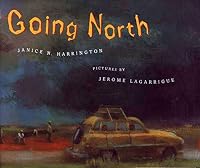
Going North
by Janice N. Harrington
On This Page
Description
A young African American girl and her family leave their home in Alabama and head for Lincoln, Nebraska, where they hope to escape segregation and find a better life.Tags
Recommendations


Member Reviews
I have not read a lot of children's books that reflect diverse experiences--adult and YA books, yes. Not children's. I really liked this one--the illustrations were lovely, and the story would provide valuable exposure for young children to some of the difficulties African-Americans faced during the Civil Rights era.
Janice N. Harrington did a phenomenal job writing this story, and I think this can be a good writing model for students. The way Harrington described things made the story come to life, and it added more detail to the story. For example, she wrote "I wish my toes were roots. I'd grow into a pin oak and never go away". That to me is so beautifully worded, compared to just saying "I want to stay forever".
Children can gain inspiration from this story, and even try to use similes and metaphors in their own writing.
Children can gain inspiration from this story, and even try to use similes and metaphors in their own writing.
This was an excellent story that revealed itself to be kind of a memoir of the author's early childhood experience moving from rural Alabama to Lincoln, Nebraska during the time of segregation and Jim Crow laws. The literary devices and the wonderful descriptive language really set this book apart.
I really enjoyed reading this book for a lot of reasons. First, I really liked plot. There was a lot of suspense whether or not the family was going to make it to the north in time to escape the segregation. Also, the author left off with a mystery at the end. The whole time she kept asking "Am I going to like the North?" and when her family finally got there the story ended. I also enjoyed the pictures. The pictures were not very clear but they were very detailed. This book really pushes readers to think back to times when segregation was real and and had a huge impact on people's lives. The characters in this book are very believable because it is based on segregation and real events. One thing I didn't like was the language used. The show more word "negro" was used a lot and nowadays it is looked at as a racist term. The word makes me feel uncomfortable while reading the story. The main message from this story is to illustrate the struggles that people suffered with during segregation and how people should value the world that we live in today because times used to be very tough. show less
I liked and disliked this book, but mostly disliked. I thought it was kind of boring. I didn't like the repetitive language such as "don't know, don't know, don't know" or "good bye, good bye, good bye." This book was poetic in the form of a story book. For example, there were stanzas on every page. I would rather have just heard the story instead of it being so lyrical. The story line itself I liked because it shows insight to how hard it was for African Americans to travel from the south to the North. For example, Jessie's family station wagon was low on gas. She says "Will we make it? Will this place serve Negroes? Gas gauges says almost gone almost gone." The only characters really developed was Jessie. She was afraid to move North show more and afraid she wouldn't like it. Children can relate to this because lots of kids experience moving and they can see how Jessie is afraid, but in the end likes it! show less
Summary:
It is during the 1960's, and Jessie and her family travel North to have a more well established life. Jessie initially does not want to go, because she wants to "stay in Big Mama's kitchen...swapping stories, and watching Big Mama knife-scrape a sweet potato..." Once the car is packed, they leave Alabama and head towards Nebraska. Traveling through the segregated South is not easy, because Mama and Papa are worried that most gas stations and restaurants will not serve "Negros." They finally make it to Nebraska, and the story ends with Papa praising his family for being so "brave."
The central message of this story was that life in the 1960's during segregation was not easy for African Americans. It is always great to stay show more optimistic and look to a better life and better opportunities. I like how this book reflects struggles that African Americans experienced. I especially liked the repetition in the story, because it added a dramatic effect. For instance, as they family left the South... "listening to the tires make a road-drum, a road-beat: good luck, good luck, good luck." Throughout the story, other phrases like "good luck," such as "may be" and "be brave" were repeated three times. show less
It is during the 1960's, and Jessie and her family travel North to have a more well established life. Jessie initially does not want to go, because she wants to "stay in Big Mama's kitchen...swapping stories, and watching Big Mama knife-scrape a sweet potato..." Once the car is packed, they leave Alabama and head towards Nebraska. Traveling through the segregated South is not easy, because Mama and Papa are worried that most gas stations and restaurants will not serve "Negros." They finally make it to Nebraska, and the story ends with Papa praising his family for being so "brave."
The central message of this story was that life in the 1960's during segregation was not easy for African Americans. It is always great to stay show more optimistic and look to a better life and better opportunities. I like how this book reflects struggles that African Americans experienced. I especially liked the repetition in the story, because it added a dramatic effect. For instance, as they family left the South... "listening to the tires make a road-drum, a road-beat: good luck, good luck, good luck." Throughout the story, other phrases like "good luck," such as "may be" and "be brave" were repeated three times. show less
An African American family is leaving behind Big Mama, loving relatives, and the familiar red soil and cotton fields of Alabama, Jessie and her family are going north to Nebraska. They are pioneers searching for a better life, one with decent schools and jobs. But traveling through the segregated South is difficult for an African American family in the 1960s. With most public places reserved for "whites only," they have problems finding places to stop to get gas and food.
Age- 6+
Source- Tacoma Public Library
Age- 6+
Source- Tacoma Public Library
Members
- Recently Added By
Lists

Picture Books About Civil Rights
51 works; 4 members
Author Information

12+ Works 977 Members
Awards and Honors
Awards
Distinctions
Common Knowledge
- Canonical title
- Going North
Classifications
Statistics
- Members
- 147
- Popularity
- 221,986
- Reviews
- 10
- Rating
- (4.30)
- Languages
- English
- Media
- Paper, Audiobook
- ISBNs
- 7
- ASINs
- 1