
On This Page
Description
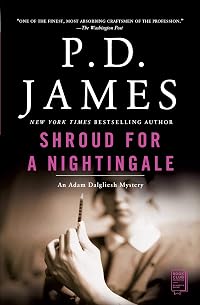
The young women of Nightingale House are there to learn to nurse and comfort the suffering. But when one of the students plays patient in a demonstration of nursing skills, she is horribly, brutally killed. Another student dies equally mysteriously and it is up to Adam Dalgliesh to unmask a killer who has decided to prescribe murder as the cure for all ills.Tags
Recommendations






Member Reviews
Shroud for a Nightingale is set in a nursing school attached to a hospital outside of London somewhere. The school itself is housed in an old Victorian mansion on the grounds of the hospital which is acknowledged from the beginning to be a very poor building for the school. But for us as readers, it adds wonderful atmosphere. And when it comes to books, I'm all about the atmosphere.
During a teaching demonstration of how to insert a feeding tube, a student nurse is somehow fed poison instead of the milk she is supposed to be given and dies on the table. She is not a student that anyone will miss. When another student dies two weeks later, Inspector Dalgleish of Scotland Yard is called in.
The course of this investigation uncovers many, show more many secrets that the inhabitants of Nightingale House did not want coming to light but which of them was someone willing to kill for? This story has suspects, red herrings and motives galore. How Dalgleish sorts them out to find the killer is a top-notch detective story.
One of the themes of the book is how much people like power and what they will do to get and hold on to it. It's a fascinating study in how even small amounts of power over others can go to a person's head.
Compared to Agatha Christie, a P.D. James novel is a much denser, heavier read. Her books remind me of the turkey at a Thanksgiving dinner while Christie would be the pumpkin pie with whipped cream. I can pick up Christie and enjoy her books anytime at all. I have to decide to read a P.D. James. But her books, and this one in particular, are worth the time and effort. show less
During a teaching demonstration of how to insert a feeding tube, a student nurse is somehow fed poison instead of the milk she is supposed to be given and dies on the table. She is not a student that anyone will miss. When another student dies two weeks later, Inspector Dalgleish of Scotland Yard is called in.
The course of this investigation uncovers many, show more many secrets that the inhabitants of Nightingale House did not want coming to light but which of them was someone willing to kill for? This story has suspects, red herrings and motives galore. How Dalgleish sorts them out to find the killer is a top-notch detective story.
One of the themes of the book is how much people like power and what they will do to get and hold on to it. It's a fascinating study in how even small amounts of power over others can go to a person's head.
Compared to Agatha Christie, a P.D. James novel is a much denser, heavier read. Her books remind me of the turkey at a Thanksgiving dinner while Christie would be the pumpkin pie with whipped cream. I can pick up Christie and enjoy her books anytime at all. I have to decide to read a P.D. James. But her books, and this one in particular, are worth the time and effort. show less
Spoilers in penultimate paragraph.
In preparation for writing this review, I skimmed some of my previous reviews and 1-5 star ratings of the other P.D. James books I’ve read. To my surprise, I’ve rated most of them as 3-stars; a little above average. Some I didn’t rate, however, judging by the reviews I think they rate higher than that, but still no 5-stars. So why do I keep coming back to Dame James?
I think it’s the mix of usual and unusual that does it. She has a very distinct formula to weaving her tales and that starts with the people involved with the crime. Usually she starts out with some environmental back story that features the victims (there is usually more than one) and the suspects. Much like a Christie mystery, show more we’re left to judge these people for ourselves. And boy, is there a lot to judge. Usually there are a bunch of jerks and a few bright spots of sanity. What an eye for the repugnant personality trait James has. Some of her characters have so many of them it’s a wonder they weren’t murdered themselves long ago. The nurses, instructors and other staff members in this book have no compunction about showing their nasty sides. No pulling punches, no being conciliatory to preserve peace, no concessions or allowances; just all vitriol all the time.
And I have to include Dalgliesh as one of the jerks. He seriously is. He instantly dislikes most of the people he comes into contact with, writing scurrilous monologues about them in his head. Then he will reach the point where he can’t hold it in any longer and will deliberately lash out at someone in a subtly cruel or manipulative way. Oh with what glee does he push people’s buttons. Sometimes we’re glad to see him get away with it, but sometimes it’s just antagonistic and mean. If this is not enough to underscore his innate anti-social personality, we also have to have snotty little asides about other people’s tastes and how superior his is to theirs. I do like that she often gives us views of Dalgliesh through the eyes of others. His underlings are particularly good at skewering him in their private thoughts. No one dares to do it to his face though.
In some ways he’s insufferable, but that’s only based on early books. In later ones she softens him by describing his inner struggles with poetry, with ethics and with the deaths of his wife and son. He also struggles with duty and how far he has to go in the name of it. It’s an old-fashioned idea and one that underscores the rigid bonds of his personality. Underneath it though, he’s thoughtful and not without mercy. Those come later though, and a reader starting at the beginning of the series will have to look past his abrasive persona to the good points of him and the way she crafts her novels.
Mostly that hinges on the plots. The crimes are usually pretty personally motivated, meaning there is some really neurotic reason for the killing. James’s novels aren’t peppered by psychopaths randomly killing based on some delusion, and that makes them all the more devious. This book is a great example because everyone in it is supposed to be a caring and gentle healthcare provider. They live in a claustrophobia inducing world that would make most of us really squirm; the lack of privacy and autonomy, the constant being at the beck-and-call of everyone else, the confinement and routine; all designed to have us sympathize, and we do. When eventually the killer is revealed (which I almost never get right and is only done after Dalgliesh does a lot of interviews and inner sleuthing) we feel sorry for her, just a little.
In this one, I had some swirling thoughts about Matron and her cool, detached sensibility and so I wasn’t surprised that she was guilty of something. Just not of everything. Her lap-dog relationship with Brumfett was just weird. They seemed so opposite that it had to be some form of obligation that bound them. That was the hinge. A lot of other suspects to consider. I couldn’t decide which of the sisters though, they were all pretty much equally repugnant, especially Rolfe and Brumfett. Witches the pair of them. And that surgeon, Courtney-Briggs. Ugh. He was pretty repellent. Oh and what’s with everyone having snotty and disparaging things to say about the police? Can’t anyone be helpful and understand how important the job is to the whole justice system? Can’t anyone be reasonable? And if you can’t how about keeping to yourself, huh? What a bunch of assholes, really.
James’s writing is sort of old-fashioned, but it’s pretty soothing overall. She uses description sparingly when it comes to locale, but is so specific with her characterizations that nothing is left to your imagination. I think she wants you to be working on filling in the blanks of the mystery, not the suspects. Another thing I like about James’s writing is that she makes me use my dictionary. Not many writers do and I like it. Little-known gems like pavane (n. a stately dance done in elegant clothing) and antiphonal (adj. sung or recited alternately by two groups). MS Word sees pavane as misspelling of pagan or paving. Anyone who can do that is worth reading. show less
In preparation for writing this review, I skimmed some of my previous reviews and 1-5 star ratings of the other P.D. James books I’ve read. To my surprise, I’ve rated most of them as 3-stars; a little above average. Some I didn’t rate, however, judging by the reviews I think they rate higher than that, but still no 5-stars. So why do I keep coming back to Dame James?
I think it’s the mix of usual and unusual that does it. She has a very distinct formula to weaving her tales and that starts with the people involved with the crime. Usually she starts out with some environmental back story that features the victims (there is usually more than one) and the suspects. Much like a Christie mystery, show more we’re left to judge these people for ourselves. And boy, is there a lot to judge. Usually there are a bunch of jerks and a few bright spots of sanity. What an eye for the repugnant personality trait James has. Some of her characters have so many of them it’s a wonder they weren’t murdered themselves long ago. The nurses, instructors and other staff members in this book have no compunction about showing their nasty sides. No pulling punches, no being conciliatory to preserve peace, no concessions or allowances; just all vitriol all the time.
And I have to include Dalgliesh as one of the jerks. He seriously is. He instantly dislikes most of the people he comes into contact with, writing scurrilous monologues about them in his head. Then he will reach the point where he can’t hold it in any longer and will deliberately lash out at someone in a subtly cruel or manipulative way. Oh with what glee does he push people’s buttons. Sometimes we’re glad to see him get away with it, but sometimes it’s just antagonistic and mean. If this is not enough to underscore his innate anti-social personality, we also have to have snotty little asides about other people’s tastes and how superior his is to theirs. I do like that she often gives us views of Dalgliesh through the eyes of others. His underlings are particularly good at skewering him in their private thoughts. No one dares to do it to his face though.
In some ways he’s insufferable, but that’s only based on early books. In later ones she softens him by describing his inner struggles with poetry, with ethics and with the deaths of his wife and son. He also struggles with duty and how far he has to go in the name of it. It’s an old-fashioned idea and one that underscores the rigid bonds of his personality. Underneath it though, he’s thoughtful and not without mercy. Those come later though, and a reader starting at the beginning of the series will have to look past his abrasive persona to the good points of him and the way she crafts her novels.
Mostly that hinges on the plots. The crimes are usually pretty personally motivated, meaning there is some really neurotic reason for the killing. James’s novels aren’t peppered by psychopaths randomly killing based on some delusion, and that makes them all the more devious. This book is a great example because everyone in it is supposed to be a caring and gentle healthcare provider. They live in a claustrophobia inducing world that would make most of us really squirm; the lack of privacy and autonomy, the constant being at the beck-and-call of everyone else, the confinement and routine; all designed to have us sympathize, and we do. When eventually the killer is revealed (which I almost never get right and is only done after Dalgliesh does a lot of interviews and inner sleuthing) we feel sorry for her, just a little.
In this one, I had some swirling thoughts about Matron and her cool, detached sensibility and so I wasn’t surprised that she was guilty of something. Just not of everything. Her lap-dog relationship with Brumfett was just weird. They seemed so opposite that it had to be some form of obligation that bound them. That was the hinge. A lot of other suspects to consider. I couldn’t decide which of the sisters though, they were all pretty much equally repugnant, especially Rolfe and Brumfett. Witches the pair of them. And that surgeon, Courtney-Briggs. Ugh. He was pretty repellent. Oh and what’s with everyone having snotty and disparaging things to say about the police? Can’t anyone be helpful and understand how important the job is to the whole justice system? Can’t anyone be reasonable? And if you can’t how about keeping to yourself, huh? What a bunch of assholes, really.
James’s writing is sort of old-fashioned, but it’s pretty soothing overall. She uses description sparingly when it comes to locale, but is so specific with her characterizations that nothing is left to your imagination. I think she wants you to be working on filling in the blanks of the mystery, not the suspects. Another thing I like about James’s writing is that she makes me use my dictionary. Not many writers do and I like it. Little-known gems like pavane (n. a stately dance done in elegant clothing) and antiphonal (adj. sung or recited alternately by two groups). MS Word sees pavane as misspelling of pagan or paving. Anyone who can do that is worth reading. show less
Re-reading this book made me feel old: the plot contains a middle aged lady who had been a young German accused of war crimes. When I, initially, consumed this tome, such was a reasonable current event; now, it ages the book. The cerebral nature of the adventure is also something one tends not to get nowadays, but something which I thoroughly enjoyed. I do not need my detective fiction to tell me what it is really like on "the mean streets". I like a poetry writing, thinking detective: top rate!
It is surprising that James remains so popular when her writing has so much dated snobbery and patronizing content. The student nurses are even referred to as "children" on more than one occasion, as if they were unruly 5-year-olds. And her characters are able to determine an individual's intelligence with just one look! James' writing style, so well-formed and genteel, obviously ameliorates the weakness. Certainly, if the reader can get past the defects and unlikeable characters, a clever mystery is the reward.
This is the fourth Adam Dalgliesh book, published in 1971, and the first I read. It was the beginning of a love affair with PD James and following her recent death, I decided to re-read them all.
The Nightingale in question is not Florence but Nightingale House, a nursing school at John Carpendar Hospital, Heatheringfield. At a student demonstration of patient feeding by intra-gastric tube, the nurse who substitutes as the patient dies a ghastly death. It is assumed to be an accident. When a second student nurse is found dead in her bed, her whisky nightcap the assumed culprit, Adam Dalgliesh is called in from Scotland Yard.
Like all James detective books, this is a complex mixture of observation of human behaviour, intricate plotting, show more detailed description, and totally believable characters. This is how Alderman Kealey is introduced, he, “looked as perky as a terrier. He was a ginger-haired, foxy little man, bandy as a jockey and wearing a plaid suit, the awfulness of its pattern emphasized by the excellence of its cut. It gave him an anthropomorphic appearance, like an animal in a children’s comic; and Dalgliesh almost expected to find himself shaking a paw.”
The brooding Victorian pile which is Nightingale House, set amongst woods which are rumoured to be haunted, is an atmospheric setting for a murder story involving young emotional women. So when there are more attacks and a fire, it somehow seems inevitable given the setting.
Did I work out the identity of the murderer? I had an early suspicion which I then forgot as I became involved in the various possibilities which Dalgliesh explores. PD James’s books are not formula whodunits, this story incorporates medical procedure, World War Two, ballroom dancing, blackmail. The story twists and turns as we see events unfold through different points of view though whether the truth is being withheld we do not know until the end.
Read more of my book reviews at http://www.sandradanby.com/book-reviews-a-z/ show less
The Nightingale in question is not Florence but Nightingale House, a nursing school at John Carpendar Hospital, Heatheringfield. At a student demonstration of patient feeding by intra-gastric tube, the nurse who substitutes as the patient dies a ghastly death. It is assumed to be an accident. When a second student nurse is found dead in her bed, her whisky nightcap the assumed culprit, Adam Dalgliesh is called in from Scotland Yard.
Like all James detective books, this is a complex mixture of observation of human behaviour, intricate plotting, show more detailed description, and totally believable characters. This is how Alderman Kealey is introduced, he, “looked as perky as a terrier. He was a ginger-haired, foxy little man, bandy as a jockey and wearing a plaid suit, the awfulness of its pattern emphasized by the excellence of its cut. It gave him an anthropomorphic appearance, like an animal in a children’s comic; and Dalgliesh almost expected to find himself shaking a paw.”
The brooding Victorian pile which is Nightingale House, set amongst woods which are rumoured to be haunted, is an atmospheric setting for a murder story involving young emotional women. So when there are more attacks and a fire, it somehow seems inevitable given the setting.
Did I work out the identity of the murderer? I had an early suspicion which I then forgot as I became involved in the various possibilities which Dalgliesh explores. PD James’s books are not formula whodunits, this story incorporates medical procedure, World War Two, ballroom dancing, blackmail. The story twists and turns as we see events unfold through different points of view though whether the truth is being withheld we do not know until the end.
Read more of my book reviews at http://www.sandradanby.com/book-reviews-a-z/ show less
The Nightingales are nursing students who live at Nightingale House, the nurse teaching school at the John Carpender Hospital. And two of them have died in very short order. One died during a demonstration of a medical procedure performed for the benefit of a school inspection, and the other died of a poisoned nightcap. Adam Dalgliesh is certain the deaths are connected; they are both clearly murder. But what was the motive? And are any of the other students in danger?
This was a nicely blended mix of Golden Age vibes from the setting, and shocking murder. I certainly found the first death horrifying to read about; it's right up there with Mrs. Inglethorp's death scene in The Mysterious Affair at Styles, with the clinical description of show more symptoms and the horror of everyone else witnessing the death throes. There are other flashes of ugliness as the story progresses, in deliberate contrast to the overall genteel tone that Dalgliesh brings to his investigations.
The book was first published in 1971, so there are some outdated attitudes expressed by the characters about women, but overall this was a very good book and well worth reading if you like the Golden Age vibe but want something a bit more modern.
This book was on one of the crime writers' associations' Top 100 lists. It won the CWA Silver Dagger in 1971 and was nominated for the Edgar Awards Best Novel in 1972. show less
This was a nicely blended mix of Golden Age vibes from the setting, and shocking murder. I certainly found the first death horrifying to read about; it's right up there with Mrs. Inglethorp's death scene in The Mysterious Affair at Styles, with the clinical description of show more symptoms and the horror of everyone else witnessing the death throes. There are other flashes of ugliness as the story progresses, in deliberate contrast to the overall genteel tone that Dalgliesh brings to his investigations.
The book was first published in 1971, so there are some outdated attitudes expressed by the characters about women, but overall this was a very good book and well worth reading if you like the Golden Age vibe but want something a bit more modern.
This book was on one of the crime writers' associations' Top 100 lists. It won the CWA Silver Dagger in 1971 and was nominated for the Edgar Awards Best Novel in 1972. show less
Nice, solid English murder story in the best traditions of the genre. I haven't always been convinced by P.D. James, but this one seems to work very well. There's a lot of insight into the peculiarities of the nursing profession that clearly comes from her own long experience of working in the health service. The book is set in the late 1960s, when nursing was still an (almost) exclusively female world, and one of the very few areas where women routinely held senior management jobs - always provided that they were prepared to remain single all their working lives. James looks at the peculiarities of life in a nurse training school attached to a large, provincial hospital, where two student nurses have died in suspicious circumstances in show more between the cocoa, disinfectant and starched caps.
The detective, Dalgliesh, is a rather oddly passive character, who does little beside listening and dealing with the occasional ethical dilemma. More sponge than Maigret. There's no real interplay with his colleagues. Only one other policeman has a significant part, and that only in one chapter, which is more a distraction than anything else, designed to move the scene out of the hospital and build the tension up a bit as we get close to the dénouement. All the real work is done by the nurses themselves, as they slowly build up a picture of the social dynamics of the training school for us. You get the feeling that James isn't very interested in writing about men: why have a male detective at all in that case, I wonder? show less
The detective, Dalgliesh, is a rather oddly passive character, who does little beside listening and dealing with the occasional ethical dilemma. More sponge than Maigret. There's no real interplay with his colleagues. Only one other policeman has a significant part, and that only in one chapter, which is more a distraction than anything else, designed to move the scene out of the hospital and build the tension up a bit as we get close to the dénouement. All the real work is done by the nurses themselves, as they slowly build up a picture of the social dynamics of the training school for us. You get the feeling that James isn't very interested in writing about men: why have a male detective at all in that case, I wonder? show less
Members
- Recently Added By
Lists

Crime and Mysteries to Read
746 works; 31 members

Top 100 Mystery Novels of All Time
98 works; 9 members

British Mystery
469 works; 14 members

Crime Writers' Association Daggers
76 works; 4 members

Best Crime Fiction
48 works; 3 members

New York Times Best Mysteries of the Year
18 works; 2 members

Detective Stories
343 works; 5 members

Books Read in 2014
2,343 works; 89 members
Animals in the Title
498 works; 11 members
Must Read Detective Stories (Nick Fuller)
278 works; 2 members
Author Information

147+ Works 69,388 Members
P. D. James, pseudonym of Phyllis Dorothy James White, was born on August 3, 1920 in Oxford, England. During World War II, she served as a Red Cross nurse. She worked in administration for 19 years with the National Health Service. After the death of her husband in 1964, she took a Civil Service examination and became an administrator in the show more forensic science and criminal law divisions of the Department of Home Affairs. She spent 30 years in British Civil Service. She became Baroness James of Holland Park in 1991. Her first novel, Cover Her Face, was published in 1962. She wrote approximately 20 books during her lifetime including the Adam Dalgliesh Mystery series, the Cordelia Gray Mystery series, and Death Comes to Pemberley. She became a full-time writer in 1979. Three titles in the Adam Dalgliesh Mystery series received the Silver Dagger award--Shroud for a Nightingale, The Black Tower, and A Taste for Death. In 2000, she published her autobiography, Time to Be in Earnest. Her dystopian novel, The Children of Men, was adapted into a movie in 2006. She received the Diamond Dagger award for lifetime achievement. She died on November 27, 2014 at the age of 94. (Bowker Author Biography) P. D. James served in the forensic & criminal justice departments of Great Britain's Home Office until her retirement in 1979. She was made a Life Peer in 1991. Her detective novels include "Cover Her Face", "An Unsuitable Job for a Woman", "Death of an Expert Witness", "A Taste for Death", "Original Sin", & "A Certain Justice", many of which have been adapted for television. Her autobiography, "Time to be in Earnest", was published in 2000. (Publisher Provided) show less
Some Editions
Awards and Honors
Series

Belongs to Publisher Series
Work Relationships
Common Knowledge
- Canonical title
- Shroud for a Nightingale
- Original title
- Shroud for a Nightingale
- Original publication date
- 1971
- People/Characters
- Adam Dalgliesh; Mary Taylor (Matron); Sergeant Charles Masterson; Nurse Josephine Fallon; Sir Miles Honeyman; Nurse Maureen Burt (show all 15); Nurse Madeline Goodale; Nurse Julia Pardoe; Nurse Christine Dakers; Muriel Beale; Dr. Stephen Courtney-Briggs; Nurse Heather Pearce; Nurse Shirley Burt; Hilda Rolfe (Sister); Edith Brumfett (Sister)
- Important places
- Scotland Yard, London, England, UK; London, England, UK; England, UK
- Related movies
- Shroud for a Nightingale (1984 | IMDb)
- Epigraph
- [None]
- Dedication
- For J. M. C.
- First words
- On the morning of the first murder Miss Muriel Beale, Inspector of Nurse Training Schools to the General Nursing Council, stirred into wakefulness soon after six o'clock and into a sluggish early morning awareness that it was... (show all) Monday, 12th January, and the day of the John Carpendar Hospital inspection.
- Last words
- (Click to show. Warning: May contain spoilers.)And it had never been in the least suitable as a nurse training school.
- Disambiguation notice*
- Oorspronkelijke titel: Shroud for a nightingale.
*Some information comes from Common Knowledge in other languages. Click "Edit" for more information.
Classifications
Statistics
- Members
- 2,454
- Popularity
- 7,898
- Reviews
- 49
- Rating
- (3.85)
- Languages
- 18 — Chinese, Czech, Danish, Dutch, English, Estonian, Finnish, French, German, Hungarian, Italian, Japanese, Norwegian (Bokmål), Polish, Portuguese, Russian, Spanish, Swedish
- Media
- Paper, Audiobook, Ebook
- ISBNs
- 98
- UPCs
- 2
- ASINs
- 39