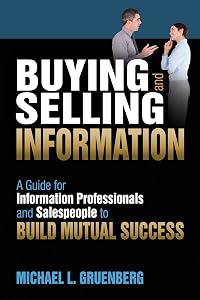
Buying and Selling Information: A Guide for Information Professionals and Salespeople to Build Mutual Success
by Michael L. Gruenberg
On This Page
Description
This guide is geared to helping librarians and salespeople understand what the "other guy" is grappling with in order to achieve the best possible outcome for everyone with special attention paid to the needs and interests of the end-user public.Tags
Member Reviews
Buying and Selling Information : A Guide for Information Professionals and Salespeople to Build Mutual Success / Michael L. Gruenberg. Review copy received from the LibraryThing Early Reviewers Program.
As a collections librarian, responsible for negotiating licenses for electronic resources on behalf of my library, I was very pleased to receive this book to review. As promised in the title, this book looks at both sides of the transaction, buyer and seller, which I found helpful, having only "seen" the buyer side before. Livened by an engaging writing style and personal anecdotes from his long career, Gruenberg takes the reader through all steps of a sale, from first contact to the post-sale relationship. He does indeed look at both show more sides, with tips to help both information professionals and salespeople ensure they're getting what they need. Recommended! show less
As a collections librarian, responsible for negotiating licenses for electronic resources on behalf of my library, I was very pleased to receive this book to review. As promised in the title, this book looks at both sides of the transaction, buyer and seller, which I found helpful, having only "seen" the buyer side before. Livened by an engaging writing style and personal anecdotes from his long career, Gruenberg takes the reader through all steps of a sale, from first contact to the post-sale relationship. He does indeed look at both show more sides, with tips to help both information professionals and salespeople ensure they're getting what they need. Recommended! show less
 This review was written for LibraryThing Early Reviewers.
In the “preference tests” we took in high school sales and marketing were always suggested for me, to my horror. After working in libraries for years, where most are introverts, I know there are elements of those careers that I might have done well at, but after reading this book I see it’s as well I didn’t take that path.
The author did a good job presenting some points that I had never thought about—why price increases are built into subscriptions (well you can guess why, but somehow I always thought it was something that was figured out each year in response to changing conditions, not projected from the beginning), why it’s important to know and explain your library’s purchase constraints right up front, why you should show more expect routine visits and calls from vendors and make time for them. And seeing this from the salesman’s perspective is useful. The members of my former library’s purchasing committee would find it interesting, but it probably wouldn’t change the bottom line too much. Particularly spending time reviewing and assessing potential purchases without any hope of knowing a “ballpark cost” until very late in the process seems unrealistic. It was also a surprise to see so little time designated for product demonstrations—if a salesman didn’t know his product backwards and forwards it wouldn’t inspire much confidence. It is clear that dealing with the higher-ups (on both sides of the negotiation) could result in a more advantageous deal, but getting the library director (or the provost) to attend a sales presentation is unlikely; usually that power is delegated to a librarian or a committee.
That said, trying to sum up and present what you have learned over your career is to be commended, and the author is honest and practical in his advice. It certainly couldn’t hurt acquisitions librarians and staff to read this book. show less
The author did a good job presenting some points that I had never thought about—why price increases are built into subscriptions (well you can guess why, but somehow I always thought it was something that was figured out each year in response to changing conditions, not projected from the beginning), why it’s important to know and explain your library’s purchase constraints right up front, why you should show more expect routine visits and calls from vendors and make time for them. And seeing this from the salesman’s perspective is useful. The members of my former library’s purchasing committee would find it interesting, but it probably wouldn’t change the bottom line too much. Particularly spending time reviewing and assessing potential purchases without any hope of knowing a “ballpark cost” until very late in the process seems unrealistic. It was also a surprise to see so little time designated for product demonstrations—if a salesman didn’t know his product backwards and forwards it wouldn’t inspire much confidence. It is clear that dealing with the higher-ups (on both sides of the negotiation) could result in a more advantageous deal, but getting the library director (or the provost) to attend a sales presentation is unlikely; usually that power is delegated to a librarian or a committee.
That said, trying to sum up and present what you have learned over your career is to be commended, and the author is honest and practical in his advice. It certainly couldn’t hurt acquisitions librarians and staff to read this book. show less
This review was written for LibraryThing Early Reviewers.This book is a basic primer for salespeople (vendors) and librarians/information professionals to better understand their professional relationship dynamics with and responsibilities to one another. It is written in a personable, simple style that felt like the author was confiding some secrets with the reader. I was initially interested in this book from the info professional's perspective, and after reading this book, I give it a sold 4/5. The simple language made it a quick read, a definite plus for busy folks, and I love how the author includes both salesperson and librarian perspectives in all scenarios throughout the book. In the foreword, a different author states that he would even recommend this book as part of a graduate show more curriculum for library science students, and this is a great suggestion because the book is practical and deals with an important topic of which most students are not aware, but will most certainly be dealing with in some point in their professional lives. I did not give the book 5 stars for several reasons. First of all, I wish the title included the word "vendors" instead of "salespeople"; this is just a personal preference. Also, some of the advice given was common sense: being prepared with questions before a sales meeting, for example. And, although most suggestions are practical, I can imagine many info pros dismissing the suggestion to speak with salespeople on a weekly basis as not practical or realistic with their busy schedules. However, despite these minor flaws, I would recommend this book for all information professionals and salespeople who work with them. show less
This review was written for LibraryThing Early Reviewers.This book was a little different than what I thought it would be based on the title. I thought I was going to be learning about “information”, as well as the buying and selling of it. This is a sales training book. That; however, did not reduce my thoughts about the book.
I have attended many sales training classes in my 30+ year career. Michael Gruenberg has done a great job of encapsulating both sides (buyer and seller) of any transaction into a well written, easy to read book. What is taught in this book should not be viewed a limited to a sales situation only. The techniques can and should be used in dealing with people.
Notable Parts
Reading The Room: Any time you are meeting with someone new in their environment (office, home, show more etc.), regardless of the situation, you should be “reading the room”. Looking around at what the person has collected, mounted on the walls, and overall condition of the room, can tell a lot about the person.
It’s About Value, Not Price: Not may people really understand the full meaning of this. When acquiring anything, the “value” can often override the “price” that is being paid.
I would recommend this book to anyone dealing with people. show less
I have attended many sales training classes in my 30+ year career. Michael Gruenberg has done a great job of encapsulating both sides (buyer and seller) of any transaction into a well written, easy to read book. What is taught in this book should not be viewed a limited to a sales situation only. The techniques can and should be used in dealing with people.
Notable Parts
Reading The Room: Any time you are meeting with someone new in their environment (office, home, show more etc.), regardless of the situation, you should be “reading the room”. Looking around at what the person has collected, mounted on the walls, and overall condition of the room, can tell a lot about the person.
It’s About Value, Not Price: Not may people really understand the full meaning of this. When acquiring anything, the “value” can often override the “price” that is being paid.
I would recommend this book to anyone dealing with people. show less
This review was written for LibraryThing Early Reviewers.A good mentoring book for salespeople who sell to libraries and librarians. It explains many of the interactions salespeople have with library and information resource people, and how access to large datasets for libraries are negotiated. Full of short, pithy observations, each chapter has a recapitulation of the basic knowledge points.
Divided into three sections, the various chapters deal with the vendor-librarian relationship(s); the sales meeting; and most importantly, "Closing the Sale." Many of the points are basic sales requirements- knowing your product, being prepared, being accessible to the customer. However, it is always important to stress the basics in salesmanship, and to go into the problems of sales from managing your show more time, attending trade shows, and working with the customers as well as your own staff.
In part this is also a memoir of the author's life in sales to libraries, and it is a good one. There is a good introduction by Guy St Clair as well.
Recommended for libraries, librarians, and business people who market or sell to the information world. This is a good and lucrative investment if you fit into this world. show less
Divided into three sections, the various chapters deal with the vendor-librarian relationship(s); the sales meeting; and most importantly, "Closing the Sale." Many of the points are basic sales requirements- knowing your product, being prepared, being accessible to the customer. However, it is always important to stress the basics in salesmanship, and to go into the problems of sales from managing your show more time, attending trade shows, and working with the customers as well as your own staff.
In part this is also a memoir of the author's life in sales to libraries, and it is a good one. There is a good introduction by Guy St Clair as well.
Recommended for libraries, librarians, and business people who market or sell to the information world. This is a good and lucrative investment if you fit into this world. show less
This review was written for LibraryThing Early Reviewers.Ratings
Members
- Recently Added By
Author Information
1 Work 14 Members
Common Knowledge
- Blurbers
- Lachance, Janice; Rogers, Tim
Classifications
- Genres
- Nonfiction, Business
- DDC/MDS
- 025.04068 — Computer science, information & general works Library & information sciences Administration; Departments Information storage and retrieval systems
- LCC
- HD9999 .I492 .G78 — Social sciences Industries. Land use. Labor Industries. Land use. Labor Special industries and trades Miscellaneous industries and trades
Statistics
- Members
- 14
- Popularity
- 1,672,726
- Reviews
- 5
- Rating
- (4.17)
- Languages
- English
- Media
- Paper, Ebook
- ISBNs
- 2