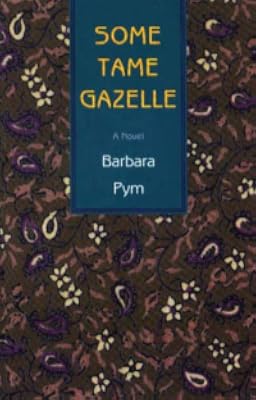
Some Tame Gazelle
by Barbara Pym 
On This Page
Description
Belinda and Harriet Bede live together in a small English village. Shy, sensible Belinda has been secretly in love with Henry Hoccleve-the poetry-spouting, married archdeacon of their church-for thirty years. Belinda's much more confident, forthright younger sister Harriet, meanwhile, is ardently pursued by Count Ricardo Bianco. Although she has turned down every marriageable man who proposes, Harriet still welcomes any new curate with dinner parties and flirtatious conversation. And one of show more the newest arrivals, the reverend Edgar Donne, has everyone talking. A warm, affectionate depiction of a postwar English village, Some Tame Gazelle perfectly captures the quotidian details that make up everyday life. With its vibrant supporting cast, it's also a poignant story of unrequited love. show lessTags
Recommendations




















Member Recommendations
Member Reviews
I've enjoyed Barbara Pym in the past. She kind of sneaks up on you with her brilliant, understated characterizations of ordinary people whose uneventful lives, when scrutinized her way, become fascinating, amusing, enlightening, and often absolutely hilarious. Some Tame Gazelle was her first novel, and she was already on her game with spinster sisters Harriet and Belinda Bede, who some indeterminate while ago "decided to spend their old age together", and who engage themselves with affairs of the parish. Harriet, who had a good university education, has long ago given up all intellectual pursuits to adopt a series of thin pale curates as they come and go, plying them with handknit items, cakes and boiled chicken suppers. Belinda, on the show more other hand, still takes pleasure in the greater and lesser English poets, and nurtures a long-standing love for the Archdeacon, who luckily for Belinda, married someone else 30 years ago. There seems to be nothing loveable left in the Archdeacon, who isn't at all happy in either his marriage or his calling, but Belinda loyally continues to look on him fondly and defend his rather shiftless performance of his clerical duties from her sister's sharp criticisms, while occasionally indulging in daydreams about how she might have been a more sympathetic helpmeet than his wife has turned out to be. There isn't anything demanding about reading Pym, but it would be a mistake to dismiss her novels as insignificant or "cosy" just because they're comfortable. It's sort of like spending an afternoon making cookies with a wise old aunt....you're richer for it.
Read and reviewed in 2013 show less
Read and reviewed in 2013 show less
It’s truly difficult to explain to others my love for Barbara Pym novels, as I feel they’re either understood or they’re not. I wanted to reread this since it’s the 70th anniversary of its publication this year (1950-2020), even though Pym started it almost two decades before that. Listening to the audiobook was delightful, and the narrator Mary Sarah sounds like she was born to read Pym. My spinster love starts here with Belinda and Harriet, although I’m forever grateful not to have to deal with any decades-old unrequited love. A favorite here: “...who would change a comfortable life of spinsterhood in a country parish, which always had its pale curate to be cherished, for the unknown trials of matrimony?”
Re-reading Barbara Pym is another of those pleasures that one feels one should ration out: I'm not sure why I allowed myself this one, but it's almost a year since the spell in hospital that was my excuse for the last re-reading session.
This one, of course, is Pym's first published novel, and like Crampton Hodnet it has a largely circular form: curates are treated as a renewable resource, and the main characters are in much the same situation at the end of the book as they were at the beginning. As so often in Pym, the central theme is the pleasure of having someone to love, contrasted with the inconvenience that would result if one were obliged to live with the person one loves. The story is presented in a setting that is positively show more Jane Austenish in its compression (Belinda and Harriet's house, the vicarage, the church, and an occasional glimpse at the village street in between).
It's conceptually difficult fitting the book into a time-slot — possibly why some people describe it as "timeless". Pym originally completed it in 1935, but failed to find a publisher at the time, then revised it after the war and finally got Jonathan Cape to publish it in 1950. However, the book as originally conceived is also in part a projection of herself and her friends into an imagined future twenty or thirty years hence. What is clear is that we aren't supposed to read it as though it's set in 1950. Middle-class ladies of a certain age still employ servants, overseas travel is freely possible, Carlsbad is still called Carlsbad, Africa is still firmly colonial, and there is no hint of economic crisis and rationing. In fact, the characters talk so incessantly about food and clothes that one feels the book could only have been written during a time of hunger and shortages. All this is rather reminiscent of P.G. Wodehouse's books of the same period. The depressing modern world is something that has no place in escapist literature.
On the other hand, we encounter the curate's underwear in the first sentence of the book, there are all sorts of jokes about people being offended by the mention of lavatories, and the "reinforced" corsets Harriet is sewing are forever being stuffed under sofa cushions when unexpected visitors arrive. There are characters who may (or may not) be gay. We are constantly being teased with the possibility of impropriety lurking below the surface of village life. If Pym is playing for the role of new Jane Austen here, it is with her tongue firmly in her cheek. show less
This one, of course, is Pym's first published novel, and like Crampton Hodnet it has a largely circular form: curates are treated as a renewable resource, and the main characters are in much the same situation at the end of the book as they were at the beginning. As so often in Pym, the central theme is the pleasure of having someone to love, contrasted with the inconvenience that would result if one were obliged to live with the person one loves. The story is presented in a setting that is positively show more Jane Austenish in its compression (Belinda and Harriet's house, the vicarage, the church, and an occasional glimpse at the village street in between).
It's conceptually difficult fitting the book into a time-slot — possibly why some people describe it as "timeless". Pym originally completed it in 1935, but failed to find a publisher at the time, then revised it after the war and finally got Jonathan Cape to publish it in 1950. However, the book as originally conceived is also in part a projection of herself and her friends into an imagined future twenty or thirty years hence. What is clear is that we aren't supposed to read it as though it's set in 1950. Middle-class ladies of a certain age still employ servants, overseas travel is freely possible, Carlsbad is still called Carlsbad, Africa is still firmly colonial, and there is no hint of economic crisis and rationing. In fact, the characters talk so incessantly about food and clothes that one feels the book could only have been written during a time of hunger and shortages. All this is rather reminiscent of P.G. Wodehouse's books of the same period. The depressing modern world is something that has no place in escapist literature.
On the other hand, we encounter the curate's underwear in the first sentence of the book, there are all sorts of jokes about people being offended by the mention of lavatories, and the "reinforced" corsets Harriet is sewing are forever being stuffed under sofa cushions when unexpected visitors arrive. There are characters who may (or may not) be gay. We are constantly being teased with the possibility of impropriety lurking below the surface of village life. If Pym is playing for the role of new Jane Austen here, it is with her tongue firmly in her cheek. show less
"His hand reached the knob simultaneously with hers. For one panic-stricken moment she even imagined that it lingered for a fraction of a second, but then dismissed the unworthy thought almost before it had time to register in her mind. She was in an agitated state, and she had read somewhere that in any case middle-aged spinsters were apt to imagine things of this kind…"
This is a character-driven book depicting the quiet lives of the inhabitants of a small English village in the 1930s, and is told both with melancholy and with biting humor. The book is delightful, following two middle-aged spinsters: the sisters Belinda and Harriet Bede, who live together. Belinda is timid and very sensible. She has been quietly in love with the show more married archdeacon of their church for nearly 30 years. Her sister Harriet is outgoing, bubbly, and a little ridiculous, delighting in welcoming any new curate with flirtatious ministrations. Their daily lives and interactions with friends and neighbors are lovingly recounted.
"When the day came for Agatha to go away, Belinda and Harriet watched her departure out of Belinda’s bedroom window. From here there was an excellent view of the vicarage drive and gate. Belinda had brought some brass with her to clean and in the intervals when she stopped her vigorous rubbing to look out the window, was careful to display the duster in her hand. Harriet stared out quite unashamedly, with nothing in her hand to excuse her presence there. She even had a pair of binoculars, which she was now trying to focus."
I loved it, and look forward to more Barbara Pym! show less
This is a character-driven book depicting the quiet lives of the inhabitants of a small English village in the 1930s, and is told both with melancholy and with biting humor. The book is delightful, following two middle-aged spinsters: the sisters Belinda and Harriet Bede, who live together. Belinda is timid and very sensible. She has been quietly in love with the show more married archdeacon of their church for nearly 30 years. Her sister Harriet is outgoing, bubbly, and a little ridiculous, delighting in welcoming any new curate with flirtatious ministrations. Their daily lives and interactions with friends and neighbors are lovingly recounted.
"When the day came for Agatha to go away, Belinda and Harriet watched her departure out of Belinda’s bedroom window. From here there was an excellent view of the vicarage drive and gate. Belinda had brought some brass with her to clean and in the intervals when she stopped her vigorous rubbing to look out the window, was careful to display the duster in her hand. Harriet stared out quite unashamedly, with nothing in her hand to excuse her presence there. She even had a pair of binoculars, which she was now trying to focus."
I loved it, and look forward to more Barbara Pym! show less
2013 marks the centenary of Barbara Pym, a British novelist with a unique gift for capturing the foibles and idiosyncrasies of post-WW II England. Her characters are usually middle-aged women, clergy, and academics; her debut novel, Some Tame Gazelle, includes all three.
Harriet and Belinda Bede are sisters, unmarried and of a certain age. Belinda is devoted to Henry Hoccleve, a love interest from her youth, now married to Agatha and serving as archdeacon in the village. Harriet is routinely pursued by an Italian count who inexplicably also lives in the village. Every few months he proposes marriage, and Harriet routinely declines. Instead, Harriet focuses her attentions on each new curate arriving in the parish, knowing full well her show more attentions will not be seen as anything other than maternal. Both women are perfectly comfortable sharing a house and caring for each other as old age approaches.
The entire village is quite comfortable, actually. Everyone goes to church on Sunday, and social life revolves around community activities like the annual garden party. People tend their gardens, women knit, and everyone seems to have at least a cook/housekeeper to prepare Sunday lunch while they are away at worship. This routine is disrupted when Agatha goes away on holiday alone, and both academics and a bishop visit the close-knit community.
Pym is delightfully witty, capturing perfectly the village's rich cast of characters. Henry has an inflated view of his abilities; his sermons are known for their length and liberal use of quotations from obscure sources. His idea of a perfect party activity is to read aloud to his guests. Really, Henry just likes hearing the sound of his own voice:
There was of course nothing she would have liked better than to hear dear Henry reciting Milton, but somehow with Agatha outside and so much to be done it didn't seem quite the thing. Also, it was the morning and it seemed a little odd to be thinking about poetry before luncheon. (p. 21)
But his talents are largely lost on his flock:
The congregation suddenly relaxed. It was just going to be one of the Archdeacon's usual sermons after all. There had been no need for those uncomfortable fears. They settled down again, now completely reassured, and prepared themselves for a long string of quotations, joined together by a few explanations from the Archdeacon. (p. 107)
The minor characters are just as amusing. There's a brilliant scene when the local seamstress refuses to eat food Belinda provided after discovering a caterpillar in the vegetables. Sock-knitting and the perils of the Kitchener stitch are covered in more detail than I would expect to find in a novel. Pym's writing had me chuckling all the way.
The plot was also satisfying, with just the right amount of conflict and uncertainty even as I knew everything would turn out all right in the end. Some Tame Gazelle is an ideal comfort read. show less
Harriet and Belinda Bede are sisters, unmarried and of a certain age. Belinda is devoted to Henry Hoccleve, a love interest from her youth, now married to Agatha and serving as archdeacon in the village. Harriet is routinely pursued by an Italian count who inexplicably also lives in the village. Every few months he proposes marriage, and Harriet routinely declines. Instead, Harriet focuses her attentions on each new curate arriving in the parish, knowing full well her show more attentions will not be seen as anything other than maternal. Both women are perfectly comfortable sharing a house and caring for each other as old age approaches.
The entire village is quite comfortable, actually. Everyone goes to church on Sunday, and social life revolves around community activities like the annual garden party. People tend their gardens, women knit, and everyone seems to have at least a cook/housekeeper to prepare Sunday lunch while they are away at worship. This routine is disrupted when Agatha goes away on holiday alone, and both academics and a bishop visit the close-knit community.
Pym is delightfully witty, capturing perfectly the village's rich cast of characters. Henry has an inflated view of his abilities; his sermons are known for their length and liberal use of quotations from obscure sources. His idea of a perfect party activity is to read aloud to his guests. Really, Henry just likes hearing the sound of his own voice:
There was of course nothing she would have liked better than to hear dear Henry reciting Milton, but somehow with Agatha outside and so much to be done it didn't seem quite the thing. Also, it was the morning and it seemed a little odd to be thinking about poetry before luncheon. (p. 21)
But his talents are largely lost on his flock:
The congregation suddenly relaxed. It was just going to be one of the Archdeacon's usual sermons after all. There had been no need for those uncomfortable fears. They settled down again, now completely reassured, and prepared themselves for a long string of quotations, joined together by a few explanations from the Archdeacon. (p. 107)
The minor characters are just as amusing. There's a brilliant scene when the local seamstress refuses to eat food Belinda provided after discovering a caterpillar in the vegetables. Sock-knitting and the perils of the Kitchener stitch are covered in more detail than I would expect to find in a novel. Pym's writing had me chuckling all the way.
The plot was also satisfying, with just the right amount of conflict and uncertainty even as I knew everything would turn out all right in the end. Some Tame Gazelle is an ideal comfort read. show less
(2020 has become my year of rereading the novels of Barbara Pym, my favourite novelist - "favourite" in the sense of "speaks most to my soul", not as in "greatest" or "best"; I believe she would have appreciated the distinction. This is my revised review.)
"Perhaps a nourishing milky drink was needed to bring her down to earth but it seemed an unromantic end to the evening."
In an unprepossessing village, two middle-aged spinster sisters live unprepossessing lives. Harriet spends her days being courted by an Italian Count for whom she feels no love, and her nights inventing excuses to cook meals or knit pullovers for an endless array of young, attractive curates who have no love to give her. Belinda, meanwhile, nurses a lifelong show more unrequited love only for one man: the married Archdeacon, Henry Hoccleve, with whom she had a brief love when they were undergraduates three decades earlier. Around them spiral love affairs, dissatisfied "decayed gentlewomen", and religious rivalries.
Barbara Pym's first novel was written when she was 22, although heavily revised before she finally got it published in her late 30s. (In between, a whole lot of self-development, failed writings, and WWII had passed.) Originally written as a knowing roman a clef for her friends, Pym casts herself and her sister in the lead roles, with her undergraduate love taking the part of the Archdeacon. Some Tame Gazelle has much of Pym's charm, and her anthropological technique of characterisation by way of minute details. It is often wryly funny, from the attempts by a group of guests to ignore what is clearly tinned soup with some potato water(!) added to a young man unsure whether a spinster quoting Ovid at him is hinting he should leave or whether she has forgotten what the lines actually mean. (It's the latter.) And that's without mentioning a sequence wherein a group of refined and dowdy churchgoing ladies find themselves giggling over a particularly phallic African musical instrument.
Some Tame Gazelle carries with it most of Pym's core themes - the choice between taking a risk to find fulfillment, or settling for comfortable dissatisfaction; class position and social status in a (very) small pond; the importance of food, clothing, and religion - or rather, the culture of religion rather than belief as such - and owes much to the tradition of English "high comedy" that dated back to Austen and had thrived in Pym's youth through authors such as E.F. Benson and (although more farcical) P.G. Wodehouse. The novel also toys with the notion of subjectivity, which would become one of her hallmarks, as characters are viewed from different perspectives, leading us to realise how difficult true human connection is, and how funny or tragic a life can seem to those who are not living it. (She has not perfected this yet.)
It is not, I think, Pym's greatest work. The novel carries too many traces of youth, even a sense of something derivative in the heavy use of literary quotations. Some of the characters (Edith Liversidge among them) bear the uncomfortable contrasts of having changed between drafts, while others (Edgar Donne) are early versions of types she will perfect in the near future. The character of Belinda Bede - representing the purest version of young Barbara - is even a little unsufferable. Many of Pym's heroines will carry unrequited loves and be charming, but Belinda is just a doormat, waiting patiently for any time Henry's wife goes away, to dote on him, yet always knowing that after 30 years she will have to settle for distant love, expecting nothing in return. (To be fair, this is how young Barbara felt about her own love, also named Henry, and her diaries become exhausting around this time, with her intention to love him forever, no matter what he may feel.)
Yet a merely good Pym is nevertheless food for the soul. There is much to give amusement and even occasionally insight. As Belinda herself says, "I'm sure we need plenty of tea after all this excitement." show less
"Perhaps a nourishing milky drink was needed to bring her down to earth but it seemed an unromantic end to the evening."
In an unprepossessing village, two middle-aged spinster sisters live unprepossessing lives. Harriet spends her days being courted by an Italian Count for whom she feels no love, and her nights inventing excuses to cook meals or knit pullovers for an endless array of young, attractive curates who have no love to give her. Belinda, meanwhile, nurses a lifelong show more unrequited love only for one man: the married Archdeacon, Henry Hoccleve, with whom she had a brief love when they were undergraduates three decades earlier. Around them spiral love affairs, dissatisfied "decayed gentlewomen", and religious rivalries.
Barbara Pym's first novel was written when she was 22, although heavily revised before she finally got it published in her late 30s. (In between, a whole lot of self-development, failed writings, and WWII had passed.) Originally written as a knowing roman a clef for her friends, Pym casts herself and her sister in the lead roles, with her undergraduate love taking the part of the Archdeacon. Some Tame Gazelle has much of Pym's charm, and her anthropological technique of characterisation by way of minute details. It is often wryly funny, from the attempts by a group of guests to ignore what is clearly tinned soup with some potato water(!) added to a young man unsure whether a spinster quoting Ovid at him is hinting he should leave or whether she has forgotten what the lines actually mean. (It's the latter.) And that's without mentioning a sequence wherein a group of refined and dowdy churchgoing ladies find themselves giggling over a particularly phallic African musical instrument.
Some Tame Gazelle carries with it most of Pym's core themes - the choice between taking a risk to find fulfillment, or settling for comfortable dissatisfaction; class position and social status in a (very) small pond; the importance of food, clothing, and religion - or rather, the culture of religion rather than belief as such - and owes much to the tradition of English "high comedy" that dated back to Austen and had thrived in Pym's youth through authors such as E.F. Benson and (although more farcical) P.G. Wodehouse. The novel also toys with the notion of subjectivity, which would become one of her hallmarks, as characters are viewed from different perspectives, leading us to realise how difficult true human connection is, and how funny or tragic a life can seem to those who are not living it. (She has not perfected this yet.)
It is not, I think, Pym's greatest work. The novel carries too many traces of youth, even a sense of something derivative in the heavy use of literary quotations. Some of the characters (Edith Liversidge among them) bear the uncomfortable contrasts of having changed between drafts, while others (Edgar Donne) are early versions of types she will perfect in the near future. The character of Belinda Bede - representing the purest version of young Barbara - is even a little unsufferable. Many of Pym's heroines will carry unrequited loves and be charming, but Belinda is just a doormat, waiting patiently for any time Henry's wife goes away, to dote on him, yet always knowing that after 30 years she will have to settle for distant love, expecting nothing in return. (To be fair, this is how young Barbara felt about her own love, also named Henry, and her diaries become exhausting around this time, with her intention to love him forever, no matter what he may feel.)
Yet a merely good Pym is nevertheless food for the soul. There is much to give amusement and even occasionally insight. As Belinda herself says, "I'm sure we need plenty of tea after all this excitement." show less
In this first novel by a 22 year old Barbara Pym, we can see the shape of things to come in her writing. She places two middle-aged spinsters in a quiet English village, with hearth and pew at the centre of things, giving us a glimpse of their quiet yet often funny lives.
This first book was a bit of play. She took her friends, her sister and herself, and wrote them into a novel, imagining them thirty years down the road. Bright and young, with everything ahead of them (including the Second World War), she played with how they might end up, no doubt poking fun at personality traits and foibles. If nothing else, it was a delightful exercise in creativity but there is a skill here, an acute ability to observe and extrapolate which shows us show more the novelist she will become.
Harriet, the extrovert, and Belinda, the introvert, lead lives which might look as dull as dishwater from the outside: faithful involvement in their church, knitting, reading poetry and the classics or the gossip rags about the gentry/nobility, gardening, the making, eating and sharing of meals, concerns about what to wear, etc. But the young Pym infuses these with gentle humour and warmth. Dead flowers making the water smell foul in a vase, a caterpillar cooked and served in cauliflower cheese, combinations showing below a pant cuff, socks knit too short, corsets being mended and stuffed under a couch cushion when visitors arrive–all the stuff of ordinary life but captured in still-life snapshots which charm.
This was a time of transition for women in England, this time between the wars. Many young men had been lost in WWI so there were many widows and many women who would never have the chance to marry. But for women of independent means, like Harriet and Belinda, it was also a time of liberating choice when they could elect to remain independent, living the lives they preferred. And, despite Harriet’s flirtations, prefer it they did. Unsuitable suitors are rejected. The marriages of others are observed with a faint sense of relief. Even Belinda, with her long-held schwarm for Archdeacon Hoccleve, can look at him with a dispassionate eye now and then, glad in her secret heart that she didn’t end up with him. Her “poor Agatha” moments aren’t too frequent (Hoccleve’s wife) and somewhat distress her when they do occur, but she knows that her life with Harriet is far preferable to being berated from an upstairs window about moth holes in a suit.
In this first novel, Pym sets the template for what will be her people in future novels: the quiet, the invisible, perhaps even the marginalised people the rest of us don’t particularly notice. She will take the Harriets, the Belindas, the Edith Liversidges who write their names in dust on other people’s pianos, the pompous jackasses like the Archdeacon and the Bishop Mbawawa, the earnest Canons and all the others, setting them in their villages, churches, jobs and homes. And she will observe like a falcon and tell us all about them, with her dry and delicious understated humour. show less
This first book was a bit of play. She took her friends, her sister and herself, and wrote them into a novel, imagining them thirty years down the road. Bright and young, with everything ahead of them (including the Second World War), she played with how they might end up, no doubt poking fun at personality traits and foibles. If nothing else, it was a delightful exercise in creativity but there is a skill here, an acute ability to observe and extrapolate which shows us show more the novelist she will become.
Harriet, the extrovert, and Belinda, the introvert, lead lives which might look as dull as dishwater from the outside: faithful involvement in their church, knitting, reading poetry and the classics or the gossip rags about the gentry/nobility, gardening, the making, eating and sharing of meals, concerns about what to wear, etc. But the young Pym infuses these with gentle humour and warmth. Dead flowers making the water smell foul in a vase, a caterpillar cooked and served in cauliflower cheese, combinations showing below a pant cuff, socks knit too short, corsets being mended and stuffed under a couch cushion when visitors arrive–all the stuff of ordinary life but captured in still-life snapshots which charm.
This was a time of transition for women in England, this time between the wars. Many young men had been lost in WWI so there were many widows and many women who would never have the chance to marry. But for women of independent means, like Harriet and Belinda, it was also a time of liberating choice when they could elect to remain independent, living the lives they preferred. And, despite Harriet’s flirtations, prefer it they did. Unsuitable suitors are rejected. The marriages of others are observed with a faint sense of relief. Even Belinda, with her long-held schwarm for Archdeacon Hoccleve, can look at him with a dispassionate eye now and then, glad in her secret heart that she didn’t end up with him. Her “poor Agatha” moments aren’t too frequent (Hoccleve’s wife) and somewhat distress her when they do occur, but she knows that her life with Harriet is far preferable to being berated from an upstairs window about moth holes in a suit.
In this first novel, Pym sets the template for what will be her people in future novels: the quiet, the invisible, perhaps even the marginalised people the rest of us don’t particularly notice. She will take the Harriets, the Belindas, the Edith Liversidges who write their names in dust on other people’s pianos, the pompous jackasses like the Archdeacon and the Bishop Mbawawa, the earnest Canons and all the others, setting them in their villages, churches, jobs and homes. And she will observe like a falcon and tell us all about them, with her dry and delicious understated humour. show less
Members
- Recently Added By
Lists

Schwob Nederland
207 works; 2 members

Fiction about missionaries
34 works; 5 members

Books Read in 2024
4,727 works; 128 members

Books Read in 2025
4,128 works; 98 members
Talk Discussions
Past Discussions
Barbara Pym Centenary: Some Tame Gazelle in Virago Modern Classics (October 2013)
Author Information

27+ Works 14,782 Members
Novelist Barbara Pym was born in Shropshire and educated at Oxford University. An editor of Africa, an anthropological review, for many years, she published her first novel, Some Tame Gazelle, in 1950. Since then, a number of popular works have been published. Often compared with the works of Jane Austen in both manner and subject, Pym's novels show more are apparently guileless evocations of the foibles of aging and isolated characters. She has a sure, if understated, sense of her characters' psychology and of their unintentionally comic revelations about themselves and their futile lives. After the publication of No Fond Return of Love (1961), all her books were out of print until she was cited, coincidentally by both David Cecil and Philip Larkin, as among the most underestimated novelists of the 20th century. She subsequently completed two successful novels, The Sweet Dove Died (1978) and Quartet in Autumn (1978), the latter a comic-pathetic study of two men and two women in their sixties who work in the same office but lead separate, lonely lives outside. Many of her earlier books have since been reprinted, including Excellent Women (1952) and A Glass of Blessings (1958), both perceptive psychological studies of aging women taken advantage of by others. A posthumous novel, A Few Green Leaves (1980), is a superb comedy of provincial village life. (Bowker Author Biography) show less
Barbara Pym has a Legacy Library. Legacy libraries are the personal libraries of famous readers, entered by LibraryThing members from the Legacy Libraries group.
Some Editions
Series
Belongs to Publisher Series
Virago Modern Classics (541)
Work Relationships
Is contained in
Has as a reference guide/companion
Common Knowledge
- Canonical title
- Some Tame Gazelle
- Original title
- Some Tame Gazelle
- Original publication date
- 1950
- People/Characters
- Belinda Bede; Harriet Bede; Archdeacon Henry Hoccleve; Agatha Hoccleve; Count Ricardo Bianco; Edith Liversidge (show all 8); Connie Aspinall; Nicholas Parnell
- Epigraph
- Some tame gazelle, or some gentle dove:
Something to love, oh, something to love!
Thomas Haynes Bailey - First words
- The new curate seemed quite a nice young man, but what a pity it was that his combinations showed, tucked carelessly into his socks, when he sat down.
- Quotations
- "Look", Harriet cried, for she had been so absorbed in her task of `strengthening' a pair of corsets with elastic thread that she had not noticed the Archdeacon creeping up the drive. ... she bundled the corsets under a cushi... (show all)on in one of the armchairs; Belinda noticed to her horror that they were imperfectly hidden and planted herself firmly in front of the chair.
She began to find ways of making things better and more bearable.
In future Belinda would continue to find such consolation as she needed in our greater English poets, when she was not gardening or making vests for the poor in Pimlico. - Last words
- (Click to show. Warning: May contain spoilers.)"Oh, come, now", laughed the curate, and although his voice was rather weak as a result of his long illness, Belinda was overjoyed to hear that it had the authentic ring.
- Blurbers
- Tyler, Anne
- Original language
- English
Classifications
Statistics
- Members
- 1,165
- Popularity
- 21,613
- Reviews
- 49
- Rating
- (3.97)
- Languages
- Dutch, English, French, Italian
- Media
- Paper, Audiobook, Ebook
- ISBNs
- 36
- ASINs
- 17