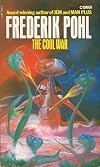
The Cool War
by Frederik Pohl
On This Page
Description
One day, the Reverend Hornswell Hake had nothing worse to contend with than the customary power shortages and his routine pastoral chores, such as counseling the vivacious Alys Brant--and her husbands and wife. At nearly forty, his life was placid, almost humdrum. The very next day, Horny Hake was first enlisted as an unwilling agent of the Team--secret successor to the long-discredited CIA--and then courted by an anti-Team underground group. In practically no time at all, Horny and Alys show more were touring Europe on a mission about which he knew zip, except that it was a new move in the Cool War, the worldwide campaign of sabotage that had replaced actual combat. show lessTags
Recommendations





















Member Reviews
Far from a new book, I just now caught up with reading Frederick Pohl’s “The Cool War” that he wrote in 1979.
The book follows the Reverend Hornswell Hake, who most of his acquaintances call “Horny”. He’s the pastor of a small church in Long Branch, New Jersey in a world where energy production and usage is quite a lot different.
For background, at some point some years before the book takes place, the Israelis nuked all the Arab oil fields as a way to reduce their power and worldwide influence. So, Hake’s world is powered by a lot of coal, some minimal oil, some solar, and it’s a lot more polluted than our world now.
Pohl’s characterization of Hake felt a lot more like sci-fi authors from the 50’s than from the late show more 70’s. Hake, and since it’s from his perspective, the reader, goes through most of the novel without much clue what’s going on.
As a reader, I felt more like I was stuck in the head of an idiot. At many points in the story I kept thinking he could’ve clarified a lot by asking some questions of others, but he never did and I felt dissatisfied.
Some of the espionage acts were interesting and some made me want more detail on what Hake’s associates were doing. But he was too stupid to ask the questions I wanted answered.
Overall, it was not a very good book. And even worse by late 70’s sci-fi literature standards than earlier. show less
The book follows the Reverend Hornswell Hake, who most of his acquaintances call “Horny”. He’s the pastor of a small church in Long Branch, New Jersey in a world where energy production and usage is quite a lot different.
For background, at some point some years before the book takes place, the Israelis nuked all the Arab oil fields as a way to reduce their power and worldwide influence. So, Hake’s world is powered by a lot of coal, some minimal oil, some solar, and it’s a lot more polluted than our world now.
Pohl’s characterization of Hake felt a lot more like sci-fi authors from the 50’s than from the late show more 70’s. Hake, and since it’s from his perspective, the reader, goes through most of the novel without much clue what’s going on.
As a reader, I felt more like I was stuck in the head of an idiot. At many points in the story I kept thinking he could’ve clarified a lot by asking some questions of others, but he never did and I felt dissatisfied.
Some of the espionage acts were interesting and some made me want more detail on what Hake’s associates were doing. But he was too stupid to ask the questions I wanted answered.
Overall, it was not a very good book. And even worse by late 70’s sci-fi literature standards than earlier. show less
I got a pristine hardback copy of this in the 1990s for 3 dollars because it was in some cut-out bin at a used book shop that I liked. I recall enjoying it a lot. It's an amusing take on cold war, with some fun ideas. But, alas, I read it so long ago that I can't vouch for it much in terms of style or what have you, except that I do remember the episodes made me chuckle.
Interesting ideas about the future of warfare (economic sabotage), but annoying characters/plot developments weaken the story.
Dated, stilted characters
Ratings
Members
- Recently Added By
Lists

David Brin: Dire Warnings And Self-Preventing Prophecies
17 works; 3 members
Author Information

641+ Works 42,946 Members
Frederik Pohl was born in New York City on November 26, 1919. More interested in writing than in school, he dropped out of high school in his senior year and took a job with a publishing company. After serving as a public relations officer in the United States Army from 1943 to 1945, he returned to publishing as copywriter for Popular Science, a show more literary agent for several sci-fi writers, and the editor for the magazines Galaxy and If from 1959 until 1969, with If winning three successive Hugo awards. His first published work, a poem entitled Elegy to a Dead Satellite: Luna, was printed in Amazing Stories magazine in 1937 under the pen name Elton Andrews. His first science fiction novels were published in the mid 1960's, some written in collaboration with other writers, others created alone. During his lifetime, he won over 16 major awards for his writing (much of which was published pseudonymously) including six Hugo Awards and three Nebula Awards. His works include Gateway, which won the Campbell Memorial, Hugo, Locus SF, and Nebula Awards, Beyond the Blue Event Horizon, and Jem, which won the National Book Award in 1979. He also embraced blogging in his later years, using his online journal as an ongoing sequel to his autobiography, The Way the Future Was. He died on September 2, 2013 at the age 93. (Bowker Author Biography) show less
Some Editions
Series
Belongs to Publisher Series
Work Relationships
Is contained in
Common Knowledge
- Canonical title
- The Cool War
- Original title
- The Cool War
- Original publication date
- 1981-04
- Original language
- English
Classifications
Statistics
- Members
- 480
- Popularity
- 63,576
- Reviews
- 4
- Rating
- (3.20)
- Languages
- 5 — Dutch, English, Finnish, French, German
- Media
- Paper, Ebook
- ISBNs
- 10
- ASINs
- 9