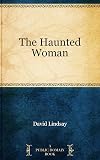
The Haunted Woman
by David Lindsay
On This Page
Description
All that prevents Isbel Loment's marriage to insurance underwriter Marshall Stokes is finding a settled home for her aunt, with whom she has been living these past nine years, drifting between a series of hotels. Marshall suggests Runhill Court, whose owner, Henry Judge, may be interested in selling after the death of his young wife. But the house comes with a mystery attached: a staircase is said to appear to certain people at certain times, but they can never remember what happens when show more they ascend. On her first visit to the house Isbel sees the stairs. Ascending them, she finds three plain doors. Through the first she sees herself in a mirror, with all the potentialities of her deepest nature written plainly upon her face - all that her coming marriage to the shallow Marshall will leave unfulfilled. Descending the stairs, she forgets it all, but is left with a troubling need to understand what happened to her, and to fulfil her truer, "tragic" nature. Lindsay's second novel questions the possibility of the deepest fulfilment in a world whose very nature seems to work against it - and which may lead those seeking it to test their relationships, values, and even their very notions of themselves. This edition of David Lindsay's The Haunted Woman is extensively annotated, placing the novel in its historical, cultural, and biographical context, and firmly within the larger body of Lindsay's work as a writer. show lessTags
Recommendations














Member Reviews
What an extraordinary, extraordinary book. Part odd romantic 1920s melodrama and part metaphysical, mystical allegory... it's easily one of the most unusual books I've ever read. You can't put it in any genre easily - although the temptation to call it a supernatural book is quite high, even though it patently isn't that - and seems, as the introduction states, to be written by two very different people. It's far from perfect but it's also one of the most astonishingly powerful books in places I've read in an age - especially the sequences with the staircase, room and the bizarre landscape. It most reminds me of Russel Hoban's "The Trokeville Way" and generally speaking Lindsay is quite like Hoban in tone as well. I'd be cautious in show more advising people to read this one as it may well annoy and frustrate but it is *genuinely* unlike anything else I have ever come across in my life. show less
Wow, what a great novel; totally different in all ways from [b:A Voyage to Arcturus|1064084|A Voyage to Arcturus|David Lindsay|https://i.gr-assets.com/images/S/compressed.photo.goodreads.com/books/1328819689l/1064084._SY75_.jpg|923907], which I have to admit I probably under appreciate. A romance hidden in a haunted house, hidden in a science fiction-parallel world, philosophical novel. This Tartarus edition has an afterword, that is properly an afterword and not an introduction, that explicates the novel so succinctly that it is a wonder in itself.
Lindsay's breadth is truly remarkable. I will have to go back and reread Arcturus. I think I was put off by it's rather dated plotting and style and did not appreciate its philosophical show more aspects as well as I should have. show less
Lindsay's breadth is truly remarkable. I will have to go back and reread Arcturus. I think I was put off by it's rather dated plotting and style and did not appreciate its philosophical show more aspects as well as I should have. show less
David Lindsey is known for his Manichaen fantasy/science fiction A Voyage to Arcturus, praised by C.S.Lewis and others, which personally I admire rather than like -- the writing is stiff, though the visualization of a universe in which the created world is evil is powerful. Lindsey is also known for saying that his concept of success as a writer is "one reader a year to the end of time" which I have always believed is valid as one type of literary success. Voyage is almost certainly a success on that level, beloved by a small but continuing cluster of readers. The Haunted Woman is less of an imaginative achievement. as it is set in a house which, at least to begin with, is in our world and inhabited by fairly ordinary people, though it show more does develop some uncanny aspects.On the other hand, the style is smother, very much the style of a conventional novel of the time, about the social interactions of a group of upper-middle-class British people. On one level the plot is very like one of those novels -- a woman engaged to but not passionately in love with a suitable man develops a bond with an older widower. However, in this
story what brings the woman together with the widower is his house, Runhill (Rune Hill). The house was originally a four-story wooden tower (a very unlikely construction for the time) built by an early Saxon named Ulf, who vanished one night together with the fourth story of the tower, supposedly carried off by trolls or elves. Stairways leading into the missing part of the house manifest themselves occasionally in lower parts of the building, and the woman and the widower both find their way into the missing rooms and meet there, though they do not recall the meetings afterwards. Later another, rather unpleasant, woman who is making a play for the widower also manages to enter that part of the house. There is no real "horror" in the story until the last 25 pages, when two of the major characters die suddenly, though even then there is very little description of what apparently frightened them to death. 'low-key" seems an apt description of the tone of the whole book. show less
story what brings the woman together with the widower is his house, Runhill (Rune Hill). The house was originally a four-story wooden tower (a very unlikely construction for the time) built by an early Saxon named Ulf, who vanished one night together with the fourth story of the tower, supposedly carried off by trolls or elves. Stairways leading into the missing part of the house manifest themselves occasionally in lower parts of the building, and the woman and the widower both find their way into the missing rooms and meet there, though they do not recall the meetings afterwards. Later another, rather unpleasant, woman who is making a play for the widower also manages to enter that part of the house. There is no real "horror" in the story until the last 25 pages, when two of the major characters die suddenly, though even then there is very little description of what apparently frightened them to death. 'low-key" seems an apt description of the tone of the whole book. show less
Everything was great if you like chit chat about men and women being different.
The ending was great, I just didn't like the very ending, it left too many unanswered questions
The ending was great, I just didn't like the very ending, it left too many unanswered questions
Ratings
Members
- Recently Added By
Lists

Cawthorn and Moorcock's Fantasy: The 100 Best Books
110 works; 7 members
Author Information

12+ Works 1,750 Members
Awards and Honors
Notable Lists
Series
Belongs to Publisher Series
Work Relationships
Is contained in
Common Knowledge
- Canonical title*
- Fenster ins Frühlicht
- Original title
- The Haunted Woman
- Original publication date
- 1922
*Some information comes from Common Knowledge in other languages. Click "Edit" for more information.
Classifications
Statistics
- Members
- 163
- Popularity
- 201,360
- Reviews
- 4
- Rating
- (3.45)
- Languages
- English, German, Swedish
- Media
- Paper, Ebook
- ISBNs
- 20
- ASINs
- 6