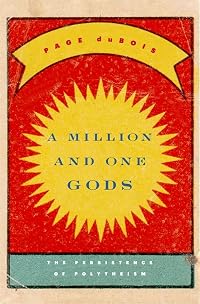
A Million and One Gods: The Persistence of Polytheism
by Page DuBois
On This Page
Description
Many people worship not just one but many gods. Yet a relentless prejudice against polytheism denies legitimacy to some of the world's oldest and richest religious traditions. In her examination of polytheistic cultures both ancient and contemporary--those of Greece and Rome, the Bible and the Quran, as well as modern India--Page duBois refutes the idea that the worship of multiple gods naturally evolves over time into the "higher" belief in a single deity. In A Million and One Gods, she show more shows that polytheism has endured intact for millennia even in the West, despite the many hidden ways that monotheistic thought continues to shape Western outlooks. In English usage, the word "polytheism" comes from the seventeenth-century writings of Samuel Purchas. It was pejorative from the beginning--a word to distinguish the belief system of backward peoples from the more theologically advanced religion of Protestant Christians. Today, when monotheistic fundamentalisms too often drive people to commit violent acts, polytheism remains a scandalous presence in societies still oriented according to Jewish, Christian, and Muslim beliefs. Even in the multicultural milieus of twenty-first-century America and Great Britain, polytheism finds itself marginalized. Yet it persists, perhaps because polytheism corresponds to unconscious needs and deeply held values of tolerance, diversity, and equality that are central to civilized societies. show lessTags
Recommendations




























Member Reviews
Dubois examines the polytheistic history of the major monotheism and their survivals as well as the many polytheistic religions current in the world. She examines the assumption that all religion is progressing toward monotheism as well as an early idea that monotheism was the early, natural faith of humans from which most fell away in into idolatry and need to be led back. Polytheism is also noted as political resistance in the case of Hinduism and indigenous peoples in America and Africa.
Ratings
Members
- Recently Added By
Published Reviews
Page duBois sets out not to defend polytheism, but to recognise the difficulty that modern scholarship has with discussing it in a sensible way, so biased is the field towards monotheism. The book rests on the premise, unstated in much Western scholarship on religion, as well as in monotheist religions and popular culture, that polytheism is somehow a primitive aspect of religious behaviour show more and belief, and that monotheism represents an ethically and philosophically superior development out of such primitive beginnings. DuBois introduces the book by exploring etymologies of the words used to describe religion – God, religion, deity – and highlights the legacy of monotheism in the English definitions, for example, the idea that worship involves love of the deity; in polytheist worship, reverence of a deity can be as inspired by respect or fear or other emotions, and does not require love. Her concern throughout the book is to bring out the roles that polytheism continues to play in Western life, although at a subaltern level, and to show the reader what can be learned from them. show less
added by cinaedus
Lists

Lārhūs Fyrnsida Suggested Reading List
34 works; 1 member
Author Information
12+ Works 277 Members
Classifications
- Genres
- Religion & Spirituality, Nonfiction, History
- DDC/MDS
- 201.4 — Religion The Bible & Christianity Religious mythology, general classes of religion, interreligious relations and attitudes, social theology General classes of religion
- LCC
- BL217 .D83 — Philosophy, Psychology and Religion Religions. Mythology. Rationalism Religions. Mythology. Rationalism Natural theology Polytheism
- BISAC
Statistics
- Members
- 40
- Popularity
- 728,232
- Reviews
- 1
- Rating
- (3.50)
- Languages
- English
- Media
- Paper, Ebook
- ISBNs
- 2