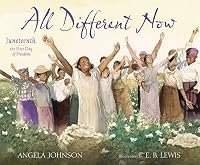
All Different Now: Juneteenth, the First Day of Freedom
by Angela Johnson, E.B. Lewis (Illustrator)
On This Page
Description
In 1865, members of a family start their day as slaves, working in a Texas cotton field, and end it celebrating their freedom on what came to be known as Juneteenth.Tags
Recommendations



Member Reviews
A young girl and her siblings wake to the smell of honeysuckle and set to work in the cotton fields as slaves. Paneled illustrations show news of their freedom spreading from "the port, to town, through the countryside, and into the fields." Once they receive word of their freedom, the girl's family eat, laugh, and tell stories into the night. The next day, she wakes to the same smell of honeysuckle, but everything is "all different now." The final page shows the former slaves leaving the fields with their belongings.
Simple, elegant, yet effective text used in this story: "that a Union general had read from a balcony that we were all now and forever free and things would be all different now." Angela Johnson very intentionally omits show more names and places; her purpose is feeling. She wants her audience to feel what people felt that day, Juneteenth. The details come after the story in a timeline of important dates from 1863-1865, the history of Juneteenth, online sources for further learning, and key terms defined in kid-friendly language. Excellent book. show less
Simple, elegant, yet effective text used in this story: "that a Union general had read from a balcony that we were all now and forever free and things would be all different now." Angela Johnson very intentionally omits show more names and places; her purpose is feeling. She wants her audience to feel what people felt that day, Juneteenth. The details come after the story in a timeline of important dates from 1863-1865, the history of Juneteenth, online sources for further learning, and key terms defined in kid-friendly language. Excellent book. show less
Beautifully delicate watercolor illustrations leave a lasting impression of the story of Juneteenth, when enslaved people in Texas learned they were free. The illustrator shows a range of reactions, trying to imagine what it was like. Back matter includes a timeline of important dates (1863-1865), a few paragraphs on "Juneteenth, Then and Now," a list of online sources, and a glossary of key terms. Now that Juneteenth is a federal holiday the back matter is not perfectly up-to-date, but don't throw the baby out with the bathwater - this is still an incredibly worthwhile book.
The book tells the story about what happened on the day when the enslaved people of the south found out in that the Civil War was over and that they were free.
There are many black people I know that celebrate Juneteenth instead of 4th of July because for our ancestors this was their independence day. I think the book does a good job of explaining the holiday and its origins to a young audience. The author's note was the most powerful part of the book for me.
There are many black people I know that celebrate Juneteenth instead of 4th of July because for our ancestors this was their independence day. I think the book does a good job of explaining the holiday and its origins to a young audience. The author's note was the most powerful part of the book for me.
A simple, beautiful telling of how news of freedom reached the last slaves in the South, those toiling in the hot Texas sun. Their celebration to mark the date lives on each June 19. Author’s Note, Illustrator’s Note, Timeline, Online Sources, Glossary.
Such a beautifully written and illustrated book that explains the history and movement of celebrating Juneteenth. It's written with language and emotion children can understand.
If you don’t already know the story of Juneteenth Day, this book won't enlighten you until you get to the author’s notes at the back of the book. By starting at the end, you will learn that at the conclusion of the Civil War, many slaves did not yet know they were now free. [The author errs in her note (although not in her timeline) by stating that slaves were free as of the Emancipation Proclamation of January 1, 1863. This was a wartime measure and in any event did not free all the slaves; some 800,000 slaves in the border states alone were unaffected by the measure. It was not until the return of the Confederate states to the Union (for which a renunciation of slavery was mandatory) and their acceptance of the Thirteenth show more Amendment to the Constitution, ratified in December of 1865, that slavery was officially abolished. In the meantime, however, Southern States remained under military government. Thus, the notification of June 19th was in the form of a military order.]
Even after slavery became illegal, slave owners in Texas did not volunteer the news to their slaves. It was only when Union Major General Gordon Granger came to Galveston, Texas on June 19, 1865 and made the announcement, that slaves understood they were officially free from bondage. [And often, as historian Henry Louis Gates, Jr. reports, slaves took advantage of their promised freedom at some peril.]
The author observes that awareness of the significance of this date increased during the Civil Rights Movement of the 1960’s, and the date is now celebrated throughout the nation.
The book takes us through a summer day for slaves on a Texas plantation, slaves who do not realize that “soon, it would all be different.” As the news spreads, more and more people gather and:
"…we ate as a free people,
laughed as a free people,
and told stories as free people
on
into
the night.”
The little girl who is telling the story muses that in the morning, when they wake again, it will be a time that is “all different now.”
Illustrator E.B. Lewis does a remarkable job with muted watercolors in capturing the range of emotions that slaves must have felt upon learning they were free, from shock to disbelief to hope to ineffable joy. He also makes great use of shadow and changes in light to show the rhythms of the day.
Evaluation: While the illustrations are lovely, I would have liked to have seen some background information made available before the end notes, which in any event are geared toward adults. show less
Even after slavery became illegal, slave owners in Texas did not volunteer the news to their slaves. It was only when Union Major General Gordon Granger came to Galveston, Texas on June 19, 1865 and made the announcement, that slaves understood they were officially free from bondage. [And often, as historian Henry Louis Gates, Jr. reports, slaves took advantage of their promised freedom at some peril.]
The author observes that awareness of the significance of this date increased during the Civil Rights Movement of the 1960’s, and the date is now celebrated throughout the nation.
The book takes us through a summer day for slaves on a Texas plantation, slaves who do not realize that “soon, it would all be different.” As the news spreads, more and more people gather and:
"…we ate as a free people,
laughed as a free people,
and told stories as free people
on
into
the night.”
The little girl who is telling the story muses that in the morning, when they wake again, it will be a time that is “all different now.”
Illustrator E.B. Lewis does a remarkable job with muted watercolors in capturing the range of emotions that slaves must have felt upon learning they were free, from shock to disbelief to hope to ineffable joy. He also makes great use of shadow and changes in light to show the rhythms of the day.
Evaluation: While the illustrations are lovely, I would have liked to have seen some background information made available before the end notes, which in any event are geared toward adults. show less
There are two reasons I liked this book. In the picture book All Different Now: Juneteenth, the First Day of Freedom, narratives the day slaves would forever be free. The African American slaves, wake up to the news that they will now be forever free, no longer having to work in the cotton fields. The illustrator E.B. Lewis used watercolor paint. The illustrations give an illusion of photographs that have been stored in a storage as a memory keepsake. For example, the last illustration shows colors of browns, whites, faded blue and black. Only two cabins are shown with two wagons and a family walking away from the cabin. The writing fit in perfectly for the time period of this book. The words weren’t to lengthy or advanced for show more children to understand the change this day brough forward. The purpose of this book to for people to remember the day slaves were announced free. show less
Members
- Recently Added By
Lists

Picture Books About Civil Rights
51 works; 4 members
Author Information

47+ Works 13,193 Members
Angela Johnson was born on June 18, 1961 in Tuskegee, Alabama. She attended Kent State University and worked with Volunteers in Service to America (VISTA) as a child development worker. She has written numerous children's books including Tell Me a Story, Mama, Shoes like Miss Alice, Looking for Red, A Cool Moonlight and Lily Brown's Paintings. She show more won the Coretta Scott King Author's Award three times for Toning the Sweep in 1994, for Heaven in 1999, and for The First Part Last in 2004, which also won the Michael L. Printz Award. In 2003, she was named a MacArthur fellow. (Bowker Author Biography) show less
Awards and Honors
Awards
Distinctions
Notable Lists
Common Knowledge
- Original publication date
- 2014
- Important events
- Juneteenth; American Civil War (1861 | 1865)
- Dedication
- For the ones who were never freed. -A. J.
To us. Those who forget our past are doomed to repeat it. E. B. L. - First words
- A June morning breeze off the port blew the smell of honeysuckle past the fields, across the yard.
- Last words
- (Click to show. Warning: May contain spoilers.)And in the morning the smell of honeysuckle will wake me again beside my sisters and brother to a time that will be, for all of us, all different now.
- Original language
- English
Classifications
- Genre
- Children's Books
- DDC/MDS
- 394.263 — Society, government, & culture Customs, etiquette & folklore General customs Special Occasions Holidays Holidays of June, July, August
- LCC
- PZ7 .J629 .A — Language and Literature Fiction and juvenile belles lettres Fiction and juvenile belles lettres Juvenile belles lettres
- BISAC
Statistics
- Members
- 297
- Popularity
- 108,189
- Reviews
- 15
- Rating
- (4.13)
- Languages
- English
- Media
- Paper, Ebook
- ISBNs
- 3
- ASINs
- 1