On This Page
Description
For years, critics have hailed Patrick O'Brian's seafaring adventure series as the best historical novels ever written (New York Times). With elegant language, eccentric characters, and authentic period atmosphere, the series transports you to the high seas of the Napoleonic era. After a dangerous tour of duty in the Great South Sea, Jack and Stephen return to their families in England. For Jack, the homecoming is joyful, but for Stephen, it is heartbreaking. His wife, Diana, has left for show more parts unknown, and his young daughter has all the symptoms of autism. To escape these painful circumstances, Stephen joins Jack on a bizarre decoy mission to the lagoons of the Gulf of Guinea. There surprises lurk in various guises: risky confrontations with slave traders, secret battle plans for a French invasion, and, possibly, word of Diana's whereabouts. show lessTags
Recommendations










Member Reviews
Not every Aubrey and Maturin novel contains a plethora of sea battles. There's only one major action in 'The Commodore' and it happens right at the end. Instead, the first half of the book recounts Jack and Stephen's adventures on land upon their return from many years at sea. As the reader has come to expect, things do not go well. Jack almost immediately falls off a horse and seriously injures himself, then argues with his wife, not to mention having serious mother-in-law problems. Meanwhile Stephen's wife has vanished off the face of the earth, leaving the mute daughter he's never met before with Clarissa Oakes, plus one of his nemeses is after him. From this unpromising start things do improve, but the two of them still head back to show more sea as soon as they can. For spying reasons, and also because it's clearly where they are both happiest (which make the last line of the book rather ominous). As with the previous two installments in the series, this one isn't terribly light-hearted. There are a few moments of amusement via social awkwardness, nonetheless:
During the voyage that follows, their mission is to disrupt the slave trade and free those captured on slave ships. Views on slavery differ between Stephen (campaigned against it), Jack (opposed, with some ambivalence), and a disagreeable captain in Jack's fleet (pro, family was in the slave trade). Slaves ships are shown in all their cruel horror. Another theme is homosexuality in the navy, as one of the other captains under Jack's command is a 'known pederast' and plays favourites with his subordinates. As a commodore, Jack has become a senior manager whose time is perpetually occupied dealing with these conflicts. He decides the overall strategy of the ships he commands and attempts to get his captains to work together properly. Now that he has reached this senior position, it's all the more clear how valuable and important his friendship with Stephen is. Their companionship isn't impacted by naval hierarchy and accusations of favouritism. Their areas of expertise and skill are totally different, while obviously complimentary, so they talk unusually freely with one another. Both are extremely capable and competent in their own spheres, yet also do some ridiculous and foolish things. One of Stephen's flaws is his fondness for substances, as the reader is reminded in this installment:
There aren't as many scenes with wildlife as in [b:The Wine-Dark Sea|938791|The Wine-Dark Sea (Aubrey & Maturin #16)|Patrick O'Brian|https://i.gr-assets.com/images/S/compressed.photo.goodreads.com/books/1565969963l/938791._SY75_.jpg|388063] sea, however there is an enchanting potto:
It is sad to contemplate that only three unread Aubrey and Maturin novels remain after this one, as the series creates such a vivid and delightful world for the reader to visit. They make ideal lockdown reading, given the beautifully described settings, endearing creatures, wonderful characters, exciting events, and general immersion in the Age of Sail. show less
"Yes," said Sophie, and she paused before going on, "And there is something on his mind. He is not the same. It is not only the ships and all the business; besides, the invaluable Mr Adams takes a great deal of that off his hands. No. There is a sort of reserve... it is not that he is in the least unkind... but you might almost say a coldness. No. That would be an absurd exaggeration. But he often sleeps in his study because of the paper-work or because he is out late. And even when he does not he gets up at night and walks about until the morning."
Into this most unpromising conversation Stephen could find nothing better to say than "Perhaps he will be happier once he gets to sea," which earned him a reproachful look. Both were poised to say something almost certainly unfortunate when Jack came in from seeing the flag-lieutenant off, the remains of a farewell smile still on his face.
During the voyage that follows, their mission is to disrupt the slave trade and free those captured on slave ships. Views on slavery differ between Stephen (campaigned against it), Jack (opposed, with some ambivalence), and a disagreeable captain in Jack's fleet (pro, family was in the slave trade). Slaves ships are shown in all their cruel horror. Another theme is homosexuality in the navy, as one of the other captains under Jack's command is a 'known pederast' and plays favourites with his subordinates. As a commodore, Jack has become a senior manager whose time is perpetually occupied dealing with these conflicts. He decides the overall strategy of the ships he commands and attempts to get his captains to work together properly. Now that he has reached this senior position, it's all the more clear how valuable and important his friendship with Stephen is. Their companionship isn't impacted by naval hierarchy and accusations of favouritism. Their areas of expertise and skill are totally different, while obviously complimentary, so they talk unusually freely with one another. Both are extremely capable and competent in their own spheres, yet also do some ridiculous and foolish things. One of Stephen's flaws is his fondness for substances, as the reader is reminded in this installment:
Yet he had some faults, and one was the habit of dosing himself, generally from a spirit of inquiry, as in his period of inhaling large quantities of the nitrous oxide and of the vapour of hemp, to say nothing of tobacco, bhang in all its charming varieties in India, betel in Java and the neighbouring islands, qat in the Red Sea, and hallucinating cacti in South America, but sometimes for relief from distress, as when he became addicted to opium in one form or another; and now he was busily poisoning himself with coca-leaves, whose virtue he has learnt in Peru.
There aren't as many scenes with wildlife as in [b:The Wine-Dark Sea|938791|The Wine-Dark Sea (Aubrey & Maturin #16)|Patrick O'Brian|https://i.gr-assets.com/images/S/compressed.photo.goodreads.com/books/1565969963l/938791._SY75_.jpg|388063] sea, however there is an enchanting potto:
At about sunset she came out, looking nervous to be sure, as any country potto might in new surroundings, but neither shattered nor terrified. She would have nothing to do with his proffered banana, still less with a finger, but she washed to some extent - a very beautiful creature - and a little before he left he saw one of the far too many local cockroaches walk into her cage. Her immense eyes glowed with an uncommon fire: she paused, motionless until it was within reach, and then seized it with both hands. Yet for eating the animal, which she did with every appearance of appetite, she used but one, and that the left.
"Good night, dear potto," he said, locking the door behind him.
It is sad to contemplate that only three unread Aubrey and Maturin novels remain after this one, as the series creates such a vivid and delightful world for the reader to visit. They make ideal lockdown reading, given the beautifully described settings, endearing creatures, wonderful characters, exciting events, and general immersion in the Age of Sail. show less
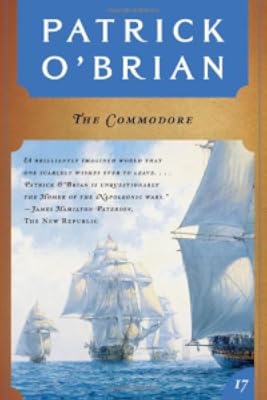
The Commodore, Patrick O’Brian’s seventeenth book in his Aubrey-Maturin series, picks up shortly after the events of The Wine-Dark Sea, with Captain Jack Aubrey and Stephen Maturin aboard the Surprise finally returning home to England. Though they had been looking forward to home, they find things changed in their absence. Stephen’s wife, Diana, has given birth to their daughter Brigid, but the girl appears to have developmental disabilities. This triggers a depressive episode in Diana, who goes to visit family, leaving the child in the care of Clarissa Oakes. Jack, for his part, becomes jealous of the time his wife Sophie spends visiting the local priest, Mr. Hinksey, while Sophie becomes jealous of Clarissa Oakes after seeing show more that he gave both women a similar bolt of silk. Before things can get much worse, he must depart to head a squadron going to the African coast in order to disrupt the slave trade. Along the way, Stephen hides Clarissa Oakes and his assistant Padeen in Spain, along with his daughter, since the pardons he had expected for both are being delayed by a royal with connections to France.
The majority of the novel focuses on events off the African coast, where Jack and Stephen, both morally opposed to slavery, encounter the conditions on slave ships for the first time. Their orders were to disrupt the trade as loudly as possible, both to make an example, and in order that their secret plans to attack a French and American convoy heading to Ireland to arm the locals against the English will go unnoticed by French intelligence. O’Brian contrasts this with the other time Aubrey was part of a squadron, in The Ionian Mission. Like that work, having a number of ships at sea together makes it possible to tell a character-driven story against a backdrop similar to a small town, with various temperaments and conflicts. Unlike The Ionian Mission, in which the squadron was on blockade duty, here they have missions taking them around the coast of West Africa and back to Ireland, so there is more action for the characters and for the reader.
Like the previous ten novels, The Commodore exists outside the normal flow of time – this novel being the eleventh and final book to exist in what O’Brian described as an extended 1812, with these books taking place between the beginning of June 1813 and November 1813. Further, this concludes the circumnavigation of the globe that began in The Thirteen Gun Salute. Those looking for a perfect chronology are advised to simply enjoy the story and the way in which O’Brian perfectly recreates the world of the Napoleonic Wars, using Aubrey and Stephen’s activities to comment on the rapid changes occurring in this era and the passage of time in the series’ internal chronology. This Folio Society edition reprints the original text with insets containing historical portraits and sketches to illustrate some of the scenes. show less
The majority of the novel focuses on events off the African coast, where Jack and Stephen, both morally opposed to slavery, encounter the conditions on slave ships for the first time. Their orders were to disrupt the trade as loudly as possible, both to make an example, and in order that their secret plans to attack a French and American convoy heading to Ireland to arm the locals against the English will go unnoticed by French intelligence. O’Brian contrasts this with the other time Aubrey was part of a squadron, in The Ionian Mission. Like that work, having a number of ships at sea together makes it possible to tell a character-driven story against a backdrop similar to a small town, with various temperaments and conflicts. Unlike The Ionian Mission, in which the squadron was on blockade duty, here they have missions taking them around the coast of West Africa and back to Ireland, so there is more action for the characters and for the reader.
Like the previous ten novels, The Commodore exists outside the normal flow of time – this novel being the eleventh and final book to exist in what O’Brian described as an extended 1812, with these books taking place between the beginning of June 1813 and November 1813. Further, this concludes the circumnavigation of the globe that began in The Thirteen Gun Salute. Those looking for a perfect chronology are advised to simply enjoy the story and the way in which O’Brian perfectly recreates the world of the Napoleonic Wars, using Aubrey and Stephen’s activities to comment on the rapid changes occurring in this era and the passage of time in the series’ internal chronology. This Folio Society edition reprints the original text with insets containing historical portraits and sketches to illustrate some of the scenes. show less
I had not realized it had been at least four years since I had read an installment of the Aubrey/Maturin series. I had intentionally slowed down, not wanting the series to end. Though it had been years, the experience of reading The Commodore was like running into an old and dear friend - great comfort combined with great joy, as if the years had never intervened.
Jack Aubrey and Stephen Maturin are each incredible characters, with their longstanding friendship creating a third. It is all here again - the shared meals, the music, the respect for the strengths of the other, and the playful jabs regarding each other's foibles. The Commodore does not disappoint.
The story takes us from England to Africa then on to Ireland, with the usual mix show more of personal stories of Aubrey and Maturin (some marital concerns for each), sea battles (against slavers off Africa and the French off Ireland), and political intrigue. As with all, it is well written and leaves one ready to tackle the next adventure after savouring the last. show less
Jack Aubrey and Stephen Maturin are each incredible characters, with their longstanding friendship creating a third. It is all here again - the shared meals, the music, the respect for the strengths of the other, and the playful jabs regarding each other's foibles. The Commodore does not disappoint.
The story takes us from England to Africa then on to Ireland, with the usual mix show more of personal stories of Aubrey and Maturin (some marital concerns for each), sea battles (against slavers off Africa and the French off Ireland), and political intrigue. As with all, it is well written and leaves one ready to tackle the next adventure after savouring the last. show less
Another intensely pleasing installment, a little quieter than a lot of the novels, but still full of the same wonderful dialogue and character interaction. I will admit to sniffling just a little over the scenes between Stephen and Brigid at the beginning; my heart broke for him, as it did frequently throughout the rest of the novel, when he seemed so likely to give into depressed spirits and to drugs. Not a happy book for either of the boys, really, though I trust most of it will be resolved. How does one spell 'peccavi', Jack, indeed.
A more somber and reflective Aubrey & Maturin novel.: The seventeenth installment of the Aubrey/Maturin series is vintage O'Brian. Those who seek mere relentless thrills and action will be disappointed. By contrast, those who enjoy a novel that flawlessly fuses historically accurate fleet actions in the Age of Sail with meditations on the nature of friendship, love, fine music, literature, wine and all that makes life worth living will come away as fulfilled as could be expected from any book in this wonderful series.
"The Commodore" finds Captain Jack Aubrey, R.N., and his friend Stephen Maturin, back in England after a prolonged, around-the-world voyage. For both, their respective home-comings are, at best bittersweet. Though show more substantially enriched from their last expedition, the two friends must confront personal and family challenges that are awkward at best, and, in Stephen's case, painful at worst. Over a decade has passed since the naval officer and the medical doctor/naturalist/intelligence agent had met in Port Mahon just before the Peace of Amiens. Sixteen novels later, in the waning months of the Napoleonic wars, we find them not only older, but more reflective and serious. Jack is now a Commodore, commanding a powerful squadron and charged with a complicated dual mission that will take him from England to the coast of West Africa and later, to the shores of Ireland. Stephen, his private life as complicated as ever, finds himself enmeshed in intelligence-related intrigues that threaten to reach far, far too close to home. For all that, the novel's dominant ambiance is never opressive. True to form, O'Brian provides his readers with plenty of flashes of humor and levity that pierce the somber clouds that now and again gather over the heads of the protagonists. There is a happy ending -- of sorts. As is always the case in the Aubrey/Maturin novels, the nature of happiness is always somewhat ambivalent, perhaps fleeting. But, then again, is that not true in real life?
show less
"The Commodore" finds Captain Jack Aubrey, R.N., and his friend Stephen Maturin, back in England after a prolonged, around-the-world voyage. For both, their respective home-comings are, at best bittersweet. Though show more substantially enriched from their last expedition, the two friends must confront personal and family challenges that are awkward at best, and, in Stephen's case, painful at worst. Over a decade has passed since the naval officer and the medical doctor/naturalist/intelligence agent had met in Port Mahon just before the Peace of Amiens. Sixteen novels later, in the waning months of the Napoleonic wars, we find them not only older, but more reflective and serious. Jack is now a Commodore, commanding a powerful squadron and charged with a complicated dual mission that will take him from England to the coast of West Africa and later, to the shores of Ireland. Stephen, his private life as complicated as ever, finds himself enmeshed in intelligence-related intrigues that threaten to reach far, far too close to home. For all that, the novel's dominant ambiance is never opressive. True to form, O'Brian provides his readers with plenty of flashes of humor and levity that pierce the somber clouds that now and again gather over the heads of the protagonists. There is a happy ending -- of sorts. As is always the case in the Aubrey/Maturin novels, the nature of happiness is always somewhat ambivalent, perhaps fleeting. But, then again, is that not true in real life?
show less
Jack and Stephen are at it again, this time with Jack in command of a small fleet of ships charged with breaking up the enemy slave trade. But Jack and Stephen are both dealing with grave personal matters. Jack has had a blowup with the wife over his perennial infidelity, and Stephen has returned to find his only child is autistic and his wife has vanished in disgrace.
One of the pleasures of reading a series this long, covering this many years, is that as the characters grow older, so do we. Stephen loses his hair. Jack is constantly battling his weight. They both succumb to dangerous wounds and illnesses. They are jealous over their wives' behavior. They are thoroughly recognizable people, living in the world of the British navy during the Napoleonic wars.
It is time for the men to return home to their families. Sophie is a paragon of wisdom, but shows her temper. The children have the vocabulary of seasoned sailors. Stephen rushes to meet his daughter for the first time. Mrs. Oakes has been raising Brigit and Padeen does the girl a world of good when she is slow of speech.
At Ashgrove, Aubrey's show more estate, Stephen comes upon Jack in the middle of the night playing the violin brilliantly and realizes that Jack holds back when he plays with Stephen. Later we learn the poignant reason for Jack's melancholy music that night.
After years at sea, many missions accomplished, Jack's disgrace long behind him, he is given the rank of commodore, commander of a squadron of ships, and Stephen as always gathers the intelligence that will make his mission more sure to be successful.
The mission is to stop the slave trade off the coast of Africa. Jack, laboring under his hero, Nelson's, view that without the slave economy, Britain would lose her luster, is not convinced of the soundness of the campaign, and it is a testament to the men's friendship that Stephen who abhors slavery for the crime that it is, does not jump all over such blathering but reasons with him about it. When Jack sees the conditions and squalor first hand, he goes at the mission with greater spirit.
But he would rather be fighting Napoleon, and is spoiling for a sea battle against the French who approach Ireland as a place to foment revolution.
In this book, as in others in the series, we learn of the exotic species under Stephen's study. A potto not to be confused with a potoo is a tiny delicate monkey that could fit in your palm. When Stephen brings it on board, the ship experiences all sorts of luck.
show less
It is time for the men to return home to their families. Sophie is a paragon of wisdom, but shows her temper. The children have the vocabulary of seasoned sailors. Stephen rushes to meet his daughter for the first time. Mrs. Oakes has been raising Brigit and Padeen does the girl a world of good when she is slow of speech.
At Ashgrove, Aubrey's show more estate, Stephen comes upon Jack in the middle of the night playing the violin brilliantly and realizes that Jack holds back when he plays with Stephen. Later we learn the poignant reason for Jack's melancholy music that night.
After years at sea, many missions accomplished, Jack's disgrace long behind him, he is given the rank of commodore, commander of a squadron of ships, and Stephen as always gathers the intelligence that will make his mission more sure to be successful.
The mission is to stop the slave trade off the coast of Africa. Jack, laboring under his hero, Nelson's, view that without the slave economy, Britain would lose her luster, is not convinced of the soundness of the campaign, and it is a testament to the men's friendship that Stephen who abhors slavery for the crime that it is, does not jump all over such blathering but reasons with him about it. When Jack sees the conditions and squalor first hand, he goes at the mission with greater spirit.
But he would rather be fighting Napoleon, and is spoiling for a sea battle against the French who approach Ireland as a place to foment revolution.
In this book, as in others in the series, we learn of the exotic species under Stephen's study. A potto not to be confused with a potoo is a tiny delicate monkey that could fit in your palm. When Stephen brings it on board, the ship experiences all sorts of luck.
show less
Members
- Recently Added By
Lists

Folio Society
831 works; 53 members

Huxley's Reading Log 2020
24 works; 1 member

Books Read in 2018
4,360 works; 110 members
Author Information

Patrick O'Brian is the author of twenty volumes in the highly respected Aubrey/Maturin series of novels. (Publisher Provided) Patrick O'Brien was born in Ireland in 1914. His education included the Sorbonne. O'Brian has produced a variety of works, including biographies of Picasso and Sir Joseph Banks and translations of the novels and memoirs of show more Simone de Beauvoir, but he is best known for the creation of an unlikely pair of Napoleonic War-era heroes in the Aubrey-Maturin Series. British naval officer Jack Aubrey and Irish scholar and physician Stephen Maturin have been featured in more than a novels published in Great Britain (five of which have also appeared in America). He died on January 2, 2000. (Bowker Author Biography) show less
Some Editions
Awards and Honors
Distinctions
Series

Work Relationships
Is contained in
Is abridged in
Common Knowledge
- Canonical title
- The Commodore
- Original publication date
- 1994
- People/Characters
- Jack Aubrey; Stephen Maturin; Clarissa Oakes; Tom Pullings; Sophie Aubrey; Diana Villiers (show all 20); Padeen Colman; Preserved Killick; Barrett Bonden; Brigid Maturin; Dick Richardson; Emily Sweeting; Sarah Sweeting; Joe Plaice; Mrs. Williams; Charlotte Aubrey; Fanny Aubrey; George Aubrey; Heneage Dundas; Sir Joseph Blaine
- Important places
- Atlantic Ocean
- Publisher's editor
- Lawrence, Starling
Classifications
Statistics
- Members
- 2,739
- Popularity
- 6,772
- Reviews
- 25
- Rating
- (4.15)
- Languages
- 6 — Czech, English, French, German, Italian, Spanish
- Media
- Paper, Audiobook, Ebook
- ISBNs
- 53
- ASINs
- 19