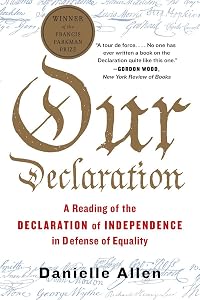
Our Declaration: A Reading of the Declaration of Independence in Defense of Equality
by Danielle S. Allen
On This Page
Description
Allen makes the case that we cannot have freedom as individuals without equality among us as a people. Evoking the colonial world between 1774 and 1777, Allen describes the challenges faced by John Adams, Thomas Jefferson, Benjamin Franklin, Roger Sherman, and Robert Livingston--the "Committee of Five" who had to write a document that reflected the aspirations of a restive population and forge an unprecedented social contract. Although the focus is usually on Jefferson, Allen restores credit show more not only to John Adams and Richard Henry Lee but also to clerk Timothy Matlack and printer Mary Katherine Goddard. Allen also restores the text of the Declaration itself. Its list of self-evident truths does not end with our individual right to the "pursuit of happiness" but with the collective right of the people to reform government so that it will "effect their Safety and Happiness." The sentence laying out the self-evident truths leads us from the individual to the community--from our individual rights to what we can achieve only together, as a community constituted by bonds of equality. show lessTags
Recommendations




Member Reviews
One of the questions we ask people as part of the #thisismilwaukee project is this: “What is democracy for you?” The “for you” part is our attempt to get beyond the textbook definitions and get at how Milwaukeeans connect with the idea of democracy, how it is part of their lives and stories. It is a seemingly simple question without easy answers. Danielle Allen’s “Our Declaration,” recommended to us by Arijit Sen, is a close read of that most fundamental of documents and an enlightened work of scholarship around this very question. There is so much in those 1,337 words, a plumb line against which we can judge society and ourselves. One of the lingering questions is about how a society founded so squarely on the notion show more equality could be and remain so persistently unequal. Or, put another way, in the language of Hannah Arendt: How could our country comply with terror and genocide for so long? Allen shares a vision of democracy as the co-creation and co-ownership of a shared world, one in which liberty and equality are not at war with each other. So much of the work of democracy is done, she also details, through the craft of storytelling and political conversation among Americans whose experiences and critiques of their government should hold equal weight. "Our Declaration" is part on our #thisismilwaukee reading list. More about this from me and Kevin Miyazaki soon. show less
A great read! The author emphasizes the political philosophy and downplays the history. Very lucid and interesting discussion of the different aspects of equality present in the document. The author handles the failure to implement the ideals extolled in the document very well, I think. I recommend this for everyone to read.
Well crafted sentences and paragraphs to dissect a fairly short (1,337 word) document. The premier of freedom and equality being the twins upon which the document and ultimately the Constituion lie was well presented. BThe short chapters were appealing when I commenced reading, but became tiresome about a third of the way through.
5341. Our Declaration A Reading of the Declaration of Independence in Defense of Equality, by Danielle Allen (read 9 Jan 2016) (Parkman Prize for 2015) This is a detailed study of the Declaration of Independence, taking it sentence by sentence. It aims to show that equality was as important to its authors as freedom. Other than decrying the expungement from the Declaration of lines decrying slavery--which Jefferson had put in his draft--it is laudatory of the document and of the men who signed.it. I read it because it won the 2015 Parkman prize and it is the 24th such winner I have read. But the Prize has been awarded for the last 59 years (the first one was awarded in 1957) so you can see that I have a lot more of the winners to read. show more Most of the winners that I have read I have enjoyed more than I did this one, but I suppose that is because I am more interested in history than in political theory. show less
Ratings
Members
- Recently Added By
Lists

Books Read in College
80 works; 5 members
Author Information

20+ Works 703 Members
Danielle S. Allen is Assistant Professor of Classics at the University of Chicago.
Awards and Honors
Common Knowledge
- Original publication date
- 2014
- Important events
- American Revolution
Classifications
Statistics
- Members
- 278
- Popularity
- 116,051
- Reviews
- 5
- Rating
- (4.10)
- Languages
- English
- Media
- Paper, Audiobook, Ebook
- ISBNs
- 7
- ASINs
- 3