On This Page
Description
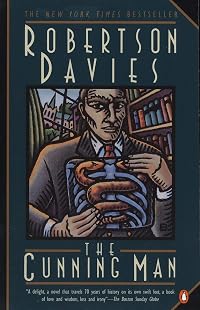
Dr. Hullah was a man who lived on the outside, concealing his nature and observing humanity. As he takes us through his long and varied life in the theatre, the army, and the consulting room, he focuses on the comedic canvas of life.Tags
Recommendations


















Member Recommendations
Member Reviews
We're in classic Robertson Davies country here, middle-class Toronto between the 1920s and the 1980s, with a cast of actors, musicians, artists, journalists and High Anglican priests and a mock-Trollope plot involving an Archdeacon at war with a parish that has been overdoing the bells-and-smells. In the middle of it all is our narrator Jonathan Hullah, a physician who believes — as I suspect most physicians do — that he has far better insight than his colleagues into his patients' problems. He attributes this superior ability partly to his reading of The anatomy of melancholy and partly to a childhood encounter with a Native-American healer and some snakes.
As we would expect, there's a strong whiff of Faustian bargains and black show more magic hanging around in the background, whilst the foreground story is full of people who start out with great promise and ambitious plans and end up in Canadian mediocrity, carving statues of the Queen Mother out of Ontario Creamery Butter. Hullah, of course, learns the limitations of his medical cunning. I don't think Davies can have been very happy when he wrote this, but there's a lot of fine sardonic humour here for the reader to enjoy, all the same. show less
As we would expect, there's a strong whiff of Faustian bargains and black show more magic hanging around in the background, whilst the foreground story is full of people who start out with great promise and ambitious plans and end up in Canadian mediocrity, carving statues of the Queen Mother out of Ontario Creamery Butter. Hullah, of course, learns the limitations of his medical cunning. I don't think Davies can have been very happy when he wrote this, but there's a lot of fine sardonic humour here for the reader to enjoy, all the same. show less
Masterful writing...which is why I read Robertson Davies. Even when characters digress into philosophical discussions, I feel as if I am in on a conversation among friends. Great characters and so many thought-provoking ideas! This one, however, is not my favourite as I found much of the humour rather juvenile.
I really liked the opening narrative "hook" in the first paragraph of this, the last novel of Canadian master Robertson Davies. "Should I have taken the false teeth? In my years as a police surgeon I would certainly have done so; who can say what might be clinging to them, or in the troughts that fit over the gums?" But unfortunately reading the next 470 pages turned out to be quite a long haul. Perhaps Davies - who was in his ninth decade when "The Cunning Man" was published, was simply unable to gather together all the diverse threads of what had the potential to be another magnificent tapestry in the manner of "The Salterton Trilogy."
This book is told almost entirely through the first person narrator Dr. Jonathan Hullah. (The show more letters from a lesbian artist who is Dr. Hullah's neighbor are a welcome break, even if it is never properly explained how they came to be part of his text.)
My problems with the book are largely based on the fact that I found Hullah to be basically unbelievable as a character and as a witness to the events and personalities he describes. He comes across - whatever Davies' intentions - as a bore and prig, rather intelligent in many ways but full of deceit about others and about himself. I kept on hoping that he would receive his "comeuppance" but alas it never came.
(This could be a "textbook" example of the difficulty of writing a novel of significant length with an utterly unreliable narrator. By contrast, I think Iris Murdoch managed to pull it off in what may be her finest book, "The Sea, The Sea.")
This book is nonetheless of some interest as a summary of Robertson Davies' literary and cultural creed, and includes some amusing bits about religion, theatre, and provincial society - even if he does "lay it on a bit thick" at times. Interesting for what Davies had to say about Toronto, and Canada! Definitely a "late" work, though. show less
This book is told almost entirely through the first person narrator Dr. Jonathan Hullah. (The show more letters from a lesbian artist who is Dr. Hullah's neighbor are a welcome break, even if it is never properly explained how they came to be part of his text.)
My problems with the book are largely based on the fact that I found Hullah to be basically unbelievable as a character and as a witness to the events and personalities he describes. He comes across - whatever Davies' intentions - as a bore and prig, rather intelligent in many ways but full of deceit about others and about himself. I kept on hoping that he would receive his "comeuppance" but alas it never came.
(This could be a "textbook" example of the difficulty of writing a novel of significant length with an utterly unreliable narrator. By contrast, I think Iris Murdoch managed to pull it off in what may be her finest book, "The Sea, The Sea.")
This book is nonetheless of some interest as a summary of Robertson Davies' literary and cultural creed, and includes some amusing bits about religion, theatre, and provincial society - even if he does "lay it on a bit thick" at times. Interesting for what Davies had to say about Toronto, and Canada! Definitely a "late" work, though. show less
It's been so long since I read [The Fifth Business] that I forgot what a wonderful writer Robertson Davies can be. So, I went into this one suspecting I might not finish it, but was hooked with the first line, which is pretty good one.
The story is narrated by Dr. Hullah, written in his notebooks as he reminisces over his life to prepare to joust with a journalist. The journalist is an in-law of sorts, a young whipper-snapper, who wants the beyond the curtain on Toronto life. And wants to frame it around the unexpected death of a priest. But Dr. Hullah doesn't want to give the goods, and suspects there was more than meets the eye with the priest's death.
Overall, the book is a meditation on a particular life lived, and all the multitudes show more of interactions and relationships that entails. Davies slips the mystery by you without notice and then yanks the rug from you at the ending revealing it all. Good ol' fashioned literature at its best.
4 bones!!!!
Recommended show less
The story is narrated by Dr. Hullah, written in his notebooks as he reminisces over his life to prepare to joust with a journalist. The journalist is an in-law of sorts, a young whipper-snapper, who wants the beyond the curtain on Toronto life. And wants to frame it around the unexpected death of a priest. But Dr. Hullah doesn't want to give the goods, and suspects there was more than meets the eye with the priest's death.
Overall, the book is a meditation on a particular life lived, and all the multitudes show more of interactions and relationships that entails. Davies slips the mystery by you without notice and then yanks the rug from you at the ending revealing it all. Good ol' fashioned literature at its best.
4 bones!!!!
Recommended show less
Robertson Davies is more than just a good storyteller. He is a literate storyteller who fills his novels with references to literature, music, art and science and does so in an engaging way while creating characters that are so interesting that it is difficult to put the book down. At least that has been my experience and my only regret is that I have read so few of his novels.
The Cunning Man is a clever story, part mystery, part bildungsroman, part family saga and a bit of a romance, that keeps you reading to find out how the life of Jonathan Hullah, the cunning and wise doctor at the center of the book, will turn out and how those of the characters whose drama fills his life will also conclude. The doctor is a cunning man in the show more sense used by Robert Burton in his The Anatomy of Melancholy, a seventeenth century compendium of information about the subject of melancholy. Thus the cunning man is a sort of wizard who is as much a doctor of the soul as he is a doctor of the body. From Dr. Hullah's early days learning from a wise Indian woman called Mrs. Smoke through his years in medical school and as medic in the army he develops both expertise in traditional medicine and sometimes mysterious abilities to look into his patients' souls. The result makes for a unique career. Throughout the story the reader is treated to the differences between high and low church Anglicanism, how one deals with a journalist in the family and, most of all, how the cunning man spins his web of masterful medicine through it all. show less
The Cunning Man is a clever story, part mystery, part bildungsroman, part family saga and a bit of a romance, that keeps you reading to find out how the life of Jonathan Hullah, the cunning and wise doctor at the center of the book, will turn out and how those of the characters whose drama fills his life will also conclude. The doctor is a cunning man in the show more sense used by Robert Burton in his The Anatomy of Melancholy, a seventeenth century compendium of information about the subject of melancholy. Thus the cunning man is a sort of wizard who is as much a doctor of the soul as he is a doctor of the body. From Dr. Hullah's early days learning from a wise Indian woman called Mrs. Smoke through his years in medical school and as medic in the army he develops both expertise in traditional medicine and sometimes mysterious abilities to look into his patients' souls. The result makes for a unique career. Throughout the story the reader is treated to the differences between high and low church Anglicanism, how one deals with a journalist in the family and, most of all, how the cunning man spins his web of masterful medicine through it all. show less
The entire story is framed as a newspaper interview that causes the elderly narrator, Dr. Jon Hullah, to remember his life through anecdotes and philosophical discussion much of it told in a gossipy tone. He delved into many topics: church, war, sex, family, medicine, even a joke told to him by an acquaintance that he recognized as a retelling of a Rabelais story. He lost my interest in a few spots, but was otherwise fascinating. This is a terrific accomplishment for Davies that came to be his unplanned last hurrah.
I quite liked most of this book. It was witty and clever, very Robertson Davies and very true to Toronto (and Sioux Lookout, for that matter). However, the denouement was disappointing. We know from the first page of the book that there may have been something questionable about the death of poor old Father Hobbes, but when the mystery is finally wrapped up it's too blatant. I was expecting something more subtle and morally ambiguous, worthy of Davies's genius and the gorgeous milieu of St. Aiden's.
Members
- Recently Added By
Published Reviews
ThingScore 75
"This is a wise, humane and consistently entertaining novel. Robertson Davies's skill and curiosity are as agile as ever, and his store of incidental knowledge is a constant pleasure. Long may he continue to divert us."
added by GYKM
Lists

Pleasant Surprises: Books That Exceeded Our Expectations
418 works; 143 members
Talk Discussions
Past Discussions
Davies - The Toronto Trilogy - discussion in Literary Centennials (December 2012)
Author Information

90+ Works 24,798 Members
William Robertson Davies was born in Thamesville, Ontario in 1913. He taught English at the University of Toronto and was an actor, journalist, and newspaper editor before winning acclaim as a novelist with Tempest-Tost, the first of his Salterton trilogy. His most famous trilogy, The Deptford Trilogy--Fifth Business, The Manticore, and World of show more Wonders--develops the earlier Salterton novels. The locale is a fictitious Ontario city that prizes its English tradition, including the Anglican Church and the genealogy of the old families. Robertson's novels have been translated into approximately 20 languages. His masterful story-telling encompasses such issues as evil, love, fear, tradition, and magic as he brings his characters to life with wisdom and humor. Robertson Davies died in 1995. (Bowker Author Biography) Robertson Davies (1913-1995) had three successive careers during the time he became an internationally acclaimed author: first as an actor with the Old Vic Company in England; then as publisher of "The Peterborough Ontario Examiner"; & finally as professor & first master of Massey College at the University of Toronto. With twelve novels & several volumes of essays & plays to his credit, Davies was the first Canadian to be inducted to the American Academy & Institute of Arts & Letters. His last novel, "The Cunning Man" (Viking 1995), was a national bestseller. (Publisher Provided) show less
Some Editions
Awards and Honors
Distinctions
Notable Lists
Series

Belongs to Publisher Series
Keltainen kirjasto (301)
Common Knowledge
- Canonical title
- The Cunning Man
- Original title
- The Cunning Man
- Original publication date
- 1994
- People/Characters
- Jonathan Hullah; Dunstan Ramsay
- Important places
- Toronto, Ontario, Canada
- Epigraph
- Cunning men, wizards, and white witches, as they call them, in every village, which, if they be sought unto, will help almost all infirmities of body and mind.... The body's mischief's, as Plato proves, proceed from the soul:... (show all) and if the mind be not first satisfied, the body can never be cured.
Robert Burton The Anatomy of Melancholy (1621) - Dedication
- For Brenda, and our daughters Miranda, Jennifer and Rosamond
- First words
- Should I have taken the false teeth?
- Quotations
- In my experience snobbery sometimes means no more than a rejection of what is truly inferior, and if mankind had never been fastidious I do not suppose that haute cuisine would ever have displaced hunks of meat parched over a... (show all) smoky fire.
My great book I had decided to call The Anatomy of Fiction ... It would, of course, be a work of extrapolation, working from the known, as given by the author about an imaginary (but not therefore unreal) character, to well-r... (show all)esearched and intelligently guessed-at elements which the author was probably aware of but which the conventions of his time did not permit him to describe. As a doctor, I could not conceive that he might have chosen to omit such details from reasons of literary choice; surely the health, physical state, and living conditions of his characters would be of absorbing interest to him? ... A commentary, a sort of footnote to that part of the Divine Drama in which Fiction has a place.
Why did Micawber lose his hair? Want of kerotin? ... What did Jane Eyre, as a governess in a gentleman's house, get to eat? ... What conclusions can we draw about the menstrual cycle of Emma Bovary? How did Nana avoid having ... (show all)babies? ... Only a partial estimate can be made of the quality of a life unless we know something about the defecatory habits of the patient. ... What was the condition of Miss Havisham's bowels, sitting all day in a wheelchair as she did? Intestinal stasis can have a profound influence on the personality. ... many women in fiction spent a great part of their life on sofas. Why? What ailed them? ... To deal with the Boozer in Lit. would mean that I should have to embark on a work of many volumes.... What do people die of, in fiction? Children frequently ... have no clear symptoms, and seem to die of Ingrowing Virtue. Would it be possible to define in broad medical terms something that could be called Heroine's Disease ...?"
Because of that duplicitous little miss Ellen Ternan, Dickens managed to make an astonishing number of people other than himself miserable, and unlike Ibsen or Trollope [who also fell for much younger women] he wanted a physi... (show all)cal fulfilment of his daft passion. Whether he got it or not remains a mystery; photographs of Miss Ternan do not suggest a passionate or even a normally warm nature. - Last words
- (Click to show. Warning: May contain spoilers.)"No, this is the Great Theatre of Life. Admission is free but the taxation is mortal. You come when you can, and leave when you must. The show is continuous. Good-night."
Classifications
Statistics
- Members
- 1,668
- Popularity
- 13,478
- Reviews
- 30
- Rating
- (3.87)
- Languages
- 7 — English, Finnish, French, German, Greek, Spanish, Swedish
- Media
- Paper, Audiobook, Ebook
- ISBNs
- 36
- ASINs
- 10