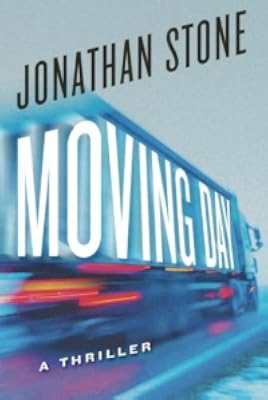
Moving Day: A Thriller
by Jonathan Stone
On This Page
Description
Forty years' accumulation of art, antiques, and family photographs are more than just objects for Stanley Peke--they are proof of a life fully lived. When a con man steals his houseful of possessions in a sophisticated moving-day scam, Peke wanders helplessly through his empty New England home, inevitably reminded of another helpless time: decades in Peke's past, a cold and threadbare Stanislaw Shmuel Pecoskowitz eked out a desperate existence in the war-torn Polish countryside.Tags
Recommendations


























Member Reviews
Moving Day is an exciting action novel on one level and an interesting philosophical discussion on another. The main theme is the contrast of light and dark, good and evil, maturation and regression. The story concerns the retirement of a 72 year old Jewish survivor of the Holocaust in Poland and his decision with his wife to sell their lovely home in New England and move to a simpler life on the West Coast. Peke, Stanislaw Shmuel Pecoskowitz, is a fortunate survivor of Nazi atrocities who has repressed his memories of survival as a 7 year old hiding from the evil of a nation gone mad. Peke was able to travel to the United States after World War II and through hard work and willingness to assume financial risk, rise to upper class show more status and economic success. Valuable possessions were tangible symbols of his survival, achievement, and success.
When his possessions are taken from him, Peke is forced to change his plans from movement to action in a 21st Century social context. Life appeared to be stable in America given his achievements, but his loss brings up strong repressed emotions related to his childhood survival in a context of the Holocaust. Although the elderly man never developed an association with Jewish religious beliefs, his identity as a member of a race of people targeted for annihilation persisted for his entire life. Now, as Peke seeks his stolen possessions, he is confronted by strong feelings of rage and fear that he thought were resolved by the hard work and accomplishments of his adult life. In terms of Erik Erikson, the 72 year old man is confronted with the task of reviewing his life in terms of a dichotomy: Ego Integrity (light, good, maturation) vs Despair (darkness, evil, regression).
Peke is physically fit and, although forgetful in minor ways, fully functioning as an intelligent and thoughtful person. He takes action, in contrast to movement, and reworks his memories from a standpoint of elderly wisdom to attempt to gain a greater understanding of his lifetime motivations, decisions, and identity. Ultimately, as a Jewish man, Peke must choose to act on the basis of a unifying philosophy of Ego Integrity or the personal chaos of Despair.
I thoroughly enjoyed reading this novel and identified with Peke in his experiences of vulnerability in our current society and the necessity of calling on survival strengths and resolving dilemmas of weaknesses carried over from past personal decisions. I give this novel my highest recommendation to all but particularly to elderly readers. show less
When his possessions are taken from him, Peke is forced to change his plans from movement to action in a 21st Century social context. Life appeared to be stable in America given his achievements, but his loss brings up strong repressed emotions related to his childhood survival in a context of the Holocaust. Although the elderly man never developed an association with Jewish religious beliefs, his identity as a member of a race of people targeted for annihilation persisted for his entire life. Now, as Peke seeks his stolen possessions, he is confronted by strong feelings of rage and fear that he thought were resolved by the hard work and accomplishments of his adult life. In terms of Erik Erikson, the 72 year old man is confronted with the task of reviewing his life in terms of a dichotomy: Ego Integrity (light, good, maturation) vs Despair (darkness, evil, regression).
Peke is physically fit and, although forgetful in minor ways, fully functioning as an intelligent and thoughtful person. He takes action, in contrast to movement, and reworks his memories from a standpoint of elderly wisdom to attempt to gain a greater understanding of his lifetime motivations, decisions, and identity. Ultimately, as a Jewish man, Peke must choose to act on the basis of a unifying philosophy of Ego Integrity or the personal chaos of Despair.
I thoroughly enjoyed reading this novel and identified with Peke in his experiences of vulnerability in our current society and the necessity of calling on survival strengths and resolving dilemmas of weaknesses carried over from past personal decisions. I give this novel my highest recommendation to all but particularly to elderly readers. show less
Moving Day is a thriller, a psychological thriller, about a theif who likes to annihilate his victims and what happens when he accidently choses as his next victim a man who refuses to accept his fate, a man psychologically driven by forces he himself can't fully comprehend, to fight annihilation with all of his being. This was the book I should have chosen as my Kindle First choice for May. It is a good book, as it explores the way the theft of all his worldy goods sends Stanley Peke, a man who literally arrived in this country as a boy with nothing after losing everything to the Nazis, a man who made a very successful life for himself, on a path into his past and parts of his psyche that he has suppressed for decades. I thought it was show more compelling and for the most part well-done. I am not informed enough about psychology to know how accurately Peek is portrayed, but many parts of his story resonated with me in a way that I could see as true, at least for some people. The use of sentence fragments could at times be moving, as Peek came to terms with bits or fragments, of memory, but the author fell back on this technique far too often, so that over time, what seemed filled with meaning became simply annoying. Still I enjoyed the book, and was driven to finish. I would be surprised however if this book stood up to a second reading. show less
There are thrillers that focus primarily on plot, narratives that, by in large, burn fast and hot and fizzle out quickly. And these can often be very enjoyable, the literary equivalent of eating a Big Mac when you’re hungry: it’s fast, tastes great . . .but it leaves you hungry again half an hour later.
And then there are slow-burning, perspective-shifting thrillers like Moving Day by Jonathan Stone. This novel is equal parts crime thriller and (unintended) master class in fiction writing. But more on that later. First: the plot.
Peke is a wealthy seventy-two year old retiree who is moving from New York to the beaches of Santa Barbara, California, and on the day before the scheduled move, a seemingly legitimate moving company shows show more up and transports his belongings to the new home. But then the following day, the actual movers show up, and Peke and his wife realize they’ve been robbed. Peke, a Holocaust survivor, manages to track his down his belongings and recovers them. Nick, the sadistic thief behind the caper, then raises the stakes by kidnapping Peke in exchange for the stolen goods. What I dig about this plot is the utter low-tech-ness of the crime itself. Nick is that unicorn rare criminal who has intelligence, patience, and discipline, which makes him the perfect adversary to Peke, who also possesses those qualities.
For my money, the character development and the never-ending supply of brilliantly written passages are what make this book so satisfying. Stone manages to capture the internal worlds of a career criminal and a Holocaust survivor, and this frequent shifting of perspective adds layer upon layer of meaning to the narrative. Below I’ve quoted a few fantastic passages from the book, so you get an idea of what I’m writing about.
From a passage where Peke discovers outside the thief’s hideout a large pile of trash: “He feels that simple realization like a weight on him. Amid the exhilaration and excitement of retrieving his belongings, a sudden weight of brooding. . .This is where it will end up for the thief, too. Their odd communion. Meaninglessness piled high.”
From a passage where Peke remembers being in Poland evading the Nazis: “He watches the bug. . .He looks at it. Watches it scoot frantically around on his broad, ancient, creviced palm, looking for a path, an exit. . .Then, impulsively, he slaps the black bug into his mouth, bites down a few times, hears and feels the unmistakable crunch in his jaw, then swallows.”
Paragraphs like these are everywhere in this book, and Moving Day is worth reading for the pure joy of language alone.
Bottom line, this thriller inches along at a snail’s pace, builds the tension very, very slowly, yet very, very effectively. You live and breathe in Peke’s world, in Nick’s world, and that level of realism makes for a highly readable book. Put another way: Moving Day is no Big Mac, and Jonathan Stone is no short order cook. Moving Day is a complex entree with a multitude of tastes and textures, and Jonathan Stone is a master chef. show less
And then there are slow-burning, perspective-shifting thrillers like Moving Day by Jonathan Stone. This novel is equal parts crime thriller and (unintended) master class in fiction writing. But more on that later. First: the plot.
Peke is a wealthy seventy-two year old retiree who is moving from New York to the beaches of Santa Barbara, California, and on the day before the scheduled move, a seemingly legitimate moving company shows show more up and transports his belongings to the new home. But then the following day, the actual movers show up, and Peke and his wife realize they’ve been robbed. Peke, a Holocaust survivor, manages to track his down his belongings and recovers them. Nick, the sadistic thief behind the caper, then raises the stakes by kidnapping Peke in exchange for the stolen goods. What I dig about this plot is the utter low-tech-ness of the crime itself. Nick is that unicorn rare criminal who has intelligence, patience, and discipline, which makes him the perfect adversary to Peke, who also possesses those qualities.
For my money, the character development and the never-ending supply of brilliantly written passages are what make this book so satisfying. Stone manages to capture the internal worlds of a career criminal and a Holocaust survivor, and this frequent shifting of perspective adds layer upon layer of meaning to the narrative. Below I’ve quoted a few fantastic passages from the book, so you get an idea of what I’m writing about.
From a passage where Peke discovers outside the thief’s hideout a large pile of trash: “He feels that simple realization like a weight on him. Amid the exhilaration and excitement of retrieving his belongings, a sudden weight of brooding. . .This is where it will end up for the thief, too. Their odd communion. Meaninglessness piled high.”
From a passage where Peke remembers being in Poland evading the Nazis: “He watches the bug. . .He looks at it. Watches it scoot frantically around on his broad, ancient, creviced palm, looking for a path, an exit. . .Then, impulsively, he slaps the black bug into his mouth, bites down a few times, hears and feels the unmistakable crunch in his jaw, then swallows.”
Paragraphs like these are everywhere in this book, and Moving Day is worth reading for the pure joy of language alone.
Bottom line, this thriller inches along at a snail’s pace, builds the tension very, very slowly, yet very, very effectively. You live and breathe in Peke’s world, in Nick’s world, and that level of realism makes for a highly readable book. Put another way: Moving Day is no Big Mac, and Jonathan Stone is no short order cook. Moving Day is a complex entree with a multitude of tastes and textures, and Jonathan Stone is a master chef. show less
This is an epic struggle between a thief who loves to annihilate his victims, and a victim who refuses to give in to that fate. Although I wish there had been a bit more about Nick the thief in Moving Day, I realize that Stanley Peke is the real focus of this book; it is his story that must be told. As Stanley and his wife Rose drive across country to locate their stolen belongings, Stanley's past is slowly uncovered a bit at a time, and we see how his traumatic childhood has closed him off from everyone around him-- even the family he loves deeply.
Moving Day succeeds on so many levels: as the story of the theft and attempted recovery of valuable art and antiques, as the road trip tale of an elderly couple who've never seen the show more interior of the country, as a glimpse into how some people live their lives in remote sections of states like Montana, but most of all as a nuanced and deeply moving character study.
This is a compelling book that's marred by only one thing: the author's writing style relies far too much on sentence fragments. Sentence fragments work in small doses, but most pages of Moving Day have several. Sentence fragments that are lists, sentence fragments where the same phrase is repeated, or one word in the phrase is changed and then repeated. It almost became too much for me to deal with because those fragments chopped the flow of the narrative to pieces. But no matter how annoying it was, the story fascinated me, and I had to know what happened.
I'm glad I kept reading, and I'm glad I know what happened to Stanley and Rose. I just wish the experience hadn't been such a chore. show less
Moving Day succeeds on so many levels: as the story of the theft and attempted recovery of valuable art and antiques, as the road trip tale of an elderly couple who've never seen the show more interior of the country, as a glimpse into how some people live their lives in remote sections of states like Montana, but most of all as a nuanced and deeply moving character study.
This is a compelling book that's marred by only one thing: the author's writing style relies far too much on sentence fragments. Sentence fragments work in small doses, but most pages of Moving Day have several. Sentence fragments that are lists, sentence fragments where the same phrase is repeated, or one word in the phrase is changed and then repeated. It almost became too much for me to deal with because those fragments chopped the flow of the narrative to pieces. But no matter how annoying it was, the story fascinated me, and I had to know what happened.
I'm glad I kept reading, and I'm glad I know what happened to Stanley and Rose. I just wish the experience hadn't been such a chore. show less
This book really surprised me. With just the first few pages I was wondering how the author was going to fill all of the rest of the pages in the book---what could possibly happen? Nice surprise----it moved right along! Discovering who Peke is, for the reader as well as for Peke himself, is quite a story.
What a great premise! A elderly man and woman welcome movers to take a lifetime of treasures cross-country from New York to California. The movers show up a day before they thought they were expected, but chalk it up to their old age. Man and wife spend the night in their newly empty house, only to have the doorbell ring the next morning. It's the REAL movers.
The story was fast-moving and easy to read. The protagonist, Peke, has a past that has prepared him to retrieve his possessions, which is exactly what he intends to do. Despite his age, he is sharp in his mind and fast on his feet.
Surrounded by a cast of interesting characters, and equally bad villians, the only reason to give this a middle-of-the-road three looks is the show more writing. I found the writing to be loose and redundant. Stone seemed to make the same point over and over, and it weighed down the flow of the storytelling. It was a nice read, and had a satisfying ending, though. I will read another by this author, and do recommend it simply for the intriguing premise. show less
The story was fast-moving and easy to read. The protagonist, Peke, has a past that has prepared him to retrieve his possessions, which is exactly what he intends to do. Despite his age, he is sharp in his mind and fast on his feet.
Surrounded by a cast of interesting characters, and equally bad villians, the only reason to give this a middle-of-the-road three looks is the show more writing. I found the writing to be loose and redundant. Stone seemed to make the same point over and over, and it weighed down the flow of the storytelling. It was a nice read, and had a satisfying ending, though. I will read another by this author, and do recommend it simply for the intriguing premise. show less
The con man does not know Stanley Peke. How could he? He picks his cons well and makes a lot of money from his ‘moving day’ scams. Nick is the master mind of the cons and they are easy for him. Most of his victims are old; trusting … and rich! Most of them never recover their goods. Most of them become helpless victims. Perhaps he should have investigated Stanley Peke a bit more. He would have found that Stanley Peke doesn’t let go of his goods that easily; Stanley Peke doesn’t just roll over and move on.
I found this story very interesting for many reasons. It pulls you in and keeps the interest going. Stanley Peke is painted as a somewhat odd. After a childhood as Stanislaw Shmuel Pecoskowitz in war-torn Poland and getting show more along on pitifully little, he comes to America and becomes very successful. Even after the thievery of all of their goods, Peke and his wife, Rose, have a comfortable journey across America. Rose is another oddity. She appears to be ‘old school’ – never questioning her husband; never pushing her own ideas. Does she really even know him after almost 50 years of marriage? Has he ever let her into his past?
Moving Day is Jonathan Stone’s fifth novel with a release date of Jun 1, 2014. Per Amazon’s author information page, it has been “optioned for film by Nick Wechsler and Steve Schwartz”. I would be interested in seeing this story played out. While there is little repetition within, the author did highly populate the book with character detail in order to understand the personalities of Peke and Nick. The ending is a little lengthy. I rated Moving Day at 4 out of 5.
Review on: http://www.fictionzeal.com/review-moving-day-jonathan-stone-tlc-book-tour/ show less
I found this story very interesting for many reasons. It pulls you in and keeps the interest going. Stanley Peke is painted as a somewhat odd. After a childhood as Stanislaw Shmuel Pecoskowitz in war-torn Poland and getting show more along on pitifully little, he comes to America and becomes very successful. Even after the thievery of all of their goods, Peke and his wife, Rose, have a comfortable journey across America. Rose is another oddity. She appears to be ‘old school’ – never questioning her husband; never pushing her own ideas. Does she really even know him after almost 50 years of marriage? Has he ever let her into his past?
Moving Day is Jonathan Stone’s fifth novel with a release date of Jun 1, 2014. Per Amazon’s author information page, it has been “optioned for film by Nick Wechsler and Steve Schwartz”. I would be interested in seeing this story played out. While there is little repetition within, the author did highly populate the book with character detail in order to understand the personalities of Peke and Nick. The ending is a little lengthy. I rated Moving Day at 4 out of 5.
Review on: http://www.fictionzeal.com/review-moving-day-jonathan-stone-tlc-book-tour/ show less
Members
- Recently Added By
Author Information
11+ Works 468 Members
Common Knowledge
- Original title
- Moving Day
Classifications
Statistics
- Members
- 186
- Popularity
- 174,339
- Reviews
- 10
- Rating
- (3.82)
- Languages
- English
- Media
- Paper, Audiobook, Ebook
- ISBNs
- 6
- ASINs
- 2