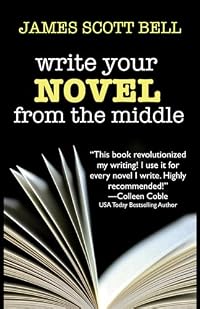
Write Your Novel From The Middle: A New Approach for Plotters, Pantsers and Everyone in Between
by James Scott Bell
Bell on Writing
On This Page
Description
A powerful secret and a fresh approach to writing bestselling fiction! What's the best way to write a next level novel? Some writers start at the beginning and let the story unfold without a plan. They are called pantsers, because they write by the seat of the pants. Other writers plan and outline and know the ending before they start. These are the plotters. The two sides never seem to agree with each other on the best approach. But what if it's not the beginning or the end that is the key show more to a successful book? What if, amazing as it may seem, the place to begin writing your novel is in the very middle of the story? According to #1 bestselling writing teacher James Scott Bell, that's exactly where you'll find your story's heart and heat. Bell's Mirror Moment is the secret, and its power is available to any writer, at any stage of the writing process. Bringing together years of craft study and personal discovery, Bell presents a truly unique approach to writing a novel, one that will stand the test of time and serve you all your writing life. I need three things before I tackle a new novel: Diet Coke, a laptop, and my dog-eared copies of James Scott Bell's books on writing craft! - Kami Garcia, #1 NYT Times & International Bestselling author. show lessTags
Recommendations







Member Reviews
It's certainly not for writing the "next level" novel as the claim goes, however, the book has something for the commercial writer who has no clue he is a plotter or a pantser or something in-between, which Bell calls Tweener. The midpoint and reversals are indeed important, but it is a well-known methodology always packaged with new names. Finally, the book is probably more soaked in the context of screenplay and not for novels, and not at all for literary fiction. It is for commercial formulaic novels, where one can at least develop a working first draft quickly.
Middles are the bane of a writer's existence. At first the new blush and excitement of a story carries you along, but eventually you hit this point where you look at your plot outline and realize that everything you wrote is utter crap. Sure, maybe you've got some big reveal at the end (maybe even wrote it), but you read the middle and it's boring boring boring and, no matter how much you stare at it, it's always hard to figure out exactly what went wrong.
Writing from the Middle helps you examine the 'turning point' that will get you from that first blush of a new story to your epic ending and re-invigorate that sorry, sagging middle of your bridge. While a short book with a few extraneous tutorials at the end to make it worth the show more $2.99, if you've ever gotten bogged down in a dumpy middle, this book is what you need. show less
Writing from the Middle helps you examine the 'turning point' that will get you from that first blush of a new story to your epic ending and re-invigorate that sorry, sagging middle of your bridge. While a short book with a few extraneous tutorials at the end to make it worth the show more $2.99, if you've ever gotten bogged down in a dumpy middle, this book is what you need. show less
I admit I'm a big fan of this guy's teaching. Something about how he explains things really resonates with me. I read this in one sitting. In fact, it was the first book I read in the New Year, so that says something. If you are a writer and looking for a little clarity when it comes to craft, you cannot go wrong with James Scott Bell's writing books.
Good advice, delivered in a mostly straightforward manner. The main problem is that even though this is a short book, it still only takes Bell about two-thirds of the book to say what he has to say on the topic. The remaining third is spent on an assortment of writing tips and suggestions that you may also find helpful, but aren't about writing from the middle and aren't mentioned in the book description. Still, I found it useful and plan to refer to it in the future.
Where I got the book: purchased on Kindle.
This short (85 pages) craft book turned out to be worth buying despite its brevity, because (apart from some cutesy stuff at the beginning about Pam Pantser, Paul Plotter and so on—why do people DO that?—James Scott Bell does a pretty good job of getting across his instruction points without the ego-boosting and meandering that so many writing gurus employ. He focuses on the realization that the mid-point of a story contains a moment where the main character has to face himself or herself, and provides a simple structure for incorporating that mid-point moment into your novel. He uses several familiar examples, including Gone With The Wind (which has an extremely memorable mid-point right show more before the intermission in the movie), and explains how to incorporate the mid-point into an outline (I rather liked his outline, which was a bit different from most).
In the last thirty or so pages, Bell shows you how to apply his simplified structure to story ideas and then leads into some general remarks on craft which are kind of filler but he didn’t over-elaborate so I was OK with them. I wouldn’t call this book earth-shattering or particularly memorable, but the notion that a great story has a mid-point is worth considering and if the price of the Kindle version continues low I’d recommend this as a no-brainer buy for writers looking for solid craft ideas. show less
This short (85 pages) craft book turned out to be worth buying despite its brevity, because (apart from some cutesy stuff at the beginning about Pam Pantser, Paul Plotter and so on—why do people DO that?—James Scott Bell does a pretty good job of getting across his instruction points without the ego-boosting and meandering that so many writing gurus employ. He focuses on the realization that the mid-point of a story contains a moment where the main character has to face himself or herself, and provides a simple structure for incorporating that mid-point moment into your novel. He uses several familiar examples, including Gone With The Wind (which has an extremely memorable mid-point right show more before the intermission in the movie), and explains how to incorporate the mid-point into an outline (I rather liked his outline, which was a bit different from most).
In the last thirty or so pages, Bell shows you how to apply his simplified structure to story ideas and then leads into some general remarks on craft which are kind of filler but he didn’t over-elaborate so I was OK with them. I wouldn’t call this book earth-shattering or particularly memorable, but the notion that a great story has a mid-point is worth considering and if the price of the Kindle version continues low I’d recommend this as a no-brainer buy for writers looking for solid craft ideas. show less
This short book introduces an interesting idea. According to Bell, there is often a moment in the middle of a book or movie in which the main character takes stock and wonders what he is becoming and how s/he will continue to battle death - physical, professional, or psychological. If you are writing a novel, this moment tells you a lot about what your story is really about. Bell recommends starting at this point because it provides information about what your character's pre-story psychology might be and about what transformation needs to happen at the end of the story to reach a resolution. While short, this book includes several other relevant points about structuring a story along with some writing exercises.
Very helpful little book! It only took about 2 hours to read (even took some notes) and I plan to be using this technique as I start planning my next novel!
Members
- Recently Added By
Lists

The Great Courses: How to Write Best-Selling Fiction
36 works; 2 members
Author Information

113+ Works 7,241 Members
Series

Classifications
Statistics
- Members
- 194
- Popularity
- 167,309
- Reviews
- 12
- Rating
- (4.11)
- Languages
- English
- Media
- Paper, Audiobook, Ebook
- ISBNs
- 1
- ASINs
- 3