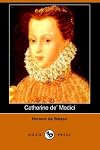
About Catherine de Medici
by Honoré de Balzac
Philosophical Studies (17), The Human Comedy (Études Philosophiques II | 77)
On This Page
Description
Balzac's La Comedie Humaine was a story cycle comprising more than 100 novels and stories. Although most of these works are set in nineteenth-century France, several hearken back to earlier periods. Catherine de' Medici centers on the life of the woman born into an aristocratic family in medieval Italy who went on to become Queen consort and, later, regent of France..
Tags
Recommendations





























Member Reviews
I read this just after completing Frieda's excellent biography on Catherine, and was glad to have a familiarity with her history. This, however, is not another biography or treatise on the lady.
The first (main) section is a narrative of an idealistic young Calvinist who eagerly participates in a dangerous scheme to gain access to Catherine with communications from the Prince de Conde's faction. The descriptions of 16th century Paris and of court life are entrancing although Balzac had a very different take on certain situations from Frieda; he portrays her and her daughter-in-law Mary (later Queen of Scots) as antagonistic, so much so that she refuses her eldest son a life-saving trepanning operation in order to rid herself of Mary's show more hated Guise relatives (Frieda argues that the two women were quite close and dismisses the idea of Catherine letting her son die as propaganda.
The second part of the book is a few years later; Catherine's second son, Charles IX, is now king- an unhappy and unwell young man, ever distrustful of his mother and her poisons. He brings in her alchemists, the Ruggieris, for questioning and here we have an explanation (went largely over my head) of their craft.
The final short section is set at an aristocratic party in 1786. One of the guests claims to have seen and spoken with Catherine, where she explained her actions. 'To leave two hostile principles at work in a government with nothing to balance them is a crime...it is sowing the seed of revolutions'... 'A revolution' said she with a look of deep meaning, which is still progressing and which you may achieve- yes, YOU, who hear me'.
Only in the last sentence do we learn that the two men are Robespierre and Marat. show less
The first (main) section is a narrative of an idealistic young Calvinist who eagerly participates in a dangerous scheme to gain access to Catherine with communications from the Prince de Conde's faction. The descriptions of 16th century Paris and of court life are entrancing although Balzac had a very different take on certain situations from Frieda; he portrays her and her daughter-in-law Mary (later Queen of Scots) as antagonistic, so much so that she refuses her eldest son a life-saving trepanning operation in order to rid herself of Mary's show more hated Guise relatives (Frieda argues that the two women were quite close and dismisses the idea of Catherine letting her son die as propaganda.
The second part of the book is a few years later; Catherine's second son, Charles IX, is now king- an unhappy and unwell young man, ever distrustful of his mother and her poisons. He brings in her alchemists, the Ruggieris, for questioning and here we have an explanation (went largely over my head) of their craft.
The final short section is set at an aristocratic party in 1786. One of the guests claims to have seen and spoken with Catherine, where she explained her actions. 'To leave two hostile principles at work in a government with nothing to balance them is a crime...it is sowing the seed of revolutions'... 'A revolution' said she with a look of deep meaning, which is still progressing and which you may achieve- yes, YOU, who hear me'.
Only in the last sentence do we learn that the two men are Robespierre and Marat. show less
AG-1
Sep 11, 2020Catalan
Ratings
Members
- Recently Added By
Lists

French Fiction of the 18th and 19th Centuries in English Translation
169 works; 3 members
Author Information

Born on May 20, 1799, Honore de Balzac is considered one of the greatest French writers of all time. Balzac studied in Paris and worked as a law clerk while pursuing an unsuccessful career as an author. He soon accumulated enormous debts that haunted him most of his life. A prolific writer, Balzac would often write for 14 to-16 hours at a time. show more His writing is marked by realistic portrayals of ordinary, but exaggerated characters and intricate detail. In 1834, Balzac began organizing his works into a collection called The Human Comedy, an attempt to group his novels to present a complete social history of France. Characters in this project reappeared throughout various volumes, which ultimately consisted of approximately 90 works. Some of his works include Cesar Birotteau, Le Cousin Pons, Seraphita, and Le Cousine Bette. Balzac wed his lifelong love, Eveline Hanska in March 1850 although he was gravely ill at the time. Balzac died in August of that year. (Bowker Author Biography) show less
Some Editions
Series


Belongs to Publisher Series
Work Relationships
Is contained in
Common Knowledge
- Canonical title
- About Catherine de Medici
- Original title
- Sur Catherine de Médicis
- Original publication date
- 1842-44
- People/Characters
- Catherine de Medici; Henri II, King of France (1519-1559)
- Important places
- Paris, France
- Dedication
- To Monsieur le Marquis de Pastoret, Member of the Academie des Beaux-Arts
- First words
- Few persons in these days know how artless were the dwellings of the citizens of Paris in the sixteenth century, and how simple their lives.
- Last words
- (Click to show. Warning: May contain spoilers.)'With pleasure, madame', replied Monsieur de Robespierre with an air of gallantry: 'I wish you had ordered me to do something more difficult.'
- Original language
- French
Classifications
Statistics
- Members
- 160
- Popularity
- 204,807
- Reviews
- 2
- Rating
- (3.28)
- Languages
- 7 — Dutch, English, French, German, Italian, Spanish, Swedish
- Media
- Paper, Ebook
- ISBNs
- 44
- ASINs
- 17