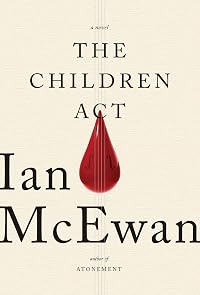
The Children Act
by Ian McEwan
On This Page
Description
"Fiona Maye is a High Court judge in London presiding over cases in family court. She is fiercely intelligent, well respected, and deeply immersed in the nuances of her particular field of law. Often the outcome of a case seems simple from the outside, the course of action to ensure a child's welfare obvious. But the law requires more rigor than mere pragmatism, and Fiona is expert in considering the sensitivities of culture and religion when handing down her verdicts. But Fiona's show more professional success belies domestic strife. Her husband, Jack, asks her to consider an open marriage and, after an argument, moves out of their house. His departure leaves her adrift, wondering whether it was not love she had lost so much as a modern form of respectability; whether it was not contempt and ostracism she really fears. She decides to throw herself into her work, especially a complex case involving a seventeen-year-old boy whose parents will not permit a lifesaving blood transfusion because it conflicts with their beliefs as Jehovah's Witnesses. But Jack doesn't leave her thoughts, and the pressure to resolve the case--as well as her crumbling marriage--tests Fiona in ways that will keep readers thoroughly enthralled until the last stunning page"-- show lessTags
Recommendations




Member Reviews
Fiona Maye and husband Jack live a life of relative luxury in Grays Inn London. She is a high court judge as well as an aspiring concert pianist. One morning Jack decides to find himself a younger lover as Fiona it would appear is not sympathetic to his needs, and so departs the family home. This does little to comfort a lady who is aware of the march of time, the unflattering affect and the cost that must be paid as the human body ages….”...her body looked foolish in the full-length mirror. Miraculously shrunken in some parts, bloated in others. Bottom heavy. A ridiculous package. Fragile, This Way up. Why would anyone not leave her?....” At work in the law court “my lady Fiona” is presented with a very difficult case and her show more decision will prove to have very far reaching and lasting consequences on all parties involved. A 17 year old boy is desperately ill in hospital and is refusing a blood transfusion which could ultimately save his life. His religious beliefs and that of his parents is viewed by the family as more important than life saving intervention…..”Religions, moral systems, her own included, were like peaks in a dense mountain range seen from a great distance, none obviously higher, more important, truer than another. What was to judge?...”
Written in the delightful prose of Ian McEwan, one of England’s greatest living authors, The Children Act is mesmerizing. The writer captures beautifully the everyday life and the important work of the English High Court and through the eyes of Fiona Maye we begin to understand difficult decisions that must be made and consequences thereof. A wonderful book which I devoured in one sitting full of insight, understanding and profound observation….”Didn’t you tell me that couples in long marriages aspire to the condition of siblings? We’ve arrived Fiona. I’ve become your brother…”
Highly highly recommended. show less
Written in the delightful prose of Ian McEwan, one of England’s greatest living authors, The Children Act is mesmerizing. The writer captures beautifully the everyday life and the important work of the English High Court and through the eyes of Fiona Maye we begin to understand difficult decisions that must be made and consequences thereof. A wonderful book which I devoured in one sitting full of insight, understanding and profound observation….”Didn’t you tell me that couples in long marriages aspire to the condition of siblings? We’ve arrived Fiona. I’ve become your brother…”
Highly highly recommended. show less
It was OK, it was fine, it just wasn't moving for me. I came to McEwan with [b:Atonement|6867|Atonement|Ian McEwan|https://d.gr-assets.com/books/1320449708s/6867.jpg|2307233] and thought "why have I not discovered this wonderful writer up until now?" Since then, I have read five other of his books, this making number six. None has measured up to Atonement and the last two have been downright disappointing.
I could not muster a whit of feeling for any of these characters. My Lady was unattainable and cold despite McEwan's attempts to give her depths, Adam was a cliche that was meant to stand in for everything that is wrong with religion. I was more interested and concerned with what the aftermath might have been for the surviving show more conjoined twin, who was just another case study. In all of Fiona's cases, the common theme seemed to be people who were more concerned with their strict religious beliefs than the survival of their children. I doubt a jurist would see even one of these cases in his time on the bench, let alone a group of them. Now, people who are more concerned with their own wants than the children...that I think would be common enough.
I was unconvinced by Fiona and Jack's relationship as well. No problems, complete fidelity, she is a stellar wife who showers him with attention and then six months of she is bothered by something and has no sexual appetite for six weeks and he is off to find a mistress. Please! I would consider all that came before a lie and boot his butt right out the door.
While I appreciate the deeply subjects McEwan meant to explore here, I think the book fails to make me truly care about them. It rather invites me to stand outside and view them intellectually, which is exactly what the tone of the book seems to be. McEwan is omniscient and uncaring himself. After closing this one, I think McEwan has to come off of my "I want to read everything he wrote" list. I can see that he and I are not always a good fit. show less
I could not muster a whit of feeling for any of these characters. My Lady was unattainable and cold despite McEwan's attempts to give her depths, Adam was a cliche that was meant to stand in for everything that is wrong with religion. I was more interested and concerned with what the aftermath might have been for the surviving show more conjoined twin, who was just another case study. In all of Fiona's cases, the common theme seemed to be people who were more concerned with their strict religious beliefs than the survival of their children. I doubt a jurist would see even one of these cases in his time on the bench, let alone a group of them. Now, people who are more concerned with their own wants than the children...that I think would be common enough.
I was unconvinced by Fiona and Jack's relationship as well. No problems, complete fidelity, she is a stellar wife who showers him with attention and then six months of she is bothered by something and has no sexual appetite for six weeks and he is off to find a mistress. Please! I would consider all that came before a lie and boot his butt right out the door.
While I appreciate the deeply subjects McEwan meant to explore here, I think the book fails to make me truly care about them. It rather invites me to stand outside and view them intellectually, which is exactly what the tone of the book seems to be. McEwan is omniscient and uncaring himself. After closing this one, I think McEwan has to come off of my "I want to read everything he wrote" list. I can see that he and I are not always a good fit. show less
Does religious belief outweigh the fight for survival? and if the one battling for life is a child, who gets to rule on what is, and isn’t, right? In The Children Act McEwan raises this question. Judge Fiona Maye is called upon to judge the case of a Jehovah’s Witness child who needs a blood transfusion to help save his life. His parents object, on religious grounds. The boy himself, although he is almost 18, not really a boy, also objects. He believes in his religion. He believes that it would be wrong to accept the blood of another, pollution of his own self.
And at the same time Maye has to deal with the fact that her own marriage may be ending.
This is a short novel, but if it hadn’t been a book club read I’m not sure I would show more have finished it. So much about the characters annoyed me. The husband, Jack, to start with. My god! what a selfish twit. He deserved such a slap. His first action in the novel is to ask for his wife’s consent to have passionate sex with another woman. Younger than himself and Maye, they are both in the sixties, of course. And when she denies him permission i he goes an does it anyway. And acts as though she is the one in the wrong for not agreeing. After all, he still loves her! Bleaurgh is my considered opinion of Jack.
The fact that Jack is such an arse isn’t grounds, in itself, to dislike the novel. Plenty of disagreeable characters can make for interesting books. It is just that the rest of the book seems so stilted and cold. The story, although third person narrated, is all from Fiona Maye’s point of view. Yet I never felt that I knew her as a person. She was so distant and cold, even with herself. Although throughout the book there are hints that it could have been so much better. Hints that could have been developed into much more of a rounded character, and indeed a rounded story.
It reads like a book where the author felt he was being clever with the story, and there are plenty of clever lines and ideas in it, but it lacked heart and emotion. Although maybe that, in and of itself, is a comment on the legal world in which the events took place. show less
And at the same time Maye has to deal with the fact that her own marriage may be ending.
This is a short novel, but if it hadn’t been a book club read I’m not sure I would show more have finished it. So much about the characters annoyed me. The husband, Jack, to start with. My god! what a selfish twit. He deserved such a slap. His first action in the novel is to ask for his wife’s consent to have passionate sex with another woman. Younger than himself and Maye, they are both in the sixties, of course. And when she denies him permission i he goes an does it anyway. And acts as though she is the one in the wrong for not agreeing. After all, he still loves her! Bleaurgh is my considered opinion of Jack.
The fact that Jack is such an arse isn’t grounds, in itself, to dislike the novel. Plenty of disagreeable characters can make for interesting books. It is just that the rest of the book seems so stilted and cold. The story, although third person narrated, is all from Fiona Maye’s point of view. Yet I never felt that I knew her as a person. She was so distant and cold, even with herself. Although throughout the book there are hints that it could have been so much better. Hints that could have been developed into much more of a rounded character, and indeed a rounded story.
It reads like a book where the author felt he was being clever with the story, and there are plenty of clever lines and ideas in it, but it lacked heart and emotion. Although maybe that, in and of itself, is a comment on the legal world in which the events took place. show less
A tough call. Many disagree with reducing the effect of a piece of literature to a simple star rating, but truth be told I do it more for myself and less for others. It's a way of keeping track and a shorthand for the books I enjoyed, or hated, or books that were just middling. A near five-star read for me, this book is written in a register which just works, or does so at least for me. The story of a British High Court judge — specializing in family law? (I can't be sure) — middle age and feeling it, forced to deal with a marriage in strife while she would rather put herself fully into her work, for which she seems to have considerable talent. Novels of manners, novels of the quiet intricacies of family life can go so wrong, so show more easily, that I'm caught off guard when someone gets it exactly right. Not that this is wholly either, but it is a novel of human intricacies, and this is what seems to trip up so many writers. McEwan seems to remember to make the stories interesting, that in fact the greatest writer of them all would poison, or stab, or rape, or to chase by bear if it came to that, and the greatest sin would be to bore, to have people sitting endless in salons chatting in mutual navel-gazing. My favorite novels are when the writer balances the equation, getting both sides right. Here is the story of these people and they are real, or seem so to us — and here is why this story is interesting absent all of that faffing about. I've read two or three or four other McEwan novels (I've lost track) but at this point I've decided to line them all up in row, everything the man has written, and read them every one, over time. I can offer no higher recommendation than that. show less
The title The Children Act has two meanings. One refers to the major piece of legislation governing the decisions of Fiona Maye, a High Court judge whose specialty is family law. The other refers to the actions of the children whose lives she is called to rule upon. However, not just the children, but also the childish, for her husband of thirty-five years has just asked her permission to conduct an affair. When do you go from being your husband's lover to being his mother?
There is no good time to come up with such a request, but this was a particularly bad time in Fiona's work life. Her current case load involved writing decisions that would be used as precedents for years to come. Perhaps that work life was part of the problem. Her show more husband Jack clearly saw it that way. Now, on a Sunday evening, she was faced with making a judgement directing the future of her own family.
Fiona's life was a good one. Her work was stimulating. Her life outside work was a pleasant cocoon of witty friends, concerts, dinner parties, interesting holidays and elegant surroundings, all held together by the polish of good manners. She knew she was lucky, but also knew she had earned it. Her private life was the antidote to the world of personal tragedy and destruction she saw before her at work each day. Now that world promised to become Fiona's.
On the night Jack made his plea for a rediscovery of youth, Fiona was the presiding judge on call. Their verbal sparring was interrupted by a call from a hospital seeking an order to transfuse a child against his wishes and those of his parents. The child Adam was less than three months from his eighteenth birthday, the age of majority. However, the Family Law Reform Act allowed minors of sixteen and seventeen to consent to treatment, which Adam could do despite his parents' wishes.
Adam's legal case is the counterpoint to Fiona's mental case against her husband. On the brink of life, Adam is prepared to deny it, while Fiona, "...an abandoned fifty-nine-year-old woman, in the infancy of old age, just learning to crawl", will fight for her life as she knew it.
McEwan skilfully portrays Fiona's work and home life, as she fights to prevent each from interfering with the other. However, the threatened dissolution of both her worlds had her looking at life from a new perspective:
This is a bleak novel. There are missed chances, unfulfilled dreams, disillusionment and despair, all delivered with McEwan's characteristic restraint. Yet there is hope too. Not the magic wand kind, but rather the kind that believes if only we remain constant to our principles and ideals, we will be able to move forward, not in a blaze of glory, but enough to live with ourselves, and so with others. show less
There is no good time to come up with such a request, but this was a particularly bad time in Fiona's work life. Her current case load involved writing decisions that would be used as precedents for years to come. Perhaps that work life was part of the problem. Her show more husband Jack clearly saw it that way. Now, on a Sunday evening, she was faced with making a judgement directing the future of her own family.
Fiona's life was a good one. Her work was stimulating. Her life outside work was a pleasant cocoon of witty friends, concerts, dinner parties, interesting holidays and elegant surroundings, all held together by the polish of good manners. She knew she was lucky, but also knew she had earned it. Her private life was the antidote to the world of personal tragedy and destruction she saw before her at work each day. Now that world promised to become Fiona's.
On the night Jack made his plea for a rediscovery of youth, Fiona was the presiding judge on call. Their verbal sparring was interrupted by a call from a hospital seeking an order to transfuse a child against his wishes and those of his parents. The child Adam was less than three months from his eighteenth birthday, the age of majority. However, the Family Law Reform Act allowed minors of sixteen and seventeen to consent to treatment, which Adam could do despite his parents' wishes.
Adam's legal case is the counterpoint to Fiona's mental case against her husband. On the brink of life, Adam is prepared to deny it, while Fiona, "...an abandoned fifty-nine-year-old woman, in the infancy of old age, just learning to crawl", will fight for her life as she knew it.
McEwan skilfully portrays Fiona's work and home life, as she fights to prevent each from interfering with the other. However, the threatened dissolution of both her worlds had her looking at life from a new perspective:
It was her impression, though the facts did not bear it out, that in the late summer of 2012, marital or partner breakdown and distress in Great Britain swelled like a freak spring tide, sweeping away entire households, scattering possessions and hopeful dreams, drowning those without a powerful instinct for survival. Loving promises were denied or rewritten, once easy companions became artful combatants, crouching behind counsel, oblivious to the costs. Once neglected domestic items were bitterly fought for, once easy trust was replaced by carefully worded "arrangements".... And the children? Counters in a game, bargaining chips for use by mothers, objects of financial or emotional neglect by fathers; ...
This is a bleak novel. There are missed chances, unfulfilled dreams, disillusionment and despair, all delivered with McEwan's characteristic restraint. Yet there is hope too. Not the magic wand kind, but rather the kind that believes if only we remain constant to our principles and ideals, we will be able to move forward, not in a blaze of glory, but enough to live with ourselves, and so with others. show less
The Children Act is a compelling read; I swallowed it more or less in one gulp. So, three stars for technique and flawless prose.
But beyond those two achievements, there is not a lot to recommend this novel. A structure that plays a tense domestic situation against a professional one full of legal and ethical complexity is a stock formulation. It is ideal for cinema, and I suspect McEwan of putting together a work for publication that is pretty much as camera-ready as it could be without already being a screen play. In terms of fiction writing, he risks nothing and goes nowhere others have not been before.
The book is nakedly manipulative. By this I mean that the emotions McEwan stimulates are in some sense imposed on the characters and show more so are imposed in turn on us. There is a musical thread running throughout the book that acts as a proxy for the main character's state, particularly if one is familiar with the works mentioned. This also is cinematic in that it provides the sound track for shepherding an audience into the desired emotional state. Fiona moves from Bach's second keyboard partita early on to finishing the book with Schubert, Mahler, and Britten's haunting setting of Yeats. From her mix tape we infer her emotional progress.
McEwan also relies on the notion that a vocalist and an accompanist enter into a form of transcendent intimacy that is a truer form of communion than language alone can accomplish. Ideally this is so in a performance; in fiction it is trite and suggests a lazy author. The novel's climax thus turns mawkish as Fiona, overwhelmed, rushes from the stage having brilliantly performed Britten's music for a tenor to sing Yeats's words, but hearing instead a poem in the same form and metre written solely for her that she has just begun to understand. This is cheap stuff. show less
But beyond those two achievements, there is not a lot to recommend this novel. A structure that plays a tense domestic situation against a professional one full of legal and ethical complexity is a stock formulation. It is ideal for cinema, and I suspect McEwan of putting together a work for publication that is pretty much as camera-ready as it could be without already being a screen play. In terms of fiction writing, he risks nothing and goes nowhere others have not been before.
The book is nakedly manipulative. By this I mean that the emotions McEwan stimulates are in some sense imposed on the characters and show more so are imposed in turn on us. There is a musical thread running throughout the book that acts as a proxy for the main character's state, particularly if one is familiar with the works mentioned. This also is cinematic in that it provides the sound track for shepherding an audience into the desired emotional state. Fiona moves from Bach's second keyboard partita early on to finishing the book with Schubert, Mahler, and Britten's haunting setting of Yeats. From her mix tape we infer her emotional progress.
McEwan also relies on the notion that a vocalist and an accompanist enter into a form of transcendent intimacy that is a truer form of communion than language alone can accomplish. Ideally this is so in a performance; in fiction it is trite and suggests a lazy author. The novel's climax thus turns mawkish as Fiona, overwhelmed, rushes from the stage having brilliantly performed Britten's music for a tenor to sing Yeats's words, but hearing instead a poem in the same form and metre written solely for her that she has just begun to understand. This is cheap stuff. show less
The case in front of High Court judge Fiona Maye is not easy – a boy a few months short of his 18th birthday is refusing a necessary blood transfusion because of the faith of his family; they are Jehovah’s Witnesses. The Hospital argues that based on The Children Act of 1989, wherein the child’s welfare is of paramount consideration, they should be allowed to override his (and his parent’s) wishes and save him. Maye is intelligent, sensitive, and well-rounded. She can dissect cases in front of her and draw fact-based conclusions, even when those leave her troubled. It’s interesting to see her navigate this and other cases.
However, her own life is also complicated - her husband feels neglected, possibly going through a midlife show more crisis, and is considering (maybe already having) an affair. We see that it’s easier for her to be the third party and judge from a distance, and that even the most intelligent, rational, and sensitive people go through what seem like clichéd acts in plays or stories (and of course life itself). We also see that Maye has to live with the consequences of her decision in the Jehovah’s Witness case – it doesn’t just ‘go away’, and life is messy. I also found it interesting to think about her reaction to the boy falling in love with her, vs. what a man’s would be, what her husband’s would be, if he was the judge and it was a young woman falling for him.
I’ve read eight books by McEwan now, and find that he’s at his best in describing relationships. In this one, the feelings and emotions of the middle-aged couple in their long-term marriage ring true. As always, his prose is clean and direct, and he’s smart and cultured without being pompous or overbearing. Well worth reading. show less
However, her own life is also complicated - her husband feels neglected, possibly going through a midlife show more crisis, and is considering (maybe already having) an affair. We see that it’s easier for her to be the third party and judge from a distance, and that even the most intelligent, rational, and sensitive people go through what seem like clichéd acts in plays or stories (and of course life itself). We also see that Maye has to live with the consequences of her decision in the Jehovah’s Witness case – it doesn’t just ‘go away’, and life is messy. I also found it interesting to think about her reaction to the boy falling in love with her, vs. what a man’s would be, what her husband’s would be, if he was the judge and it was a young woman falling for him.
I’ve read eight books by McEwan now, and find that he’s at his best in describing relationships. In this one, the feelings and emotions of the middle-aged couple in their long-term marriage ring true. As always, his prose is clean and direct, and he’s smart and cultured without being pompous or overbearing. Well worth reading. show less
Members
- Recently Added By
Published Reviews
ThingScore 58
Ian McEwan, master of obsession, fumbles with his latest, The Children Act
added by Nickelini
McEwan, always a smart, engaging writer, here takes more than one familiar situation and creates at every turn something new and emotionally rewarding in a way he hasn’t done so well since On Chesil Beach (2007).
added by Nickelini
Although thrillingly close to the child within us, McEwan nonetheless writes for, and about, the grown-ups. In a climate that breeds juvenile cynicism, we more than ever need his adult art.
added by Nickelini
Lists

1001 Books You Must Read Before You Die
1,448 works; 1,134 members

Best Books Set in London
157 works; 42 members

Best 21st Century Books (So Far)
670 works; 85 members

2015 Notable Books for Adults
26 works; 4 members

Books Read in 2014
2,343 works; 89 members

Books Read in 2015
3,299 works; 129 members

Dublin Literary Award Longlist 2016
148 works; 4 members

Five star books
1,767 works; 110 members
Books Read in 2016
4,666 works; 199 members

Most Frequently Tagged "Read in 2015"
70 works; 1 member

Kirkus Reviews Best Fiction of 2014
100 works; 7 members

Books read in 2015
213 works; 5 members
Author Information

77+ Works 100,062 Members
Ian McEwan was born in Aldershot, England on June 21, 1948. He received a B.A. in English Literature from the University of Sussex and an M.A. in English Literature from the University of East Anglia. He writes novels, plays, and collections of short stories including In Between the Sheets, The Cement Garden, The Comfort of Strangers, The show more Innocent, Black Dogs, The Daydreamer, Enduring Love, Sweet Tooth, The Children Act and Nutshell. He has won numerous awards including the 1976 Somerset Maugham Award for First Love, Last Rites; the 1987 Whitbread Novel Award and the 1993 Prix Fémina Etranger for The Child in Time; the 1998 Booker Prize for Fiction for Amserdam; the 2002 W. H. Smith Literary Award, the 2003 National Book Critics' Circle Fiction Award, the 2003 Los Angeles Times Prize for Fiction, and the 2004 Santiago Prize for the European Novel for Atonement; and the 2006 James Tait Black Memorial Prize for Saturday. (Bowker Author Biography) show less
Some Editions
Awards and Honors
Awards
Distinctions
Notable Lists
Series
Belongs to Publisher Series
Work Relationships
Has the adaptation
Common Knowledge
- Canonical title*
- De kinderwet
- Original title
- The Children Act
- Original publication date
- 2014-09; 2014 (Nederlands) (Nederlands)
- People/Characters
- Fiona Maye; Jack Maye; Adam Henry
- Important places
- London, England, UK
- Related movies
- The Children Act (2017 | IMDb)
- Epigraph
- 'When a court determines any question with respect to...the upbringing of a child...the child's welfare shall be the court's paramount consideration.'
Section 1(a) The Children Act (1989) - Dedication
- To Ray Dolan
- First words
- London. Trinity term one week old.
- Last words
- (Click to show. Warning: May contain spoilers.)They lay face to face in the semidarkness, and while the great rain-cleansed city beyond the room settled to its softer nocturnal rhythms and their marriage uneasily resumed, she told him in a steady quiet voice of her shame, of the boy's passion for life and her part in his death.
- Original language*
- Engels
*Some information comes from Common Knowledge in other languages. Click "Edit" for more information.
Classifications
Statistics
- Members
- 3,362
- Popularity
- 5,032
- Reviews
- 197
- Rating
- (3.79)
- Languages
- 17 — Catalan, Danish, Dutch, English, Finnish, French, German, Hebrew, Italian, Norwegian (Bokmål), Polish, Portuguese, Romanian, Slovenian, Spanish, Swedish, Turkish
- Media
- Paper, Audiobook, Ebook
- ISBNs
- 71
- ASINs
- 20
