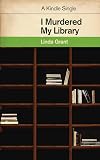
I Murdered My Library
by Linda Grant
On This Page
Tags
Recommendations









Member Reviews
This will resonate with anyone who shares Grant’s – and my – problem. When you’re an enthusiastic reader, you will, sooner or late, come to this point: ‘The books in alphabetical rows were overgrown by piles of new books, doubled in front. Books multiplied, books swarmed, books, I sometimes dreamt, seemed to reproduce themselves – they were a papery population explosion‘. When she downsizes to a smaller flat in London, Grant faces the physically painful task of decimating her library. Confronted with this literary mirror of her past, she remembers how she has engaged with books throughout her life and what having a library means to her. Funnily enough (or not, if you’re in the same boat) it transpires that a show more ‘library’ isn’t really that much about the contents of the books. It’s a time capsule, a record of memories, friends and events otherwise forgotten, an assertion of personality, (perhaps, shamefully) a display of one’s intellect (“I bloody well will read Herodotus / Proust / Camus one day”), a way to impress boyfriends or colleagues.
Grant has been a book fetishist (‘junkie‘) for much of her life. Those broken-backed spines and scruffy pages have been beloved objects. But now, as she gets older, she finds that the tiny print of her 1960s paperbacks is proving too much of a challenge. She finds herself increasingly seduced by the Kindle, with its resizeable text, its clarity and, joy of joys, its capacity. A library can now be in a pocket (assuming, that is, you can get the books you want on Kindle and, as Grant laments, that isn’t always the case). Far from shunning modern technology, Grant embraces it and she makes an interesting point. As an author, she knows all too well what it’s like to write a book and she makes a point that books are now written on screens. Authors bring their books to life in Microsoft Word, in a white, blank space. Reading the book on a Kindle screen is, perhaps, much closer to the author’s experience of writing it than reading it in a cherished hard copy. It’s a good point. A love story about books, yet also about the need to let them go, it’s a short piece that will strike a chord with anyone who’s come back from Oxfam with yet another pile of books, thinking, “Oh bugger. No more shelf space…”
For this review and other reviews of bite-sized books, please see my blog:
https://theidlewoman.net/2018/04/28/bite-sized-books/ show less
Grant has been a book fetishist (‘junkie‘) for much of her life. Those broken-backed spines and scruffy pages have been beloved objects. But now, as she gets older, she finds that the tiny print of her 1960s paperbacks is proving too much of a challenge. She finds herself increasingly seduced by the Kindle, with its resizeable text, its clarity and, joy of joys, its capacity. A library can now be in a pocket (assuming, that is, you can get the books you want on Kindle and, as Grant laments, that isn’t always the case). Far from shunning modern technology, Grant embraces it and she makes an interesting point. As an author, she knows all too well what it’s like to write a book and she makes a point that books are now written on screens. Authors bring their books to life in Microsoft Word, in a white, blank space. Reading the book on a Kindle screen is, perhaps, much closer to the author’s experience of writing it than reading it in a cherished hard copy. It’s a good point. A love story about books, yet also about the need to let them go, it’s a short piece that will strike a chord with anyone who’s come back from Oxfam with yet another pile of books, thinking, “Oh bugger. No more shelf space…”
For this review and other reviews of bite-sized books, please see my blog:
https://theidlewoman.net/2018/04/28/bite-sized-books/ show less
This essay struck such a chord with me - we're moving soon and there won't be as much space for books. Which do I get rid of, and which do I keep? Linda Grant takes a long hard look at her own collection, books that have very much defined who she is, and culls those she feels she can let go. (I have taken on board the lesson she learnt so painfully ... she finds in the end that she has let go of far too many.) Along the way she examines her (read - any booklover's) relationship with both physical books and ebooks.
Any bookaholic will find this a worthwhile read and cautionary tale.
Any bookaholic will find this a worthwhile read and cautionary tale.
This essay rings true for every book lover, such as myself, who has hundreds or thousands of books, read and unread, taking up precious room in their home. Linda Grant had to get rid of (or murder) many books when she moved house and this is her account of that, along with ruminations about books.
It's a lovely little read and filled in a gap between two full length books perfectly. I liked reading her thoughts about paper books and ebooks, technology and the way that culling her library made her feel.
It's a lovely little read and filled in a gap between two full length books perfectly. I liked reading her thoughts about paper books and ebooks, technology and the way that culling her library made her feel.
This is a long essay about "weeding the collection" and about what books mean in the live of those who love them. I totally understood the feelings of the author as she ruthlessly discarded books in preparation for a move--I have done that. I ended up buying them back later. I like my Kindle, as she said, but I still like my paper books too.
Interesting Essay on Books vs. Kindle and contemplating one's mortality
I am currently culling my own physical library so this little book speaks to my current situation. Any avid reader can relate to this, being overrun by books and yet feeling heretical when it comes time to get rid of some.
I am currently culling my own physical library so this little book speaks to my current situation. Any avid reader can relate to this, being overrun by books and yet feeling heretical when it comes time to get rid of some.
(Nonfiction, Bibliophilic, Kindle Single)
When Grant downsized her living space in 2013, she had to purge thousands of her books from her personal library, started when she was a child.
Amazon says: ”Both a memoir of a lifetime of reading and an insight into how interior décor has banished the bookcase, her account of the emotional struggle of her relationship with books asks questions about the way we live today.“
The author is an award winning novelist and nonfiction writer, so this is a well-written and fascinating treatise.
4 stars
When Grant downsized her living space in 2013, she had to purge thousands of her books from her personal library, started when she was a child.
Amazon says: ”Both a memoir of a lifetime of reading and an insight into how interior décor has banished the bookcase, her account of the emotional struggle of her relationship with books asks questions about the way we live today.“
The author is an award winning novelist and nonfiction writer, so this is a well-written and fascinating treatise.
4 stars
Very short, but nice read, with great quotes on what a personal library stands for.
Members
- Recently Added By
Published Reviews
[Edited extract] I am moving house. I am moving from the spacious flat I have lived in for 19 years, a corner house, very bright and full of windows, a place of flights of stairs and landings and hallways, no room on the same level as another. There has always been space for more books, you could tuck in a few shelves in all kinds of places. [continues]
added by Cynfelyn
Lists

Bibliomemoirs
46 works; 8 members

Books Read in 2014
2,343 works; 89 members
Author Information

14+ Works 2,503 Members
Linda Grant is a novelist and journalist. She won the Orange Prize for Fiction in 2000 and the Lettre Ulysses Prize for the Art of Reportage in 2006. Her most recent novel, The Clothes on Their Back, was shortlisted for the Man Booker Prize in 2008. She writes for The Guardian, the Telegraph, and Vogue.
Classifications
Statistics
- Members
- 117
- Popularity
- 278,501
- Reviews
- 9
- Rating
- (3.73)
- Media
- Ebook
- ASINs
- 1