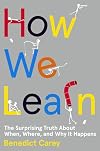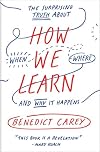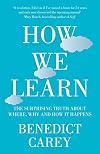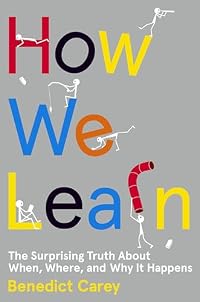
How We Learn: The Surprising Truth About When, Where, and Why It Happens
by Benedict Carey
On This Page
Description
In the tradition of The Power of Habit and Thinking, Fast and Slow comes a practical, playful, and endlessly fascinating guide to what we really know about learning and memory today—and how we can apply it to our own lives.From an early age, it is drilled into our heads: Restlessness, distraction, and ignorance are the enemies of success. We’re told that learning is all self-discipline, that we must confine ourselves to designated study areas, turn off the music, and maintain a strict show more ritual if we want to ace that test, memorize that presentation, or nail that piano recital.
But what if almost everything we were told about learning is wrong? And what if there was a way to achieve more with less effort?
In How We Learn, award-winning science reporter Benedict Carey sifts through decades of education research and landmark studies to uncover the truth about how our brains absorb and retain information. What he discovers is that, from the moment we are born, we are all learning quickly, efficiently, and automatically; but in our zeal to systematize the process we have ignored valuable, naturally enjoyable learning tools like forgetting, sleeping, and daydreaming. Is a dedicated desk in a quiet room really the best way to study? Can altering your routine improve your recall? Are there times when distraction is good? Is repetition necessary? Carey’s search for answers to these questions yields a wealth of strategies that make learning more a part of our everyday lives—and less of a chore.
By road testing many of the counterintuitive techniques described in this book, Carey shows how we can flex the neural muscles that make deep learning possible. Along the way he reveals why teachers should give final exams on the first day of class, why it’s wise to interleave subjects and concepts when learning any new skill, and when it’s smarter to stay up late prepping for that presentation than to rise early for one last cram session. And if this requires some suspension of disbelief, that’s because the research defies what we’ve been told, throughout our lives, about how best to learn.
The brain is not like a muscle, at least not in any straightforward sense. It is something else altogether, sensitive to mood, to timing, to circadian rhythms, as well as to location and environment. It doesn’t take orders well, to put it mildly. If the brain is a learning machine, then it is an eccentric one. In How We Learn, Benedict Carey shows us how to exploit its quirks to our advantage. show less
Tags
Recommendations
Member Reviews
Benedict Carey's "How We Learn: The Surprising Truth about When, Where, and Why it Happens" is an often insightful and thought-provoking look at how people learn information. In contrast to many current ideas regarding learning, such as the importance of persistence or "grit" and the usefulness of repeated practice, Carey's book presents research from a number of different studies that portrays learning in a different light. Instead of single-minded focus, the research here suggests that things like taking breaks and distractions do not inhibit learning and can actually help people learn and remember concepts.
There are a number of things that I appreciated about Carey’s approach. Given the recent focus on grit, especially when it show more comes to learning and academic success, the information presented here is balanced. For instance, while the book notes that some distractions can be useful and that walking away when stuck on a problem can ultimately help us find and remember a solution, it also does not endorse constant slacking or procrastination. Instead, it suggests that focus is important, but that a prescriptive, regimented routine can be counterproductive. In other words, it urges us to take a grounded approach to learning. This is reasonable and achievable.
Also notable is Carey’s clear and accessible writing style. Learning and memory are both complex things, and making cognitive science and research understandable to laymen is a daunting task that holds a number of traps. The first is to simplify it so much that readers miss vital information. The second possible trap is to include so much detail that readers get bogged down and overwhelmed. Carey manages to avoid both problems, and the end result is that the book is informative without being too erudite. Additionally, his inclusion of anecdotes (from his experience and from the researchers and studies he includes) help prevent the text from being a dull slog from one set of results to another.
If there is a weakness in “How We Learn,” it is the lack of concrete takeaways that students (and teachers) can employ when it comes to optimizing learning. However, the blame here lies not with Carey or with the research he cites but with the complexity of the subject and of the human brain. Despite what some of the current literature suggests, mastering a concept and remembering it is not as simple as applying a set number of hours to a certain task. Instead, as with many things that involve the human element, the answer is messy, imprecise, and difficult to pin down. Carey and “How We Learn” portray this messiness in all of this imprecise glory. show less
There are a number of things that I appreciated about Carey’s approach. Given the recent focus on grit, especially when it show more comes to learning and academic success, the information presented here is balanced. For instance, while the book notes that some distractions can be useful and that walking away when stuck on a problem can ultimately help us find and remember a solution, it also does not endorse constant slacking or procrastination. Instead, it suggests that focus is important, but that a prescriptive, regimented routine can be counterproductive. In other words, it urges us to take a grounded approach to learning. This is reasonable and achievable.
Also notable is Carey’s clear and accessible writing style. Learning and memory are both complex things, and making cognitive science and research understandable to laymen is a daunting task that holds a number of traps. The first is to simplify it so much that readers miss vital information. The second possible trap is to include so much detail that readers get bogged down and overwhelmed. Carey manages to avoid both problems, and the end result is that the book is informative without being too erudite. Additionally, his inclusion of anecdotes (from his experience and from the researchers and studies he includes) help prevent the text from being a dull slog from one set of results to another.
If there is a weakness in “How We Learn,” it is the lack of concrete takeaways that students (and teachers) can employ when it comes to optimizing learning. However, the blame here lies not with Carey or with the research he cites but with the complexity of the subject and of the human brain. Despite what some of the current literature suggests, mastering a concept and remembering it is not as simple as applying a set number of hours to a certain task. Instead, as with many things that involve the human element, the answer is messy, imprecise, and difficult to pin down. Carey and “How We Learn” portray this messiness in all of this imprecise glory. show less
 This review was written for LibraryThing Early Reviewers.
"We all 'know' we need to be organized, to develop good, consistent study routines, to find a quiet place and avoid distractions, to focus on one skill at a time, and above all to concentrate on our work. What's to question about that?
A lot, as it turns out." (215)
Varying the setting in which you study, as long as you don't study in silent conditions, can improve your recall. Context cues are important. Distributed (or "spaced") practice is more powerful than longer and fewer periods of studying, with a longer period between sessions if the test is farther away. And forgetting something helps you learn it better the next time.
We do badly on tests because of the "fluency illusion," which is the belief that because we understand something show more now, we don't need to study it later. The best way to deal with the "fluency illusion" is to test right away. In fact, after preliminary memorization, a good two-thirds of your study time should be spent testing yourself. In fact, pretesting (taking a test before you learn anything) (as long as you get immediate feedback) has been shown to improve your later learning of the subject, even if you got everything wrong. And teaching the subject to someone else also helps.
Problem solving follows a different path from factual learning. The stages of problem solving include preparation (learning and studying the problem), incubation (walking away from it when you're stuck), illumination, and verification.
In fact, interrupting a job before it is finished tends to push it to the forefront of the mind and allows for percolation. The ideal pattern is interruption-percolation-reflection.
We believe in isolated practice, but varied practice (different circumstances, variations of the same problem) is more effective for both motor and verbal learning. Interleaving is also effective - "mixing related but distinct material during study" (163) It helps students decide on the appropriate kind of solution.
Sleep consolidates learning - REM improves pattern recognition, percolation, and interpreting emotionally charged memories; Stage 2 sleep improves motor learning; and Stage 3 & 4 improve retention and declarative memory.
In other words, in order to learn effectively, you need to include distraction in your environment and in your routines, you need to study less at any one time, you should take tests before and during the learning process, and you should start projects immediately instead of clearing the decks but interrupt them just when you get interested. You need to sleep on things, mix things up, and deliberately confuse yourself.
Or so Carey says. It's an enjoyable read, both as an overview of learning theory and as a set of things for teachers and learners to consider. show less
A lot, as it turns out." (215)
Varying the setting in which you study, as long as you don't study in silent conditions, can improve your recall. Context cues are important. Distributed (or "spaced") practice is more powerful than longer and fewer periods of studying, with a longer period between sessions if the test is farther away. And forgetting something helps you learn it better the next time.
We do badly on tests because of the "fluency illusion," which is the belief that because we understand something show more now, we don't need to study it later. The best way to deal with the "fluency illusion" is to test right away. In fact, after preliminary memorization, a good two-thirds of your study time should be spent testing yourself. In fact, pretesting (taking a test before you learn anything) (as long as you get immediate feedback) has been shown to improve your later learning of the subject, even if you got everything wrong. And teaching the subject to someone else also helps.
Problem solving follows a different path from factual learning. The stages of problem solving include preparation (learning and studying the problem), incubation (walking away from it when you're stuck), illumination, and verification.
In fact, interrupting a job before it is finished tends to push it to the forefront of the mind and allows for percolation. The ideal pattern is interruption-percolation-reflection.
We believe in isolated practice, but varied practice (different circumstances, variations of the same problem) is more effective for both motor and verbal learning. Interleaving is also effective - "mixing related but distinct material during study" (163) It helps students decide on the appropriate kind of solution.
Sleep consolidates learning - REM improves pattern recognition, percolation, and interpreting emotionally charged memories; Stage 2 sleep improves motor learning; and Stage 3 & 4 improve retention and declarative memory.
In other words, in order to learn effectively, you need to include distraction in your environment and in your routines, you need to study less at any one time, you should take tests before and during the learning process, and you should start projects immediately instead of clearing the decks but interrupt them just when you get interested. You need to sleep on things, mix things up, and deliberately confuse yourself.
Or so Carey says. It's an enjoyable read, both as an overview of learning theory and as a set of things for teachers and learners to consider. show less
(17) Just OK. I may have been more fascinated by this in the past, but I have been exposed to these learning theories in the recent past as part of my job as an educator. I bought the book as a "prize" for a teaching competition at work and thought I should read it myself first. I think interesting for a novice educator without formal training and also maybe for a young adult student. I liked thinking about the mental conundrum of the one question you can ask the lying and truth-telling guards by the arena doors -behind one of which is the exit, and the other a lion. I am definitely not as clever as I once was.
Somehow, I always avoided fluency and figured out most of this on my own as a student - no one ever taught me. My show more conscientiousness made me start big projects early, study over time, test myself, and never pull all-nighters. Here I always just thought I was incredibly smart or had a great memory.
A few of the mentioned studies and fascinomas - like the man without a hippocampus, we quite interesting. But in general the book was a slog as many of these pop-psychology, self-helpy type books are for me.
I guess I will still include it as a 'door prize' - the information is truly interesting and a neophyte would likely enjoy, but it was just not new to me. show less
Somehow, I always avoided fluency and figured out most of this on my own as a student - no one ever taught me. My show more conscientiousness made me start big projects early, study over time, test myself, and never pull all-nighters. Here I always just thought I was incredibly smart or had a great memory.
A few of the mentioned studies and fascinomas - like the man without a hippocampus, we quite interesting. But in general the book was a slog as many of these pop-psychology, self-helpy type books are for me.
I guess I will still include it as a 'door prize' - the information is truly interesting and a neophyte would likely enjoy, but it was just not new to me. show less
I try to avoid saying that a book is a “must-read”, but if you’re interested in learning science, you’ll probably want to read this one. There’s been a lot of progress in the field in recent decades, and Carey brings together the findings from numerous studies into an accessible and practical book for the layperson.
Each chapter is focused on a different aspect of learning and how it can be improved. The topics include spaced repetition (the ideal gaps between study sessions to maximize retention), the value of interruptions and deliberate breaks when working on a tricky problem, self-testing and how to avoid the illusion of fluency created by passive reviewing, the benefits of mixing up your study/practice sessions rather than show more focusing on the same skill for long chunks of time, and even the importance of sleep. All of these chapters include explanations of the studies that led to their conclusions.
Carey’s writing is very clear and readable, as you’d expect from a journalist, but I still found that this book took me a while to get through because there was just so much helpful information to take in. The theme throughout is that there are lots of specific techniques that we can use to improve our learning efficiency and ultimately learn more without making a huge additional investment of time. It’s a very encouraging message, and I’m definitely planning to keep this book around so that I can refer back to the specific techniques that he discusses. The book will be of particular interest to teachers and students, but I think pretty much anyone can benefit from applying these approaches in their daily lives. show less
Each chapter is focused on a different aspect of learning and how it can be improved. The topics include spaced repetition (the ideal gaps between study sessions to maximize retention), the value of interruptions and deliberate breaks when working on a tricky problem, self-testing and how to avoid the illusion of fluency created by passive reviewing, the benefits of mixing up your study/practice sessions rather than show more focusing on the same skill for long chunks of time, and even the importance of sleep. All of these chapters include explanations of the studies that led to their conclusions.
Carey’s writing is very clear and readable, as you’d expect from a journalist, but I still found that this book took me a while to get through because there was just so much helpful information to take in. The theme throughout is that there are lots of specific techniques that we can use to improve our learning efficiency and ultimately learn more without making a huge additional investment of time. It’s a very encouraging message, and I’m definitely planning to keep this book around so that I can refer back to the specific techniques that he discusses. The book will be of particular interest to teachers and students, but I think pretty much anyone can benefit from applying these approaches in their daily lives. show less
Memory and learning are not the same thing, but How We Learn tries to unite them. The first half of the book is about innumerable ways people try to memorize. And there as many studies as there are ways. Cramming will let you remember things the next day, but like a telephone number you learn in a bar, it vaporizes soon after. The best way to memorize is to take lots of breaks; change subjects, follow a distraction, even sleep. They are all proven to give better results than marathon memorizing. Studies show twice as much.
Carey says the human brain has the capacity to store the equivalent of three million television shows, which translates into every moment of an entire lifetime. Retrieving all that data however, is problematic. We show more don’t do that very well. But it’s there. That’s why you might suddenly remember something that happened in childhood that you hadn’t thought of in years, but comes back clearly while thinking about something else entirely. There was an association there. That’s why your brain called it up, but you probably missed it.
Learning is more than memorizing. Learning means you internalize facts, methods and images, and you manipulate them as needed to your advantage. So breaking up learning sessions by applying the knowledge allows you to take ownership of it; it’s all yours if you go farther than just memorizing. There is a disused saying that if you use a new word in three sentences, it’s yours forever. Turns out there’s truth in that.
The learning portion of the book is also a constant emphasis on interleaving, varying activities so that learning one thing is not the only activity. Study after study after study after study shows that the more varied things test subjects do, the more they learn what researchers want them to. This includes having to think about applying what has been learned, diverting to some other subject, and even sleeping.
But with all the studies he explores, Carey never examines the interleaving of mind-altering drugs. There is an entire school of thought that claims the mind-expanding properties of certain chemicals leads to far greater mental processing and creativity than say, cramming for an exam. Great scientists, authors and artists publicly claim they solved problems or had eureka insights or created masterpieces thanks to a session with some drug or other. It should be mentioned if only to dismiss it. But Carey ignores it.
Another learning area Carey doesn’t explore is categorization compared to association. Our brains are pre-tech. They don’t know about number and letter combinations. They don’t file things alphabetically or by date. They file them by association. Just recently (May 2014), San Diego hosted a memorizing contest with acclaimed contestants from around the world. The winners all used the same method: they pictured a scene they liked while memorizing a list of numbers or letters or syllables or words. When they recalled the scene, there were the test letters, ready to be repeated. This turns out to be the standard practice of all the great memory experts. It leverages the brain’s own method of image association, because that’s how we work internally. So taking in the surroundings where you’re memorizing is a hugely important factor in how much you remember.
Burying your head in a book or a screen – not so much.
Categorization vs association is something Douglas Hofstader beat to death in Surfaces and Essences, but Carey doesn’t give him or it any ink.
How We Learn has far too much padding for my tastes. Carey loves to give lists of examples, and he likes to get chatty with the reader. It diminishes the impact and slows you down. The studies go on ad infinitum.
The bottom line is we can memorize, but we learn best if we use our brains to employ what we’ve memorized. Otherwise the memory disappears – the next day or the next week or the next month. This is no breakthrough.
David Wineberg show less
Carey says the human brain has the capacity to store the equivalent of three million television shows, which translates into every moment of an entire lifetime. Retrieving all that data however, is problematic. We show more don’t do that very well. But it’s there. That’s why you might suddenly remember something that happened in childhood that you hadn’t thought of in years, but comes back clearly while thinking about something else entirely. There was an association there. That’s why your brain called it up, but you probably missed it.
Learning is more than memorizing. Learning means you internalize facts, methods and images, and you manipulate them as needed to your advantage. So breaking up learning sessions by applying the knowledge allows you to take ownership of it; it’s all yours if you go farther than just memorizing. There is a disused saying that if you use a new word in three sentences, it’s yours forever. Turns out there’s truth in that.
The learning portion of the book is also a constant emphasis on interleaving, varying activities so that learning one thing is not the only activity. Study after study after study after study shows that the more varied things test subjects do, the more they learn what researchers want them to. This includes having to think about applying what has been learned, diverting to some other subject, and even sleeping.
But with all the studies he explores, Carey never examines the interleaving of mind-altering drugs. There is an entire school of thought that claims the mind-expanding properties of certain chemicals leads to far greater mental processing and creativity than say, cramming for an exam. Great scientists, authors and artists publicly claim they solved problems or had eureka insights or created masterpieces thanks to a session with some drug or other. It should be mentioned if only to dismiss it. But Carey ignores it.
Another learning area Carey doesn’t explore is categorization compared to association. Our brains are pre-tech. They don’t know about number and letter combinations. They don’t file things alphabetically or by date. They file them by association. Just recently (May 2014), San Diego hosted a memorizing contest with acclaimed contestants from around the world. The winners all used the same method: they pictured a scene they liked while memorizing a list of numbers or letters or syllables or words. When they recalled the scene, there were the test letters, ready to be repeated. This turns out to be the standard practice of all the great memory experts. It leverages the brain’s own method of image association, because that’s how we work internally. So taking in the surroundings where you’re memorizing is a hugely important factor in how much you remember.
Burying your head in a book or a screen – not so much.
Categorization vs association is something Douglas Hofstader beat to death in Surfaces and Essences, but Carey doesn’t give him or it any ink.
How We Learn has far too much padding for my tastes. Carey loves to give lists of examples, and he likes to get chatty with the reader. It diminishes the impact and slows you down. The studies go on ad infinitum.
The bottom line is we can memorize, but we learn best if we use our brains to employ what we’ve memorized. Otherwise the memory disappears – the next day or the next week or the next month. This is no breakthrough.
David Wineberg show less
Naturally, the first thing that attracted me to this book was the subject matter, but the second reason I snatched it up was because I immediately recognized who the author was: Benedict Carey is a journalist I recognize and admire. I’m interested in practically all branches of science, but pay close attention to advances in neuroscience, psychiatry, and neurology. Those just happen to be the ones that Carey also specializes in. That is why I am well aware of his style of writing and his achievements over the years.
I’m am pleased that I was given the opportunity to read and review an Advanced Reader’s Edition of “How We Learn: The Surprising Truth About When, Where, and Why It Happens.” Once I started reading it, I couldn’t show more put it down. Carey took a formidable subject—the neuroscience of learning—and made it easy and fun to discover scientists have learned about this topic in recent years.
This book targets the general reading population. It is written at a level that is easy for just about anyone to understand. Personally, I’d have preferred a book aimed slightly higher because I’ve already read a lot in this area, but the book still held my interest and I am happy I read it.
The book consists of discussions of all the latest research on the neurology of learning. Much of the book feels like sitting down with the author over coffee (or a beer) and having him enthusiastically and eloquently relate to you stories about hundreds of experiments that have lead us to all that we know today about the neurology of learning. All of the experiments are fascinating, but many are downright funny. Take, for example, this one: “… participants tried to memorize a word list they heard through earphones while standing with their heads inside a box containing multicolored flashing lights (two dropped out due to nausea). In another, subjects studied nonsense syllables while strapped to a board, which tipped on an axis like a teeter-totter, like some cruel schoolyard prank.” I had to laugh out loud when I read that. Science and scientists can be so bizarre! But most of the science stories he tells are about brilliantly conceived and executed experiments, each of which propelled us closer and closer to understanding how the brain learns best.
Naturally, I learned a lot while reading this book. Heck, it was a book about learning! And yes, I think I can actually remember a great deal of it. But the million-dollar question is: will I remember it all in a few weeks after I’ve read and reviewed half-a-dozen more books? The thing is: we do tend to remember what shocks us and there is a lot of shocking and amazing new knowledge about the science of learning between the covers of this fine book…so chances are I will continue to remember those parts that were the most shocking and those that prove to be most useful to me. show less
I’m am pleased that I was given the opportunity to read and review an Advanced Reader’s Edition of “How We Learn: The Surprising Truth About When, Where, and Why It Happens.” Once I started reading it, I couldn’t show more put it down. Carey took a formidable subject—the neuroscience of learning—and made it easy and fun to discover scientists have learned about this topic in recent years.
This book targets the general reading population. It is written at a level that is easy for just about anyone to understand. Personally, I’d have preferred a book aimed slightly higher because I’ve already read a lot in this area, but the book still held my interest and I am happy I read it.
The book consists of discussions of all the latest research on the neurology of learning. Much of the book feels like sitting down with the author over coffee (or a beer) and having him enthusiastically and eloquently relate to you stories about hundreds of experiments that have lead us to all that we know today about the neurology of learning. All of the experiments are fascinating, but many are downright funny. Take, for example, this one: “… participants tried to memorize a word list they heard through earphones while standing with their heads inside a box containing multicolored flashing lights (two dropped out due to nausea). In another, subjects studied nonsense syllables while strapped to a board, which tipped on an axis like a teeter-totter, like some cruel schoolyard prank.” I had to laugh out loud when I read that. Science and scientists can be so bizarre! But most of the science stories he tells are about brilliantly conceived and executed experiments, each of which propelled us closer and closer to understanding how the brain learns best.
Naturally, I learned a lot while reading this book. Heck, it was a book about learning! And yes, I think I can actually remember a great deal of it. But the million-dollar question is: will I remember it all in a few weeks after I’ve read and reviewed half-a-dozen more books? The thing is: we do tend to remember what shocks us and there is a lot of shocking and amazing new knowledge about the science of learning between the covers of this fine book…so chances are I will continue to remember those parts that were the most shocking and those that prove to be most useful to me. show less
This review was written for LibraryThing Early Reviewers.This is a book that challenges conventional ideas about learning methods.
Everyone wants to increase their learning skills. If you think that focusing, buckling down and concentrating are the best/only ways to accomplish learning you may be in for a surprise. How about forgetting, distraction and napping as study aids? Confused? According to author Benedict Carey many of the things that are supposed to enhance learning actually make it more difficult and things that are thought to be a hinderance may be more beneficial then given credit for. Carey carefully reveals what works and why, using solid methods and research.
There are many things I liked about this book. This was not my inital response as I felt it started off as a re-hash of a show more basic Psych 101 course. But the further I read the more impressed I became. Carey drew me in with a series of learning hacks that were not only imminently doable but also solidly backed by science. The hacks were also specific - what works well for language learning did not always work for math learning for instance. My favorite part of the book was Chapter 10 - You Snooze, You Win which covers how sleep can be used to the best advantage to retain material.
One thing that I felt was lacking were short chapter summaries at the end of each chapter (making the hack easy to refer to later). Instead of individual summaries there was an appendix of Eleven Essential Questions that does a similiar job. If I were trying to decide whether this book was a worthwhile read I would read this section first - it works as somewhat of a synopsis for the entire book.
I found the book fascinating and well written. Obvious target audiences would be parents and students. My wish would be that teachers and school boards would also read and use these methods but with the current emphasis so much on testing I'm afraid that would probably be a hard sell. Highly recommended for anyone interested in learning methods. show less
Everyone wants to increase their learning skills. If you think that focusing, buckling down and concentrating are the best/only ways to accomplish learning you may be in for a surprise. How about forgetting, distraction and napping as study aids? Confused? According to author Benedict Carey many of the things that are supposed to enhance learning actually make it more difficult and things that are thought to be a hinderance may be more beneficial then given credit for. Carey carefully reveals what works and why, using solid methods and research.
There are many things I liked about this book. This was not my inital response as I felt it started off as a re-hash of a show more basic Psych 101 course. But the further I read the more impressed I became. Carey drew me in with a series of learning hacks that were not only imminently doable but also solidly backed by science. The hacks were also specific - what works well for language learning did not always work for math learning for instance. My favorite part of the book was Chapter 10 - You Snooze, You Win which covers how sleep can be used to the best advantage to retain material.
One thing that I felt was lacking were short chapter summaries at the end of each chapter (making the hack easy to refer to later). Instead of individual summaries there was an appendix of Eleven Essential Questions that does a similiar job. If I were trying to decide whether this book was a worthwhile read I would read this section first - it works as somewhat of a synopsis for the entire book.
I found the book fascinating and well written. Obvious target audiences would be parents and students. My wish would be that teachers and school boards would also read and use these methods but with the current emphasis so much on testing I'm afraid that would probably be a hard sell. Highly recommended for anyone interested in learning methods. show less
This review was written for LibraryThing Early Reviewers.Members
- Recently Added By
Lists

Top Five Books of 2014
1,064 works; 397 members

Non-Fiction Worth Reading
1,015 works; 257 members

The Great Courses: The Learning Brain
61 works; 1 member
Author Information
4+ Works 1,099 Members
Awards and Honors
Distinctions
Notable Lists
Common Knowledge
- Canonical title
- How We Learn: The Surprising Truth About When, Where, and Why It Happens
- Original publication date
- 2014-09-09
- Blurbers
- Coyle, Daniel; Bjork, Robert A.; Willingham, Daniel T.; Roach, Mary
Classifications
Statistics
- Members
- 895
- Popularity
- 29,931
- Reviews
- 42
- Rating
- (3.85)
- Languages
- 6 — Dutch, English, German, Italian, Portuguese (Portugal), Spanish
- Media
- Paper, Audiobook, Ebook
- ISBNs
- 17
- UPCs
- 1
- ASINs
- 17