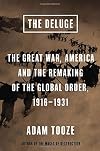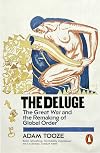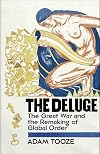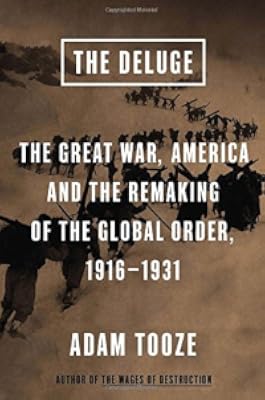
The Deluge: The Great War, America and the Remaking of the Global Order, 1916-1931
by Adam Tooze
On This Page
Description
In the depths of the Great War, with millions dead and no imaginable end to the conflict, societies around the world began to buckle. The heart of the financial system shifted from London to New York. The infinite demands for men and materiel reached into countries far from the front. The strain of the war ravaged all economic and political assumptions, bringing unheard-of changes in the social and industrial order.A century after the outbreak of fighting, Adam Tooze revisits this seismic show more moment in history, challenging the existing narrative of the war, its peace, and its aftereffects. From the day the United States entered the war in 1917 to the precipice of global financial ruin, Tooze delineates the world remade by American economic and military power. Tracing the ways in which countries came to terms with America's centrality-including the slide into fascism-The Deluge is a chilling work of great originality that will fundamentally change how we view the legacy of World War I. show lessTags
Recommendations


Member Reviews
Adam Tooze is a British historian currently serving as Kathryn and Shelby Cullom Davis Professor of History at Columbia University. The Deluge, which won the 2015 LA Times Book Prize for History, is an incisive, extensively researched, and comprehensive retelling of the consequences and immediate aftermath of World War I.
Most historians have described the end of World War I as a return to old-fashioned power politics, with the winning states scrambling over the leftovers for influence and domination. Tooze sees it differently. Tooze avers that “[t]he Great War weakened all the European combatants irreversibly, even the strongest amongst them and even the victors.” The United States, on the other hand, came out of the war as the show more world’s dominant economic power, not having squandered its wealth or manpower on the war, and not as interested in empirical or colonial aggrandizement.
Tooze shows that Churchill, Hitler, and Trotsky were prescient in their understanding that a fundamental change had been effected in world affairs. In particular, Britain would no longer be acting as an arbiter of world affairs; that role had been assumed by a much greater economic power, the United States. Prior to the war, America barely registered in Europe. As Tooze pointed out in an interview:
"This year in Europe we’ve spent much time commemorating and discussing the outbreak of WWI, and in virtually none of those discussions does the U.S. even figure. It’s the war that transforms this, because in fighting the war, Britain, France and Russia make themselves financially dependent as never before on the U.S. Because their fighting depends on the blockade and the blockade impinges on the U.S. — and the one dimension of military power in which the United States has emerged is naval — it becomes clear that the decisive strategy … against Germany and its allies hinges on America’s willingness to go along.
There’s a really radical transformation from a position in which America is really … a nonentity in global politics to being really the decisive factor.”
But that Power (with a capital “P”) was reluctant to exercise its new found power (with a lower case “p”). President Wilson wanted a “peace without victors,” and he did his best to promote “self-determination” among various (predominantly white European) ethnic groups, and to prevent the war’s big winners from taking too much from the losers. Moreover, he was too enamored of his own ideas to lend support for the ideas of others. In Tooze’s words:
"Why did the western Powers lose their grip in such spectacular fashion? When all is said and done, the answer must be sought in the failure of the United States to cooperate with the efforts of the French, British, Germans, and the Japanese to stabilize a viable world economy and to establish new institutions of collective security.”
Furthermore, the reluctance of America to assert its new hegemony in world affairs may have not only discouraged the development of genuine democracy in China but conversely allowed for the rise of fascism and communism in Europe and Russia. Differing from many other historians of the period, Tooze contends that “[w]e grasp movements like fascism or Soviet communism only very partially if we normalize them as familiar expressions of the racist, imperialist mainstream of modern European history…” Rather, for Tooze,
"It was precisely the looming potential, the future dominance of American capitalist democracy, that was the common factor impelling Hitler, Stalin, the Italian Fascists and their Japanese counterparts to such radical action.”
Evaluation: This is an excellent book, with a well-written and powerfully argued thesis presenting a novel view of a very important historical period. While some may argue about the relative influence of the new American hegemony on the ideological fanaticism of other parts of the world, it cannot be denied that Tooze gives the student of history much to consider. show less
Most historians have described the end of World War I as a return to old-fashioned power politics, with the winning states scrambling over the leftovers for influence and domination. Tooze sees it differently. Tooze avers that “[t]he Great War weakened all the European combatants irreversibly, even the strongest amongst them and even the victors.” The United States, on the other hand, came out of the war as the show more world’s dominant economic power, not having squandered its wealth or manpower on the war, and not as interested in empirical or colonial aggrandizement.
Tooze shows that Churchill, Hitler, and Trotsky were prescient in their understanding that a fundamental change had been effected in world affairs. In particular, Britain would no longer be acting as an arbiter of world affairs; that role had been assumed by a much greater economic power, the United States. Prior to the war, America barely registered in Europe. As Tooze pointed out in an interview:
"This year in Europe we’ve spent much time commemorating and discussing the outbreak of WWI, and in virtually none of those discussions does the U.S. even figure. It’s the war that transforms this, because in fighting the war, Britain, France and Russia make themselves financially dependent as never before on the U.S. Because their fighting depends on the blockade and the blockade impinges on the U.S. — and the one dimension of military power in which the United States has emerged is naval — it becomes clear that the decisive strategy … against Germany and its allies hinges on America’s willingness to go along.
There’s a really radical transformation from a position in which America is really … a nonentity in global politics to being really the decisive factor.”
But that Power (with a capital “P”) was reluctant to exercise its new found power (with a lower case “p”). President Wilson wanted a “peace without victors,” and he did his best to promote “self-determination” among various (predominantly white European) ethnic groups, and to prevent the war’s big winners from taking too much from the losers. Moreover, he was too enamored of his own ideas to lend support for the ideas of others. In Tooze’s words:
"Why did the western Powers lose their grip in such spectacular fashion? When all is said and done, the answer must be sought in the failure of the United States to cooperate with the efforts of the French, British, Germans, and the Japanese to stabilize a viable world economy and to establish new institutions of collective security.”
Furthermore, the reluctance of America to assert its new hegemony in world affairs may have not only discouraged the development of genuine democracy in China but conversely allowed for the rise of fascism and communism in Europe and Russia. Differing from many other historians of the period, Tooze contends that “[w]e grasp movements like fascism or Soviet communism only very partially if we normalize them as familiar expressions of the racist, imperialist mainstream of modern European history…” Rather, for Tooze,
"It was precisely the looming potential, the future dominance of American capitalist democracy, that was the common factor impelling Hitler, Stalin, the Italian Fascists and their Japanese counterparts to such radical action.”
Evaluation: This is an excellent book, with a well-written and powerfully argued thesis presenting a novel view of a very important historical period. While some may argue about the relative influence of the new American hegemony on the ideological fanaticism of other parts of the world, it cannot be denied that Tooze gives the student of history much to consider. show less
TL;DR: all of our problems are Woodrow Wilson's fault.
A detailed analysis of the politics and economics from the middle of WWI until the fateful events of 1931 steered central Europe toward totalitarianism and made WWII inevitable.
The author makes the perceptive observation how everything at this time gravitated around the United States and the policies it would pursue. The Entente was completely dependent on US finances and materiel; the central European powers understood how the United States would become a significant threat to their positions of power in the 20th century.
The United States had no problem using their standing for their political and economic benefit, but did not exactly see itself as responsible for the world show more order.
They wanted to promote some kinds of democracy in places like Europe; less so in Asia.
It is fascinating to read about the various postures of Britain, France, and Germany, especially how there could have been a real future for the Weimar Republic if it hadn't been for a lot of the decisions made by the Entente. France is interested in its future survival; Britain, about its power. We all know how it all turned out.
Very important analysis. Highly recommended. show less
A detailed analysis of the politics and economics from the middle of WWI until the fateful events of 1931 steered central Europe toward totalitarianism and made WWII inevitable.
The author makes the perceptive observation how everything at this time gravitated around the United States and the policies it would pursue. The Entente was completely dependent on US finances and materiel; the central European powers understood how the United States would become a significant threat to their positions of power in the 20th century.
The United States had no problem using their standing for their political and economic benefit, but did not exactly see itself as responsible for the world show more order.
They wanted to promote some kinds of democracy in places like Europe; less so in Asia.
It is fascinating to read about the various postures of Britain, France, and Germany, especially how there could have been a real future for the Weimar Republic if it hadn't been for a lot of the decisions made by the Entente. France is interested in its future survival; Britain, about its power. We all know how it all turned out.
Very important analysis. Highly recommended. show less
Maybe you were thinking Noah came into the story somewhere?
This is a book on the effort to create a stable new global order following the First World War, and on the role the United States played in the events of this time. It begins more or less with the U.S. intervention in the First World War and continues up to the Great Depression and the rise of Hitler.
It's revisionist but of the mild and credible kind. Tooze argues that the United States had already become the superpower by the end of the First World War, and that the effort of the United States to remain exceptional did not turn out well. He does not mean that the United States was isolationist; he makes the argument that genuine isolationism was a phenomenon that arrived with show more the Great Depression and was something of an aberration. He seems to be thinking more of the notion that the United States could impose its particular liberal vision on the world without having to much change itself. I'm not sure I'm very sympathetic with this view, but then I'm also not sure Tooze actually pushes it that hard. In fact, while Tooze tries to look at this time period with fresh eyes, he seems to make a lot of the unspoken assumptions common to modern academia. Tooze routinely uses "liberal" and "progressive" as synonyms for "good" and "conservative" as a synonym for "bad" but in not quite as obnoxious a manner as one might fear.
That's the bad news. The good news is that the history is served pretty much straight up, and in a fairly readable way for a 518-page book (not counting the extensive footnotes.) It's not quick reading, which was a bit of a problem for me since I had it on one-week new book loan from my library, but apparently no one else is jumping to read it because I was able to renew twice. Yeah, I gots lots else going on right now.
My knowledge of this time history was not terribly deep, and I feel a little as if I've just drunk from a fire hose. But a few things that stand out:
Wilson really, really wanted "peace without victory" and most everyone else would probably have settled for it but for one little problem: The French had had their best industrial regions occupied for years, and the departing Germans had quite thoroughly flooded and demolished France's best coal mines, with the quite deliberate intent of crippling French industry for a generation. And demographics dictated that Germany would only become a worse security threat to France if something was not done. Hence, reparations were rather important to France. They were less important if France succeeded in making a lasting security alliance with Great Britain and the United States, but things didn't work out that way.
The Russian revolution -- by which I mean the first, non-Communist one -- had quite a lot of popular support. Lenin comes across as almost as cynical and ruthless as Stalin. The negotiations at Brest-Litovsk were actually working towards a just and sustainable peace in eastern Europe, with a lot of genuine attention paid to the Wilsonian ideal of self-determination, until Lenin kicked over the ant pile, threw all eastern Europe into turmoil (yes, even greater than during the fighting), alienated the Entente, and tried to suck up to Germany by giving the Germans everything they might want. The German Army sense weakness, took over the negotiations, and imposed brutal terms that made a mockery of the earlier quest for a just and sustainable peace. I was struck how democracy actually had some foothold in imperial Germany; the famous mutiny of the German Navy was sailors who mutinied against officers that wanted to disobey the government and fight one last battle against the Entente. (Which raises the question: Does that really constitute a mutiny?)
The Bolsheviks very nearly lost the Russian civil war. They won largely because the Entente decided that a powerful and united white Russia was not in their interest. This strikes me as a wee bit of a miscalculation.
The Republicans who famously scuttled the Versailles Treaty were hardly isolationists; they were led by men who were as internationalist in outlook as Wilson. But the Republicans put more stock in a French-British-American strategic alliance than in the League (well, so did France and Britain), and Wilson absolutely refused to accept any advice on the treaty or to consider any modifications to its terms. So the whole thing turned into a pissing match.
The upshot was neither a league nor a forerunner to NATO, heavy reparations that were not actually heavy enough to repair the damage to France, no agreements that might settle wartime debts, a brutal postwar inflation that was nipped by the painful (and, today, politically impossible) expedient of brutal central bank deflation, and a cycle of money loaned by U.S. bankers to Germany which was used to pay reparations to France which was used to pay war debts back to the United States. This did not end well.
Turkey was an absolute mess, and Britain very nearly went back to war against a most improbable alliance of Turkey and Russia. Britain felt enormous pressure from the Muslim community in India to give generous terms to the Ottomans, but the nationalists ended up taking over Turkey making the issue moot. Not before tens of thousands more died in the fighting in Turkey, including a large contingent of Greeks happy to settle old scores in a proxy war for Britain.
Lenin continued to suck up to Germany, culminating in the Treaty of Rapallo. This alliance never really died until 1941.
Tooze claims that the new order established after World War I was actually pretty resilient, judging from how it weathered all these crises -- certainly more resilient than the aristocratic system that preceded it in most of Europe. What brought it all down was the Great Depression, and what caused the Great Depression was too great reluctance to leave the gold standard, coupled with Smoot-Tawley (the onset of genuine U.S. isolationism), coupled with a really boneheaded decision by a conservative German government to announce negotiations for a customs union with Austria that panicked all the financial markets of Europe. I suppose that's as good a theory as any.
Really, just too much here to digest quickly. Probably a book that rewards re-reading, if I can ever find the time. show less
This is a book on the effort to create a stable new global order following the First World War, and on the role the United States played in the events of this time. It begins more or less with the U.S. intervention in the First World War and continues up to the Great Depression and the rise of Hitler.
It's revisionist but of the mild and credible kind. Tooze argues that the United States had already become the superpower by the end of the First World War, and that the effort of the United States to remain exceptional did not turn out well. He does not mean that the United States was isolationist; he makes the argument that genuine isolationism was a phenomenon that arrived with show more the Great Depression and was something of an aberration. He seems to be thinking more of the notion that the United States could impose its particular liberal vision on the world without having to much change itself. I'm not sure I'm very sympathetic with this view, but then I'm also not sure Tooze actually pushes it that hard. In fact, while Tooze tries to look at this time period with fresh eyes, he seems to make a lot of the unspoken assumptions common to modern academia. Tooze routinely uses "liberal" and "progressive" as synonyms for "good" and "conservative" as a synonym for "bad" but in not quite as obnoxious a manner as one might fear.
That's the bad news. The good news is that the history is served pretty much straight up, and in a fairly readable way for a 518-page book (not counting the extensive footnotes.) It's not quick reading, which was a bit of a problem for me since I had it on one-week new book loan from my library, but apparently no one else is jumping to read it because I was able to renew twice. Yeah, I gots lots else going on right now.
My knowledge of this time history was not terribly deep, and I feel a little as if I've just drunk from a fire hose. But a few things that stand out:
Wilson really, really wanted "peace without victory" and most everyone else would probably have settled for it but for one little problem: The French had had their best industrial regions occupied for years, and the departing Germans had quite thoroughly flooded and demolished France's best coal mines, with the quite deliberate intent of crippling French industry for a generation. And demographics dictated that Germany would only become a worse security threat to France if something was not done. Hence, reparations were rather important to France. They were less important if France succeeded in making a lasting security alliance with Great Britain and the United States, but things didn't work out that way.
The Russian revolution -- by which I mean the first, non-Communist one -- had quite a lot of popular support. Lenin comes across as almost as cynical and ruthless as Stalin. The negotiations at Brest-Litovsk were actually working towards a just and sustainable peace in eastern Europe, with a lot of genuine attention paid to the Wilsonian ideal of self-determination, until Lenin kicked over the ant pile, threw all eastern Europe into turmoil (yes, even greater than during the fighting), alienated the Entente, and tried to suck up to Germany by giving the Germans everything they might want. The German Army sense weakness, took over the negotiations, and imposed brutal terms that made a mockery of the earlier quest for a just and sustainable peace. I was struck how democracy actually had some foothold in imperial Germany; the famous mutiny of the German Navy was sailors who mutinied against officers that wanted to disobey the government and fight one last battle against the Entente. (Which raises the question: Does that really constitute a mutiny?)
The Bolsheviks very nearly lost the Russian civil war. They won largely because the Entente decided that a powerful and united white Russia was not in their interest. This strikes me as a wee bit of a miscalculation.
The Republicans who famously scuttled the Versailles Treaty were hardly isolationists; they were led by men who were as internationalist in outlook as Wilson. But the Republicans put more stock in a French-British-American strategic alliance than in the League (well, so did France and Britain), and Wilson absolutely refused to accept any advice on the treaty or to consider any modifications to its terms. So the whole thing turned into a pissing match.
The upshot was neither a league nor a forerunner to NATO, heavy reparations that were not actually heavy enough to repair the damage to France, no agreements that might settle wartime debts, a brutal postwar inflation that was nipped by the painful (and, today, politically impossible) expedient of brutal central bank deflation, and a cycle of money loaned by U.S. bankers to Germany which was used to pay reparations to France which was used to pay war debts back to the United States. This did not end well.
Turkey was an absolute mess, and Britain very nearly went back to war against a most improbable alliance of Turkey and Russia. Britain felt enormous pressure from the Muslim community in India to give generous terms to the Ottomans, but the nationalists ended up taking over Turkey making the issue moot. Not before tens of thousands more died in the fighting in Turkey, including a large contingent of Greeks happy to settle old scores in a proxy war for Britain.
Lenin continued to suck up to Germany, culminating in the Treaty of Rapallo. This alliance never really died until 1941.
Tooze claims that the new order established after World War I was actually pretty resilient, judging from how it weathered all these crises -- certainly more resilient than the aristocratic system that preceded it in most of Europe. What brought it all down was the Great Depression, and what caused the Great Depression was too great reluctance to leave the gold standard, coupled with Smoot-Tawley (the onset of genuine U.S. isolationism), coupled with a really boneheaded decision by a conservative German government to announce negotiations for a customs union with Austria that panicked all the financial markets of Europe. I suppose that's as good a theory as any.
Really, just too much here to digest quickly. Probably a book that rewards re-reading, if I can ever find the time. show less
5274. The Deluge The Great War, America and the Remaking of the Global Order, 1916-1931, by Adam Tooze (read 12 May 2015) This excellent book covers the years from 1916 to 1931, telling of the economic and diplomatic events and showing that mistakes were made which resulted in much evil for the world. He details Wilson's early view that peace without victory would have been preferable for all the world and I think one has to, with the benefit of hindsight, agree with that. The awfulness of Hitler might have been avoided. The book is full of insights, with many of which I agreed. It is an absorbing read which I found utterly fascinating.
Tooze retells some of the runup to WWI as well as the consequences of the peace, arguing that many of the things that set the stage for WWII were about responding to the rise of the United States as an unprecedented level of hegemon and the US’s simultaneous refusal to acknowledge its role. When the US demanded war debt repayment but didn’t promise France any help with ensuring its security against the Germans, for example, France occupied the Ruhr. Tooze also gives a fair amount of time to China and Japan.
This was picked up - read - put down - picked up - read - put down. Finally, about a month a go, I had to tell myself "No excuses! Ten pages a day minimum!" Very informative, insightful, and surprisingly readable (though very, very dense). It follows an unusual path between chronological and topical that can make different related events difficult to view in relation to each other quite frequently, but with such an enormous width and depth of information on so many differing concepts, such a problem is insurmountable without getting exceptionally repetitive. I enjoyed this quite immensely.
Useful for it's narrow focus on importance of America in the concluding years of WWI - surprising parts about China/Japan and the financial side of things. For example, great section on Japan trying to put in a agreed point in a treaty about racial equality and being battered back - by England mostly, but also US. Rather loses the thread (for me) with the deep machinations about reparations, gold standard and America's selfish actions that ruined everything for everyone (why?).
Members
- Recently Added By
Lists

World War I books
32 works; 8 members

Books about World War I
80 works; 14 members
Author Information

Adam Tooze teaches in the history faculty, University of Cambridge.
Some Editions
Awards and Honors
Awards
Notable Lists
Series
Belongs to Publisher Series
Common Knowledge
- Canonical title
- The Deluge: The Great War, America and the Remaking of the Global Order, 1916-1931
- Original title
- The Deluge. The Great War, America and the remaking of the global order, 1916-1931
- Original publication date
- 2014 (1e édition originale anglaise ∙ Allen Lane) (1e édition originale anglaise ∙ Allen Lane); 2015-10-19 (1e traduction et édition française ∙ Les Belles lettres) (1e traduction et édition française ∙ Les Belles lettres)
- Important events
- World War I
- First words*
- Introduction
Le déluge ou la refondation de l'ordre mondial
Noël 1915, au matin, David Lloyd George, jadis libéral-radical et désormais ministre des Munitions, s'adresse à une foule tumultueuse de... (show all) syndicalistes glaswégiens. [...] - Original language*
- Anglais (Etats-Unis) (Etats-Unis)
*Some information comes from Common Knowledge in other languages. Click "Edit" for more information.
Classifications
Statistics
- Members
- 644
- Popularity
- 45,107
- Reviews
- 12
- Rating
- (4.09)
- Languages
- 5 — Dutch, English, French, German, Spanish
- Media
- Paper, Audiobook, Ebook
- ISBNs
- 18
- UPCs
- 2
- ASINs
- 6