On This Page
Description
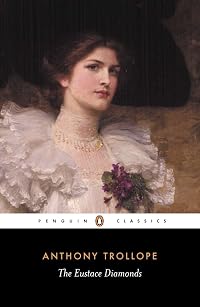
The third novel in his famed Palliser series, Anthony Trollope's The Eustace Diamonds centers on a beautiful diamond necklace that has been passed down for generations in the Eustace family and has now fallen into the hands of Lizzie Greystock, a gold digger extraordinaire. Soon afterwards, Lizzie reports the diamonds missing, but is there more to this story than meets the eye?.
Tags
Recommendations

















Member Reviews
Fanny Price meets Becky Sharp in a straight fight, no holds barred. Plus a detective story à la Wilkie Collins, a cameo appearance by Lady Glencora Palliser, an attempt to introduce decimal currency a hundred years too soon, and a couple of racy Surteesian hunting sequences—plenty of fun for all. The story itself isn't as interesting as the detailing of the characters and dialogue (we have a pretty good idea how it's all going to turn out), but it's still good fun. Lizzie Eustace, the Becky-character, is especially nicely done: utterly amoral, a skilled liar, but just a fraction short of being clever enough to get everything she wants.
The political background this time isn't much (the decimal-currency saga is a very minor show more distraction), but the story of the diamonds does run along on the fringe of one of the hot topics of the time, the extent to which married women could own property in their own right. Very possibly this is the only place in English literature where the reader needs to understand the legal definition of "paraphernalia". show less
The political background this time isn't much (the decimal-currency saga is a very minor show more distraction), but the story of the diamonds does run along on the fringe of one of the hot topics of the time, the extent to which married women could own property in their own right. Very possibly this is the only place in English literature where the reader needs to understand the legal definition of "paraphernalia". show less
This novel is notable for one unsympathetic female protagonist, Lizzie Greystock Eustace; one somewhat insipid protagonist, Lucy Morris; and a moving portrait of a woman driven into a nervous breakdown by pressure to marry a man she physically loathes, Lucinda Roanoke. Trollope may often adhere to the letter of Victorian morality in contemning some of his heroines that the modern reader finds unexceptional, but he also excels in understanding the pressures affecting his characters in the artificial structures of upper middle class life.
Rather a darker installation of the Palliser books than the previous two, with nobody very pleasant except some of our friends from earlier volumes making cameo appearances. This book is pretty much a catalog of horribles, but with one of the most interesting horribles ever written populating its pages. Lizzie Eustace, to put it bluntly, is a real piece of work, a born schemer who can't seem to stop even when she knows she's just hurting herself and those around her. No matter how much you might want to, you can't look away, either. The subplots in this one aren't quite as well-developed (or as interesting) in other Trollope novels, but both, like the main storyline, are quite discomforting.
Now, back to the adventures of our old buddy show more Phineas Finn, if the title of the next book is in any way descriptive. show less
Now, back to the adventures of our old buddy show more Phineas Finn, if the title of the next book is in any way descriptive. show less
In The Eustace Diamonds, Anthony Trollope explores the dark side of marriage in the Victorian era. Our heroine, Lizzie Eustace, is a very unlikeable young widow who, thanks to her husband's fortune, has a roof over her head and a steady income until her son comes of age and inherits everything. She is also in possession of a diamond necklace, which she insists was a gift from her husband but by law is not rightfully hers. A lawsuit is brought against her concerning the necklace, and Lizzie pouts and stamps her feet and refuses to deal with it. Her fiance, Lord Fawn, begins to regret his proposal. Meanwhile, Lizzie's cousin Frank Greystock has fallen in love with Lucy Morris, who works as a governess in the Fawn family and is Lizzie's show more complete opposite: kind, honest, and poor. Frank is a lawyer and Member of Parliament, but in the eyes of his family "needs" to marry money. In that respect, Lizzie would be a much better match and while Frank finds her attractive, he knows Lucy is the better person. When Lizzie's necklace is stolen, the pace picks up and Lizzie becomes further entrenched in selfish deceit.
I liked this book less than the earlier Palliser and Barchester novels. It was darker and lacked the satire Trollope is known for. The characters were unlikeable or boring, and familiar faces from previous books were not sufficiently present to compensate. There was also a strong anti-semitic thread involving jewelers, money-lenders, and a clergyman and while I understand the views expressed were typical of that time period, it made for unpleasant reading. But at least now I can say I'm halfway through the Palliser novels, and look forward to the next one. show less
I liked this book less than the earlier Palliser and Barchester novels. It was darker and lacked the satire Trollope is known for. The characters were unlikeable or boring, and familiar faces from previous books were not sufficiently present to compensate. There was also a strong anti-semitic thread involving jewelers, money-lenders, and a clergyman and while I understand the views expressed were typical of that time period, it made for unpleasant reading. But at least now I can say I'm halfway through the Palliser novels, and look forward to the next one. show less
"The Eustace Diamonds" is probably the most well-recognized of the "Palliser" novels… a series written by Anthony Trollope in the 1870’s.
The author’s theme centers on society in Victorian London where there were few wealthy people, a small middle class, vast distinction between the “haves and the have-nots”, and a commonly accepted practice of marrying for money and status. Life was not easy, especially for women. They could not hold positions of power and even if they inherited money, staying single was not an option. They needed an escort… a protector… a husband… to give them even minimal recognition, status, and credibility.
This story focuses on the greed of Lizzie Eustace and the extremes to which she goes to achieve show more wealth and local fame, and her stubborn determination to hold onto a very expensive heirloom diamond necklace that rightfully belongs to her late husband’s estate. The plot - similar to “Age of Innocence”- involves the allure of a beautiful non-conformist woman who is perceived to have “scandalous” behavior, and a respected gentleman bachelor - Lizzie’s cousin Frank - who is torn between maintaining proper social protocol and the temptations of the flirtatious seductress. Subplots involve Lizzie’s other suitors, friends, and house guests including one plain, lower class governess who is madly in love with Frank.
I liked the writing style, the satire, the humor, and the philosophical message of The Eustace Diamonds but found myself personally offended by the blatant amount of anti-Semitism. True enough that during this era in Eastern Europe, Jewish people often found themselves on the fringes of society. But in Trollope’s view, all Jewish people were villains and all villains just happened to be Jewish. He consistently describes them as “dark, shady, greasy, characters”.
This was my first experience reading Trollope and I was curious to learn if he used harsh, derogatory descriptions of Jewish people in any of his other numerous novels. Upon googling “Trollope” and “Anti-Semitism”, I was astounded to uncover 6,040 similar observations by others. I suppose the Jewish characters of his numerous novels could have merely been a reflection of upper-class British mentality during that era, but he certainly didn’t attempt to dispel the negative stereotype. Instead he exploited and capitalized on it.
Trollope may have been the most “successful, prolific, respected English Novelist of the Victorian era” (quoted from Wikipedia), but he apparently had been an embarrassingly small-minded man in terms of today’s thinking. show less
The author’s theme centers on society in Victorian London where there were few wealthy people, a small middle class, vast distinction between the “haves and the have-nots”, and a commonly accepted practice of marrying for money and status. Life was not easy, especially for women. They could not hold positions of power and even if they inherited money, staying single was not an option. They needed an escort… a protector… a husband… to give them even minimal recognition, status, and credibility.
This story focuses on the greed of Lizzie Eustace and the extremes to which she goes to achieve show more wealth and local fame, and her stubborn determination to hold onto a very expensive heirloom diamond necklace that rightfully belongs to her late husband’s estate. The plot - similar to “Age of Innocence”- involves the allure of a beautiful non-conformist woman who is perceived to have “scandalous” behavior, and a respected gentleman bachelor - Lizzie’s cousin Frank - who is torn between maintaining proper social protocol and the temptations of the flirtatious seductress. Subplots involve Lizzie’s other suitors, friends, and house guests including one plain, lower class governess who is madly in love with Frank.
I liked the writing style, the satire, the humor, and the philosophical message of The Eustace Diamonds but found myself personally offended by the blatant amount of anti-Semitism. True enough that during this era in Eastern Europe, Jewish people often found themselves on the fringes of society. But in Trollope’s view, all Jewish people were villains and all villains just happened to be Jewish. He consistently describes them as “dark, shady, greasy, characters”.
This was my first experience reading Trollope and I was curious to learn if he used harsh, derogatory descriptions of Jewish people in any of his other numerous novels. Upon googling “Trollope” and “Anti-Semitism”, I was astounded to uncover 6,040 similar observations by others. I suppose the Jewish characters of his numerous novels could have merely been a reflection of upper-class British mentality during that era, but he certainly didn’t attempt to dispel the negative stereotype. Instead he exploited and capitalized on it.
Trollope may have been the most “successful, prolific, respected English Novelist of the Victorian era” (quoted from Wikipedia), but he apparently had been an embarrassingly small-minded man in terms of today’s thinking. show less
Loved. I marvel at the author creating a compelling story out of a palpably uninteresting story of who owns some diamonds / how some diamonds weren't really stolen and then were stolen. But that anti-heroine.... so real so false so true. The pleasures of the twists and resolutions were many. So glad that it all worked out for the policeman and Patience Crabstick.
And to imagine I considered skipping this one and moving on to the looked forward to Phineas Redux...
And to imagine I considered skipping this one and moving on to the looked forward to Phineas Redux...
Oh, what a maddening book!
As I read there were moments when I thought this might be my favourite Trollope (to date) and there were moments when I thought it would be at the bottom of the list.
In the end I did like it. But ….
The story spins around Lizzie Greystock, who will quickly rise to become Lady Eustace.
Lizzie was the only child of the disreputable Admiral Greystock, who died leaving her nothing but debts. Fortunately his daughter had learned to live by her wits, and she realised that to marry money to make her way in the world. And so she chose to live with a rather difficult elderly relation, because that put her in the right location and the right strata of society to catch a wealthy husband.
She caught Sir Florian Eustace. He show more was exceedingly rich, but he was in poor health, and Lizzie was a widow before her first wedding anniversary. She was wealthy, she would soon be the other of the Eustace heir, and she was in possession of the Eustace Diamonds; a fabulous diamond necklace, valued at ten thousand pounds then, which equates to around half a million now
Lizzie said that they were hers; the Eustace family insisted that they were part of the estate and must be returned to the trustees. Though Lizzie knew her claim was shaky she held her ground, she spun a very good story, and she began to look for a husband who she hoped would protect her and look after her interests.
Lord Fawn proposed, but he tried to back out when he realised that dispute over the diamonds might have consequences for his own reputation for her. Lizzie didn’t want to marry a an like that, but she wasn’t going to let herself be jilted. She had to be the victor, she had to have the final word. Always.
She was fond of her cousin Frank, the only one of her relations who had stood by her, and Lizzie knew that, as a barrister and a member of parliament with very limited resources, he needed a wealthy bride. She didn’t understand why he didn’t propose. She didn’t know – he didn’t tell her – that he was engaged already.
Lucy Morris had been left alone in the world, just like Lizzie, but she had dealt with the situation rather differently. She accepted that she had to earn her own living, she became a governess, and she had the qualities she needed to make her a very good governess. She loved Frank, she knew that he loved her, but because she worked for the Fawn family she found herself in a rather awkward position.
One night, when she was travelling between her Scottish home and her London home Lizzie’s room was broken into, and the metal chest that kept her diamonds secure was stolen.
Who was responsible? Who had the diamonds?
The answer was surprising, and it seemed inevitable that Lizzie’s lies would be revealed and that she, and anyone close to her, would be ruined.
How ever could Lizzie rise above that.
The way the story played out was wonderful.
But I couldn’t help thinking that it didn’t suit its author, that there were other authors who might have handled this particular story rather better.
most of all, I was disappointed that Trollope, who usually had understanding for all of his characters, had none for Lizzie. He said at the start that he didn’t like her and he took every chance he could to point out that she was manipulative, dishonest, a compulsive liar, a thief …..
Yes, she was all of those things, but I understood why. I couldn’t warm to her, but I appreciated that she was taking charge of her own life, that she strove to be successful and to find her ‘corsair’ – the dashing romantic hero who would sweep her off her feet.
She was all those things, but she was so much more than that.
Others are judged less harshly.
Consider Frank, who proposes when he knows his financial situation makes marriage impossible, and who neglects his fiancée because he must look after his cousin’s interests.
Consider Lizzie’s friend Mrs Carbuncle who is determined that her niece Lucy must marry, who pushed her towards an engagement with a horrible man, and who fails to understand that her niece feels only revulsion, so that in the end her mind snaps.
Both of those stories were neglected; they felt secondary, and they are fatally compromised; Lucy would have been much more at home in a Dickens novel; I’d love to see what Wilkie Collins could do with Lucinda’s story.
A lot of this book just didn’t feel like Trollope; it feels like an attempt to do something a little different. There’s an early reference to ‘Vanity Fair’ and though this is a very different story I think that’s telling.
I still have to say that there was much that I loved.
I loved Lady Fawn, who was both warm and gracious, and who did her very best for Lucy.
I loved watching first Lizzie and then Lucy deal with the rather difficult Lady Linlithgow, in very different ways and with very different consequences.
I loved the sojourns – and the incidents – in the Scottish countryside.
I loved watching Lizzie outmanoeuvre Lord Fawn, who was ever bit as wishy-washy and self-serving as I remembered from ‘Phinneas Finn’
Most of all I loved watching Lizzie and following her progress.
Yes, I found much to enjoy, but I’m afraid that the book as a whole didn’t work as well as Trollope's usually does. show less
As I read there were moments when I thought this might be my favourite Trollope (to date) and there were moments when I thought it would be at the bottom of the list.
In the end I did like it. But ….
The story spins around Lizzie Greystock, who will quickly rise to become Lady Eustace.
Lizzie was the only child of the disreputable Admiral Greystock, who died leaving her nothing but debts. Fortunately his daughter had learned to live by her wits, and she realised that to marry money to make her way in the world. And so she chose to live with a rather difficult elderly relation, because that put her in the right location and the right strata of society to catch a wealthy husband.
She caught Sir Florian Eustace. He show more was exceedingly rich, but he was in poor health, and Lizzie was a widow before her first wedding anniversary. She was wealthy, she would soon be the other of the Eustace heir, and she was in possession of the Eustace Diamonds; a fabulous diamond necklace, valued at ten thousand pounds then, which equates to around half a million now
Lizzie said that they were hers; the Eustace family insisted that they were part of the estate and must be returned to the trustees. Though Lizzie knew her claim was shaky she held her ground, she spun a very good story, and she began to look for a husband who she hoped would protect her and look after her interests.
Lord Fawn proposed, but he tried to back out when he realised that dispute over the diamonds might have consequences for his own reputation for her. Lizzie didn’t want to marry a an like that, but she wasn’t going to let herself be jilted. She had to be the victor, she had to have the final word. Always.
She was fond of her cousin Frank, the only one of her relations who had stood by her, and Lizzie knew that, as a barrister and a member of parliament with very limited resources, he needed a wealthy bride. She didn’t understand why he didn’t propose. She didn’t know – he didn’t tell her – that he was engaged already.
Lucy Morris had been left alone in the world, just like Lizzie, but she had dealt with the situation rather differently. She accepted that she had to earn her own living, she became a governess, and she had the qualities she needed to make her a very good governess. She loved Frank, she knew that he loved her, but because she worked for the Fawn family she found herself in a rather awkward position.
One night, when she was travelling between her Scottish home and her London home Lizzie’s room was broken into, and the metal chest that kept her diamonds secure was stolen.
Who was responsible? Who had the diamonds?
The answer was surprising, and it seemed inevitable that Lizzie’s lies would be revealed and that she, and anyone close to her, would be ruined.
How ever could Lizzie rise above that.
The way the story played out was wonderful.
But I couldn’t help thinking that it didn’t suit its author, that there were other authors who might have handled this particular story rather better.
most of all, I was disappointed that Trollope, who usually had understanding for all of his characters, had none for Lizzie. He said at the start that he didn’t like her and he took every chance he could to point out that she was manipulative, dishonest, a compulsive liar, a thief …..
Yes, she was all of those things, but I understood why. I couldn’t warm to her, but I appreciated that she was taking charge of her own life, that she strove to be successful and to find her ‘corsair’ – the dashing romantic hero who would sweep her off her feet.
She was all those things, but she was so much more than that.
Others are judged less harshly.
Consider Frank, who proposes when he knows his financial situation makes marriage impossible, and who neglects his fiancée because he must look after his cousin’s interests.
Consider Lizzie’s friend Mrs Carbuncle who is determined that her niece Lucy must marry, who pushed her towards an engagement with a horrible man, and who fails to understand that her niece feels only revulsion, so that in the end her mind snaps.
Both of those stories were neglected; they felt secondary, and they are fatally compromised; Lucy would have been much more at home in a Dickens novel; I’d love to see what Wilkie Collins could do with Lucinda’s story.
A lot of this book just didn’t feel like Trollope; it feels like an attempt to do something a little different. There’s an early reference to ‘Vanity Fair’ and though this is a very different story I think that’s telling.
I still have to say that there was much that I loved.
I loved Lady Fawn, who was both warm and gracious, and who did her very best for Lucy.
I loved watching first Lizzie and then Lucy deal with the rather difficult Lady Linlithgow, in very different ways and with very different consequences.
I loved the sojourns – and the incidents – in the Scottish countryside.
I loved watching Lizzie outmanoeuvre Lord Fawn, who was ever bit as wishy-washy and self-serving as I remembered from ‘Phinneas Finn’
Most of all I loved watching Lizzie and following her progress.
Yes, I found much to enjoy, but I’m afraid that the book as a whole didn’t work as well as Trollope's usually does. show less
Members
- Recently Added By
Lists

Favourite 19th century fiction
257 works; 62 members

Read the book and saw the movie
1,170 works; 195 members

Anti-heroines in fiction
59 works; 9 members

Folio Society
831 works; 53 members

Books Set in Great Britain
191 works; 13 members

19th Century
190 works; 16 members

Global Reads: Books Set in the United Kingdom and Ireland
109 works; 5 members

Victorian Period
113 works; 10 members

1870s
15 works; 2 members

Books Read in 2020
4,379 works; 123 members

Books Read in 2022
5,226 works; 115 members

Recommend the 20 best books you've read in the last five years
2,168 works; 608 members
New Lifetime Reading Plan by Fadiman and Major
225 works; 5 members

Tagged 19th Century
104 works; 7 members

Detective Stories
343 works; 5 members

Great American Authors
4 works; 1 member
Inheritance and Succession Literature
24 works; 5 members

W. S. Maugham's Reading Suggestions for Spiritual Enrichment: British
24 works; 3 members

Crinoline and gumption
12 works; 1 member
Talk Discussions
Past Discussions
Group read: The Eustace Diamonds by Anthony Trollope in 75 Books Challenge for 2015 (November 2017)
1815: Anthony Trollope - Palliser series III: The Eustace Diamonds in Literary Centennials (October 2015)
Author Information

343+ Works 50,701 Members
Anthony Trollope was born in London, England on April 24, 1815. In 1834, he became a junior clerk in the General Post Office, London. In 1841, he became a deputy postal surveyor in Banagher, Ireland. He was sent on many postal missions ending up as a surveyor general in the post office outside of London. His first novel, The Macdermots of show more Ballycloran, was published in 1847. His other works included Castle Richmond, The Last Chronicle of Barset, Lady Anna, The Two Heroines of Plumplington, and The Noble Jilt. He died after suffering from a paralytic stroke on December 6, 1882. (Bowker Author Biography) show less
Some Editions
Awards and Honors
Notable Lists
Series

Belongs to Publisher Series
Work Relationships
Is contained in
The Palliser Novels, Volume One, Including: Can You Forgive Her? Phineas Finn and the Eustace Diamonds by Anthony Trollope
The Palliser Novels: The Duke's Children, Phineas Redux, The Eustace Diamonds, Phineas Finn, Can You Forgive Her? 5 vol set by Anthony Trollope
Contains
Has the adaptation
Is abridged in
Has as a study
Common Knowledge
- Original publication date
- 1871-07-01 to 1873-02-01 as a serial in the Fortnightly Review; 1872-12-01 book form in 3 volumes
- People/Characters
- Lizzie Eustace; Lord Fawn; Lucy Morris; Frank Greystock; Mr. Camperdown; Mr. Emilius (show all 15); Lady Penelope Linlithgow; Sir Florian Eustace; Frank Greystock; Patience Crabstick; Lucinda Roanoke; Mrs. Jane Carbuncle; Lord George de Bruce Carruthers; Sir Griffin Tewett; Lady Glencora Palliser
- Important places
- Portray Castle, Scotland, UK (fictional); Brook Street, London, England, UK; London, England, UK
- First words
- It was admitted by all her friends, and also by her enemies, - who were in truth the more numerous and active body of the two, - that Lizzie Greystock had done very well with herself.
- Quotations
- We hear that a man has behaved badly to a girl, when the behaviour of which he has been guilty has resulted simply from want of thought. He has found a certain companionship to be agreeable to him, and he has accepted the ple... (show all)asure without inquiry. Some vague idea has floated across his brain that the world is wrong in supposing that such friendship cannot exist without marriage, or question of marriage. It is simply friendship. And yet were his friend to tell him that she intended to give herself in marriage elsewhere, he would suffer all the pangs of jealousy, and would imagine himself to be horribly ill-treated! To have such a friend,—a friend whom he cannot or will not make his wife,—is no injury to him. To him it is simply a delight, an excitement in life, a thing to be known to himself only and not talked of to others, a source of pride and inward exultation. It is a joy to think of when he wakes, and a consolation in his little troubles. It dispels the weariness of life, and makes a green spot of holiday within his daily work. It is, indeed, death to her;—but he does not know it.
"To have been always in the right, and yet always on the losing side, always being ruined . . and yet never to lose anything, is pleasant enough. A huge, living, daily increasing grievance that does one no palpable harm, is t... (show all)he happiest possession that a man can have." - Last words
- (Click to show. Warning: May contain spoilers.)In this opinion of the Duke of Omnium's, the readers of this story will perhaps agree.
- Original language
- English
Classifications
Statistics
- Members
- 2,165
- Popularity
- 9,454
- Reviews
- 43
- Rating
- (3.89)
- Languages
- English, French, Italian, Russian
- Media
- Paper, Audiobook, Ebook
- ISBNs
- 98
- ASINs
- 66