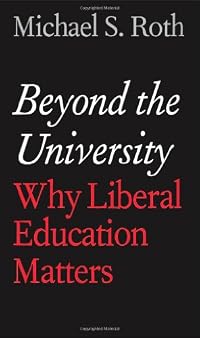
Beyond the University: Why Liberal Education Matters
by Michael S. Roth
On This Page
Description
"Contentious debates over the benefits-or drawbacks-of a liberal education are as old as America itself. From Benjamin Franklin to the Internet pundits, critics of higher education have attacked its irrelevance and elitism-often calling for more vocational instruction. Thomas Jefferson, by contrast, believed that nurturing a student's capacity for lifelong learning was useful for science and commerce while also being essential for democracy. In this provocative contribution to the disputes, show more university president Michael S. Roth focuses on important moments and seminal thinkers in America's long-running argument over vocational vs. liberal education. Conflicting streams of thought flow through American intellectual history: W.E.B. Du Bois's humanistic principles of pedagogy for newly emancipated slaves developed in opposition to Booker T. Washington's educational utilitarianism, for example. Jane Addams's emphasis on the cultivation of empathy and John Dewey's calls for education as civic engagement were rejected as impractical by those who aimed to train students for particular economic tasks. Roth explores these arguments (and more), considers the state of higher education today, and concludes with a stirring plea for the kind of education that has, since the founding of the nation, cultivated individual freedom, promulgated civic virtue, and instilled hope for the future"-- show lessTags
Recommendations



Member Reviews
Beyond the university: Why liberal education matters provides a comprehensive, well-documented historical review of philosophical thought about the role of higher education in the United States. Roth summarizes the views of Socrates, Benjamin Franklin, Thomas Jefferson, Frederick Douglass, Booker T. Washington, W. E. B. Du Bois, Thomas Jefferson, William James, Ralph Waldo Emerson, Jane Addams, Thomas Dewey, and others. Ultimately, however, I came away disappointed. Although the chronology of philosophical views is interesting, it is only in the last 10 pages that the author actually turns his attention to the topic implied by the title, why it matters.
Beyond the University must be judged a complete failure if Roth intended to craft a show more convincing case for liberal education. He relies exclusively on appeals to authority to support the importance of liberal education. Few readers—certainly not those who have benefited from a liberal education—will be content to uncritically apply the views of Socrates, Franklin or James to contemporary education. American society and the world are quite different from the situation confronting most of the writers reviewed in this volume. Through most of the book Roth made almost no attempt to relate the views of these philosophers to the issues and problems faced by contemporary students and educators.
Stylistically, the book reads like an undergraduate term paper. Roth relies primarily on quotations of the authors original words when paraphrasing their message would have yielded a more direct, understandable, cogent reading experience. He often writes in the passive academic style that lacks even a spark of liveliness. For example, an analysis of a representative selection from Beyond the University revealed that 29% of the sentences use a passive sentence structure.
Furthermore, the writing requires an unnecessarily advanced reading level. The Flesch Reading Ease score (28.3) of the portion I analyzed is close to that of the Harvard Law Review. The Flesch-Kincaid Grade Level (12.0) greatly exceeds the 9th grade reading level that states commonly require for important legal documents such as insurance policies. As if that is not enough, the reading difficulty is further increased by the failure to break the text into digestible segments. Many of the paragraphs go on for an entire page and often for two pages or more.
Roth's research is impressive but his ability to convey his message in an interesting style and illustrate its relevance to the contemporary issues is lacking. Beyond the University addresses a topic that will appeal to a highly educated audience, but with a bit of thought Roth could have pitched the text at a level that is more accessible to the broader audience that pays the taxes that support our schools, and sends their children to universities. That audience could benefit from a consideration about the best approach to American higher education. Instead, the book seems like an academic exercise rather than an attempt to make a case for the importance of contemporary liberal education. show less
Beyond the University must be judged a complete failure if Roth intended to craft a show more convincing case for liberal education. He relies exclusively on appeals to authority to support the importance of liberal education. Few readers—certainly not those who have benefited from a liberal education—will be content to uncritically apply the views of Socrates, Franklin or James to contemporary education. American society and the world are quite different from the situation confronting most of the writers reviewed in this volume. Through most of the book Roth made almost no attempt to relate the views of these philosophers to the issues and problems faced by contemporary students and educators.
Stylistically, the book reads like an undergraduate term paper. Roth relies primarily on quotations of the authors original words when paraphrasing their message would have yielded a more direct, understandable, cogent reading experience. He often writes in the passive academic style that lacks even a spark of liveliness. For example, an analysis of a representative selection from Beyond the University revealed that 29% of the sentences use a passive sentence structure.
Furthermore, the writing requires an unnecessarily advanced reading level. The Flesch Reading Ease score (28.3) of the portion I analyzed is close to that of the Harvard Law Review. The Flesch-Kincaid Grade Level (12.0) greatly exceeds the 9th grade reading level that states commonly require for important legal documents such as insurance policies. As if that is not enough, the reading difficulty is further increased by the failure to break the text into digestible segments. Many of the paragraphs go on for an entire page and often for two pages or more.
Roth's research is impressive but his ability to convey his message in an interesting style and illustrate its relevance to the contemporary issues is lacking. Beyond the University addresses a topic that will appeal to a highly educated audience, but with a bit of thought Roth could have pitched the text at a level that is more accessible to the broader audience that pays the taxes that support our schools, and sends their children to universities. That audience could benefit from a consideration about the best approach to American higher education. Instead, the book seems like an academic exercise rather than an attempt to make a case for the importance of contemporary liberal education. show less
Ratings
Members
- Recently Added By
Published Reviews
ThingScore 75
"“Beyond the University” is a lucid, helpful and accessible account of the current challenges to higher education. My only slight reservation comes from my conviction that liberal education at its best cannot be entirely circumscribed by the philosophical and rhetorical traditions." (The former, "emphasizing preparation for inquiry", the latter, "emphasizing initiation into a common show more culture through the study of canonical works"). show less
added by jodi
Lists

Books for Educators
164 works; 6 members
Author Information

11+ Works 317 Members
Michael S. Roth is president of Wesleyan University. A professor in history and the humanities, he teaches at Wesleyan and reaches many thousands more through his open online Coursera course, The Modern and the Post-Modern.
Awards and Honors
Awards
Common Knowledge
- Dedication
- For my teachers and my students
- First words
- When I began my freshman year at Wesleyan University almost forty years ago, I had only the vaguest notion of what a liberal education was.
- Last words
- (Click to show. Warning: May contain spoilers.)Liberal education matters far beyond the university because it increases our capacity to understand the world, contribute to it, and reshape ourselves. When it works, it never ends.
- Blurbers
- Bok, Derek; Mathews, Jay; Kronman, Anthony T.
Classifications
- Genres
- Nonfiction, General Nonfiction, History, Philosophy
- DDC/MDS
- 370.11 — Society, Government, and Culture Education Education Theory of education; Meaning; Aim Objectives of Education
- LCC
- LC1011 .R75 — Education Special aspects of education Special aspects of education Types of education Humanistic education. Liberal education
- BISAC
Statistics
- Members
- 131
- Popularity
- 246,410
- Reviews
- 1
- Rating
- (3.25)
- Languages
- English
- Media
- Paper, Ebook
- ISBNs
- 4
- ASINs
- 1