On This Page
Description
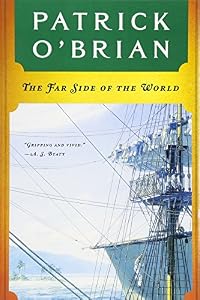
The South Seas are a paradise for battle-weary Captain Jack Aubrey and ship's surgeon Stephen Maturin. But their peace is disturbed when Stephen's fancy for a peculiar marine organism lands him overboard. Acting in his usual headstrong fashion, Jack dives in to the rescue, unfortunately failing to plan what will happen once they are both in the water watching the sails of the Surprise disappear in the mist.Tags
Recommendations







Member Reviews
The Far Side of The World, Patrick O’Brian’s tenth book in his Aubrey-Maturin series, picks up shortly after the events of Treason’s Harbour, with Captain Jack Aubrey tasked to take the HMS Surprise into the whaling waters around Cape Horn to protect British whalers from the USS Norfolk, tasked by the American Navy to harry British industry in those waters. Dr. Stephen Maturin, meanwhile, longs to see the natural specimens unique to that environment, particularly those of the Galapagos Islands, though, as Jack reminds him, the promise to stop there is “subject to the requirements of the service” (pg. 216). O’Brian also uses the novel to further explore the peculiarities of life at sea, including the belief in a Jonah, the show more intrigues that sailors – and, in certain circumstances, their wives – get up to, and the alternating existence between predation and ease. The extensive summary of whaling recalls Melville’s Moby Dick and, in his Author’s Note, O’Brian admits to cribbing William Hickey’s description of a storm’s first aspect as he felt Hickey’s “words did not seem capable of improvement” (pg. ix).
This same note is where O’Brian first explicitly acknowledged that this novel exists outside the normal flow of time – this novel being the fourth of twelve to exist in what O’Brian described as an extended 1812, with these dozen books taking place between the beginning of June 1813 and November 1813. Like his previous novels, O’Brian perfectly recreates the world of the Napoleonic War in 1812, using Aubrey’s nostalgia at the coming retirement of the Surprise to view the life aboard ship, particularly aboard this idealized ship, through rose-colored glasses and with a sentimentality that will delight his readers. This Folio Society edition reprints the original text with insets containing historical portraits and sketches to illustrate some of the scenes. This novel leant its title to Peter Weir’s 2003 adaptation of the series, which borrowed elements from multiple books, including Master and Commander, HMS Surprise, The Letter of Marque, and The Fortune of War. show less
This same note is where O’Brian first explicitly acknowledged that this novel exists outside the normal flow of time – this novel being the fourth of twelve to exist in what O’Brian described as an extended 1812, with these dozen books taking place between the beginning of June 1813 and November 1813. Like his previous novels, O’Brian perfectly recreates the world of the Napoleonic War in 1812, using Aubrey’s nostalgia at the coming retirement of the Surprise to view the life aboard ship, particularly aboard this idealized ship, through rose-colored glasses and with a sentimentality that will delight his readers. This Folio Society edition reprints the original text with insets containing historical portraits and sketches to illustrate some of the scenes. This novel leant its title to Peter Weir’s 2003 adaptation of the series, which borrowed elements from multiple books, including Master and Commander, HMS Surprise, The Letter of Marque, and The Fortune of War. show less
This must be one of my favourite instalments of the Aubrey and Maturin series. It contains a good many exciting pursuits, terrible storms, unfortunate misadventures, amusing puns, appealing creatures, even some frightening and sad moments. The whole book concerns one very long voyage to the South Pacific and thus there is a lot more in the way of ship shenanigans than spy happenings. As usual, I laughed out loud many times, for example at Jack misquoting "Lead on, Macbeth," only for a crewman named Macbeth to mistake it for an order. This description also tickled me: 'Valparaiso was notorious for possessing nothing, and that nothing of the very lowest quality as well as exorbitantly dear and delivered only after endless delay'.
The show more relationship of Aubrey and Maturin is especially central to this book. Stephen sulking at not being allowed to visit the Galapagos, Jack diving after in after Stephen falls into the sea (again), and their attempts to gather coconuts on a desert island are all delightful. Both have endearing quirks: Jack’s continued attempts to be witty, Stephen’s newfound taste for coca leaves, both of their particularity about coffee and grilled cheese. I also appreciated the many flora and fauna that appeared, including regular cameos from Scourge the ship’s cat and Aspasia the ship’s goat. How could you fail to smile at lines like, 'They met on the quay, Lopez accompanied by an embarrassing, unnecessary spider monkey that had to be menaced and hissed at to make it go home'.
I won’t spoil things any further by detailing all that I enjoyed, suffice it to say that 'The Far Side of the World' is exceptional even by Patrick O’Brian’s high standards. I couldn’t help noticing that the plot of the film adaptation does not bear very close resemblance to the book. I can understand why, though, as too much occurs to be easily fitted into film format. The film is entertaining and well-cast but the book, of course, is much better. show less
The show more relationship of Aubrey and Maturin is especially central to this book. Stephen sulking at not being allowed to visit the Galapagos, Jack diving after in after Stephen falls into the sea (again), and their attempts to gather coconuts on a desert island are all delightful. Both have endearing quirks: Jack’s continued attempts to be witty, Stephen’s newfound taste for coca leaves, both of their particularity about coffee and grilled cheese. I also appreciated the many flora and fauna that appeared, including regular cameos from Scourge the ship’s cat and Aspasia the ship’s goat. How could you fail to smile at lines like, 'They met on the quay, Lopez accompanied by an embarrassing, unnecessary spider monkey that had to be menaced and hissed at to make it go home'.
I won’t spoil things any further by detailing all that I enjoyed, suffice it to say that 'The Far Side of the World' is exceptional even by Patrick O’Brian’s high standards. I couldn’t help noticing that the plot of the film adaptation does not bear very close resemblance to the book. I can understand why, though, as too much occurs to be easily fitted into film format. The film is entertaining and well-cast but the book, of course, is much better. show less
Captain Aubrey of the British Royal Navy is sent to the South Seas to prevent the American frigate Norfolk from harassing English whalers. It's an excellent book all around, but there are moments of pure perfection in it. The prim parson Martin shows Maturin the letter he wants to woo his lady-love with, it's horrifyingly bad, Maturin tries to tell him so as gently as possible, and Martin completely refuses to hear it. Or at one point Maturin falls out of the cabin window while Aubrey is talking. Aubrey immediately realizes what happens and, without a moment's hesitation, dives in after him, for Maturin is so uncoordinated that he could drown in only an inch of water. Later, upon finding entering the cabin and finding both Aubrey and show more Maturin missing, their shipmate immediately knows that Maturin fell out of the ship and Aubrey went after him. And of course the ending is basically the best ending of all endings in the entire world. In order to secure the shipwrecked Norfolk's people, Captain Aubrey lands his gig on a small island surrounded by reefs and dangerous tides. The tides mean he can't get back to the Surprise that night, and in the morning he can't see the ship at all. The Norfolk crew assures him that the Surprise has definitely wrecked, and Aubrey is afraid they're right. At least a week goes by without sighting any ship, but then he sees an American whaler coming toward the island. Aubrey knows that if the whaler picks them up, he and his men will be imprisoned, and so he works at brutal speed to get his little gig sea-worthy. But the Norfolk's men destroy his gig at the last moment (I was so angry at this point I was practically weeping with rage), and Aubrey is without hope. The whaler is close enough to hail--and THEN! STUFF HAPPENS! VERY EXCITING STUFF!
I will note that this book contains Maturin once again refusing to help a woman have an abortion. It's a particularly bad situation because he's pretty sure that her sterile husband will kill her once he finds she's pregnant. And lo and behold, her husband does indeed kill her. Your principles sure did help, huh Maturin? If the vaunted spy-master really wanted to save lives, surely he could have come up with SOMETHING besides just letting this teenager go back to her abusive husband and waiting till he kills her. He couldn't come up with a medical lie, like she's suffering from dropsy? Or ask his "particular friend" Captain Aubrey to put the abusive husband on a treasure ship or something? gah! My frustration with him was mitigated somewhat when, later in the novel, he goes on a several minute tirade about how shitty the patriarchy is for women. But still. Maturin, get your shit together. show less
I will note that this book contains Maturin once again refusing to help a woman have an abortion. It's a particularly bad situation because he's pretty sure that her sterile husband will kill her once he finds she's pregnant.
Read this one in Bermuda in the throes of a gale, with the wind howling, palms rustling, and the flag stretched straight out almost all day. There's something about reading an Aubrey-Maturin book within sight of the sea that just brings the words to life. Here we find our duo dispatched far into the reaches of the Pacific in search of an American warship sent to harry the English whalers. With a crack crew of sailors on the Surprise (plus a few former mutineers and lunatics thrown in for good measure), they're off to the "far side of the world," which several much-too-brief and always-cut-short stops for "botanizing" along the way.
With the usual good humor, surprises and rollicking good adventure that characterizes the series, a well show more done book (though I confess I was a bit surprised that a few plot threads that I expected would go somewhere ended up not amounting to a whole lot). show less
With the usual good humor, surprises and rollicking good adventure that characterizes the series, a well show more done book (though I confess I was a bit surprised that a few plot threads that I expected would go somewhere ended up not amounting to a whole lot). show less
Yet another intensely satisfying installment in the series. It's one of the books of the series least capable of standing by itself, both because it is intricately bound up with nine previous books full of characters and events, and because, as with the rest of the Aubrey-Maturin books, it functions much more as a chapter within a longer saga than as an individual novel. The pacing is certainly much different than one would normally expect from a novel; it takes them 200 pages to leave port in order to give chase to the Norfolk, and the denouement is unexpected and rather abrupt. I still found myself enjoying it immensely; I would have done so if all the novel had done was to reacquaint me with Jack and Stephen, who are like old friends show more at this stage. The quality of the writing is fine enough, though, that I could enjoy this book for other reasons than solely the fact that it is another book in the A-M series.
The period detail is as exacting and as precise as ever, as are the descriptions of the various cultures with which the crew cross paths, and I really do appreciate that. The dialogue is gorgeously textured, and all too often extremely funny. I found myself laughing over several parts this morning on the bus into college, which did frighten the woman next to me somewhat. I particularly enjoyed the method by which Stephen was awoken after his concussion, which was more than a little surreal, and yet so utterly Stephen.
One of the most interesting parts of the book for me was comparing it mentally to the plot of the Master and Commander: The Far Side of the World movie, because that is how I originally came to the book series. They really are nothing alike; for all that M&C:tFSotW is a very fine movie indeed, it is much more typically Hollywood in tone and content than the book is. One is a chase movie; one is a book which records a voyage, however exciting and however dull that may be at times. They're both creations which I love, just in different ways. Also in connection with the movie, I was very entertained by the fact that in the movie, the crew of the Surprise are chasing a French frigate, but in the book, they're chasing an American ship. I'm sure that change wasn't occasioned by commercial bias at all. show less
The period detail is as exacting and as precise as ever, as are the descriptions of the various cultures with which the crew cross paths, and I really do appreciate that. The dialogue is gorgeously textured, and all too often extremely funny. I found myself laughing over several parts this morning on the bus into college, which did frighten the woman next to me somewhat. I particularly enjoyed the method by which Stephen was awoken after his concussion, which was more than a little surreal, and yet so utterly Stephen.
One of the most interesting parts of the book for me was comparing it mentally to the plot of the Master and Commander: The Far Side of the World movie, because that is how I originally came to the book series. They really are nothing alike; for all that M&C:tFSotW is a very fine movie indeed, it is much more typically Hollywood in tone and content than the book is. One is a chase movie; one is a book which records a voyage, however exciting and however dull that may be at times. They're both creations which I love, just in different ways. Also in connection with the movie, I was very entertained by the fact that in the movie, the crew of the Surprise are chasing a French frigate, but in the book, they're chasing an American ship. I'm sure that change wasn't occasioned by commercial bias at all. show less
In which Aubrey and Maturin lead Surprise on an unexpected trip into the South Atlantic, aiming to prevent the American frigate Norfolk from harassing British whalers. Maturin with privileged intelligence on a cache of paper currency aboard a sister ship, Aubrey knows only of gold: an opportunity for another misinformation campaign as proved useful in Malta? Confronting them are both an unreliable sea and a dicey crew: the able Surprises are joined by a mutinous complement dispersed from Defender, a group of rescued whalers, and a Jonah.
//
Stephen's witticism regarding the only proper name for a bosun's cat: Scourge (K III). The device of a letter written to Diana, relaying events which occur offstage, only to throw it away as "all the show more wrong tone". O'Brian is creative in his use of the epistolary form throughout the canon.
Stephen falls down an open grating onto a heap of coals while avoiding "the most pretentious cat I have ever seen", and later suffers concussion & coma during a heavy blow (yet avoids trepanning at the hand of an overly eager Mr Butcher). Chapter VIII is a set-piece confection, with Stephen pulled out the taffrail window, ensnared in his own net. He is saved only by Jack's quick thinking, swimming & navigation skill, and a prodigious amount of luck. Comic relief, yes, but also affording O'Brian a chance to discuss sailing and sea life elsewise missing from life aboard a naval vessel.
Pullings joins as volunteer 1st lieutenant, still without commission and not likely to get one without such a distinction in his career. Mowett serves again: will either be commended officially for their contributions?
Theme of cuckoldry continues, with Hollum's and Mrs Horner's affair intertwined with Stephen's continued distraction over Diana. Stephen has written to Diana, but in ignorance entrusts Wray with its delivery. That all will end in tears seems spelled out in the character of Mr Horner.
O'Brian first avoids a melodramatic confrontation in wrecking the Norfolk, then resuscitates melodrama by stranding Surprises alongside hostile Norfolks with tensions building. The genre game is wrapped up neatly via a beautifully concise ending (typically of O'Brian, almost entirely void of detail after such a precise build-up) with the sudden arrival of the American whaler ... chased by Surprise.
//
O'Brian in an author's note introduces the notion of "hypothetical years" to account for the duration of what seems officially to occur all in a "repeating year" (Seltzer) of 1813. Has the War of 1812 actually ended, as Capt Palmer claims, is it a ruse, or a case of mistaken intelligence? show less
//
Stephen's witticism regarding the only proper name for a bosun's cat: Scourge (K III). The device of a letter written to Diana, relaying events which occur offstage, only to throw it away as "all the show more wrong tone". O'Brian is creative in his use of the epistolary form throughout the canon.
Stephen falls down an open grating onto a heap of coals while avoiding "the most pretentious cat I have ever seen", and later suffers concussion & coma during a heavy blow (yet avoids trepanning at the hand of an overly eager Mr Butcher). Chapter VIII is a set-piece confection, with Stephen pulled out the taffrail window, ensnared in his own net. He is saved only by Jack's quick thinking, swimming & navigation skill, and a prodigious amount of luck. Comic relief, yes, but also affording O'Brian a chance to discuss sailing and sea life elsewise missing from life aboard a naval vessel.
Pullings joins as volunteer 1st lieutenant, still without commission and not likely to get one without such a distinction in his career. Mowett serves again: will either be commended officially for their contributions?
Theme of cuckoldry continues, with Hollum's and Mrs Horner's affair intertwined with Stephen's continued distraction over Diana. Stephen has written to Diana, but in ignorance entrusts Wray with its delivery. That all will end in tears seems spelled out in the character of Mr Horner.
O'Brian first avoids a melodramatic confrontation in wrecking the Norfolk, then resuscitates melodrama by stranding Surprises alongside hostile Norfolks with tensions building. The genre game is wrapped up neatly via a beautifully concise ending (typically of O'Brian, almost entirely void of detail after such a precise build-up) with the sudden arrival of the American whaler ... chased by Surprise.
//
O'Brian in an author's note introduces the notion of "hypothetical years" to account for the duration of what seems officially to occur all in a "repeating year" (Seltzer) of 1813. Has the War of 1812 actually ended, as Capt Palmer claims, is it a ruse, or a case of mistaken intelligence? show less
This is book 10 in Patrick O'Brian's Aubrey-Maturin series. It's also the basis for the 2003 movie Master and Commander: The Far Side of the World (hence the picture of Russell Crowe on the cover of my copy). I did see the movie when it came out, but I can't say how faithful an adaptation it was, as I remember almost nothing of the plot, although I do remember liking it well enough.
I have slightly more mixed feelings about the novel, but I'm starting to think that my reactions to the books in this series may say a lot more about my mood while reading them than about the books themselves. I think I remarked on the previous book, Treason's Harbour, that it seemed like a shining example of O'Brian's complete inability (or perhaps show more unconcern) with any kind of reasonable pacing, but I found it a very pleasant read, anyway. But, then, I read it on some nice, pleasant days. With this one, I spent the first 200 pages or so just feeling incredibly impatient and annoyed with the lack of anything interesting happening, but I enjoyed the second half much, much better. Is that because there were more interesting incidents in the back half, and a few amusing instances of Stephen Manurin being entertainingly Stephen Maturin-ish to keep me engaged? Maybe. Or maybe it's just because I was less sleep-deprived and stressed while reading that than I was in the beginning. It's hard to say, really, but I am nevertheless making a note to myself not to pick one of these up again while I'm in the middle of working extra night shifts.
Mind you, I'm still not quite sure how I feel about the very ending, which was interesting, but rather startlingly abrupt. Eh, well. Let's just say that, overall, this one gave me a better reading experience than I initially thought it was going to, but not quite as good a one as I might hope for. show less
I have slightly more mixed feelings about the novel, but I'm starting to think that my reactions to the books in this series may say a lot more about my mood while reading them than about the books themselves. I think I remarked on the previous book, Treason's Harbour, that it seemed like a shining example of O'Brian's complete inability (or perhaps show more unconcern) with any kind of reasonable pacing, but I found it a very pleasant read, anyway. But, then, I read it on some nice, pleasant days. With this one, I spent the first 200 pages or so just feeling incredibly impatient and annoyed with the lack of anything interesting happening, but I enjoyed the second half much, much better. Is that because there were more interesting incidents in the back half, and a few amusing instances of Stephen Manurin being entertainingly Stephen Maturin-ish to keep me engaged? Maybe. Or maybe it's just because I was less sleep-deprived and stressed while reading that than I was in the beginning. It's hard to say, really, but I am nevertheless making a note to myself not to pick one of these up again while I'm in the middle of working extra night shifts.
Mind you, I'm still not quite sure how I feel about the very ending, which was interesting, but rather startlingly abrupt. Eh, well. Let's just say that, overall, this one gave me a better reading experience than I initially thought it was going to, but not quite as good a one as I might hope for. show less
Members
- Recently Added By
Lists

Folio Society
831 works; 53 members

Books You Bought in 2013
35 works; 3 members

Huxley's reading log 2017
45 works; 1 member

Books Read in 2018
4,360 works; 110 members
Author Information

153+ Works 76,809 Members
Patrick O'Brian is the author of twenty volumes in the highly respected Aubrey/Maturin series of novels. (Publisher Provided) Patrick O'Brien was born in Ireland in 1914. His education included the Sorbonne. O'Brian has produced a variety of works, including biographies of Picasso and Sir Joseph Banks and translations of the novels and memoirs of show more Simone de Beauvoir, but he is best known for the creation of an unlikely pair of Napoleonic War-era heroes in the Aubrey-Maturin Series. British naval officer Jack Aubrey and Irish scholar and physician Stephen Maturin have been featured in more than a novels published in Great Britain (five of which have also appeared in America). He died on January 2, 2000. (Bowker Author Biography) show less
Some Editions
Series

Work Relationships
Common Knowledge
- Original publication date
- 1984
- People/Characters
- Jack Aubrey; Stephen Maturin; Tom Pullings; Preserved Killick; Barrett Bonden; William Mowett (show all 7); Nathaniel Martin
- Important places
- HMS Surprise; Pacific Ocean; Galápagos Islands
- Important events
- Age of Sail
- Related movies
- Master and Commander: The Far Side of the World (2003 | IMDb)
- Dedication
- For Wolcott Gibbs Jr., who first encouraged these tales.
- First words
- 'Pass the word for Captain Aubrey, pass the word for Captain Aubrey,' cried a sequence of voices, at first dim and muffled far aft on the flagship's maindeck, then growing louder and more distinct as the call wafted up to the... (show all) quarterdeck and so along the gangway to the forecastle, where Captain Aubrey stood by the starboard thirty-two-pounder carronade contemplating the Emperor of Morocco's purple galley as it lay off Jumper's Bastion with the vast grey and tawny Rock of Gibraltar soaring behind it, while Mr Blake, once a puny member of his midshipman's berth but now a tall, stout lieutenant almost as massive as his former captain, explained the new carriage he had invented, a carriage that should enable carronades to fire twice as fast, with no fear of oversetting, twice as far, and with perfect accuracy, thus virtually putting an end to war.
- Last words
- (Click to show. Warning: May contain spoilers.)'She is the Surprise,' said Stephen, and he whispered, 'The joyful Surprise, God and Mary be with her.'
- Publisher's editor
- Lawrence, Starling
- Blurbers
- Ferguson, John; Paulson, Neil; Snow, Richard; Bayley, John; Binyon, T.J.; Burke, Helen Lucy (show all 7); Teachout, Terry
Classifications
Statistics
- Members
- 3,837
- Popularity
- 4,110
- Reviews
- 42
- Rating
- (4.21)
- Languages
- 9 — Dutch, English, French, German, Hungarian, Italian, Norwegian (Bokmål), Spanish, Swedish
- Media
- Paper, Audiobook, Ebook
- ISBNs
- 63
- UPCs
- 1
- ASINs
- 27