Omensetter's Luck
by William H. Gass
On This Page
Description
Greeted as a masterpiece when it was first published in 1966, Omensetter's Luck is the quirky, impressionistic, and breathtakingly original story of an ordinary community galvanized by the presence of an extraordinary man. Set in a small Ohio town in the 1890s, it chronicles - through the voices of various participants and observers - the confrontation between Brackett Omensetter, a man of preternatural goodness, and the Reverend Jethro Furber, a preacher crazed with a propensity for violent show more thoughts. This book meticulously brings to life a specific time and place as it illuminates timeless questions about life, love, good, and evil. -- Back cover. show lessTags
Recommendations














Member Recommendations
Member Reviews
One of the most beautifully surreal and wonderfully executed novels I've read in years. Gass is that rare writer who augments the canon by negotiating both divides of adhering to a tradition (bridging the Joycean and Falknerian into the post-modern milieu) and concomitantly standing singularly (and profoundly) alone. Over the course of this novel I was treated to serene and haunting descriptions, baroque details explicating both the madness and the wonder (at least in terms of purity of expression) implicit in the most common to the most elevated person.
What else can I say? Without giving anything away I can only say give yourself the time and leave yourself the energy to read this book cover to cover. If you do this you will see that show more literary brilliance might be endangered but it is still very much fighting to survive, without compromise, and without cares as to ostensible readability; Gass has won my respect and my admiration. show less
What else can I say? Without giving anything away I can only say give yourself the time and leave yourself the energy to read this book cover to cover. If you do this you will see that show more literary brilliance might be endangered but it is still very much fighting to survive, without compromise, and without cares as to ostensible readability; Gass has won my respect and my admiration. show less
Apparently I've been delegated to write the dissenting opinion on this one. I first read it in college and was so unimpressed that I gave the book away (a bad idea in retrospect, it's nice to have around). I was equally unimpressed this time, despite, I flatter myself, being a much better reader, and, particularly, having read much more Gass. But Omensetter's Luck (one of the great *titles* of the twentieth century) inspires a lot of rapture from reviewers, and I'm not sure I've come across any book that inspires people to write more creative responses. Well, well, what do we live for but to disagree about books.
The Gass you may know and love from The Tunnel, Middle C and his essays (possibly novellas too, which are next on my Gass show more reading itinerary) is absent for all but a few pages of this one. Instead of the post-Bernhardian rants of his later novels, OL is mostly post-Joyceian stream of consciousness, or quasi-Gaddisian dialogue. It's also interesting to note that there's a real plot in this book, and that The Tunnel, for instance, seems to have been written at least in part to prove that even a 700 page book (probably closer to 800 standard sized pages) can be written with literally no plot other than "I dug a tunnel, but didn't get anywhere".
Stream of consciousness: I have to come up with some rules for what I will and won't read. I'm getting older, and reading more, but there's still an infinite number of books, good books, that I will never get to read. So, I will no longer be reading books written after... 1945, say, which feature stream of consciousness that is not obviously parodic. Contrary to what is sometimes suggested, nobody's internal world looks like that. Which wouldn't matter at all, if it was formally, intellectually or emotionally invigorating. It is not. Even a master of prose and ideas like Gass can't make silk from a series of sow's ears. "That's mighty funny, you know that. He wore a fur hat like a hunter's. Thin hot face. Determined. Splotched. Knox on his arm like a cane. Pride, Furber suggested. Pride. Domestic tiff" etc etc... This kind of thing is almost deliberately destructive of everything that Gass does well: here there's no syntactical or rhythmic complexity, and little rhetorical bloat (a good thing, in his case).
Dialogue: there's almost no dialogue in the later novels, and now I know why--Gass is the anti-Gaddis. While double D can conjure the entire history of financial capital in a few words spoken over the phone by a middle-school student, Gass's dialogue (particularly towards the end, when Furber starts defending Omensetter) is less interesting and a good deal more repetitive than his narration (though more interesting and less repetitive than the stream of consciousness stuff).
In other words, this book comprises, for the most part, three thing that Gass is not good at, or that nobody is good at, plot, dialogue and stream of consciousness. And yet people love it, and occasionally give reasons for loving it. And there are things here I like, I admit. Furber is a glorious character, halfway between a Gaddis creation and Gass's later ranters. His sermon certainly points toward the latter, as does his general position as an intelligent man driven mad by stupidity (and, presumably, religion).
Also, the afterword is wonderful. The afterword is actually better than the novel, inasmuch as Gass's style has matured into its acid and hate, and the little tale he spins about the book is truly fascinating. You should read Gass, but if you're looking for someone to tell you to start elsewhere, I'm your man. Start with Middle C (pending the re-release of In the Heart of the Heart of the Country). show less
The Gass you may know and love from The Tunnel, Middle C and his essays (possibly novellas too, which are next on my Gass show more reading itinerary) is absent for all but a few pages of this one. Instead of the post-Bernhardian rants of his later novels, OL is mostly post-Joyceian stream of consciousness, or quasi-Gaddisian dialogue. It's also interesting to note that there's a real plot in this book, and that The Tunnel, for instance, seems to have been written at least in part to prove that even a 700 page book (probably closer to 800 standard sized pages) can be written with literally no plot other than "I dug a tunnel, but didn't get anywhere".
Stream of consciousness: I have to come up with some rules for what I will and won't read. I'm getting older, and reading more, but there's still an infinite number of books, good books, that I will never get to read. So, I will no longer be reading books written after... 1945, say, which feature stream of consciousness that is not obviously parodic. Contrary to what is sometimes suggested, nobody's internal world looks like that. Which wouldn't matter at all, if it was formally, intellectually or emotionally invigorating. It is not. Even a master of prose and ideas like Gass can't make silk from a series of sow's ears. "That's mighty funny, you know that. He wore a fur hat like a hunter's. Thin hot face. Determined. Splotched. Knox on his arm like a cane. Pride, Furber suggested. Pride. Domestic tiff" etc etc... This kind of thing is almost deliberately destructive of everything that Gass does well: here there's no syntactical or rhythmic complexity, and little rhetorical bloat (a good thing, in his case).
Dialogue: there's almost no dialogue in the later novels, and now I know why--Gass is the anti-Gaddis. While double D can conjure the entire history of financial capital in a few words spoken over the phone by a middle-school student, Gass's dialogue (particularly towards the end, when Furber starts defending Omensetter) is less interesting and a good deal more repetitive than his narration (though more interesting and less repetitive than the stream of consciousness stuff).
In other words, this book comprises, for the most part, three thing that Gass is not good at, or that nobody is good at, plot, dialogue and stream of consciousness. And yet people love it, and occasionally give reasons for loving it. And there are things here I like, I admit. Furber is a glorious character, halfway between a Gaddis creation and Gass's later ranters. His sermon certainly points toward the latter, as does his general position as an intelligent man driven mad by stupidity (and, presumably, religion).
Also, the afterword is wonderful. The afterword is actually better than the novel, inasmuch as Gass's style has matured into its acid and hate, and the little tale he spins about the book is truly fascinating. You should read Gass, but if you're looking for someone to tell you to start elsewhere, I'm your man. Start with Middle C (pending the re-release of In the Heart of the Heart of the Country). show less
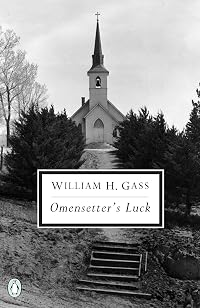
Abandoned church near Somerset, Ohio.
This is a strange and almost mystic book, and invites as much dissection and study as some more holy writ.
The story mainly concerns two characters. The first is Brackett Omensetter, "inhuman as a tree", a bearded man-child with almost supernaturally kind and simple personality and 'luck' behind him. The second is Jethro Furber, a tight-lipped man of god whose only companions are dead men and his own warped mind, fixed between doggerel and theology. He spits out poems about ass-cracks and St. Augustine within the span of two pages. These two characters are placed in the arena of a tedious little town in Ohio. There they collide with each other, and Furber's little mind unravels. His bawdy lyrics show more become stretched out, his mind reverts to an animal form.
The book is so dense in allusions, wordplay, and stream-of-consciousness that it is only with great effort I can discern such things as a 'plot'. Omensetter himself does not make too much of an appearance, as a bulk of the story is in Furber's own mind. This book is not easy. It is damnably frustrating. It even has the luxury of being stupid-looking at first glance.
If I might use the reviewer's cliche and make a comparison to other books, this is somewhere between a few of the run-on chapters of Ulysses, Faulkner's Southern Gothic essence, Flannery O'Connor's morality, and the poop jokes of William Gaddis. This book is sensitive to the needs of the mind and soul, and dives deep into the questions of philosophy, and repression, and the human spirit. It should be read aloud. Not just the monologues or the furious imaginings of the priest, but the descriptions as well.
To read and re-read.
He had fathered every folly, every sin. No goat knew gluttony like his, no cat had felt his pride, no crow his avarice. He had said the psalm against envy, the psalm against anger, the psalm against sloth and the loss of hope, but they were no defense. He had wanted women. He had imagined them in every posture. He had wanted men. There was no perversity he had not thought to practice with them. Further, he had wanted little girls. He had wanted boys. He had wanted most of all himself. He had stolen. He had blasphemed. He had cheated. He had lied�EÂÂEhis single skill. He had been cruel and contemptuous, malicious and willful. He'd lacked courage, piety, loyalty, hope. Without moderation or charity, without relish or enthusiasm, he'd led a wanton, heedless, selfish life. In meanness, in darkness and squalor of spirit, he had passed his time. Faithless he'd professed a faith. Faithlessly, he'd preached. Indeed, he'd laboshow less
This is the first Gass novel I've tried. I was slightly disappointed because the novel started out convincing and extremely polished. The transition into Furber's stream of consciousness was a tad jarring. There is a lot of punning, wandering narration, Biblical rap lyrics, odd juxtapositions, and I am convinced that Gass is frequently nonsensical. However, the novel is not overlong, and is likely to surprise you once or twice per paragraph with some verbal trickery.
Gass's highly amusing Afterword goes on to explain the history of the book's publication. It is told in the manner of an autobiographical short story and I found it one of the best parts of the volume, though, like much of what came before, not strictly show more necessary.
Omensetter's Luck, as a novel, was an interesting experiment, an experience in self-indulgent images and voices, sort of reverberating prose, a suggestive, bleak, detailed, unique reading challenge. The examination of character is pretty one-sided, but that does not stop it from being interesting. I had the feeling that Gass is a capable writer, one who could have gone on for 500 more pages in this manner without running out of quirky ideas. But he restrains himself (for the most part). It is not all one thing. It could have been all sadness or all farce. It is both and much more. The variety is refreshing, and though the plot isn't that complicated, its obfuscated by lyrical labyrinths.
I recommend reading a summary. Spoiling the plot won't detract from your enjoyment of the novel. Then relish the sheer breadth of language contortions to follow. You could isolate many situations in the first sections of the book, and examine their symbolism. Gass invites you to pick apart what he is getting at. But if writing book reports is not your speed, you can also simply sit back and contemplate his impressionistic gusto. It is possible to feel the repressive strictures of the tormented Furber and the wily fascinations of Israbestis and the other inhabitants of Gilean so lovingly depicted by the author, like flashes of lightning, and I find myself thinking about them after reluctantly finishing the book. show less
Gass's highly amusing Afterword goes on to explain the history of the book's publication. It is told in the manner of an autobiographical short story and I found it one of the best parts of the volume, though, like much of what came before, not strictly show more necessary.
Omensetter's Luck, as a novel, was an interesting experiment, an experience in self-indulgent images and voices, sort of reverberating prose, a suggestive, bleak, detailed, unique reading challenge. The examination of character is pretty one-sided, but that does not stop it from being interesting. I had the feeling that Gass is a capable writer, one who could have gone on for 500 more pages in this manner without running out of quirky ideas. But he restrains himself (for the most part). It is not all one thing. It could have been all sadness or all farce. It is both and much more. The variety is refreshing, and though the plot isn't that complicated, its obfuscated by lyrical labyrinths.
I recommend reading a summary. Spoiling the plot won't detract from your enjoyment of the novel. Then relish the sheer breadth of language contortions to follow. You could isolate many situations in the first sections of the book, and examine their symbolism. Gass invites you to pick apart what he is getting at. But if writing book reports is not your speed, you can also simply sit back and contemplate his impressionistic gusto. It is possible to feel the repressive strictures of the tormented Furber and the wily fascinations of Israbestis and the other inhabitants of Gilean so lovingly depicted by the author, like flashes of lightning, and I find myself thinking about them after reluctantly finishing the book. show less
OMENSETTER'S LUCK is an impressionistic steam-of-consciousness novel featuring many voices. A dense yet playful fiction that isn't easy to grasp (never mind keep hold of!). In many ways it is reminiscent of a vivid dream - a dream reflecting a long-lost North American past - quirky, nostalgic, full of merging meaning, colours and scenes. I would say this is primarily a work for prose-lovers: surreal and wondrous descriptions mingle with gritty realism, stark machinations and crazy-clunky confabs. A book to either get joyously lost in or be utterly bemused by.
What is the nature of good and evil? In this original story we are presented with thoroughgoing goodness in the character of Brackett Omensetter; but he faces challenges, foremost as presented by the Rev. Jethro Furber. In reading this novel the question is raised as to the fate of goodness and innocence in our lives. Gass writes this novel in a stream of consciousness style that reminded me of William Faulkner. The novel is not long but its complexity and depth of allusions makes it more difficult to read than the average novel. In this case that is a good thing.
I started Gass's The Tunnel a few years ago and stalled. I decided to try Omensetter's Luck as a shorter entre into Gass's work. It's not an easy book. It's often called "impressionistic," and for much of it, I thought it was much like Joyce at his (non-Wake) hardest (but thankfully briefer). I began to doubt my fitness to read such a book. But then it began clicking, and the last half or so goes down more smoothly. It's a book that needs rereading, and it's worth picking up for the afterword if nothing else.
Members
- Recently Added By
Published Reviews
ThingScore 75
This is a first novel of considerable power which deals with simple things in simple terms-- namely good and evil, life and death, and black and white. Elegiac in tone, sometimes elliptical in technique, words and images swarm and sometimes numb and while one wonders if Mr. Gass could have found a language not so dependent on obscenity, one can acknowledge its primal strength.
added by Richardrobert
Lists

Larry McCaffery's 20th Century Greatest Hits: 100 English-Language Books
103 works; 12 members

1960s, Best books published therein
254 works; 22 members

E's Reader
30 works; 1 member
Harold Bloom - The Western Canon: D. The Chaotic Age
833 works; 24 members

Canon de la narrativa universal del s. XX (cicutadry)
499 works; 3 members

Personal 2026 reads
29 works; 1 member
Author Information

William Howard Gass was born in Fargo, North Dakota on July 30, 1924. During World War II, he served as an ensign in the Navy. He received an A.B. in philosophy from Kenyon College in 1947 and a PhD in philosophy from Cornell University in 1954. He taught at several universities including The College of Wooster, Purdue University, and Washington show more University in St. Louis. He wrote novels, collections of short stories and novellas, and collections of criticism. His novels included Omensetter's Luck, Middle C, and The Tunnel, which received the American Book Award. His other works of fiction included In the Heart of the Heart of the Country, Willie Master's Lonesome Wife, Cartesian Sonata and Other Novellas, and Eyes: Novellas and Stories. His collections of criticism included Tests of Time; A Temple of Texts, which won the 2007 Truman Capote Award for Literary Criticism; and Habitations of the Word and Finding a Form, which both won the National Book Critics Circle Award for Criticism. His essay collections included Fiction and the Figures of Life, The World Within the Word, and Reading Rilke. He died from congestive heart failure on December 6, 2017 at the age of 93. (Bowker Author Biography) show less
Awards and Honors
Awards
Notable Lists
Common Knowledge
- Canonical title
- Omensetter's Luck
- Original publication date
- 1966
Classifications
Statistics
- Members
- 878
- Popularity
- 30,829
- Reviews
- 18
- Rating
- (4.02)
- Languages
- English, Italian, Spanish
- Media
- Paper
- ISBNs
- 10
- ASINs
- 17