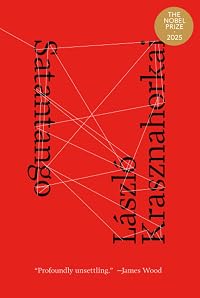
Satantango
by Laszlo Krasznahorkai
On This Page
Description
"Set in an isolated hamlet, Satantango unfolds over the course of a few rain-soaked days. Only a dozen inhabitants remain in the bleak village, rank with the stench of failed schemes, betrayals, failure, infidelity, sudden hopes, and aborted dreams. At the center of Satantango is the eponymous drunken dance."--P. [i].Tags
Recommendations








Member Recommendations
Member Reviews
I bought this book in Palm Springs in April 2023, after or maybe during Coachella, it was hot as fuck and the air was rasping. But inside the book, it turns out — if only I, and Palm Springs, had known — is a squelching world of endless rain, rain unvarying, and irredeemable squalid mud. Palm Springs contained its own antidote, but I, unknowing, didn't open the book then, instead I waited more than a year, until summer in Vancouver, to let the effluvium of Satantango flow over me.
Krasznahorkai's paragraphless chapters rush headlong like a damned soul descending into hell. But it's a story of two resurrections, one fake and one real, or maybe four, because Beckett and Kafka are also resurrected here and seem quite content to play show more along. The text loops, the characters loop, the clocks loop and glitch, everyone swirls down the drain in the unvarying Hungarian rain. It bothered me to have to put this book down. There are unexplained vagabond horses in the town square, a madman in a chapel — these things just happen to happen. Bureaucracy, spiders. Krasz's playful use of inverted commas to insert poetry slash cliché into his mudfest. Your savior definitely won't save yer. And chapter-opening sentences like this:
Krasznahorkai's paragraphless chapters rush headlong like a damned soul descending into hell. But it's a story of two resurrections, one fake and one real, or maybe four, because Beckett and Kafka are also resurrected here and seem quite content to play show more along. The text loops, the characters loop, the clocks loop and glitch, everyone swirls down the drain in the unvarying Hungarian rain. It bothered me to have to put this book down. There are unexplained vagabond horses in the town square, a madman in a chapel — these things just happen to happen. Bureaucracy, spiders. Krasz's playful use of inverted commas to insert poetry slash cliché into his mudfest. Your savior definitely won't save yer. And chapter-opening sentences like this:
Quietly, continually, the rain fell and the inconsolable wind that died then was forever resurrected ruffled the still surfaces of puddles so lightly it failed to disturb the delicate dead skin that had covered them during the night so that instead of recovering the previous day's tired glitter they increasingly and remorselessly absorbed the light that swam slowly out of the east.Every chapter (tr. Szirtes, whose poetry I like) was like an excellent drug to me. show less
An absorbing work of magnificent fiction that trudges the muddy grounds of Communism. The promise of a utopian society collapses in, washed away by the endlessly pouring and pelting rain of violence and despair in an isolated, seemingly inescapable, godforsaken Hungarian village. The hands of the clock stagnate in waiting there. Its residents gather at a bar, conversing about their aimless, stranded lives, until they drift into an outlandish orgy to cope, where everyone covets each other, and everyone craves for something. Children themselves adapt through bizarre means. A place morally purloined; nihilistically incarcerated; deathly perfumed. Sacrifices are inevitable in the name of these people's anticipated salvation. So it goes, show more this also becomes a story of fanaticism as they look ahead to the arrival of their so-called messiah, the crook Irimiás, and his deceitful doctrine, which carries and validates their faith.
The false prophet Irimiás thus speaketh:
"What I want is to establish a small island for a few people with nothing left to lose, a small island free of exploitation, where people work for, not against each other, where everyone has plenty and peace and security and can go to sleep at night like a proper human being..." (p182)
The people tremble with gratitude, pack their bags for an almost biblical exodus, only to set foot in another isolated, seemingly inescapable, godforsaken Hungarian village.
Krasznahorkai's prose presses with adequate claustrophobia, teetering finely between humour and horror, between loose morals and tight motives. Non-linear with its approach, it flips from a dream into a nightmare, capturing the immersive illusions of its (any) failed ideology, even the dangerous appeal of any dogma to the emotion instead of reason.
My first Krasznahorkai, and definitely won't be my last. show less
The false prophet Irimiás thus speaketh:
"What I want is to establish a small island for a few people with nothing left to lose, a small island free of exploitation, where people work for, not against each other, where everyone has plenty and peace and security and can go to sleep at night like a proper human being..." (p182)
The people tremble with gratitude, pack their bags for an almost biblical exodus, only to set foot in another isolated, seemingly inescapable, godforsaken Hungarian village.
Krasznahorkai's prose presses with adequate claustrophobia, teetering finely between humour and horror, between loose morals and tight motives. Non-linear with its approach, it flips from a dream into a nightmare, capturing the immersive illusions of its (any) failed ideology, even the dangerous appeal of any dogma to the emotion instead of reason.
My first Krasznahorkai, and definitely won't be my last. show less
The epigraph by Kafka is illuminating: the influence is everywhere in this mysterious and bleak novel, especially in the section near the end where bureaucrats are attempting to translate each character into official government idiom. There is also some of Beckett's absurdism, and the tone is very 19th century Russian, especially Dostoevsky. The girl Esti echoes Stinking Lizaveta in the Brothers Karamazov, as a kind of human symbol of suffering.
The religious aspect of the story is most striking. The residents of the farm collective are trapped in a type of purgatory, as they wait for Irimias to arrive and redeem them. There is a Mary Magdalene character (Mrs. Schmidt), and Irimias supposedly returns from the dead, which is never fully show more explained. At the end, the characters are spread to the wind by Irimias as they wait for paradise to come at the manor, much like Jesus' disciples are scattered to spread the word of the Gospel.
Which makes me wonder about the title and the source of evil in the story. The doctor at the end is writing the novel as it cycles back to the beginning, and it is notable that he along with Esti's family are the only characters left behind at the collective. The symbol of the bell ringing at the beginning of the end was evocative, especially once the doctor finds out that it is just an "idiot" making the noise (Macbeth allusion?). The doctor returns to his chair, his drinking, and his writing. He embodies the malaise that trapped the other characters in the village. That he is writing the story means that he has some omniscience and power over the characters' lives. The tango in the title is the drunken dance the characters do as they wait in the bar for Irimias. This time loop is the trap that Satan has sprung for them. The book is saying that, although the Christ-figure is probably also a con man, and his promises of paradise are lies, the real evil is in the debauched stasis of the character's lives before his arrival.
Just my interpretation. show less
The religious aspect of the story is most striking. The residents of the farm collective are trapped in a type of purgatory, as they wait for Irimias to arrive and redeem them. There is a Mary Magdalene character (Mrs. Schmidt), and Irimias supposedly returns from the dead, which is never fully show more explained. At the end, the characters are spread to the wind by Irimias as they wait for paradise to come at the manor, much like Jesus' disciples are scattered to spread the word of the Gospel.
Which makes me wonder about the title and the source of evil in the story. The doctor at the end is writing the novel as it cycles back to the beginning, and it is notable that he along with Esti's family are the only characters left behind at the collective. The symbol of the bell ringing at the beginning of the end was evocative, especially once the doctor finds out that it is just an "idiot" making the noise (Macbeth allusion?). The doctor returns to his chair, his drinking, and his writing. He embodies the malaise that trapped the other characters in the village. That he is writing the story means that he has some omniscience and power over the characters' lives. The tango in the title is the drunken dance the characters do as they wait in the bar for Irimias. This time loop is the trap that Satan has sprung for them. The book is saying that, although the Christ-figure is probably also a con man, and his promises of paradise are lies, the real evil is in the debauched stasis of the character's lives before his arrival.
Just my interpretation. show less
Review published in the LA Review of Books: https://lareviewofbooks.org/article/dancing-with-the-devil-laszlo-krasznahorkais...
On Monday, July 2, László Krasznahorkai read before a considerably rapt crowd at the Housing Works Bookstore in Manhattan. The Hungarian writer read from Satantango and spoke about his elliptical and enigmatic prose style, offering the following anecdote when asked about his long-winded and often maddening sentences: "Everyone knows that the dot belongs not to human beings but the dot belongs to the gods. The gods will get the last dot." As Satantango deals with people's reactions to promises of hope and salvation, Krasznahorkai's comments during the question-and-answer period underscore a major concerns in show more this novel: "I'm not interested to believe in something, but to understand the people who believe."
The epigraph to Satantango – Krasznahorkai's first novel, published in Hungarian in 1985, and this year by New Directions in an impeccable English translation by poet George Szirtes – is from Kafka's The Castle: "In that case, I'll miss the thing by waiting for it." This sets the tone for the novel's perverse, absurdist humanity and desolation. Fans of Krasznahorkai's other books published in English – The Melancholy of Resistance (1989/2002) and War & War (1999/2006) – may have seen the impressive Hungarian auteur Béla Tarr's seven-plus hour film adaptation from 1994, but for most this is a first encounter. It is set on a rundown estate near an abandoned mill, just after the end of communist rule. Depravity abounds; the young girls living there have taken to prostitution; getting drunk and swindling one's neighbors are the only ways to pass the time. And yet, everyone is waiting for something without knowing it, whether an end or a new beginning. Do they miss the thing by waiting for it?
The very first sentence of the novel highlights Krasznahorkai's inimitable prose (deliberate omission of commas replicated below) as well as the dark sense of foreboding with which all the characters grapple:
The metalled road at times figures as the most stable configuration on the crumbling estate, and at others as simply another place to be lost. In one scene, the drunken doctor, heading to the bar to refresh his liquor supply, runs into the young Esti Horgos. She clings to him briefly, craving human contact she does not get at home, and then runs away: "He stepped onto the metalled road and shouted out in the darkness. 'Esti! I won't harm you! Have you gone mad?! Come back here at once!' There was no answer." This brief moment of shared intimacy between a lonely hermit and a young girl teetering on the edge comes at the cost of losing their way: the doctor "turned back and was astounded to observe that he seemed to have moved a long way from the bar. He started toward it but after a couple of steps the whole world went dark in an instant and he felt his legs sliding in the mud." The word "dark" and its variants, as in the two quotes above, occur 76 times throughout the novel.
Krasznahorkai structures Satantango as a Möbius strip, rendering topologically the movement from isolation to a more collective identity in the middle of the novel, hinging on Irimis's return and young Esti's tragic death. The story buckles and spirals back on itself while still remaining intact – frayed, perhaps, chaotic, in as well as outside of time, maddened and utterly exhausted, yet somehow stoically in one piece. This movement is crucial to the novel, as well as to Krasznahorkai's analysis of individual and group psychology. As Jacques Lacan reminds us, the Möbius strip allows us to see how "that which is interpersonal (conscious and spoken) is connected to that which is intrapsychic (unconscious and pre-spoken)," thus "indicating how an 'inside' (the unconscious) has continuity with an 'outside' (the conscious)." This continuity is exactly what Krasznahorkai is exploring so ambitiously in Satantango. When the resurrected Irimias – perhaps savior, perhaps devil – gives a speech that brings the community together in a state of hope (or delusion), it is eerily reminiscent of what Freud says of group psychology: "The impulses which a group obeys may according to circumstances be generous or cruel, but they are always so imperious that no personal interest, not even that of self-preservation, can make itself felt."
Esti's death and Irimias's speech rally the residents together, and a particular kind of group psychology takes over. For example, "the kid" who joins Irimis and his sidekick, Petrina, realizes that he must shed his personal identity and mimic "the master" in order to be accepted: "It was perfectly clear to him that his own best option was faithfully to copy Irimis in every small detail because this way he was sure not to get a nasty surprise."
The living spaces are overrun with spiderwebs and yet, as the barkeeper says, they "never once saw an actual spider." It was as if the spiders sensed the bartender "watching them, and they simply wouldn't appear. Even after he had resigned himself to the situation he still hoped – just once – to set eyes on one of them." All the characters – from Futazi to the beautiful and unfaithful Mrs. Schmidt, from the local driver, who has last seen Irimis whom they all await, to the hyper-religious Mrs. Halics – are caught in the web of whomever orchestrates what transpires, be it Irimis the redeemer, Irimis the destroyer, or, not to ruin the final turn of Krasznahorkai's spiraling narrative, a more absent figure who suggests the travails and torments involved in the storytelling process.
A drunken dance, a Satanic tango, prefaces the backward structural twist in Satantango's Möbius strip. In the space of the dance, the community comes together to experience the trauma of Esti's death and the return of Irimias; with the backward spiral in the second half of the narrative, we see the individuals revert to their prior state of isolation and alienation. The dance embodies Krasznahorkai's mix of dark comedy and crippling sense of anxiety: the dance is celebratory and funeral, hopeful and despairing. The dance is also the point at which Krasznahorkai begins numbering his chapters backward: we begin at one and progress to six, at which point six is repeated and the journey back to one is recommenced along the Möbius's turn – six being the number of the wild beast, judgment, and also mankind.
The virile voice of Irimias blames them all and none of them – "I am not accusing any particular person of anything and yet ... let me put this question to you: are we not all to blame?" – a perverse acknowledgment of collective complicity or else a brazen refutation of it, or, better, an ambiguous combination of the two. Indeed, it is at this point that the narrative cleaves, becoming Bosch-meets-Beckett in a nightmarish scene at which even words fail to function, melt: "itwasneithermorningnoreveningitjust carriedondawnnortwilightwhichever..."
Self-preservation is subsumed by a more blatant desire for acceptance, despite a host of characters spectacularly selfish and greedy. What does the tension between community and alienation mean for individuals living in limbo, on the cusp of some indefinable and intangible world while still visually reminded – and the metalled road reappears to underscore this point – of the shackles of their lives under communism? Krasznahorkai handles this question deftly, but he never attempts to answer it one way or the other. His textual ambiguities make any concrete reading of Satantango nearly impossible, and we are put in the same befuddled, liminal state of mind as the fictional residents themselves: missing the thing by waiting for it. show less
On Monday, July 2, László Krasznahorkai read before a considerably rapt crowd at the Housing Works Bookstore in Manhattan. The Hungarian writer read from Satantango and spoke about his elliptical and enigmatic prose style, offering the following anecdote when asked about his long-winded and often maddening sentences: "Everyone knows that the dot belongs not to human beings but the dot belongs to the gods. The gods will get the last dot." As Satantango deals with people's reactions to promises of hope and salvation, Krasznahorkai's comments during the question-and-answer period underscore a major concerns in show more this novel: "I'm not interested to believe in something, but to understand the people who believe."
The epigraph to Satantango – Krasznahorkai's first novel, published in Hungarian in 1985, and this year by New Directions in an impeccable English translation by poet George Szirtes – is from Kafka's The Castle: "In that case, I'll miss the thing by waiting for it." This sets the tone for the novel's perverse, absurdist humanity and desolation. Fans of Krasznahorkai's other books published in English – The Melancholy of Resistance (1989/2002) and War & War (1999/2006) – may have seen the impressive Hungarian auteur Béla Tarr's seven-plus hour film adaptation from 1994, but for most this is a first encounter. It is set on a rundown estate near an abandoned mill, just after the end of communist rule. Depravity abounds; the young girls living there have taken to prostitution; getting drunk and swindling one's neighbors are the only ways to pass the time. And yet, everyone is waiting for something without knowing it, whether an end or a new beginning. Do they miss the thing by waiting for it?
The very first sentence of the novel highlights Krasznahorkai's inimitable prose (deliberate omission of commas replicated below) as well as the dark sense of foreboding with which all the characters grapple:
One morning near the end of October not long before the first drops of the mercilessly long autumn rains began to fall on the cracked and saline soil on the western side of the estate (later the stinking yellow sea of mud would render footpaths impassable and put the town too beyond reach) Futaki woke to hear bells.The same bells are remarked upon by the doctor, a drunk who has retreated into his apartment and his books. Although neither Futaki nor the doctor realize it, the bells are signs of the "resurrection" of Irimi's, who vanished from the estate some eighteen months before and had long been considered dead. The plot of Satantango is too simple – or too complex, depending on how one reads the novel – to reduce here without giving some critical element away. Krasznahorkai's ambiguous use of metaphors and symbols is compounded by his odd juxtaposition of opposites – darkness and light, salvation and damnation, or, as a chapter title puts it, "Heavenly Vision? Hallucination?" Alongside the never-ending rain, the "metalled" road is Satantango's most ambiguous metaphor, signifying less a link to civilization than a reminder of it, and nearly each character makes reference to the road as if measuring his or her space in time and ruin by their relation to it.
The metalled road at times figures as the most stable configuration on the crumbling estate, and at others as simply another place to be lost. In one scene, the drunken doctor, heading to the bar to refresh his liquor supply, runs into the young Esti Horgos. She clings to him briefly, craving human contact she does not get at home, and then runs away: "He stepped onto the metalled road and shouted out in the darkness. 'Esti! I won't harm you! Have you gone mad?! Come back here at once!' There was no answer." This brief moment of shared intimacy between a lonely hermit and a young girl teetering on the edge comes at the cost of losing their way: the doctor "turned back and was astounded to observe that he seemed to have moved a long way from the bar. He started toward it but after a couple of steps the whole world went dark in an instant and he felt his legs sliding in the mud." The word "dark" and its variants, as in the two quotes above, occur 76 times throughout the novel.
Krasznahorkai structures Satantango as a Möbius strip, rendering topologically the movement from isolation to a more collective identity in the middle of the novel, hinging on Irimis's return and young Esti's tragic death. The story buckles and spirals back on itself while still remaining intact – frayed, perhaps, chaotic, in as well as outside of time, maddened and utterly exhausted, yet somehow stoically in one piece. This movement is crucial to the novel, as well as to Krasznahorkai's analysis of individual and group psychology. As Jacques Lacan reminds us, the Möbius strip allows us to see how "that which is interpersonal (conscious and spoken) is connected to that which is intrapsychic (unconscious and pre-spoken)," thus "indicating how an 'inside' (the unconscious) has continuity with an 'outside' (the conscious)." This continuity is exactly what Krasznahorkai is exploring so ambitiously in Satantango. When the resurrected Irimias – perhaps savior, perhaps devil – gives a speech that brings the community together in a state of hope (or delusion), it is eerily reminiscent of what Freud says of group psychology: "The impulses which a group obeys may according to circumstances be generous or cruel, but they are always so imperious that no personal interest, not even that of self-preservation, can make itself felt."
Esti's death and Irimias's speech rally the residents together, and a particular kind of group psychology takes over. For example, "the kid" who joins Irimis and his sidekick, Petrina, realizes that he must shed his personal identity and mimic "the master" in order to be accepted: "It was perfectly clear to him that his own best option was faithfully to copy Irimis in every small detail because this way he was sure not to get a nasty surprise."
The living spaces are overrun with spiderwebs and yet, as the barkeeper says, they "never once saw an actual spider." It was as if the spiders sensed the bartender "watching them, and they simply wouldn't appear. Even after he had resigned himself to the situation he still hoped – just once – to set eyes on one of them." All the characters – from Futazi to the beautiful and unfaithful Mrs. Schmidt, from the local driver, who has last seen Irimis whom they all await, to the hyper-religious Mrs. Halics – are caught in the web of whomever orchestrates what transpires, be it Irimis the redeemer, Irimis the destroyer, or, not to ruin the final turn of Krasznahorkai's spiraling narrative, a more absent figure who suggests the travails and torments involved in the storytelling process.
A drunken dance, a Satanic tango, prefaces the backward structural twist in Satantango's Möbius strip. In the space of the dance, the community comes together to experience the trauma of Esti's death and the return of Irimias; with the backward spiral in the second half of the narrative, we see the individuals revert to their prior state of isolation and alienation. The dance embodies Krasznahorkai's mix of dark comedy and crippling sense of anxiety: the dance is celebratory and funeral, hopeful and despairing. The dance is also the point at which Krasznahorkai begins numbering his chapters backward: we begin at one and progress to six, at which point six is repeated and the journey back to one is recommenced along the Möbius's turn – six being the number of the wild beast, judgment, and also mankind.
The virile voice of Irimias blames them all and none of them – "I am not accusing any particular person of anything and yet ... let me put this question to you: are we not all to blame?" – a perverse acknowledgment of collective complicity or else a brazen refutation of it, or, better, an ambiguous combination of the two. Indeed, it is at this point that the narrative cleaves, becoming Bosch-meets-Beckett in a nightmarish scene at which even words fail to function, melt: "itwasneithermorningnoreveningitjust carriedondawnnortwilightwhichever..."
Self-preservation is subsumed by a more blatant desire for acceptance, despite a host of characters spectacularly selfish and greedy. What does the tension between community and alienation mean for individuals living in limbo, on the cusp of some indefinable and intangible world while still visually reminded – and the metalled road reappears to underscore this point – of the shackles of their lives under communism? Krasznahorkai handles this question deftly, but he never attempts to answer it one way or the other. His textual ambiguities make any concrete reading of Satantango nearly impossible, and we are put in the same befuddled, liminal state of mind as the fictional residents themselves: missing the thing by waiting for it. show less
Much like the seven-and-a-half-hour Béla Tarr film it spawned, Satantango requires patience. Underlying this morass of atrophying humanity is a structure of subtle movements, the structure of the tango, a structure only apparent at a far remove. It is a structure I only recognized somewhere in the seventh hour of the film and which, while immersed in the novel, seems ever elusive, although there are indications. Even if you don't have the patience for the gran mal, there are moments of Handkean brilliance in the minutiae.
Laszlo Krasznahorkai: Satantango
(David H, Maria S, Mariko, Susan C, Susan M, Larry, Martina, Oxana)
Satantango (1985) was Krasznahorkai's first major publication. It is, at one level, a stark metaphor for the crushing despair of life under the Communist regime, which no doubt accounted for part of its popularity in Hungary, if not why the authorities even allowed it be be printed. Krasznahorkai won the Man Booker International in 2015 for his body of work.
A jacket blurb from James Wood describes Satantango as "profoundly unsettlingly" and it is--unsettling in its bleak depiction of human nature, proclivities, and promise, and unsettling in its writing style. The action, such as it is, is set in the grounds of a derelict 'Manor' (some show more sort of failed collective) in the Hungarian countryside, post-WWII. It is essentially a small village of hovels masquerading as homes, wth the inhabitants masquerading as people with any real prospects.
The opening sentence of the novel sets the tone throughout: "One morning near the end of October not long before the first drops of the mercilessly long autumn rain began to fall on the cracked and saline soil of the western side of the estate (later the stinking yellow sea of mud would render footpaths impassable and put the town too beyond reach) Futaki woke to hear bells." The rain is unrelenting throughout the novel, soaking the homes, the countryside, and the people, washing out skies, colours, and hopes.
In the first couple of pages, Krasznahorkai uses short, trenchant descriptions and observations to set the mood of the place and the people: "mousehole-sized kitchen window....the only light to be seen was the one glimmering in the doctor's window whose house was set well apart from the others on the far side, and that was only because its occupant had for years been unable to sleep in the dark....burned out remnants of a locust-plagued summer...as if the whole of time were a frivolous interlude in the much greater spaces of eternity, a brilliant conjuring trick to produce something apparently orderly out of chaos, to establish a vantage point from which chance might begin to look like necessity...the east, once the home of a thriving industry, now nothing but a set of dilapidated and deserted buildings...first rays of a swollen sun broke through the topmost beams of a derelict farmhouse from which the roof tiles had been stripped..."
The Manor, as a physical and psychological space, represents a derelict past, a miserable present, and a parlours future. The half dozen or so protagonists live without harmony and without help, without wisdom or even much sense, prone to false hopes perpetrated by charlatans. And the charlatan appears in a character named Irimias, for whom everyone has been waiting for delivery from their blasted lives, but who might be a secret police agent, or a con-man or, maybe, Satan himself. I don't think it matters who, or what, Irimias is; the 'Satan' in the story is the ungraspable hopes of everyone in the novel; these provide the motors for mad decisions and actions. At the end of the novel we discover that the Doctor, who has been a close observer of all the players is, in fact, not just a reporter of activities (to the secret police?), not just a chronicler, but (in a post-modernist twist) the writer of the novel and, as such, he constructs and deconstructs the lives of the characters:
"He scribbled feverishly and was practically seeing everything that was happening over there, and he knew, was deadly certain, that from then on this was how it would be. He realized that all those years of arduous, painstaking work had finally borne fruit: he had finally become the master of a singular art that enabled him not only to describe a world whose eternal unremitting progress in one direction required such mastery but also--to a certain extent--he could even intervene in the mechanism behind an apparently chaotic swirl of events!" [Italics in the original]
So where and what is reality?
Krasznahorkai does not believe in traditional sentences and certainly not in periods; phrases run-on sometimes for pages, twisting and looping around, sometimes back on themselves. Krasznahorkai has argued that people do not think in sentences, so it is futile to portray their thoughts, or even to convey third-party descriptions, like that. He at least provides quotation marks to assist in tracking speakers as there are no paragraph breaks.
So, with this sort of synopsis, why read such a novel? Because, despite the bleakness, the people are real in their strengths and weaknesses, their hopes and fears. Many people live such bleak lives, in many different circumstances, and understanding is a step towards empathy for their state, and understanding of the circumstances that brought them to it. There is a chapter entitled "Unravelling" that describes, with painful perception, the descent to death of a little girl, lost and unloved in life; unsettling though it is to read, it is psychologically acute in its depiction of one life that is wasted and that we know is multiplied time and time again in reality. The book is worth reading for the writing in this chapter alone.
Krasznahorkai can be a struggle, but he is an intrepid and intriguing writer who pushes the boundaries of how a writer can try to convey reality. Virginia Woolf called upon the novelist to find new ways to represent consciousness: "Let us record the atoms as they fall upon the mind in the order in which they fall, let us trace the pattern, however disconnected and incoherent in appearance, which each sight or incident scores upon the consciousness." Krasznahorkai aspires to the level of writing.
In his novel, War and War, Krasznahorkai echoes Woolf when he has the main protagonist posit: "The manuscript was interested in one thing only, and that was reality examined to the point of madness, and the experience of all those intense mad details, the engraving by sheer manic repetition of the matter into the imagination, was, and he meant this literally, Korin explained, as if the writer had written the text not with pen and words but with his nails, scratching the words into the paper and into the mind." This--"reality examined to the point of madness"--is a good description of Satantango.
This is a book that could be parsed to a considerable degree. It is worth the challenge and the reward. show less
(David H, Maria S, Mariko, Susan C, Susan M, Larry, Martina, Oxana)
Satantango (1985) was Krasznahorkai's first major publication. It is, at one level, a stark metaphor for the crushing despair of life under the Communist regime, which no doubt accounted for part of its popularity in Hungary, if not why the authorities even allowed it be be printed. Krasznahorkai won the Man Booker International in 2015 for his body of work.
A jacket blurb from James Wood describes Satantango as "profoundly unsettlingly" and it is--unsettling in its bleak depiction of human nature, proclivities, and promise, and unsettling in its writing style. The action, such as it is, is set in the grounds of a derelict 'Manor' (some show more sort of failed collective) in the Hungarian countryside, post-WWII. It is essentially a small village of hovels masquerading as homes, wth the inhabitants masquerading as people with any real prospects.
The opening sentence of the novel sets the tone throughout: "One morning near the end of October not long before the first drops of the mercilessly long autumn rain began to fall on the cracked and saline soil of the western side of the estate (later the stinking yellow sea of mud would render footpaths impassable and put the town too beyond reach) Futaki woke to hear bells." The rain is unrelenting throughout the novel, soaking the homes, the countryside, and the people, washing out skies, colours, and hopes.
In the first couple of pages, Krasznahorkai uses short, trenchant descriptions and observations to set the mood of the place and the people: "mousehole-sized kitchen window....the only light to be seen was the one glimmering in the doctor's window whose house was set well apart from the others on the far side, and that was only because its occupant had for years been unable to sleep in the dark....burned out remnants of a locust-plagued summer...as if the whole of time were a frivolous interlude in the much greater spaces of eternity, a brilliant conjuring trick to produce something apparently orderly out of chaos, to establish a vantage point from which chance might begin to look like necessity...the east, once the home of a thriving industry, now nothing but a set of dilapidated and deserted buildings...first rays of a swollen sun broke through the topmost beams of a derelict farmhouse from which the roof tiles had been stripped..."
The Manor, as a physical and psychological space, represents a derelict past, a miserable present, and a parlours future. The half dozen or so protagonists live without harmony and without help, without wisdom or even much sense, prone to false hopes perpetrated by charlatans. And the charlatan appears in a character named Irimias, for whom everyone has been waiting for delivery from their blasted lives, but who might be a secret police agent, or a con-man or, maybe, Satan himself. I don't think it matters who, or what, Irimias is; the 'Satan' in the story is the ungraspable hopes of everyone in the novel; these provide the motors for mad decisions and actions. At the end of the novel we discover that the Doctor, who has been a close observer of all the players is, in fact, not just a reporter of activities (to the secret police?), not just a chronicler, but (in a post-modernist twist) the writer of the novel and, as such, he constructs and deconstructs the lives of the characters:
"He scribbled feverishly and was practically seeing everything that was happening over there, and he knew, was deadly certain, that from then on this was how it would be. He realized that all those years of arduous, painstaking work had finally borne fruit: he had finally become the master of a singular art that enabled him not only to describe a world whose eternal unremitting progress in one direction required such mastery but also--to a certain extent--he could even intervene in the mechanism behind an apparently chaotic swirl of events!" [Italics in the original]
So where and what is reality?
Krasznahorkai does not believe in traditional sentences and certainly not in periods; phrases run-on sometimes for pages, twisting and looping around, sometimes back on themselves. Krasznahorkai has argued that people do not think in sentences, so it is futile to portray their thoughts, or even to convey third-party descriptions, like that. He at least provides quotation marks to assist in tracking speakers as there are no paragraph breaks.
So, with this sort of synopsis, why read such a novel? Because, despite the bleakness, the people are real in their strengths and weaknesses, their hopes and fears. Many people live such bleak lives, in many different circumstances, and understanding is a step towards empathy for their state, and understanding of the circumstances that brought them to it. There is a chapter entitled "Unravelling" that describes, with painful perception, the descent to death of a little girl, lost and unloved in life; unsettling though it is to read, it is psychologically acute in its depiction of one life that is wasted and that we know is multiplied time and time again in reality. The book is worth reading for the writing in this chapter alone.
Krasznahorkai can be a struggle, but he is an intrepid and intriguing writer who pushes the boundaries of how a writer can try to convey reality. Virginia Woolf called upon the novelist to find new ways to represent consciousness: "Let us record the atoms as they fall upon the mind in the order in which they fall, let us trace the pattern, however disconnected and incoherent in appearance, which each sight or incident scores upon the consciousness." Krasznahorkai aspires to the level of writing.
In his novel, War and War, Krasznahorkai echoes Woolf when he has the main protagonist posit: "The manuscript was interested in one thing only, and that was reality examined to the point of madness, and the experience of all those intense mad details, the engraving by sheer manic repetition of the matter into the imagination, was, and he meant this literally, Korin explained, as if the writer had written the text not with pen and words but with his nails, scratching the words into the paper and into the mind." This--"reality examined to the point of madness"--is a good description of Satantango.
This is a book that could be parsed to a considerable degree. It is worth the challenge and the reward. show less
Satantango estreava há 30 anos no Festival de Berlin.
Filme do Tarr/livro do Krasznahorkai
Vou comentar tanto o livro quanto o filme porque talvez essa seja a adaptação mais fiel que vi na vida. Veja bem, nem sempre acho fidelidade uma boa ideia em relação à adaptações de livros em filmes, acho inclusive um tipo pobre de transposição de linguagem, mas estamos falando de Bela Tarr aqui, um dos maiores cineastas dos últimos 50 anos.
Krasznahorkai usa parágrafos infinitos para escrever seu livro, isso se transforma em planos sequência no filme de Tarr, já no plano sequência inicial o diretor resume todo o filme: o gado debandando pra longe.
Tarr também mantém a estrutura narrativa do livro no filme no ritmo do tango, seis pra show more lá, seis pra cá. E mantém a questão do título nas possíveis significações, a própria questão coletiva de ser um "tango de Satã" as 12 partes do livro com idas e vindas e um eterno retorno circular nietzschiano, o tango de Satã na taverna antes da chegada de Irimiás, este que por sua vez tem todas as características de um personagem luciferiano e o tango pode ser como ele manipula e amedronta as pessoas na comuna, seis pra lá, seis pra cá.
É um filme/livro muito rico simbólica e estruturalmente, podia passar a noite toda escrevendo sobre ele (nem mencionei a alegoria do regime comunista!), até deu vontade de relê-lo assim que terminei, mas ainda bem que eu tinha o filme pra ver.
Plus: Para quem ficou preocupado com a morte do gato no filme, havia um veterinário no set cuidado dele, ele não morreu. Quando li no livro fiquei preocupada porque esses cineastas pré anos 2000 matavam bichos a torto e direito nas filmagens por aí. show less
Filme do Tarr/livro do Krasznahorkai
Vou comentar tanto o livro quanto o filme porque talvez essa seja a adaptação mais fiel que vi na vida. Veja bem, nem sempre acho fidelidade uma boa ideia em relação à adaptações de livros em filmes, acho inclusive um tipo pobre de transposição de linguagem, mas estamos falando de Bela Tarr aqui, um dos maiores cineastas dos últimos 50 anos.
Krasznahorkai usa parágrafos infinitos para escrever seu livro, isso se transforma em planos sequência no filme de Tarr, já no plano sequência inicial o diretor resume todo o filme: o gado debandando pra longe.
Tarr também mantém a estrutura narrativa do livro no filme no ritmo do tango, seis pra show more lá, seis pra cá. E mantém a questão do título nas possíveis significações, a própria questão coletiva de ser um "tango de Satã" as 12 partes do livro com idas e vindas e um eterno retorno circular nietzschiano, o tango de Satã na taverna antes da chegada de Irimiás, este que por sua vez tem todas as características de um personagem luciferiano e o tango pode ser como ele manipula e amedronta as pessoas na comuna, seis pra lá, seis pra cá.
É um filme/livro muito rico simbólica e estruturalmente, podia passar a noite toda escrevendo sobre ele (nem mencionei a alegoria do regime comunista!), até deu vontade de relê-lo assim que terminei, mas ainda bem que eu tinha o filme pra ver.
Plus: Para quem ficou preocupado com a morte do gato no filme, havia um veterinário no set cuidado dele, ele não morreu. Quando li no livro fiquei preocupada porque esses cineastas pré anos 2000 matavam bichos a torto e direito nas filmagens por aí. show less
Members
- Recently Added By
Published Reviews
added by doomjesse
Lists

Top Five Books of 2013
1,562 works; 715 members

1980s
356 works; 23 members

Nobel Price Winners
222 works; 20 members

Literature in Translation
113 works; 5 members

contemporary literary fiction list to check out
47 works; 1 member
Author Information

39+ Works 6,628 Members
László Krasznahorkai is an Hungarian Author who has won the 2015 Man Booker International Prize. The $117,600 biennial prize is awarded to a living author, whose body of work is available in English or English translation, in recognition of his or her contribution to fiction 'on the world stage'. (Bowker Author Biography)
All Editions
Some Editions
Awards and Honors
Awards
Distinctions
Series
Belongs to Publisher Series
Work Relationships
Has the adaptation
Common Knowledge
- Canonical title
- Satantango
- Original title
- Sátántango
- Original publication date
- 1985
- Related movies
- Sátántangó (1994 , tt0111341)
- Epigraph
- In that case, I'll miss the thing by waiting for it. – FK
- First words
- Op een ochtend tegen eind oktober, vlak voordat de eerste druppels van de onbarmhartig lange herfstregens op de gebarsten grond van het verdorde land ten westen van de kolonie zouden neerdalen (waarna door de stinkende modder... (show all)zee de landwegen tot het invallen van de vorst onbegaanbaar zouden zijn, zodat ook de stad niet meer te bereiken was), werd Futaki wakker van het gebeier van klokken.
One morning near the end of October not long before the first drops of the mercilessly long autumn rains began to fall on the cracked and saline soil on the western side of the estate (later the stinking yellow sea of mud wou... (show all)ld render footpaths impassable and put the town too beyond reach) Futaki woke to hear bells. - Last words
- (Click to show. Warning: May contain spoilers.)Maar er bewoog niets, en ook hij verroerde zich niet in bed, totdat er plotseling een nerveuze conversatie ontstond tussen de zwijgende voorwerpen om hem heen...
(Click to show. Warning: May contain spoilers.)But he did not move a muscle, not until the objects around him, that had so far been merely listening, started up a nervous conversation (the sideboard gave a creak, a saucepan rattled, a china plate slid back into the rack) at which point . . .” - Blurbers
- Sontag, Susan; Sebald, Susan; Preston, Alex; Krauss, Nicole
- Original language
- Hungarian
Classifications
- Genres
- General Fiction, Fiction and Literature
- DDC/MDS
- 894.51134 — Literature & rhetoric Literatures of other languages Literatures of Altaic, Uralic, Hyperborean, Dravidian languages; literatures of miscellaneous languages of south Asia Finno-Ugric languages Ugric languages Hungarian Hungarian fiction 2000–
- LCC
- PH3281 .K8866 .S2813 — Language and Literature Uralic languages. Basque language Uralic. Basque Hungarian
- BISAC
Statistics
- Members
- 1,636
- Popularity
- 13,758
- Reviews
- 38
- Rating
- (3.93)
- Languages
- 21 — Catalan, Czech, Danish, Dutch, English, Estonian, Finnish, French, German, Greek, Hungarian, Italian, Norwegian (Bokmål), Polish, Portuguese, Romanian, Russian, Serbian, Spanish, Swedish, Turkish
- Media
- Paper, Audiobook, Ebook
- ISBNs
- 46
- ASINs
- 15