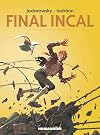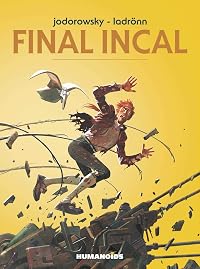
Final Incal
by Alejandro Jodorowsky, Ladrönn (Illustrator)
The Incal Universe (4), The Incal Saga (Collections and Selections — Omnibus D1-D3)
On This Page
Description
Lowly class 'R' detective John Difool and his faithful companion, Deepo, are unwillingly hurled into yet another universe-saving mission, as their world is faced with the threat of an all-devouring metallic virus. Visionary storyteller Jodorowsky returns to the epic mythology he created with the late Mœbius in the early 80s. For the conclusion of the legendary spiritual space adventure series, he partners with Eisner-winning artist Ladrönn.Tags
Recommendations











Member Reviews
Final Incal is a reworking and completion of After the Incal, the twenty-first century sequel to Jodorowsky's mystical space opera bandes dessinées published in the 1980s. While After the Incal had featured art from the original Incal artist Moebius, Final Incal is illustrated by Ladrönn, who credits Moebius' Incal for inspiring him to pursue a career in comics art in the first place. I like Ladrönn's art very well; it has its own style, but the spirit of the characters and places from Moebius is preserved, and there is obvious influence in the compositions.
The central conflict in this story has a malefic intelligence (how do you pronounce "Benthacodon"?) attempt to exterminate all organic life on Earth 2014, "cloning" humans into show more metal androids, while a lethal virus destroys their old bodies. In typical comic book fashion, the stakes quickly escalate from city-shaft to planet to universe to multiverse. Setting aside the metaphysical backdrop, the villains here reminded me of Doctor Who's Cybermen.
The divine Incal itself is largely concerned to perform matchmaking between John DiFool and Luz de Garra as a way of somehow producing an antidote to the evil plague. For most of the story, Luz is cold to John, which is understandable, since he mostly just whines around her. In his initial quest for her, DiFool is amusingly multiplied with variants from other universes, so that he is analyzed into four characters of base fool, adonis, swami, and angel (92). Jodo's allegory was less than transparent here, and I don't know whether he was referencing cabalistic parts of the soul, Maslow's hierarchy of needs, or something else.
The Final title is misleading, inasmuch as Jodorowsky explicitly said he intended to write further in the Incal setting, and in fact later materials have appeared by him and other other authors. Nor is the narrative particularly closed with the resolution of this book's plot. But it is a good complementary bookend to Before the Incal, building out from the core of the original work. show less
The central conflict in this story has a malefic intelligence (how do you pronounce "Benthacodon"?) attempt to exterminate all organic life on Earth 2014, "cloning" humans into show more metal androids, while a lethal virus destroys their old bodies. In typical comic book fashion, the stakes quickly escalate from city-shaft to planet to universe to multiverse. Setting aside the metaphysical backdrop, the villains here reminded me of Doctor Who's Cybermen.
The divine Incal itself is largely concerned to perform matchmaking between John DiFool and Luz de Garra as a way of somehow producing an antidote to the evil plague. For most of the story, Luz is cold to John, which is understandable, since he mostly just whines around her. In his initial quest for her, DiFool is amusingly multiplied with variants from other universes, so that he is analyzed into four characters of base fool, adonis, swami, and angel (92). Jodo's allegory was less than transparent here, and I don't know whether he was referencing cabalistic parts of the soul, Maslow's hierarchy of needs, or something else.
The Final title is misleading, inasmuch as Jodorowsky explicitly said he intended to write further in the Incal setting, and in fact later materials have appeared by him and other other authors. Nor is the narrative particularly closed with the resolution of this book's plot. But it is a good complementary bookend to Before the Incal, building out from the core of the original work. show less
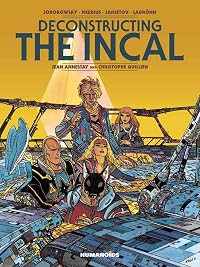
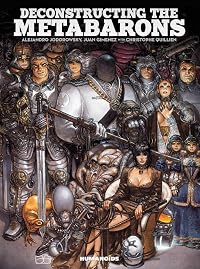
Jodorowsky keeps on coming back to the Incal. This is hardly a surprise as it’s been his most successful title – although Incal spin-off the Metabarons has probably appeared in more media incarnations. In Final Incal, the multiverse is in danger when an evil machine intelligence creates a plague and the only defence is to convert everyone into a robot… Three iterations of John DiFool all meet up between universes, in the hunt for their lover, Luz, and the means to save the multiverse from destruction. But only one of them can complete the task. The artwork, by Ladrönn, is very good indeed. Apparently, Moebius did start work on the project, but only completed the first part, so Jodorowsky had Ladrönn redo it from the start. The show more story is the usual Jodorowsky weirdness, although it’s starting to feel a little recycled by now. This was an astonishing piece of sf in its day, and it continues to make for good reading decades later. But I have to wonder whether these returns and extensions to it are doing it any favours. I guess I’ll find out when I get around to reading Deconstructing the Incal… show less
Final Incal begins where we left John DiFool, falling down the shaft of the great city of Terra 2014 towards an acid lake, his cosmic encounters forgotten. He's rescued by plasma shooting giant bugs and informed of a new universal conflict. The great black Bentacodon, a horrible energy vampire, is conspiring with the Prezident of Terra 2014 to release a horrible plague, killing all organic life and forcing the survivors into metal bodies. DiFool meets up with Elohim, a glowing white archangel who informs him that only his love for Luz can save the galaxy, and they're off through the Incal cosmology, meeting mutants, space pirates, techno-technos, and the hermaphroditic Emperor/ess of the Galaxy.
What this feel like most is a retread, a show more return to basically the same themes and story beats as both previous Incals and the Metabaron, without the psychological tension or originality that made those stories great. Jodorowsky has his themes, and returns to them again and again. DiFool alternates between cowardice and heroic self-sacrifice as the narrative demands. The war between black and white, and their ultimate fusion, seems like an empty play of symbols. And finally, something is off about the art. It's incredibly detailed in every panel, but when I found in the end that Ladronn did it entirely digitally, and 3D modeled key elements like the city shaft, it made sense. Some things are better analog. show less
What this feel like most is a retread, a show more return to basically the same themes and story beats as both previous Incals and the Metabaron, without the psychological tension or originality that made those stories great. Jodorowsky has his themes, and returns to them again and again. DiFool alternates between cowardice and heroic self-sacrifice as the narrative demands. The war between black and white, and their ultimate fusion, seems like an empty play of symbols. And finally, something is off about the art. It's incredibly detailed in every panel, but when I found in the end that Ladronn did it entirely digitally, and 3D modeled key elements like the city shaft, it made sense. Some things are better analog. show less
Após ler a obra prima - o Incal - e continuar pela sua continuação - Antes do Incal, o projeto de sequência final com Ladrönn nos desenhos parece como algo para fãs: legal mas sem a leveza e desenvoltura dos anteriores. Suas imagens são incríveis e realistas, mas com isso há informação demais e a narrativa parece mais séria e sujeita a ser apreendida como corrida e desconexa, e a aparição de Luz como apelativa. Ademais, os diálogos ficam exprimidos, de tão pequenas as letras nos balões. Resulta então naquela sensação de "é bom, mas há algo de errado - talvez o autor esteja se repetindo?". Sensação que é consolidada quando terminamos a história principal e vamos para a versão inacabada com Moebius (Depois do show more Incal), mais leve e paspalha. E o início é essencialmente o mesmo mas de repente tudo funciona e é incrível. Fica a sensação de que seja uma pena que não tenham terminado (mas tudo bem). Ao final da edição capa dura há pequenos textos sobre o Incal, que para variar erram a mão ao não decidir fazer algo para os fãs e ao invés disso optar por algo introdutório ao universo. O que é ok, mas um ok que levanta a pergunta - para quem isso foi escrito? show less
Jun 14, 2025Portuguese
Ratings
Members
- Recently Added By
Lists

Drawn Out: The 50 Best Non-Superhero Graphic Novels
175 works; 8 members

Pipoca & Nanquim
138 works; 2 members
Author Information

522+ Works 12,582 Members
Alejandro Jodorowsky is a filmmaker who made the legendary cult films El Topo and The Holy Mountain. His most recent film, The Dance of Reality, debuted at the Cannes Film Festival in 2013. He is the author of more than 20 books, including Psychomagic, The Way of Tarot, and Metagenealogy. He lives in Paris.
Awards and Honors
Awards
Series


Work Relationships
Common Knowledge
- Canonical title
- Final Incal
- Original title
- Final Incal
- Original publication date
- 2008-2014
- People/Characters
- John Difool; Luz de Garra; Deepo; Diavaloo; Elohim; ORH (show all 10); Sami Siri Johnanda Difool; Kaimann; Gorgo the Foul; Kill
Classifications
- Genre
- Graphic Novels & Comics
- DDC/MDS
- 741.5 — Arts & recreation Drawing & decorative arts Drawing Comic books, graphic novels, fotonovelas, cartoons, caricatures, comic strips
- LCC
- PN6747 .J63 .F5613 — Language and Literature Literature (General) Literature (General) Collections of general literature Comic books, strips, etc.
- BISAC
Statistics
- Members
- 118
- Popularity
- 276,178
- Reviews
- 4
- Rating
- (3.00)
- Languages
- English, French, Italian, Portuguese (Portugal)
- Media
- Paper, Ebook
- ISBNs
- 10
- ASINs
- 1