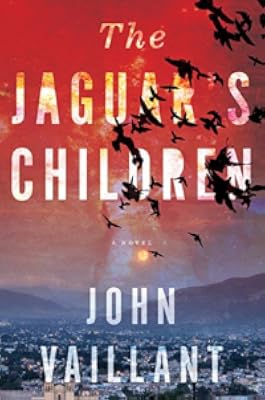
The Jaguar's Children
by John Vaillant
On This Page
Description
This "extraordinary" novel of one man's border crossing reveals "a human history of sorrow and suffering, all of it beginning with the thirst to be free" (NPR).Héctor is trapped. The water truck, sealed to hide its human cargo, has broken down. The coyotes have taken all the passengers' money for a mechanic and have not returned.
Héctor finds a name in his friend César's phone: AnniMac. A name with an American number. He must reach her, both for rescue and to pass along the message show more César has come so far to deliver. But are his messages going through?
Over four days, as water and food run low, Héctor tells how he came to this desperate place. His story takes us from Oaxaca—its rich culture, its rapid change—to the dangers of the border, exposing the tangled ties between Mexico and El Norte. And it reminds us of the power of storytelling and the power of hope, as Héctor fights to ensure his message makes it out of the truck and into the world.
Both an outstanding suspense novel and an arresting window into the relationship between two great cultures, The Jaguar's Children shows how deeply interconnected all of us are.
"This is what novels can do—illuminate shadowed lives, enable us to contemplate our own depths of kindness, challenge our beliefs about fate. Vaillant's use of fact to inspire fiction brings to mind a long list of powerful novels from the past decade or so: What is the What by Dave Eggers; The Map of Love by Ahdaf Soueif; The Storyteller by Jodi Picoult." —Amanda Eyre Ward, The New York Times Book Review
"[A] heartbreaker . . . Wrenching . . . with a voice fresh and plangent enough to disarm resistance." —The Boston Globe
"Fearless." —The Globe and Mail
. show less
Tags
Recommendations







































Member Reviews
John Vailant does not write fluffy beach books. He writes brilliant, important, socially relevant books, and makes them such easy and engaging reads! When he wrote about tigers [b:The Tiger: A True Story of Vengeance and Survival|7624594|The Tiger A True Story of Vengeance and Survival|John Vaillant|https://d.gr-assets.com/books/1320490797s/7624594.jpg|10109525] he gave us everything about the tigers, their history, their, present perilous situation, etc. In this novel we are introduced to Hector an Oaxacan who is trapped in an abandoned and sealed water truck somewhere in the desert. This is the story of how Hector found himself in this situation. It is also the story of many who risk their lives to cross illegally into the USA.
This show more book should be required reading for all High School students and definitely all USA politicians. It is not a difficult read, but it is a thoughtful, impactful one. It was very educational for me, as I thought the reason behind this difficult, often deadly journey was financial. That is part of the story for many, but there is so much more leading these people to risk everything; death, rape, life-long debt, loss of family and more, to head North.
Vaillant has Hector tell his story as he lies, alternately freezing and boiling, in the body of the truck, wondering if he will survive. He has his friend's cell phone with it's dying battery, and he is sending out his story to a contact in the phone, as his last hope, for rescue, or if that fails, at least for his story to be known.
The story goes as far back as Hector's grandfather and it includes many aspects of life in his home province of Oaxaca. We learn about the daily life, culture, education, and corruption in Oaxaca. We see how rapidly things are changing. There are themes that are relevant to everyone, issues that effect all of us, and we see them through his eyes.
There is a mystery within the story and there is obvious suspense. In this novel we have history, social relevance, moral issues, engaging characters, love stories, brilliant writing and yes, a jaguar. What more could you ask for? show less
This show more book should be required reading for all High School students and definitely all USA politicians. It is not a difficult read, but it is a thoughtful, impactful one. It was very educational for me, as I thought the reason behind this difficult, often deadly journey was financial. That is part of the story for many, but there is so much more leading these people to risk everything; death, rape, life-long debt, loss of family and more, to head North.
Vaillant has Hector tell his story as he lies, alternately freezing and boiling, in the body of the truck, wondering if he will survive. He has his friend's cell phone with it's dying battery, and he is sending out his story to a contact in the phone, as his last hope, for rescue, or if that fails, at least for his story to be known.
The story goes as far back as Hector's grandfather and it includes many aspects of life in his home province of Oaxaca. We learn about the daily life, culture, education, and corruption in Oaxaca. We see how rapidly things are changing. There are themes that are relevant to everyone, issues that effect all of us, and we see them through his eyes.
There is a mystery within the story and there is obvious suspense. In this novel we have history, social relevance, moral issues, engaging characters, love stories, brilliant writing and yes, a jaguar. What more could you ask for? show less
I would hope that even the loudest opponent of illegal immigration would agree that no one deserves Héctor's experience in that water truck.
While the book can be a tricky read if you don't speak or read Spanish, the author brilliantly blends Héctor's past and present.
This book broke my heart but I hope a lot of people read it.
While the book can be a tricky read if you don't speak or read Spanish, the author brilliantly blends Héctor's past and present.
This book broke my heart but I hope a lot of people read it.
Wow!
I'm a prolific reader, and it is a rare book that knocks the wind out of me...a rare book that I have to put down sometimes because I'm overwhelmed and need to remember to breathe. This is such a book.
I shouldn't be surprised that I loved this book, and I also really liked Mr. Vaillant's two nonfiction books, The Gold Spruce and The Tiger.
In the Jaguar's Children, we have the story of Hector (Tito) Gonzales and his friend Cesar Ramirez Santiago who are trying to sneak across the U.S.-Mexican border. Cesar is running from certain death as he has uncovered information the government doesn't want known. Hector is running towards a better life in el Norte, having no future in his homeland.
Mr. Vaillant brings us deep into the lives and show more feelings of his characters so that the story becomes riveting. I don't want to say too much about the story as I fear spoilers would be inevitable. Let me, instead, give you two quotes that I found especially poignant:
"When those Greeks were hiding in that horse they wanted to attack the city, and when the terrorists were hiding in those planes they wanted to attack the country, but when Mexicanos hide in a truck, what do they want do do? They want to pick lettuce. And cut your grass." (Page 11)
"...but it's hard to be hard, especially when someone's telling you that the world that made you is being killed in front of your eyes and what can you do but wait for some men you don't know and don't trust to take your life in their hands and drive you someplace you never been before where all you have is your uncle's phone number and with this you're supposed to make some new kind of life because the old one is broken and you don't know how to fix it except to do what everyone else is doing and go somewhere far away with bad food, cold weather and people who hate you. You know what I'm saying? What would you do?" (Page 145)
Read this book! show less
I'm a prolific reader, and it is a rare book that knocks the wind out of me...a rare book that I have to put down sometimes because I'm overwhelmed and need to remember to breathe. This is such a book.
I shouldn't be surprised that I loved this book, and I also really liked Mr. Vaillant's two nonfiction books, The Gold Spruce and The Tiger.
In the Jaguar's Children, we have the story of Hector (Tito) Gonzales and his friend Cesar Ramirez Santiago who are trying to sneak across the U.S.-Mexican border. Cesar is running from certain death as he has uncovered information the government doesn't want known. Hector is running towards a better life in el Norte, having no future in his homeland.
Mr. Vaillant brings us deep into the lives and show more feelings of his characters so that the story becomes riveting. I don't want to say too much about the story as I fear spoilers would be inevitable. Let me, instead, give you two quotes that I found especially poignant:
"When those Greeks were hiding in that horse they wanted to attack the city, and when the terrorists were hiding in those planes they wanted to attack the country, but when Mexicanos hide in a truck, what do they want do do? They want to pick lettuce. And cut your grass." (Page 11)
"...but it's hard to be hard, especially when someone's telling you that the world that made you is being killed in front of your eyes and what can you do but wait for some men you don't know and don't trust to take your life in their hands and drive you someplace you never been before where all you have is your uncle's phone number and with this you're supposed to make some new kind of life because the old one is broken and you don't know how to fix it except to do what everyone else is doing and go somewhere far away with bad food, cold weather and people who hate you. You know what I'm saying? What would you do?" (Page 145)
Read this book! show less
"It is a tradition in the pueblo to bury the baby's plancenta in the dirt floor of the house. It means you will always come back. For most of us it is a root into a place, but for my father I think it is a chain."
This book packs a punch. It is heart-breaking and poetic and powerful. I might have to bump my rating up to the full five stars because I. Cannot. Stop. Thinking. About. It. I don't even know where to begin, really. It's about illegal immigration. And desire. And dreams. And it is also about how greed and small-mindedness make these things mostly incompatible.
Héctor tells us his story and it begins inside of a water truck - a group of illegal immigrants hoping to travel from Mexico to America have been sealed inside a tanker show more truck which has been abandoned. The journey was only supposed to take a few hours, so they have not come prepared to be trapped for days. It is dark and dank, and the temperature varies from beyond hot to unbearably cold. I mean, it's a metal tank. The sides are rounded, so they cannot even stand up or change position easily. It's a nightmare, and as someone who suffers from claustrophobia, it is beyond the realm of my imagination how they could even begin to cope with the situation without completely panicking. I had to read in bits and pieces at first because it was too much.
Héctor is traveling with his friend César, who has been hurt, and as the story unfolds, we learn that César's phone has become their lifeline - or it would be if they could reach anyone. To keep himself grounded and remain cognizant, Héctor begins telling his story and also César's story, and the stories become bigger than the moment because they are not just the stories of an individual but of a people.
"But in here, we have no trail to follow and no one is finding us. So how do we keep going? In the morning, my mother makes the fire from nothing, only by blowing on the gray ash. You can't see it from the outside, but the fire is in there waiting for someone to notice, waiting for some reason to burn again. Waiting - en español "to wait" is the same as "to hope" - esperar. Besides chingar, esperar is the other official verb of Mexico, and it is what I do for you all this time - all these hours and days and words." show less
This book packs a punch. It is heart-breaking and poetic and powerful. I might have to bump my rating up to the full five stars because I. Cannot. Stop. Thinking. About. It. I don't even know where to begin, really. It's about illegal immigration. And desire. And dreams. And it is also about how greed and small-mindedness make these things mostly incompatible.
Héctor tells us his story and it begins inside of a water truck - a group of illegal immigrants hoping to travel from Mexico to America have been sealed inside a tanker show more truck which has been abandoned. The journey was only supposed to take a few hours, so they have not come prepared to be trapped for days. It is dark and dank, and the temperature varies from beyond hot to unbearably cold. I mean, it's a metal tank. The sides are rounded, so they cannot even stand up or change position easily. It's a nightmare, and as someone who suffers from claustrophobia, it is beyond the realm of my imagination how they could even begin to cope with the situation without completely panicking. I had to read in bits and pieces at first because it was too much.
Héctor is traveling with his friend César, who has been hurt, and as the story unfolds, we learn that César's phone has become their lifeline - or it would be if they could reach anyone. To keep himself grounded and remain cognizant, Héctor begins telling his story and also César's story, and the stories become bigger than the moment because they are not just the stories of an individual but of a people.
"But in here, we have no trail to follow and no one is finding us. So how do we keep going? In the morning, my mother makes the fire from nothing, only by blowing on the gray ash. You can't see it from the outside, but the fire is in there waiting for someone to notice, waiting for some reason to burn again. Waiting - en español "to wait" is the same as "to hope" - esperar. Besides chingar, esperar is the other official verb of Mexico, and it is what I do for you all this time - all these hours and days and words." show less
Fiction
John Vaillant
The Jaguar’s Children: A Novel
Houghton Mifflin Harcourt
978-0-544-29008-2, ebook, 280 pgs., $12.99 (also available in hardcover, Audible, and audio CD)
January 2015
Thu Apr 5— 08: 31 [text]
hello i am sorry to bother you but i need your assistance— i am hector— cesars friend— its an emergency now for cesar— are you in el norte? i think we are also— arizona near nogales or sonoita— since yesterday we are in this truck with no one coming— we need water and a doctor— and a torch for cutting metal
The Jaguar’s Children is journalist and author (who cites as sources Luis Alberto Urrea and Charles Bowden; how could you go wrong?) John Vaillant’s devastatingly powerful first novel. Mexicans and show more Nicaraguans, men, women, and children, bakers, students and scientists, have paid coyotes (“They were talking fast all the time, but not as fast as their eyes”) to provide safe passage into the United States, welded inside a water truck (“like a bucket of crabs with the lid on and no place to go”). As the book begins, they’ve been abandoned for two days in the Sonoran Desert of Arizona (“la via dolorosa”).
Héctor (“Pollo is chicken cooked on a plate— a dinner for coyotes. This is who is speaking to you now.”) finds a contact, AnniMac, with a United States area code in his friend César’s phone and tries to reach her. In an attempt to comfort himself and save his sanity, Héctor takes us with him as he “escapes into his head,” making audio files as he talks to AnniMac about his home. Héctor talks about his family, Mexican history and geography, religion and mythology, culture and sociology, as he describes the diversity of Mexico, not a monolith, and these people as individuals, not stereotypes.
The Jaguar’s Children is full of rich description. A market in Oaxaca: “It is not even four, but already the first trucks are coming in from the coast with fish and oranges, seashells and coconuts, maybe a special order of turtle eggs hiding in the belly of a tuna, or a crocodile skull with all its teeth. And from the south they come with coffee and mangoes, chocolate, iguanas and velvet huipils, and from the Sierra with calla lilies, beef, pots in all sizes still scarred by the fire that made them.”
Vaillant’s imagery is both profound in its simplicity and brutal in its sophistication. “More and more the tank is feeling and smelling like the intestine of some animal, slowly digesting us.” Héctor watches time in the form of the cell phone’s battery life and thinks of his beloved grandfather. “Time, you know. Minutes. When my abuelo was young he didn’t know what a minute was because in Zapotec there aren’t any minutes, only days and seasons and harvests.”
There is even humor in the midst of tragedy.
When she [Héctor’s mother] was tired of listening to me, she said, “Héctorcito? How long have there been these Transformers?
And I said, “Always, Mamá. Since I was young.”
And she said, “Yes, well, that is not so long. Our beloved Jesus has been a Transformer for two thousand years.”
The Jaguar’s Children is harrowing and beautiful, brilliant and exhausting. The concept is inspired, the plot simple and stark and terrible, the pacing inexorable. The ending is wholly unexpected in the great tradition of magical realism. This is the total package.
Originally published in Lone Star Literary Life. show less
John Vaillant
The Jaguar’s Children: A Novel
Houghton Mifflin Harcourt
978-0-544-29008-2, ebook, 280 pgs., $12.99 (also available in hardcover, Audible, and audio CD)
January 2015
Thu Apr 5— 08: 31 [text]
hello i am sorry to bother you but i need your assistance— i am hector— cesars friend— its an emergency now for cesar— are you in el norte? i think we are also— arizona near nogales or sonoita— since yesterday we are in this truck with no one coming— we need water and a doctor— and a torch for cutting metal
The Jaguar’s Children is journalist and author (who cites as sources Luis Alberto Urrea and Charles Bowden; how could you go wrong?) John Vaillant’s devastatingly powerful first novel. Mexicans and show more Nicaraguans, men, women, and children, bakers, students and scientists, have paid coyotes (“They were talking fast all the time, but not as fast as their eyes”) to provide safe passage into the United States, welded inside a water truck (“like a bucket of crabs with the lid on and no place to go”). As the book begins, they’ve been abandoned for two days in the Sonoran Desert of Arizona (“la via dolorosa”).
Héctor (“Pollo is chicken cooked on a plate— a dinner for coyotes. This is who is speaking to you now.”) finds a contact, AnniMac, with a United States area code in his friend César’s phone and tries to reach her. In an attempt to comfort himself and save his sanity, Héctor takes us with him as he “escapes into his head,” making audio files as he talks to AnniMac about his home. Héctor talks about his family, Mexican history and geography, religion and mythology, culture and sociology, as he describes the diversity of Mexico, not a monolith, and these people as individuals, not stereotypes.
The Jaguar’s Children is full of rich description. A market in Oaxaca: “It is not even four, but already the first trucks are coming in from the coast with fish and oranges, seashells and coconuts, maybe a special order of turtle eggs hiding in the belly of a tuna, or a crocodile skull with all its teeth. And from the south they come with coffee and mangoes, chocolate, iguanas and velvet huipils, and from the Sierra with calla lilies, beef, pots in all sizes still scarred by the fire that made them.”
Vaillant’s imagery is both profound in its simplicity and brutal in its sophistication. “More and more the tank is feeling and smelling like the intestine of some animal, slowly digesting us.” Héctor watches time in the form of the cell phone’s battery life and thinks of his beloved grandfather. “Time, you know. Minutes. When my abuelo was young he didn’t know what a minute was because in Zapotec there aren’t any minutes, only days and seasons and harvests.”
There is even humor in the midst of tragedy.
When she [Héctor’s mother] was tired of listening to me, she said, “Héctorcito? How long have there been these Transformers?
And I said, “Always, Mamá. Since I was young.”
And she said, “Yes, well, that is not so long. Our beloved Jesus has been a Transformer for two thousand years.”
The Jaguar’s Children is harrowing and beautiful, brilliant and exhausting. The concept is inspired, the plot simple and stark and terrible, the pacing inexorable. The ending is wholly unexpected in the great tradition of magical realism. This is the total package.
Originally published in Lone Star Literary Life. show less
John Vaillant’s The Jaguar’s Children is an essential, remarkable read. This is a novel about migration, cultural loss (and retention), and the impact of big agriculture and its use of genetic engineering.
The narrator has traveled from Oaxaca to the U.S. border. He and another dozen or so hopeful immigrants have paid to be welded into an empty water truck to travel across the border. The remaining opening in the tank is a hole small enough to pump out the water (if there were any), but much too small for a person to pass through. Who would expect a tanker without access to be carrying a human cargo?
Disaster hits when the truck breaks down just north of the border. The two coyotes driving it abandon their human cargo—but only after show more demanding additional money, which they claim will be used to pay a mechanic. There is no mechanic; there is no exit. During the desert days the walls of the tank become too hot to touch; during the nights temperatures plummet.
If this sounds like a bleak situation, it is—bleak and all too real. The last few years have seen death rates for migrants ranging from 477 in 2012 to 307 in 2014 (according to AP reports).
The immigrants’ phones have little reception and are losing power. The narrator, Tito, is unable to telephone out and records his life story in a series of audio and text messages he is unable to send. Tito describes the miserable conditions in the tanker. He shares many of the stories his grandfather told—of the old ways in Oaxaca and his work on a series of archaeological digs in the years before World War II. He also tells a tale of the impending crisis facing small farmers in Oaxaca as genetically modified corn strains contaminate the local crops.
Vaillant succeeds in weaving these different narratives together to create a novel that is both disturbing and beautiful. He avoids polemic; he avoids discontinuity; and, remarkably, he avoids bathos. This is a book that compels readers both because of and despite the sense of menace hanging over it. The Jaguar’s Children deserves to be widely read both for its success as a novel and for the issues it raises. show less
The narrator has traveled from Oaxaca to the U.S. border. He and another dozen or so hopeful immigrants have paid to be welded into an empty water truck to travel across the border. The remaining opening in the tank is a hole small enough to pump out the water (if there were any), but much too small for a person to pass through. Who would expect a tanker without access to be carrying a human cargo?
Disaster hits when the truck breaks down just north of the border. The two coyotes driving it abandon their human cargo—but only after show more demanding additional money, which they claim will be used to pay a mechanic. There is no mechanic; there is no exit. During the desert days the walls of the tank become too hot to touch; during the nights temperatures plummet.
If this sounds like a bleak situation, it is—bleak and all too real. The last few years have seen death rates for migrants ranging from 477 in 2012 to 307 in 2014 (according to AP reports).
The immigrants’ phones have little reception and are losing power. The narrator, Tito, is unable to telephone out and records his life story in a series of audio and text messages he is unable to send. Tito describes the miserable conditions in the tanker. He shares many of the stories his grandfather told—of the old ways in Oaxaca and his work on a series of archaeological digs in the years before World War II. He also tells a tale of the impending crisis facing small farmers in Oaxaca as genetically modified corn strains contaminate the local crops.
Vaillant succeeds in weaving these different narratives together to create a novel that is both disturbing and beautiful. He avoids polemic; he avoids discontinuity; and, remarkably, he avoids bathos. This is a book that compels readers both because of and despite the sense of menace hanging over it. The Jaguar’s Children deserves to be widely read both for its success as a novel and for the issues it raises. show less
A powerfully moving story of illegal border crossing from Mexico which went wrong. Thirteen people from various regions of Mexico are abandoned by the coyote who promised he could get them across welded inside an empty water truck tank. No way out, and their provisions don't last. The story is told in memories Hector records as long as the cell phone battery lasts. The motivations for crossing are many, and so often US trade policy and multinational company profit motives at the expense of workers and environment are at play. And then there are the ethnic mistrusts and aggressions between some of the migrants from different regions.
Although an American, Ozzie Rodriguez's Latinx narration is very convincing to this white listener, and show more effectively puts me right in the scene. show less
Although an American, Ozzie Rodriguez's Latinx narration is very convincing to this white listener, and show more effectively puts me right in the scene. show less
Members
- Recently Added By
Lists

Top Five Books of 2016
795 works; 229 members

International Dublin Literary Award Longlist 2017
147 works; 3 members

Dublin Literary Award Longlist 2017
147 works; 2 members
Kirkus Starred Fiction Reviews of Books Published in 2015
310 works; 6 members

Must-Read Books About the Southwest
98 works; 2 members

Evergreen Award™ Winners and Nominees 2005–2024
200 works; 3 members
Author Information

5+ Works 3,575 Members
Awards and Honors
Awards
Notable Lists
Common Knowledge
- Original publication date
- 2015
- People/Characters
- Cesar Ramirez Santiago; Hector 'Tito' Gonzales
- Important places
- Arizona, USA; Mexico; Mexico-U.S. border
- Epigraph
- Anyone attempting to classify Olmec figures will be borne imperceptibly into those of the jaguar. Gradually, human faces will acquire feline features, blending into one another before turning, finally, into jaguars. Wha... (show all)t is important is the intimate connection between the man and the animal. -- Ignacio Bernal, The Olmec World
- Dedication
- For my family passed and present
- First words
- Hello I'm sorry to bother you but I need your assistance -- I am Hector -- Cesar's friend -- It's an emergency now for Cesar -- Are you in el norte?
- Quotations
- When those Greeks were hiding in that horse they wanted to attack the city, and when the terrorists were hiding in those planes they wanted to attack the country, but when Mexicanos hide in a truck, what do they want do do? T... (show all)hey want to pick lettuce. And cut your grass. (Page 11)
...but it's hard to be hard, especially when someone's telling you that the world that made you is being killed in front of your eyes and what can you do but wait for some men you don't know and don't trust to take your life ... (show all)in their hands and drive you someplace you never been before where all you have is your uncle's phone number and with this you're supposed to make some new kind of life because the old one is broken and you don't know how to fix it except to do what everyone else is doing and go somewhere far away with bad food, cold weather and people who hate you. You know what I'm saying? What would you do? (Page 145) - Blurbers
- Urrea, Luis Alberto; Schwartz, John Burnham; Boyden, Joseph; Thon, Melanie Rae
Classifications
Statistics
- Members
- 215
- Popularity
- 152,002
- Reviews
- 19
- Rating
- (4.07)
- Languages
- English, French, Spanish
- Media
- Paper, Audiobook, Ebook
- ISBNs
- 14
- ASINs
- 2