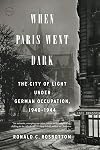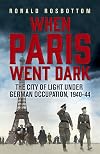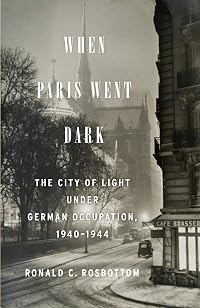
When Paris Went Dark: The City of Light Under German Occupation, 1940-1944
by Ronald C. Rosbottom
On This Page
Description
On June 14, 1940, German tanks entered a silent and nearly deserted Paris. Eight days later, France accepted a humiliating defeat and foreign occupation. Subsequently, an eerie sense of normalcy settled over the City of Light. Many Parisians keenly adapted themselves to the situation-even allied themselves with their Nazi overlords. At the same time, amidst this darkening gloom of German ruthlessness, shortages, and curfews, a resistance arose. Parisians of all stripes, Jews, immigrants, show more adolescents, communists, rightists, cultural icons such as Colette, de Beauvoir, Camus and Sartre, as well as police officers, teachers, students, and store owners-rallied around a little known French military officer, Charles de Gaulle. When Paris Went Dark evokes with stunning precision the detail of daily life in a city under occupation, and the brave people who fought against the darkness. Relying on a range of resources--memoirs, diaries, letters, archives, interviews, personal histories, flyers and posters, fiction, photographs, film and historical studies, Rosbottom has forged a groundbreaking book that will forever influence how we understand those dark years in the City of Light. show lessTags
Recommendations


















Member Reviews
Rosbottom offers us a deep view of what Paris was like for the occupied and the occupier during the German occupation - 1940 - 1944. He looks at the individuals who comprised the Resistance (he takes a closer look at the youths who made up the majority of the resistance in, Sudden Courage) and the circumstances and reasoning that motivated them. A large number of them ended up executed. The "Brigades," French civilian clothes policemen would, Rosbottom explains, spend months tailing and staking out suspects, even allowing acts of resistance to occur if they thought they could snare important Resistance leaders. The Resistance covered those who simply distributed encouraging underground newspapers to those individuals committing sabotage show more and assassination. When the author informs us that the The Brigades caught 1500 members in a given time, the reader understands the claim that life expectancy for active Resistance members was six weeks. The most painful part of the book related to families. During the sweeps of July 16-17, 1942, the French police rounded up children between the ages of two to sixteen. "It was," says Rosbottom, "the most significant mistake of the Vichy government...." Rosbottom is saying something of great import here. The Nazis could not have apprehended, deported and murdered foreign and French Jews without the help of the French police. And tragically, the French police accommodated the occupiers efficiently. "It is the separation of children from their parents that most affects the French population...." Rosbottom quotes a report. The recuse by many gentile French citizens of their Jewish neighbors and friends does not balance the unforgivable collaboration by the French police. "Paris will never be able to erase its responsibility for the roundups," Rosbottom concludes. And even here, when 13,000 Jews were rounded up by the French police on July 16th, "the German authorities, surreptitiously evaluating the results,were apoplectic." They expected 27,500.
On a personal note, I must offer this anecdote. Serving as a translator, my father entered Paris soon after the liberation. There he listened to French families tell him details of their four-year ordeal. Later on, after my father had shipped back home and was demobilized, after I was born, he could not help repeating over and over to his six-year-old son: "It could happen here." Reading Rosbottom's book, recalling my father's words, I cannot help but understand the reaction: "Never forget." show less
On a personal note, I must offer this anecdote. Serving as a translator, my father entered Paris soon after the liberation. There he listened to French families tell him details of their four-year ordeal. Later on, after my father had shipped back home and was demobilized, after I was born, he could not help repeating over and over to his six-year-old son: "It could happen here." Reading Rosbottom's book, recalling my father's words, I cannot help but understand the reaction: "Never forget." show less
Thorough coverage of this painful era of world history, and an important read for anyone who cares for Paris. Early on, Rosbottom bends over backwards to be "fair," with lengthy descriptions of the poor, lonely, sad, despised German soldiers stationed in a city where no one wanted to even look at them. This is a surprise? Nazi administrators are politely accommodating to the brothel madam who complains about the quality of her new clientele. So, it looks like it wasn't really all that bad, then, was it? The tone shifts when the horrific roundups begin to occur, with full assistance from the French police. The nightmare of collaborationists, moles, spies, and concierges who send tips to the Nazis (while others helped shift Jewish show more families from one empty apartment to another to hide and protect them) unspools. Keeping your head down and your mouth shut and following the rules was no guarantee of safety. Unless, of course, you were wealthy or creative or somehow special with friends in useful places (Cocteau and Chanel, for two rather shameful examples, who partied their way through the war in Paris while others fled for their lives or were shipped away to the end of theirs). The reckless courage of many young men and women in the loose resistance movement is impressive, and he does a good job here - and has written another book devoted to them (Sudden Courage: Youth in France Confront the Germans, 1940-1945).
Finally, the Germans begin to lose the war. Paris is liberated. And it gets uglier. The suppressed fury of the Parisians is unleashed in violent reprisals - against fellow Parisians believed to have collaborated or supported the occupiers. Women are shaved, burned, stripped and humiliated; men are shot in secret "black sites" or just dark alleys. Skeletal, traumatized PoWs or camp survivors begin to trickle back to families who barely recognize them. Vichy politicians begin to worm their way back into government; factions of Communists and Resistance fighters are at odds with each other and everyone else. It takes a long time for life to resume, and the heroes and villains are still being sorted out.
Disturbing, disheartening, tragic. But we must not forget. Not any of it. show less
Finally, the Germans begin to lose the war. Paris is liberated. And it gets uglier. The suppressed fury of the Parisians is unleashed in violent reprisals - against fellow Parisians believed to have collaborated or supported the occupiers. Women are shaved, burned, stripped and humiliated; men are shot in secret "black sites" or just dark alleys. Skeletal, traumatized PoWs or camp survivors begin to trickle back to families who barely recognize them. Vichy politicians begin to worm their way back into government; factions of Communists and Resistance fighters are at odds with each other and everyone else. It takes a long time for life to resume, and the heroes and villains are still being sorted out.
Disturbing, disheartening, tragic. But we must not forget. Not any of it. show less
An excellent example of two phenomena: the human desire to describe past events as simple stories, and that when one examines an historical event or period more and more closely, our preconceptions are challenged by the complex nature of reality. Prof. Rosbottom has written an account of the German occupation of Paris, 1940 - 1944, that does not seem to have any clear prejudices. Consequently the story is confusing, the accounts of resistance are minimized and one cannot know if anyone is truly responsible for anything or if a complex organic situation (á la Camus) defines our actions. In a story like this one, even the bravest, those who sacrifice themselves, may seem selfish or naive. What did they ultimately accomplish? Who paid a show more price for their activities? [A gift from Dr. D.] show less
When I was in Paris on my honeymoon in 1976, I went with my husband, who is a military history buff, to the War Museum at the Invalides in Paris. When we came to the part in the exhibit that covered Frances surrender to the Germans in 1940, we were stunned to find that the surrender and the subsequent occupation was termed "France Changes her Tactics." We were further surprised to find Charles DeGaulle portrayed as leading the D-Day invasion. At the time we just thought the French were being weird, but later we discovered that apparently these seemingly farcical statements in a museum were part of a much larger rationalization for both the collapse of France in 1940 and its subsequent behavior during the 4-year German occupation. Ronald show more Rosbottom's excellent When Paris Went Dark explores the blows to the proud French psyche that both the defeat in 1940 and the long occupation of the capital caused.
Using interviews with people who lived in Paris during the war as well as diaries, memoirs and other primary sources, the author dispels the myth of the "Heroic Resistance" and shows how the French police were willing collaborators with the occupation forces (a fact that the French government did not admit to until 1995). He also shows how the almost orgiastic revenge on suspected collaborationist citizens (primarily women who had sexual relations with the German occupiers) was in large part to assuage the larger communal guilt of having been defeated.
This is an enlightening story of feckless government and military officials, the venality of opportunistic Parisians, the daily grind of wartime survival and the few brave who individuals who did fight against the Nazis. show less
Using interviews with people who lived in Paris during the war as well as diaries, memoirs and other primary sources, the author dispels the myth of the "Heroic Resistance" and shows how the French police were willing collaborators with the occupation forces (a fact that the French government did not admit to until 1995). He also shows how the almost orgiastic revenge on suspected collaborationist citizens (primarily women who had sexual relations with the German occupiers) was in large part to assuage the larger communal guilt of having been defeated.
This is an enlightening story of feckless government and military officials, the venality of opportunistic Parisians, the daily grind of wartime survival and the few brave who individuals who did fight against the Nazis. show less
Three stars.
This is a dense book, but it’s easy to read. It’s an almost 400-page look at the four years when the Nazis occupied Paris. As someone raised in the U.S., I’ve heard jokes about how quickly the French surrendered during World War II, and how the U.S. liberated them. But that seemed a bit simplistic, so when I saw this in a book store I knew I wanted to read it.
Mr. Rosbottom has done a ton of research and created a really interesting story. Even though there is no, say, central narrative (i.e. there is no one family we follow from start to finish, which some writers of history do, such as Erik Larson did with “In the Garden of Beasts,” which I read earlier this year), each chapter follows the previous in a logical show more manner, and is still filled with stories that help us understand what life was like.
He spends time talking through how very quickly the French did come to an agreement with the Nazis about how France would be governed. Ultimately this probably saved Paris from being destroyed in bombing campaigns. He follows that up with how the Nazis were greeted and interacted with Parisians during the first year, and how that slowly changed. There were eventually curfews, and rations. Jewish people (especially foreign-born Jewish people) were rounded up and send off to prisons and concentration camps.
And this is where the most interesting discussions come up. How much should the French people – not the military, but the people – have fought back? By not engaging in a resistance movement, were they essentially accepting the Nazis? Were they cowards, or were they people who recognized that they didn’t have much they could do? Should we blame those who, say, served Nazi soldiers, even though the acts of resistance some carried out resulted in many deaths of French people? Do we blame people for doing what they think they need to do to survive?
This is clearly a sore spot in French history. Immediately after the liberation, those who were considered to be ‘collaborators’ were treated horribly – and many of those were women, who were taken in the street, had their heads shaved, and paraded around for sleeping with Nazis. Some people were accused of things they didn’t do and were killed by mobs. And some, like members of the French Police, helped bring in people to be sent out of the country and ultimately killed. How much responsibility should they bear when acting under an Occupation?
These are bigger discussions than can be resolved in one book, but if Paris interests you, if World War II interests you, and if philosophical discussions interest you, I’d suggest this book. show less
This is a dense book, but it’s easy to read. It’s an almost 400-page look at the four years when the Nazis occupied Paris. As someone raised in the U.S., I’ve heard jokes about how quickly the French surrendered during World War II, and how the U.S. liberated them. But that seemed a bit simplistic, so when I saw this in a book store I knew I wanted to read it.
Mr. Rosbottom has done a ton of research and created a really interesting story. Even though there is no, say, central narrative (i.e. there is no one family we follow from start to finish, which some writers of history do, such as Erik Larson did with “In the Garden of Beasts,” which I read earlier this year), each chapter follows the previous in a logical show more manner, and is still filled with stories that help us understand what life was like.
He spends time talking through how very quickly the French did come to an agreement with the Nazis about how France would be governed. Ultimately this probably saved Paris from being destroyed in bombing campaigns. He follows that up with how the Nazis were greeted and interacted with Parisians during the first year, and how that slowly changed. There were eventually curfews, and rations. Jewish people (especially foreign-born Jewish people) were rounded up and send off to prisons and concentration camps.
And this is where the most interesting discussions come up. How much should the French people – not the military, but the people – have fought back? By not engaging in a resistance movement, were they essentially accepting the Nazis? Were they cowards, or were they people who recognized that they didn’t have much they could do? Should we blame those who, say, served Nazi soldiers, even though the acts of resistance some carried out resulted in many deaths of French people? Do we blame people for doing what they think they need to do to survive?
This is clearly a sore spot in French history. Immediately after the liberation, those who were considered to be ‘collaborators’ were treated horribly – and many of those were women, who were taken in the street, had their heads shaved, and paraded around for sleeping with Nazis. Some people were accused of things they didn’t do and were killed by mobs. And some, like members of the French Police, helped bring in people to be sent out of the country and ultimately killed. How much responsibility should they bear when acting under an Occupation?
These are bigger discussions than can be resolved in one book, but if Paris interests you, if World War II interests you, and if philosophical discussions interest you, I’d suggest this book. show less
I re-found this book on my library's shelves, and remembered it as being pretty good. My memory was correct; this is a well-written, engaging account of Paris during the 1940-1944 German occupation. The author does something I have a weakness for: haul you into the footnotes at the bottom of the page for a private conversation. The book doesn't flinch from looking at the seamier side of the French existence with the Germans, though I do think that the author does let a lot of folks off the hook (like de Beauvoir). Much of what's in the book has been recounted elsewhere -- why it doesn't get five stars -- though the original nature of some of the author's work makes it very close. Recommended.
If you don't like France or the French people, you may find some ammunition to fuel your dislike. This is a book about what life was like in Paris under the Nazi occupation. The French and their military have been attacked for their lack of fight when Germany invaded. Paris and its citizens largely avoided the bombings and battles that took place in the rest of Europe. Most of the French have felt some shame and embarrassment that greater resistance did not take place.
What is interesting is how Parisians adapted to the Nazi occupation. Rosbottom provides a lot of stories and anecdotes on how Parisians try to continue to live their ordinary everyday lives. It was not easy – – Parisians were subject to food lines and food shortages. show more French Jews were also targeted not only by the Germans but by the French police who took responsibility for rounding them up.
What struck me about the book was whether the French behavior to the Nazi occupation was that unusual or unexpected. For example, how would Americans react if they were under some type of Occupation? Would most or some Americans collaborate with the enemy? I'm not so sure that the rest of the world can throw stones at the French behavior between 1940 and 1944.
Interesting history. Gives one pause for thought. show less
What is interesting is how Parisians adapted to the Nazi occupation. Rosbottom provides a lot of stories and anecdotes on how Parisians try to continue to live their ordinary everyday lives. It was not easy – – Parisians were subject to food lines and food shortages. show more French Jews were also targeted not only by the Germans but by the French police who took responsibility for rounding them up.
What struck me about the book was whether the French behavior to the Nazi occupation was that unusual or unexpected. For example, how would Americans react if they were under some type of Occupation? Would most or some Americans collaborate with the enemy? I'm not so sure that the rest of the world can throw stones at the French behavior between 1940 and 1944.
Interesting history. Gives one pause for thought. show less
Members
- Recently Added By
Lists

Chronological 2016
33 works; 1 member

Books Read in 2025
4,091 works; 97 members
Author Information

6 Works 498 Members
Ronald C. Rosbottom is the Winifred L. Arms Professor in the Arts and Humanities and professor of French, European studies, and architectural studies at Amherst College. His previous book, When Paris Went Dark: The City of Light Under German Occupation, 1940-1944, was long-listed for the National Book Award in Nonfiction. He divides his time show more between Amherst, Massachusetts, and Paris. show less
Awards and Honors
Common Knowledge
- Original title
- When Paris Went Dark: The City of Light Under German Occupation, 1940-1944
- Original publication date
- 2014
- Important places
- Paris, France
- Important events
- World War II (1939 | 1945); World War II, German Occupation of France (1940 | 1944)
- First words
- My affection for and personal experience of Paris led me to wonder what it would have been like to live there under German Occupation during the Second World War. (Preface)
Paris is and always has been obsessed with itself--its place within France, within Europe, within the world, and within the imaginations of those who have visited it or who want to. (Introduction)
How did this debacle happen, and so rapidly? - Last words
- (Click to show. Warning: May contain spoilers.)For either way, or both ways, you would have thickened your knowledge so that the next time you confront Paris, either in person or imaginatively, you will have more respect for her resiliency as well as for the hope that she still offers those seeking to escape the deprivations of ignorance and cultural violence.
- Original language
- English US
- Canonical DDC/MDS
- 944.3610816
Classifications
Statistics
- Members
- 448
- Popularity
- 68,234
- Reviews
- 11
- Rating
- (3.91)
- Languages
- Dutch, English
- Media
- Paper, Audiobook, Ebook
- ISBNs
- 16
- ASINs
- 7