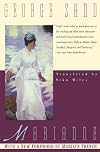
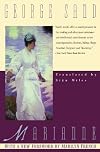
Marianne
by George Sand
On This Page
Description
"George Sand's delightful last novel takes the timeless theme of a younger woman in love with an older man and gives the stuff of nineteenth century romance a modern feminist twist at the same time that it subtly attacks that other Marianne, the French Republic's convention-bound Muse."--P. [4] of cover.Tags
Recommendations































Member Reviews
Marianne is worth reading for its historical perspectives on the value of females,
notable in that Marianne decides to marry the man who has so silently misjudged her.
Not only is Andre depressed and totally self absorbed,
but he has no work, no desire to support himself, and so lives dependent on his Mother
which will transfer to complete dependence on Marianne.
Independent Marianne, judged eccentric because she loves solitude and riding her horse alone,
deserves a stronger mate. Love does not always conquer all...
Why Marianne would choose to marry this guy instead of the more accomplished and fun,
though shallow, Philippe, still feels false.
Where is Henry David Thoreau when he is obviously needed?!?
(Story is preceded by one of the longest show more introductions ever = 78 pages.) show less
notable in that Marianne decides to marry the man who has so silently misjudged her.
Not only is Andre depressed and totally self absorbed,
but he has no work, no desire to support himself, and so lives dependent on his Mother
which will transfer to complete dependence on Marianne.
Independent Marianne, judged eccentric because she loves solitude and riding her horse alone,
deserves a stronger mate. Love does not always conquer all...
Why Marianne would choose to marry this guy instead of the more accomplished and fun,
though shallow, Philippe, still feels false.
Where is Henry David Thoreau when he is obviously needed?!?
(Story is preceded by one of the longest show more introductions ever = 78 pages.) show less
The things that made the character, Marianne, shocking in the 1800s, make her seem somewhat provincial today. She is an unmarried twenty-five year old with land--unheard of. She is unafraid to ride her horse about the countryside alone--unheard of. She knows what she wants in a husband and refuses to settle for anything less--unheard of. I think the affect of people being shocked is lost and that probably diminishes the impact that this novel would have had when released.
It is short, even for a novella, but it makes its point with some beautiful prose stylings. I was anxious to read something from George Sand. The forward, which consumes almost a half of this edition, made me all the more interested in her as a person and author. I am show more now quite anxious to read The Dream Lover, a biographical novel of her life.
I could have gone 3.5, but not 4, so I have rounded down. show less
It is short, even for a novella, but it makes its point with some beautiful prose stylings. I was anxious to read something from George Sand. The forward, which consumes almost a half of this edition, made me all the more interested in her as a person and author. I am show more now quite anxious to read The Dream Lover, a biographical novel of her life.
I could have gone 3.5, but not 4, so I have rounded down. show less
An engaging book about a strong woman that does not act as society expects. A short read and a good introduction to George Sand.
Ratings
Members
- Recently Added By
Author Information

457+ Works 6,466 Members
George Sand began life as Aurore Dupin, the daughter of a count and a dressmaker. Educated both on her aristocratic grandmother's estate and in a Parisian convent, at 18 she married Casimer Dudevant, a provincial gentleman whose rough temperament was the opposite of her own, and from whom she obtained a separation several years later. At 31 she show more moved to Paris, where she changed her name and plunged into the bohemian world of French romanticism. Frequently dressed in men's clothing, she participated actively in literary debates, cultural events, and even the revolution of 1848. Sand was friend and correspondent with many of the major artists and writers of her age, including Balzac, Flaubert, and Liszt. Her love affairs with the poet Musset and the composer Chopin were the stuff of legend, chronicled in her own Story of My Life. Sand's immensely popular novels ranged from sentimental stories of wronged women, to utopian socialist fictions, such as her masterpiece in Consuelo, 1842, to explorations of pastoral themes written when she retired, late in life, to her estate in Berry. Though frequently dismissed as overblown or too sentimental, Sand's fiction has recently undergone a revaluation, emerging as an influential body of women's writing. As both a writer and an intellectual personality, Sand is a central figure in nineteenth-century French cultural life. George Sand died in 1876 (Bowker Author Biography) show less
Series
Belongs to Publisher Series
Common Knowledge
- Original publication date
- 1876
- People/Characters
- Marianne Chevreuse; Piere Andre; Philippe Gaucher
- Important places
- La Faille-sur-Gouvre
- First words
- What is it that you think about, Sleeping Beauty, as you ride along the country lanes on that skinny mare of yours?
- Last words
- (Click to show. Warning: May contain spoilers.)On the following day, the banns were announced for the marriage of Pierre Andre and Marianne Chevreuse.
Classifications
- Genres
- Fiction and Literature, General Fiction, Romance
- DDC/MDS
- 843.7 — Literature & rhetoric French Literature French fiction Constitutional monarchy 1815–48
- LCC
- PQ2409 .M413 — Language and Literature French, Italian, Spanish and Portuguese literatures French literature Modern literature 19th century
- BISAC
Statistics
- Members
- 156
- Popularity
- 210,770
- Reviews
- 3
- Rating
- (3.33)
- Languages
- Danish, English, French
- Media
- Paper, Ebook
- ISBNs
- 10
- ASINs
- 2