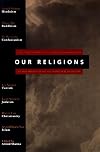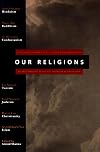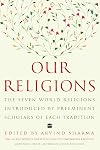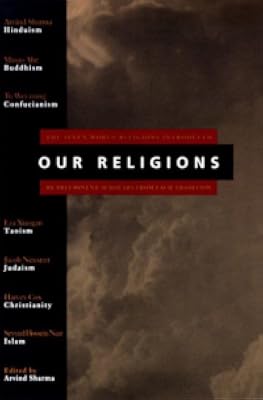
Our Religions: The Seven World Religions Introduced by Preeminent Scholars from Each Tradition
by Arvind Sharma
On This Page
Description
An essential introduction to the world's living religions by experts from each tradition -- published in conjunction with the 1993 Parliament of the World's Religions.Tags
Recommendations













Member Reviews
I have an MA in Comparative Religion, and I still found this a challenging book to get through. It was very dense, and sometimes the authors focused on issues more of interest to religious scholars than to general readers.
I suspect that individual reactions to this book will vary widely based on the degree of the reader's experience in religious studies and interest in the individual religions profiled. My personal reactions the various chapters:
Hinduism: Interesting and educational
Buddhism: Hard to get through (but I've always been challenged by Buddhist thinking)
Confucianism: Fascinating and inspiring
Taosim: Apologies to the author, but I skipped it
Judaism: Frustrating. The author framed the discussion in terms of oppression and show more resentment and promise -- which may be accurate (I don't know) but never really explained to me what it was like to practice Judaism. Of course, part of the point of the chapter was that, unlike other faiths, Judaism has an ethnic as well as a spiritual component, and he needed to address that.
Christianity: Enjoyed it a lot. I thought it was an excellent expression of both the diversity and unity of Christianity.
Islam: Very interesting and eye-opening.
If I could give this half-stars, this would be 3-1/2, but I rounded up because of the overall quality and ambition of the collection.
The book was published in 1994, and I would love to see another edition, hopefully one which also includes indigenous and neo-pagan faiths, which have become the focus of scholarly work. show less
I suspect that individual reactions to this book will vary widely based on the degree of the reader's experience in religious studies and interest in the individual religions profiled. My personal reactions the various chapters:
Hinduism: Interesting and educational
Buddhism: Hard to get through (but I've always been challenged by Buddhist thinking)
Confucianism: Fascinating and inspiring
Taosim: Apologies to the author, but I skipped it
Judaism: Frustrating. The author framed the discussion in terms of oppression and show more resentment and promise -- which may be accurate (I don't know) but never really explained to me what it was like to practice Judaism. Of course, part of the point of the chapter was that, unlike other faiths, Judaism has an ethnic as well as a spiritual component, and he needed to address that.
Christianity: Enjoyed it a lot. I thought it was an excellent expression of both the diversity and unity of Christianity.
Islam: Very interesting and eye-opening.
If I could give this half-stars, this would be 3-1/2, but I rounded up because of the overall quality and ambition of the collection.
The book was published in 1994, and I would love to see another edition, hopefully one which also includes indigenous and neo-pagan faiths, which have become the focus of scholarly work. show less
Ratings
Members
- Recently Added By
Author Information
84+ Works 863 Members
Arvind Sharma is Briks Professor of Comparative Religion at McGill University. His many books include Hinduism as a Missionary Religion; Religious Studies and Comparative Methodology: The Case for Reciprocal Illumination; and Sleep as a State of Consciouseness in Advaita Vedanta, all published by Suny Press.
Classifications
Statistics
- Members
- 282
- Popularity
- 113,985
- Reviews
- 1
- Rating
- (3.54)
- Languages
- English, German
- Media
- Paper, Ebook
- ISBNs
- 6
- ASINs
- 1