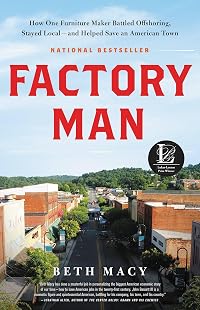
Factory Man: How One Furniture Maker Battled Offshoring, Stayed Local, and Helped Save an American Town
by Beth Macy
On This Page
Description
The instant New York Times bestseller about one man's battle to save hundreds of jobs by demonstrating the greatness of American business.The Bassett Furniture Company was once the world's biggest wood furniture manufacturer. Run by the same powerful Virginia family for generations, it was also the center of life in Bassett, Virginia. But beginning in the 1980s, the first waves of Asian competition hit, and ultimately Bassett was forced to send its production overseas.
One man fought back: show more John Bassett III, a shrewd and determined third-generation factory man, now chairman of Vaughan-Bassett Furniture Co, which employs more than 700 Virginians and has sales of more than $90 million. In Factory Man, Beth Macy brings to life Bassett's deeply personal furniture and family story, along with a host of characters from an industry that was as cutthroat as it was colorful. As she shows how he uses legal maneuvers, factory efficiencies, and sheer grit and cunning to save hundreds of jobs, she also reveals the truth about modern industry in America.
. show less
Tags
Recommendations






































Member Reviews
If I did my ratings based on some sort of objective evaluation of the quality of a book, this would probably be a four-plus-star read, but I rate based on my reading experience and this just utterly failed to float my canoe. The book does what it says on the tin, giving a history of the Bassett family and their furniture business, providing a biography of John Bassett III, and outlining how he kept the business going as Americans increasingly bought cheaper furniture made in Asia. I probably would have been all about a twenty-page magazine article on this subject, but 400+ pages deadened any interest I had in it. Beth Macy writes well and gives the facts a decent narrative thrust, but I just couldn't get stuck in. Even the fact that show more most of the important stuff in the book happened within one hundred miles of where I'm sitting didn't help. I ended up skimming. Even so, recommended to people who like biography and nonfiction about business and/or economics. show less
One of the most challenging issues facing the United States in the 21st century is how to cope with the consequences of economic globalization. Free trade agreements along with the adoption of free market principles in communist countries such as China and Vietnam have resulted in rapid and dramatic changes in the U.S. labor market, generally to the detriment of those at its lowest levels. Beth Macy looks at this challenge by focusing on how one industry centered in southwest Virginia and northern North Carolina coped with these changes
The furniture manufacturing industry that was formed in this area, founded largely by a small cadre of families in the early 20th century, grew and thrived based on an ethic of hard work, innovation, show more luck, connections and ruthlessness. Macy concentrates her story on the businesses spawned by one family – the Bassetts. Descendants of an old Virginia family, John D. Bassett, Charles Columbus Bassett, Samuel H. Bassett, and Reed L. Stone started Bassett furniture in 1902. From that time until the 1980s Bassett Furniture and the companies spun off from it grew to be the largest furniture manufacturer in the United States, and one of the largest in the world. Bassett,VA, where the company was formed became a company town, with the Bassett family and the Bassett furniture company providing not only jobs but virtually all the other institutions and services required to service its population, including schools, banks, places of worship, and housing. This arrangement helped keep Bassett furniture supplied with steady labor, while at the same time providing its employees with a comfortable level of stability. This arrangement began to crumble however as the balance of trade began to favor formerly closed societies that were implementing capitalist economies.
By the beginning of the 21st century Asian manufacturers found ways to produce furniture of competitive quality with that produced in the United States at a much lower price. Eventually American companies, unable to compete, began importing furniture and furniture parts from these manufacturers, resulting in the rapid closing of their plants in the United States, Bassett Furniture included. For the workers formerly employed at these plants, globalization was beginning to look like the apocalypse as thousands lost their formerly secure jobs. In an economy where the quarterly bottom line was becoming the yardstick by which success was measured, their plight was of little concern. One man, however, tried to buck that trend.
John D. Bassett III had spent his formative years learning the furniture industry working for his family’s company and believed he would one day be its chairman. However, as time went on it became apparent this would not happen. He left the company his family built and eventually took over operation of the much smaller Vaughan-Bassett furniture company in Galax, VA. That company had become moribund, set in its ways, and saw its sales shrink and the quality of its offerings decline. John D. Bassett III turned the company around, instituting a hard charging attitude that saw the company adopt among other things an express service that provided a service that retailers who relied on imported Asian furniture could not compete with, rapid delivery of orders in less than a week. This allowed these retailers to minimize the inventory they had to keep on hand, thus reducing overhead costs. Despite these innovations however, by the early 2000s Vaughan-Bassett was beginning to slip behind, unable to keep up with the low prices offered by his Asian based competition; prices he believed that were not in line with the cost of their manufacture. Bassett was sure the Chinese were dumping cheap furniture into the American market in order to drive out competition.
In the two decades after the death of Mao tse Tung China became one of the top exporters in the world, eventually surpassing Japan and South Korea as the main trading partner with the United States. In 2001 they became a member of the World Trade Organization, a compact set up to “review and propagate … national trade policies, and to ensure the coherence and transparency of trade policies through surveillance in global economic policy-making.” Among these policies was an agreement not to dump cheap goods subsidized by government funding into foreign markets in order to drive out competing businesses. In 2003 it became apparent to John D. Bassett III that China was dumping cheap furniture into the American market in violation of this obligation. Rather than accept this as the natural result of evolution in the marketplace as many American manufacturers and retailers who were benefiting from these low prices were willing to do, Bassett formed a coalition of manufacturers and successfully fought China, winning a large settlement which he invested in his manufacturing operation, and saving his company and the 700 jobs that went along with it. For this action he is regarded as a hero in his adopted hometown of Galax, VA.
I really did enjoy this book for the most part. The first half or so recounts the genealogy of the Bassett family, their entry into the furniture manufacturing business, and the inevitable conflict that results when a company stays in one family for so long. In many ways the Bassetts were not all that likeable. They could be condescending to their employees, did everything they could to keep unions out of their factories, and in general behaved as you would expect good old boy millionaires from southwest Virginia would act. They were just really full of themselves, a trait I find very unattractive.
The sections of the book that dealt with John D. Bassett III’s fight against the Chinese, and his effort to save his company and the jobs it provided was riveting, and it really gave a human face to the consequences of globalization. Where labor used to be viewed as an asset, it has now simply become another cost center to be trimmed, with little thought given to the effect that trimming would have. As a result we are going through a massive shift in what kinds of jobs workers are trained for, and are reorienting how our economy relates with its trading partners. As John D.Bassett III showed however, manufacturing in the United States can survive as long as it stays nimble, combative, innovative, and has leaders who are unwilling to view its existence solely in terms of its bottom line. show less
The furniture manufacturing industry that was formed in this area, founded largely by a small cadre of families in the early 20th century, grew and thrived based on an ethic of hard work, innovation, show more luck, connections and ruthlessness. Macy concentrates her story on the businesses spawned by one family – the Bassetts. Descendants of an old Virginia family, John D. Bassett, Charles Columbus Bassett, Samuel H. Bassett, and Reed L. Stone started Bassett furniture in 1902. From that time until the 1980s Bassett Furniture and the companies spun off from it grew to be the largest furniture manufacturer in the United States, and one of the largest in the world. Bassett,VA, where the company was formed became a company town, with the Bassett family and the Bassett furniture company providing not only jobs but virtually all the other institutions and services required to service its population, including schools, banks, places of worship, and housing. This arrangement helped keep Bassett furniture supplied with steady labor, while at the same time providing its employees with a comfortable level of stability. This arrangement began to crumble however as the balance of trade began to favor formerly closed societies that were implementing capitalist economies.
By the beginning of the 21st century Asian manufacturers found ways to produce furniture of competitive quality with that produced in the United States at a much lower price. Eventually American companies, unable to compete, began importing furniture and furniture parts from these manufacturers, resulting in the rapid closing of their plants in the United States, Bassett Furniture included. For the workers formerly employed at these plants, globalization was beginning to look like the apocalypse as thousands lost their formerly secure jobs. In an economy where the quarterly bottom line was becoming the yardstick by which success was measured, their plight was of little concern. One man, however, tried to buck that trend.
John D. Bassett III had spent his formative years learning the furniture industry working for his family’s company and believed he would one day be its chairman. However, as time went on it became apparent this would not happen. He left the company his family built and eventually took over operation of the much smaller Vaughan-Bassett furniture company in Galax, VA. That company had become moribund, set in its ways, and saw its sales shrink and the quality of its offerings decline. John D. Bassett III turned the company around, instituting a hard charging attitude that saw the company adopt among other things an express service that provided a service that retailers who relied on imported Asian furniture could not compete with, rapid delivery of orders in less than a week. This allowed these retailers to minimize the inventory they had to keep on hand, thus reducing overhead costs. Despite these innovations however, by the early 2000s Vaughan-Bassett was beginning to slip behind, unable to keep up with the low prices offered by his Asian based competition; prices he believed that were not in line with the cost of their manufacture. Bassett was sure the Chinese were dumping cheap furniture into the American market in order to drive out competition.
In the two decades after the death of Mao tse Tung China became one of the top exporters in the world, eventually surpassing Japan and South Korea as the main trading partner with the United States. In 2001 they became a member of the World Trade Organization, a compact set up to “review and propagate … national trade policies, and to ensure the coherence and transparency of trade policies through surveillance in global economic policy-making.” Among these policies was an agreement not to dump cheap goods subsidized by government funding into foreign markets in order to drive out competing businesses. In 2003 it became apparent to John D. Bassett III that China was dumping cheap furniture into the American market in violation of this obligation. Rather than accept this as the natural result of evolution in the marketplace as many American manufacturers and retailers who were benefiting from these low prices were willing to do, Bassett formed a coalition of manufacturers and successfully fought China, winning a large settlement which he invested in his manufacturing operation, and saving his company and the 700 jobs that went along with it. For this action he is regarded as a hero in his adopted hometown of Galax, VA.
I really did enjoy this book for the most part. The first half or so recounts the genealogy of the Bassett family, their entry into the furniture manufacturing business, and the inevitable conflict that results when a company stays in one family for so long. In many ways the Bassetts were not all that likeable. They could be condescending to their employees, did everything they could to keep unions out of their factories, and in general behaved as you would expect good old boy millionaires from southwest Virginia would act. They were just really full of themselves, a trait I find very unattractive.
The sections of the book that dealt with John D. Bassett III’s fight against the Chinese, and his effort to save his company and the jobs it provided was riveting, and it really gave a human face to the consequences of globalization. Where labor used to be viewed as an asset, it has now simply become another cost center to be trimmed, with little thought given to the effect that trimming would have. As a result we are going through a massive shift in what kinds of jobs workers are trained for, and are reorienting how our economy relates with its trading partners. As John D.Bassett III showed however, manufacturing in the United States can survive as long as it stays nimble, combative, innovative, and has leaders who are unwilling to view its existence solely in terms of its bottom line. show less
found this book at the same time Fascinating and Gut-wrenching. Beth Macy has explored the History of the factory town of Bassett Virginia, its progress to becoming the foremost manufacturer of quality furniture and its eventual decline on losing market share to imports.
So, how could this be interesting? The author tells the story of the Bassett family along with the story of furniture manufacture. The infighting and the family politics is what makes it so.
I thought I'd be skimming through the book to see how imports jeopardized American manufacture. Instead I read every page and savored the details of John Bassett III's personality and his fight to keep his factories running.
So, how could this be interesting? The author tells the story of the Bassett family along with the story of furniture manufacture. The infighting and the family politics is what makes it so.
I thought I'd be skimming through the book to see how imports jeopardized American manufacture. Instead I read every page and savored the details of John Bassett III's personality and his fight to keep his factories running.
John Douglas Bassett, a.k.a. J.D. Bassett, started first a sawmill and then a furniture company with his brother, C.C. Bassett, in Virginia in 1902. The unincorporated town of Bassett grew up around the factory. As the business and the family grew, J.D. assisted relatives and in-laws to start other furniture companies, and the region became a powerhouse in the American furniture industry.
And then the 1980s and the beginnings of globalization and cheap Chinese import furniture arrived.
This is mainly the story of John D. Bassett III (JBIII), J.D.'s grandson, and his battle to keep his factory alive, his employees working, and American-made furniture in American homes. Macy makes JBIII, his ancestors, and his cousins and in-laws rich and show more compelling characters. The growth of the Bassett companies, the cooperation and conflict within the family, and the close intertwining among the family, the industry, and the communities they operate in is revealed in beautiful and absorbing detail. When JBIII recognizes the impact Chinese imports are having not just on his business but on the whole industry, he decides to fight back. Because Vaughn-Bassett is closely held, unlike many other furniture companies, even the original Bassett Furniture, he's free to pursue what he thinks is the best course, and not just the quarterly bottom line.
He uses the tools provided by the same laws that enabled the foreign threat to his business to fight back, and keep his factory and his town alive.
Macy brings the story to life, clearly explaining the business issues, the economic issues, and the personalities at play here. She and Bassett ask a question often overlooked in the free market purists' enthusiasm for low consumer prices: What good are low prices if the would-be consumers don't have jobs, or are making so little that they can't afford even those "low" prices?
Highly recommended.
Book trailer: Meet John Bassett III
http://youtu.be/aj5KyVdmkho
I received a free electronic galley of this book from the publisher via NetGalley. show less
And then the 1980s and the beginnings of globalization and cheap Chinese import furniture arrived.
This is mainly the story of John D. Bassett III (JBIII), J.D.'s grandson, and his battle to keep his factory alive, his employees working, and American-made furniture in American homes. Macy makes JBIII, his ancestors, and his cousins and in-laws rich and show more compelling characters. The growth of the Bassett companies, the cooperation and conflict within the family, and the close intertwining among the family, the industry, and the communities they operate in is revealed in beautiful and absorbing detail. When JBIII recognizes the impact Chinese imports are having not just on his business but on the whole industry, he decides to fight back. Because Vaughn-Bassett is closely held, unlike many other furniture companies, even the original Bassett Furniture, he's free to pursue what he thinks is the best course, and not just the quarterly bottom line.
He uses the tools provided by the same laws that enabled the foreign threat to his business to fight back, and keep his factory and his town alive.
Macy brings the story to life, clearly explaining the business issues, the economic issues, and the personalities at play here. She and Bassett ask a question often overlooked in the free market purists' enthusiasm for low consumer prices: What good are low prices if the would-be consumers don't have jobs, or are making so little that they can't afford even those "low" prices?
Highly recommended.
Book trailer: Meet John Bassett III
http://youtu.be/aj5KyVdmkho
I received a free electronic galley of this book from the publisher via NetGalley. show less
An in-depth look at the almost impossible mission of the Bassett family and their in-law rivals to save a tiny slice of American manufacturing: the North Carolina-based furniture factory. These benevolent overlords employed white and Black workers at their company town facilities (albeit with lower wages and more menial jobs for Black workers). Much is made of the rivalry between heirs JD (Jim) Bassett III and his brother-in-law Bob Spilman, perhaps too much. There is some commentary from actual workers in the plants, especially after so many were shut down due to off-shoring to China, Indonesia, and Vietnam. The chapters on the actual fight to keep Bassett alive once Bill Clinton and congress brought NAFTA and its "giant sucking sound" show more of American jobs disappearing to fruition is portrayed as a noble one, with Jim Bassett never wanting to surrender, both for the livelihoods of his neighbors and for family tradition and pride. Has there ever been a comprehensive lookback at the impact of globalization on the working and middle class of this country and of the countries that directly benefitted, creating a higher standard of living for the world and a lower one for most Americans? Now, more then 50 years since, we can look at AI and ChatGPT as movers of yet another tsunami of worker displacement, this time led by Americans. The book is very thorough in showing how small towns dependent on one industry are no longer viable, thus the fleeing from dying rural locales. My criticism is that it's way too long and focuses too much on the Bassett personalities. show less
Very engaging book covering the effects of globalization and free trade from a variety of perspectives: business, political, social, regional, and personal. The temptations to cheat in a global economy seem to be overwhelming, and the cost of oversight seems to be too high. Throw into the mix a combustible stew of racial and caste issues of the post-Reconstruction South, and you've got a book hitting on more cylinders than you thought it had.
It's not just about the details of the furniture business and trade policy, although that was enough to make me want to read this book. By the time I had finished this tale of company-town Southside/Southwest Virginia , I was left with the impression that one could take this book and create a dramatic series just as interesting as a Mad Men or Downton Abbey.
Members
- Recently Added By
Lists

2015 Notable Books for Adults
26 works; 4 members
Author Information

8+ Works 2,595 Members
Beth Macy is a journalist. Her work has appeared in national magazines and The Roanoke Times, where her reporting has won more than a dozen national awards, including a Nieman Fellowship for Journalism at Harvard. Her first book, Factory Man: How One Furniture Maker Battled Offshoring, Stayed Local - and Helped Save an American Town, was published show more in 2014. (Bowker Author Biography) show less
Some Editions
Awards and Honors
Awards
Common Knowledge
- Canonical title
- Factory Man: How One Furniture Maker Battled Offshoring, Stayed Local, and Helped Save an American Town
- People/Characters
- John D. Bassett III
- Epigraph
- Black cat, white cat, all that matters is that it catches mice.
- - Teng Hsiao-P'ing - Dedication
- For all the world's factory workers, past and present, and especially for my long-ago factory mom, Sarah Macy Slack, whose airplane lights I still imagine I can glimpse, up among the stars
- First words
- John D. Bassett III was snaking his way through the sooty streets of rural northern China on a three-day fact-finding mission.
- Canonical DDC/MDS
- 338.76841040973
- Canonical LCC
- HD9773.U74
Classifications
- Genres
- Economics, Business, General Nonfiction, Nonfiction, Biography & Memoir, History
- DDC/MDS
- 338.76841040973 — Society, government, & culture Economics Production Business Enterprises By Industry Manufacture of products for specific uses Furnishings and home workshops Furniture
- LCC
- HD9773 .U74 — Social sciences Industries. Land use. Labor Industries. Land use. Labor Special industries and trades Manufacturing industries
- BISAC
Statistics
- Members
- 340
- Popularity
- 92,933
- Reviews
- 13
- Rating
- (3.85)
- Languages
- English
- Media
- Paper, Audiobook, Ebook
- ISBNs
- 8
- ASINs
- 6