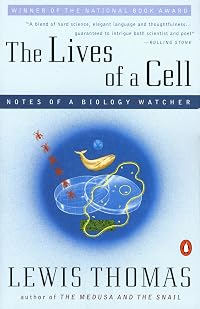
The Lives of a Cell: Notes of a Biology Watcher
by Lewis Thomas
On This Page
Description
Elegant, suggestive, and clarifying, Lewis Thomas's profoundly humane vision explores the world around us and examines the complex interdependence of all things. Extending beyond the usual limitations of biological science and into a vast and wondrous world of hidden relationships, this provocative book explores in personal, poetic essays to topics such as computers, germs, language, music, death, insects, and medicine. Lewis Thomas writes, "Once you have become permanently startled, as I show more am, by the realization that we are a social species, you tend to keep an eye out for the pieces of evidence that this is, by and large, good for us." show lessTags
Recommendations

















Member Reviews
Several years ago an immunologist happened to tell me how much she admired The Lives of a Cell. Lucky for me, because now I’ve read it and there is much in it I hope not to forget.
Early in this charming collection of short essays, Lewis Thomas writes:
“Ants are so much like human beings as to be an embarrassment. They farm fungi, raise aphids as livestock, launch armies into wars, use chemical sprays to alarm and confuse enemies, capture slaves. The families of weaver ants engage in child labor, holding their larvae like shuttles to spin out the thread that sews the leaves together for their fungus gardens. They do everything but watch television.”
Hmm . . . I gave up watching TV years ago so it appears the narrow ground show more differentiating me from an ant is now vanished. Well, I am lazier than an ant. I’ve never captured a slave, for example. Maybe that’s enough to claim I ain’t an ant! But probably I should just admit our kinship and go research which species it’d be best to enlist with.
After all, a large theme for Thomas is the sociability of organisms, their being together with their own kind, driven to finding relationships, congenial or not, with other kinds, forming dependencies capable of sustaining illusions of independence for the party that doesn’t understand the situation. It has about it something of the miraculous.
While reading The Lives of a Cell one becomes impressed by the scope of these relations, by the rarity of “separateness,” by little-known continua in life. This last idea is dramatically illustrated in the process of dying. Thomas shares in his essay “The Long Habit” the following remarkable intelligence:
“Judging from what has been found out thus far, from the first generation of people resuscitated from cardiac standstill…Those who remember parts or all of their episodes do not recall any fear, or anguish. Several people who remained conscious throughout, while appearing to have been quite dead, could only describe a remarkable sensation of detachment . . .
“In a recent study of the reaction of patients to dying of obstructive disease of the lungs, it was concluded that the process was considerably more shattering for the professional observers than the observed. Most of the patients appeared to be preparing themselves with equanimity for death, as though intuitively familiar with the business. One elderly woman reported that the only painful and distressing part of the process was in being interrupted; on several occasions she was provided with conventional therapeutic measures…and each time she found the experience of coming back harrowing; she deeply resented the interference with her dying.”
What could speak more of the completeness of life’s preparations for the living individual in all its natural events?
In what Lewis Thomas tells us, in The Lives of a Cell, the reader enjoys more than mere acquaintance with interesting information. The book quietly extends our perceptions and alters our perspectives. show less
Early in this charming collection of short essays, Lewis Thomas writes:
“Ants are so much like human beings as to be an embarrassment. They farm fungi, raise aphids as livestock, launch armies into wars, use chemical sprays to alarm and confuse enemies, capture slaves. The families of weaver ants engage in child labor, holding their larvae like shuttles to spin out the thread that sews the leaves together for their fungus gardens. They do everything but watch television.”
Hmm . . . I gave up watching TV years ago so it appears the narrow ground show more differentiating me from an ant is now vanished. Well, I am lazier than an ant. I’ve never captured a slave, for example. Maybe that’s enough to claim I ain’t an ant! But probably I should just admit our kinship and go research which species it’d be best to enlist with.
After all, a large theme for Thomas is the sociability of organisms, their being together with their own kind, driven to finding relationships, congenial or not, with other kinds, forming dependencies capable of sustaining illusions of independence for the party that doesn’t understand the situation. It has about it something of the miraculous.
While reading The Lives of a Cell one becomes impressed by the scope of these relations, by the rarity of “separateness,” by little-known continua in life. This last idea is dramatically illustrated in the process of dying. Thomas shares in his essay “The Long Habit” the following remarkable intelligence:
“Judging from what has been found out thus far, from the first generation of people resuscitated from cardiac standstill…Those who remember parts or all of their episodes do not recall any fear, or anguish. Several people who remained conscious throughout, while appearing to have been quite dead, could only describe a remarkable sensation of detachment . . .
“In a recent study of the reaction of patients to dying of obstructive disease of the lungs, it was concluded that the process was considerably more shattering for the professional observers than the observed. Most of the patients appeared to be preparing themselves with equanimity for death, as though intuitively familiar with the business. One elderly woman reported that the only painful and distressing part of the process was in being interrupted; on several occasions she was provided with conventional therapeutic measures…and each time she found the experience of coming back harrowing; she deeply resented the interference with her dying.”
What could speak more of the completeness of life’s preparations for the living individual in all its natural events?
In what Lewis Thomas tells us, in The Lives of a Cell, the reader enjoys more than mere acquaintance with interesting information. The book quietly extends our perceptions and alters our perspectives. show less
In 1974, Lewis Thomas wrote in 'The Lives of a Cell' that the function of humans is communication:
'We pass thoughts around, from mind to mind, so compulsively and with such speed that the brains of mankind often appear, functionally, to be undergoing fusion.'
Thirty-some years later, with the twittering Internet and its newsgroups, email, websites, and media, these words show real prescience.
'Or perhaps we are only at the beginning of learning to use the system, with almost all our evolution as a species still ahead of us. Maybe the thoughts we generate today and flick around from mind to mind...are the primitive precursors of more complicated, polymerized structures that will come later, analogous to the prokaryotic cells that drifted show more through shallow pools in the early days of biological evolution. Later, when the time is right, there may be fusion and symbiosis among the bits, and then we will see eukaryotic thought, metazoans of thought, huge interliving coral shoals of thought.
The mechanism is there [n.b.: in the human brain], and there is no doubt that it is already capable of functioning...
We are simultaneously participants and bystanders, which is a puzzling role to play. As participants, we have no choice in the matter; this is what we do as a species.' show less
'We pass thoughts around, from mind to mind, so compulsively and with such speed that the brains of mankind often appear, functionally, to be undergoing fusion.'
Thirty-some years later, with the twittering Internet and its newsgroups, email, websites, and media, these words show real prescience.
'Or perhaps we are only at the beginning of learning to use the system, with almost all our evolution as a species still ahead of us. Maybe the thoughts we generate today and flick around from mind to mind...are the primitive precursors of more complicated, polymerized structures that will come later, analogous to the prokaryotic cells that drifted show more through shallow pools in the early days of biological evolution. Later, when the time is right, there may be fusion and symbiosis among the bits, and then we will see eukaryotic thought, metazoans of thought, huge interliving coral shoals of thought.
The mechanism is there [n.b.: in the human brain], and there is no doubt that it is already capable of functioning...
We are simultaneously participants and bystanders, which is a puzzling role to play. As participants, we have no choice in the matter; this is what we do as a species.' show less
Thank you LibraryThing reader who suggested this book to me!
An assemblage of twenty-nine short essays on the recent genetic and molecular biologic revolution, presenting a holistic vision of nature: the earth as a superorganism of species, societies as superorganisms of individuals, man as the superorganism of organelles, and so on. Summary BPL
Although written between 1971 and 1973, these lyric essays retain their relevance in the 21st century. Dr. Thomas has been called a “cosmic dreamer”: he suggests sending Bach into outerspace as our first auditory contact with other species. Any language or data would be too outdated by the time it reaches the nearest livable planet (200 years), he says. Because he understands many show more subjects—not just medical—at a cellular level, Dr. Thomas writes about things in their essence. I hesitate to call his writing philosophical since that would necessitate organizing his thoughts into a system; his musings are more akin to poetic observation from which he deduces an underlying connectedness among all things. When he compares the view of our planet from outer space—a blue and green orb enveloped in the protective membrane of the atmosphere—to a cell, I had to catch my breath.
8 out 10 For readers who like to understand the world at its most basic level… show less
An assemblage of twenty-nine short essays on the recent genetic and molecular biologic revolution, presenting a holistic vision of nature: the earth as a superorganism of species, societies as superorganisms of individuals, man as the superorganism of organelles, and so on. Summary BPL
Although written between 1971 and 1973, these lyric essays retain their relevance in the 21st century. Dr. Thomas has been called a “cosmic dreamer”: he suggests sending Bach into outerspace as our first auditory contact with other species. Any language or data would be too outdated by the time it reaches the nearest livable planet (200 years), he says. Because he understands many show more subjects—not just medical—at a cellular level, Dr. Thomas writes about things in their essence. I hesitate to call his writing philosophical since that would necessitate organizing his thoughts into a system; his musings are more akin to poetic observation from which he deduces an underlying connectedness among all things. When he compares the view of our planet from outer space—a blue and green orb enveloped in the protective membrane of the atmosphere—to a cell, I had to catch my breath.
8 out 10 For readers who like to understand the world at its most basic level… show less
A collection of very short essays from the 1970s in which Lewis Thomas, a medical researcher, muses about various topics related to medicine, biology, and nature. He is particularly interested in mitochondria, social insects and the ways in which human society does or doesn't resemble theirs, and the importance of basic research in medical science.
This is regarded as a real classic of science writing, or at least of writing by a scientist, so it's a little surprising it took me this long to get to it. I must say that, when I first started it, I didn't exactly think it was living up to its reputation. The essays here are really tiny, more a series of individual thoughts than anything else. And Thomas not infrequently uses some technical show more terms without explaining them, which I didn't find too much of a problem, but which does make it feel less accessible than I was expecting. He also engages in a fair amount of speculation and the occasional flight of fancy that aren't at all scientific, which bugs me possibly more than it ought to.
But the more I read, the more I came to appreciate Thomas's writing. It's rather beautiful, always thoughtful and often thought-provoking, and laced with subtle wit. And although it is very much of its time, aside from a few now-humorous remarks about computers, it's actually aged quite well.
So. Do I still think Lewis Thomas is over-hyped, for lack of a better phrase? Well, yes, a bit. But he is still good. show less
This is regarded as a real classic of science writing, or at least of writing by a scientist, so it's a little surprising it took me this long to get to it. I must say that, when I first started it, I didn't exactly think it was living up to its reputation. The essays here are really tiny, more a series of individual thoughts than anything else. And Thomas not infrequently uses some technical show more terms without explaining them, which I didn't find too much of a problem, but which does make it feel less accessible than I was expecting. He also engages in a fair amount of speculation and the occasional flight of fancy that aren't at all scientific, which bugs me possibly more than it ought to.
But the more I read, the more I came to appreciate Thomas's writing. It's rather beautiful, always thoughtful and often thought-provoking, and laced with subtle wit. And although it is very much of its time, aside from a few now-humorous remarks about computers, it's actually aged quite well.
So. Do I still think Lewis Thomas is over-hyped, for lack of a better phrase? Well, yes, a bit. But he is still good. show less
Although written in the 1970′s, these essays by Lewis Thomas cover subjects that are still some of the most interesting questions in biology today. From the awe-inspiring complexity of a single cell to our approach to curing diseases, from how our interactions compare to those of social insects to the health care system, the essays in this book will give you a new appreciation for biology and a unique, thoughtful perspective on these fascinating topics. Every time I finished an essay, I was struck by the thought that surely no one really just sits down and writes essays like this any more. More than anything else, the author reminded me of a naturalist, someone from the early twentieth century simply observing, wondering at, and show more trying to learn from nature.
As a scientist, I want that. Every day, I work at science and occasionally I get the feeling this book captures; a feeling of stepping back and no longer working at science, but wondering at it. In every essay, Thomas writes about biology in a deceptively casual, meditative manner which requires intimate knowledge of so much science just to be able to connect the concepts he uses to draw the bigger picture. And he doesn’t just write about it in a science-y way. I think anyone, even a non-scientist, could pick this book up and appreciate the poetic beauty with which he describes life. They might even learn a little biology along the way.
I know I’m handing out 5 star reviews like candy this week, but this another book where all I can say is: read this! The essays are each short, all under 10 pages, and they’re written in a very approachable way. I would highly recommend this book to a book club or even a journal club for all the thought provoking ideas it presents, as well as to any scientist because occasionally we need to be reminded just how awesome what we’re doing really is. show less
As a scientist, I want that. Every day, I work at science and occasionally I get the feeling this book captures; a feeling of stepping back and no longer working at science, but wondering at it. In every essay, Thomas writes about biology in a deceptively casual, meditative manner which requires intimate knowledge of so much science just to be able to connect the concepts he uses to draw the bigger picture. And he doesn’t just write about it in a science-y way. I think anyone, even a non-scientist, could pick this book up and appreciate the poetic beauty with which he describes life. They might even learn a little biology along the way.
I know I’m handing out 5 star reviews like candy this week, but this another book where all I can say is: read this! The essays are each short, all under 10 pages, and they’re written in a very approachable way. I would highly recommend this book to a book club or even a journal club for all the thought provoking ideas it presents, as well as to any scientist because occasionally we need to be reminded just how awesome what we’re doing really is. show less
Lives of a Cell is a collection of 29 beautifully written essays on science. Although focused on biology, you'll find essays touching on etymology, cosmology and healthcare. That's a blessing for the layperson. The treatment of some topics feels dated. For instance, genetics is mentioned only briefly. On other topics, such as treatment of the elderly and palliative care, Thomas shows great foresight.
In addition, Thomas dispels myths and adds interesting anecdotes. Several stick in my mind. First, mitochondria in our cells have more in common with bacteria than other animals. Second, illness is often caused by bacteria themselves becoming infected or abnormal. Third, symbiosis is an arrangement as common as competition, and often more show more stable. Fourth, many insect species are social and have a critical mass beyond which they act as a single organism. There are many more nuggets which feed the layman's mind and expand horizons.
Given the collection's breadth of outlook, I recommend this for anyone interested in biology, nature or science generally. show less
In addition, Thomas dispels myths and adds interesting anecdotes. Several stick in my mind. First, mitochondria in our cells have more in common with bacteria than other animals. Second, illness is often caused by bacteria themselves becoming infected or abnormal. Third, symbiosis is an arrangement as common as competition, and often more show more stable. Fourth, many insect species are social and have a critical mass beyond which they act as a single organism. There are many more nuggets which feed the layman's mind and expand horizons.
Given the collection's breadth of outlook, I recommend this for anyone interested in biology, nature or science generally. show less
A great read for the scientist and poet alike, The Lives of a Cell sits at the busy cross streets of sociology, biology, and language. No one would argue with the fact that we, as humans, are social animals but Thomas goes one step further asserting "the whole dear notion of one’s own self – marvelous old free-willed, free-enterprising, autonomous, independent, isolated island of a Self – is a myth". Like an ant, only in the context of the entire anthill do we each take on meaning, serving as an organelle in the function of the whole organism which appears to have a collective conscious. Thomas also applies the language of genetics to the genetics of language, purporting language is itself a species, with a genesis and antiquity show more all its own. Like mitochondria, language is a constantly evolving suborganism carried along transiently by our most singly human artifact (culture), supported by our biological disposition for grammar and syntax, and equally as vital to our existence. show less
Members
- Recently Added By
Lists

To Read - Medicine
18 works; 1 member

25 Greatest Science Books of All Time
33 works; 6 members

Modern Library 100 Best Nonfiction Books
100 works; 8 members

KIB Non-Fiction Book Cloud
41 works; 1 member

Shaykh Hamza's Book Recommendations
439 works; 3 members

The r/AskScience Reading List
159 works; 3 members

Mustich's 1000 Books to Read Before You Die: A Life Changing List
1,001 works; 19 members

Recommended Reading : 600 Classics Reviewed, Editors of Salem Press, 2015
634 works; 6 members
Author Information

21+ Works 5,524 Members
Lewis Thomas was born in Flushing, New York, and received his medical degree from Harvard University, with a specialization in internal medicine and pathology. He has been a professor at several medical schools, as well as dean of the Yale Medical School. Most recently Thomas has been chancellor and president emeritus of the Memorial show more Sloan-Kettering Cancer Center in New York City and professor of medicine at the Cornell Medical School. His erudite books have earned him a wide audience, making him one of the best-known advocates of science in the United States during the past 20 years. For example, The Lives of a Cell won the National Book Award in arts and letters in 1974, and The Medusa and the Snail won the American Book Award for science in 1981. (Bowker Author Biography) show less
Awards and Honors
Awards
Distinctions
Notable Lists
Series
Belongs to Publisher Series
Work Relationships
Common Knowledge
- Canonical title
- The Lives of a Cell: Notes of a Biology Watcher
- Original publication date
- 1974
- First words
- We are told that the trouble with Modern Man is that he has been trying to detach himself from nature.
- Last words
- (Click to show. Warning: May contain spoilers.)Even though our receptors are not sensitive enough to hear it, there is comfort in knowing that the sound is there overhead, like the random noise of rain on the roof at night.
Classifications
- Genres
- Science & Nature, Nonfiction, General Nonfiction, Philosophy
- DDC/MDS
- 301.3101 — Society, government, & culture Social sciences, sociology & anthropology Sociology and anthropology Formerly: Ecology and community Sociology of the environment
- LCC
- QH331 .T45 — Science Natural history – Biology Biology (General)
- BISAC
Statistics
- Members
- 2,265
- Popularity
- 8,832
- Reviews
- 32
- Rating
- (4.15)
- Languages
- 7 — Chinese, Dutch, English, Hungarian, Portuguese, Spanish, Swedish
- Media
- Paper, Audiobook, Ebook
- ISBNs
- 29
- ASINs
- 17