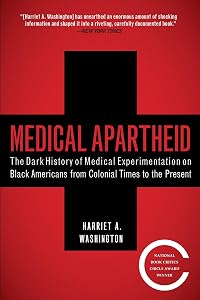
Medical Apartheid: The Dark History of Medical Experimentation on Black Americans from Colonial Times to the Present
by Harriet A. Washington 
On This Page
Description
Medical Apartheid is the first and only comprehensive history of medical experimentation on African Americans. Starting with the earliest encounters between black Americans and Western medical researchers and the racist pseudoscience that resulted, it details the ways both slaves and freedmen were used in hospitals for experiments conducted without their knowledge-a tradition that continues today within some black populations. It reveals how blacks have historically been prey to show more grave-robbing as well as unauthorized autopsies and dissections. Moving into the twentieth century, it shows how the pseudoscience of eugenics and social Darwinism were used to justify experimental exploitation and shoddy medical treatment of blacks. The product of years of prodigious research into medical journals and experimental reports long undisturbed, Medical Apartheid reveals the hidden underbelly of scientific research and makes possible, for the first time, an understanding of the roots of the African American health deficit. show lessTags
Recommendations


















Member Recommendations


Member Reviews
this book doesn't seem to know what it wants to be: a comprehensive scholarly treatise or a nightstand book for anti-racists? and trying to be both, does not succeed.
very good in many ways, very important of course, but as a read, the latter 200 pages lagged terribly: lack of focus, repetitive structure, segments that seemed out of order, and more of the facetious reasoning seen elsewhere -- ie. Washington argued that blacks were over-represented in prison experiments at, we'll say, 40% of the total, because the local unincarcerated black population was only 8%. she admits that blacks made up 60% of the total prisoners, but says it's incorrect to count only within the prison population because incarceration is such a racist system. show more
that's nonsense. the structural racism of incarceration is one problem; the structural racism of using primarily POC for medical experiments is another problem; the lack of better options for income among prisoners (of any race) that leads them to volunteer for prison experiments is another problem; the racism that leads POC, particularly blacks, to have generational poverty, is yet another. all of these problems intertwine, and feed one another, but they are not the same.
what i found most interesting (and Washington seemed to be uncomfortable with) was how the black people/patients navigated their experience: I mean their own sense of agency within the maws of racism. she mentions, for example, that prisoners often volunteered for the medical experiments because the payments were substantially higher than other job opportunities, and they were told the side effects would be minimal; it was seen as a good gig. Washington brushes that aside, just like she brushed aside the claims of Saartje Baartman, the young African woman exhibited as "Hottentot Venus," who claimed in court that she was there voluntarily; Washington says that you cannot make a true choice under those constrictions.
she's right of course, to an extent, that there aren't any true choices within structural racism (or capitalism, or disability, or arguably for any humans at any time); but at the same time it's demeaning to the victims to say that they had no agency whatsoever, or that their choices don't matter, when we have their own voices saying that this is what they wanted. it is, i believe, much more accurate -- and better honors the memory -- to see blacks as full humans who were intelligent and capable and brave enough to make their own work against the tide of racism, even within the context of slavery or prison. finding the strength to make a situation turn for your own benefit when exposed to cruelty is an incredibly legacy, and stripping these people of that past is another way to silence them. i'm sure it was inadvertent -- Washington was simply more interested in focusing on the inhumanity of their situation. that's not a crime, but it's an unbalanced story.
... this last bit reads like i'm advocating inspiration-porn, and that's not true at all; i just want to see the book include a discussion of why a slave might say aloud in court that she preferred to be displayed as a literal animal in a zoo, and why we should take her at her word that she's the aribtrator of her experience. there's a paternalism in saying "Baartman doesn't know what she's talking about" that reminds me of pro-slavery arguments, is what i'm saying; those anti-abolitionists were great ones for saying that slaves didn't know what they wanted, that they were treated much better as they were, that freed or escaped slaves were simply lying that their lives were better now. we have to center the stated, recorded experience of the actual people involved, no matter how uncomfortable it makes our twenty-first century selves. show less
very good in many ways, very important of course, but as a read, the latter 200 pages lagged terribly: lack of focus, repetitive structure, segments that seemed out of order, and more of the facetious reasoning seen elsewhere -- ie. Washington argued that blacks were over-represented in prison experiments at, we'll say, 40% of the total, because the local unincarcerated black population was only 8%. she admits that blacks made up 60% of the total prisoners, but says it's incorrect to count only within the prison population because incarceration is such a racist system. show more
that's nonsense. the structural racism of incarceration is one problem; the structural racism of using primarily POC for medical experiments is another problem; the lack of better options for income among prisoners (of any race) that leads them to volunteer for prison experiments is another problem; the racism that leads POC, particularly blacks, to have generational poverty, is yet another. all of these problems intertwine, and feed one another, but they are not the same.
what i found most interesting (and Washington seemed to be uncomfortable with) was how the black people/patients navigated their experience: I mean their own sense of agency within the maws of racism. she mentions, for example, that prisoners often volunteered for the medical experiments because the payments were substantially higher than other job opportunities, and they were told the side effects would be minimal; it was seen as a good gig. Washington brushes that aside, just like she brushed aside the claims of Saartje Baartman, the young African woman exhibited as "Hottentot Venus," who claimed in court that she was there voluntarily; Washington says that you cannot make a true choice under those constrictions.
she's right of course, to an extent, that there aren't any true choices within structural racism (or capitalism, or disability, or arguably for any humans at any time); but at the same time it's demeaning to the victims to say that they had no agency whatsoever, or that their choices don't matter, when we have their own voices saying that this is what they wanted. it is, i believe, much more accurate -- and better honors the memory -- to see blacks as full humans who were intelligent and capable and brave enough to make their own work against the tide of racism, even within the context of slavery or prison. finding the strength to make a situation turn for your own benefit when exposed to cruelty is an incredibly legacy, and stripping these people of that past is another way to silence them. i'm sure it was inadvertent -- Washington was simply more interested in focusing on the inhumanity of their situation. that's not a crime, but it's an unbalanced story.
... this last bit reads like i'm advocating inspiration-porn, and that's not true at all; i just want to see the book include a discussion of why a slave might say aloud in court that she preferred to be displayed as a literal animal in a zoo, and why we should take her at her word that she's the aribtrator of her experience. there's a paternalism in saying "Baartman doesn't know what she's talking about" that reminds me of pro-slavery arguments, is what i'm saying; those anti-abolitionists were great ones for saying that slaves didn't know what they wanted, that they were treated much better as they were, that freed or escaped slaves were simply lying that their lives were better now. we have to center the stated, recorded experience of the actual people involved, no matter how uncomfortable it makes our twenty-first century selves. show less
This is a sweeping account of the long, tragic history of the abuse of African Americans in medical research. The shocking nature of the abuses described in this book, along with the sheer quantity of them, is nearly overwhelming. But Washington does much more than merely shock the reader; she helps us to understand why the black community has been so distrustful of medicine and the health care system -- which tragically worsens the health disparities between blacks and whites -- and argues that restoring that trust must begin with an honest accounting of the wrongs that have been done.
The one major criticism I have of the book is, in describing some of the more recent episodes, its tendency to understate the role of socioeconomic show more class discrimination in order to continue pressing the issue of race. To be sure, class discrimination has meant that blacks have been overrepresented, there is a meaningful distinction to make between medical abuses motivated by racism and/or racist medical theory, and medical abuses that disproportionately affect blacks by taking advantage of the vulnerability of people in poverty. But this is a relatively small criticism of what is a powerful and important book that should be read by anyone concerned with social justice and ethical research. show less
The one major criticism I have of the book is, in describing some of the more recent episodes, its tendency to understate the role of socioeconomic show more class discrimination in order to continue pressing the issue of race. To be sure, class discrimination has meant that blacks have been overrepresented, there is a meaningful distinction to make between medical abuses motivated by racism and/or racist medical theory, and medical abuses that disproportionately affect blacks by taking advantage of the vulnerability of people in poverty. But this is a relatively small criticism of what is a powerful and important book that should be read by anyone concerned with social justice and ethical research. show less
An excellent, thorough, and sickening recounting of how Black people have been abused and used by the medical community for centuries. It is so far beyond the Tuskegee syphilis trials or the Henrietta Lacks genes, this has been systemic failure or purposeful abuse for as long as medicine has existed. And though it is no longer going on in our country (as far as we know), it has moved to the African continent where research is taking place outside the restrictions of our laws. A very important read, especially if you ever questioned why a Black person might be medical treatment hesitant.
This book by Harriet J. Washington is very well researched. It is also a text that has taken be a long time to get through as I could only read 1 chapter at a time - then I needed to internalized and come to grips with the information and truths each chapter contained. I was truly and deeply affected by the unethical behaviors, lack of both truth and informed consent , coercion to care. As I read this, I also thought of the "Radium Girls" as both contained multiplicities of coverups. I salute Harriet Washington for her work as an ethicist and for opening my eyes to realities of medical apartheid that was present then and unfortunately is still with us today. That must be changed and this book is the perfect catalyst to action. While a show more difficult read, this is a MUST READ! show less
After reading medical history for a few years I have become accustomed to the fact that until about 200 years ago physicians offered nothing more than comfort and false hope. Thanks to Harriet Washington’s book, “Medical apartheid : the dark history of medical experimentation on Black Americans from colonial times to the present“ I realized that many patients, even today, are still only offered false hope in spite of effective treatments being available and that their comfort, their health, is considered irrelevant against the quest for gain. As soon as scientific methods allowed for the development of effective treatments people with no power to resist became the unwilling, and often unknowing, test subjects in the competition show more for personal and corporate profits. Hopefully this book will do for medical research what the Rodney King video did for law enforcement.
I came to read this book for my research into early 19th century medical training. It helped me document what I suspected, anatomy classes dissected primarily black bodies. Hundreds of black bodies being robbed of their eternal slumber was as ineffective then at grabbing the attention of legislatures and law enforcement as hundreds of black bodies being gunned down in our streets is today. Having grown up in the United States I knew what to expect from the popular opinion of the WASP majority. I did not expect the persistent ignorance that is racism to be practiced by educated physicians .
Washington’s writing and research are excellent although I do have a few very minor problems with the book. When discussing the ethnic imbalance in medical studies Washington mentions a study with majority African American subjects in a majority African American city. Isn’t proportional representation what we should strive for? Perhaps there was another flaw in that study’s methodology but I did not see it mentioned in the text. When discussing African American’s over representation as subjects in prison studies the passing mention of the fact that African Americans are proportionately over represented in the prison population compared to the general population seemed to me to be understated . Although the over incarceration of minority citizens is outside the focus of the book I felt that the double discrimination could have been emphasized a bit more.
Although I feel that Washington’s professional detachment wavered during the examination of forced sterilization I am in awe of her ability to, over all, maintain her professionalism. Reading this book affected me more than any other work I can remember reading. As I said, I expected racial bigotry to be shown in antebellum selection of subjects for medical school dissection, but I was shocked at how much farther it went. I naively expected that post Mengele, post Nuremberg, post AMA, NIH and CDC ethics standards the intentional targeting of minorities and the poor would have diminished. It did not. For some reason I expected better of educated “healers”. I feel the need to go and reread John Dittmer’s “The Good Doctors” in the hope that it will restore some of my faith in the medical profession. show less
I came to read this book for my research into early 19th century medical training. It helped me document what I suspected, anatomy classes dissected primarily black bodies. Hundreds of black bodies being robbed of their eternal slumber was as ineffective then at grabbing the attention of legislatures and law enforcement as hundreds of black bodies being gunned down in our streets is today. Having grown up in the United States I knew what to expect from the popular opinion of the WASP majority. I did not expect the persistent ignorance that is racism to be practiced by educated physicians .
Washington’s writing and research are excellent although I do have a few very minor problems with the book. When discussing the ethnic imbalance in medical studies Washington mentions a study with majority African American subjects in a majority African American city. Isn’t proportional representation what we should strive for? Perhaps there was another flaw in that study’s methodology but I did not see it mentioned in the text. When discussing African American’s over representation as subjects in prison studies the passing mention of the fact that African Americans are proportionately over represented in the prison population compared to the general population seemed to me to be understated . Although the over incarceration of minority citizens is outside the focus of the book I felt that the double discrimination could have been emphasized a bit more.
Although I feel that Washington’s professional detachment wavered during the examination of forced sterilization I am in awe of her ability to, over all, maintain her professionalism. Reading this book affected me more than any other work I can remember reading. As I said, I expected racial bigotry to be shown in antebellum selection of subjects for medical school dissection, but I was shocked at how much farther it went. I naively expected that post Mengele, post Nuremberg, post AMA, NIH and CDC ethics standards the intentional targeting of minorities and the poor would have diminished. It did not. For some reason I expected better of educated “healers”. I feel the need to go and reread John Dittmer’s “The Good Doctors” in the hope that it will restore some of my faith in the medical profession. show less
This is an overwhelming but highly worthwhile book. I would recommend it to anyone interested in the history of medicine, racism in America, or just good non-fiction. Harriet Washington attempts a very ambitious project and draws on a huge number of medical studies/records and personal narratives of those who participated in them, either as subjects or experimenters, and those who analyzed these studies. Her overall purpose is to explore and expose the role of racism in the history of American medicine and to restore the experiences and voices of black Americans - most of whom were unwilling or unwitting participants - to this history.
The title, which some may find hyperbolic, is an apt description of the history that Washington show more uncovers, as black and white Americans have truly existed in separate spheres where medical experimentation and medical care was concerned. Although she begins her story in antebellum America, describing medical experimentation on slaves and free blacks, her examination of studies conducted in the last 10 to 20 years demonstrates that, although the situation has certainly improved, the exploitation of disadvantaged blacks for the benefit of scientific "advancement" is far a thing of the past. Despite this history of abuse, Washington ends her book with a plea for more participation by blacks in clinical studies, arguing that - with strict control of such studies and improvements in study design and ethical constraints - these studies offer blacks an invaluable opportunity to improve their health, which has suffered throughout history due to precisely the kind of medical experimentation that she details in her book.
Washington's book is divided into a number of "themes" that emerged throughout the history of medical research on black Americans, most of which are manifested to a greater or lesser extent in different periods, so the chapters do tend to follow a rough historical progression from the plantation to the present. These themes include: (1) the display of black bodies, whether in surgical theaters or circus "freak shows" like the Worlds' Fair; (2) the misappropriation of black bodies by science, including grave robbing in order to procure bodies for medical school dissection instruction & use of individuals as experimental subjects without their consent - informed or otherwise, as in the practice of the "Mississippi appendectomy," the practice of sterilizing black women through hysterectomy or other means during the course of other surgical procedures; (3) the use of the least powerful among American blacks - slaves, sharecroppers, the poor or homeless, soldiers, children, prisoners, and the already-ill; and (4) the use of black experimental subjects to develop & perfect treatments that tended to benefit white and/or wealthy Americans.
The use of American blacks to develop treatments for whites is particularly interesting given the fact that most of the history of experimentation on black Americans has tended to promote and reinforce the belief in an inherent racial difference between blacks and whites; additionally, blacks were not simply different, they were inferior to whites - more prone to disease, less intelligent, hyper-sexual, less evolutionarily advanced. Even traits found primarily among blacks that indicated superior immunity to certain diseases were rephrased as "inferior susceptibility" to those diseases. Despite the belief that blacks and whites were completely different "species," black bodies provided the testing ground for many medical treatments and devices that were later used on whites.
A further theme that runs throughout Washington's book, but is only made explicit in the later chapters focusing on contemporary American studies of urban blacks, is the assumption that all pathologies found in American blacks, whether physical, psychological, or social in nature, were the result of genetics. Social explanations - poverty, lack of opportunity, violent environments, etc - that might contribute to criminal behavior amongst urban black youth were dismissed in favor of claims that they were inherently condemned by faulty brain chemistry, leading to attempts to predict criminal behavior among younger siblings of boys already in the juvenile justice system by measuring the younger boys' levels of neurotransmitters thought to be linked to aggression. Lobotomies were practiced and promoted in the 1960s as a cure-all for urban riots, in total dismissal of the reality that discontent among urban blacks in the 1960s might reflect genuinely oppressive social conditions, rather than mental illness or some other deviancy that needed to be stamped out.
Despite this history of abuses, many of which occurred as recently as the 1990s, Washington does feel that - with strict controls & improved ethics - it is vitally important for American blacks to participate in clinical trials and to not fear the American medical system, because this fear causes communities to avoid truly beneficial therapies. She feels that, by clearing the air and addressing the issue of exploitation of black Americans by the scientific and medical communities throughout history, she paves the way for this participation. I don't know if I agree with that, however, because after reading this book, even I - an educated, upper-middle class white woman - felt highly paranoid about the safety of a lot of drugs and supposedly "safe" medical interventions. Still, a great book - very highly recommended, even though it is quite emotionally draining. show less
The title, which some may find hyperbolic, is an apt description of the history that Washington show more uncovers, as black and white Americans have truly existed in separate spheres where medical experimentation and medical care was concerned. Although she begins her story in antebellum America, describing medical experimentation on slaves and free blacks, her examination of studies conducted in the last 10 to 20 years demonstrates that, although the situation has certainly improved, the exploitation of disadvantaged blacks for the benefit of scientific "advancement" is far a thing of the past. Despite this history of abuse, Washington ends her book with a plea for more participation by blacks in clinical studies, arguing that - with strict control of such studies and improvements in study design and ethical constraints - these studies offer blacks an invaluable opportunity to improve their health, which has suffered throughout history due to precisely the kind of medical experimentation that she details in her book.
Washington's book is divided into a number of "themes" that emerged throughout the history of medical research on black Americans, most of which are manifested to a greater or lesser extent in different periods, so the chapters do tend to follow a rough historical progression from the plantation to the present. These themes include: (1) the display of black bodies, whether in surgical theaters or circus "freak shows" like the Worlds' Fair; (2) the misappropriation of black bodies by science, including grave robbing in order to procure bodies for medical school dissection instruction & use of individuals as experimental subjects without their consent - informed or otherwise, as in the practice of the "Mississippi appendectomy," the practice of sterilizing black women through hysterectomy or other means during the course of other surgical procedures; (3) the use of the least powerful among American blacks - slaves, sharecroppers, the poor or homeless, soldiers, children, prisoners, and the already-ill; and (4) the use of black experimental subjects to develop & perfect treatments that tended to benefit white and/or wealthy Americans.
The use of American blacks to develop treatments for whites is particularly interesting given the fact that most of the history of experimentation on black Americans has tended to promote and reinforce the belief in an inherent racial difference between blacks and whites; additionally, blacks were not simply different, they were inferior to whites - more prone to disease, less intelligent, hyper-sexual, less evolutionarily advanced. Even traits found primarily among blacks that indicated superior immunity to certain diseases were rephrased as "inferior susceptibility" to those diseases. Despite the belief that blacks and whites were completely different "species," black bodies provided the testing ground for many medical treatments and devices that were later used on whites.
A further theme that runs throughout Washington's book, but is only made explicit in the later chapters focusing on contemporary American studies of urban blacks, is the assumption that all pathologies found in American blacks, whether physical, psychological, or social in nature, were the result of genetics. Social explanations - poverty, lack of opportunity, violent environments, etc - that might contribute to criminal behavior amongst urban black youth were dismissed in favor of claims that they were inherently condemned by faulty brain chemistry, leading to attempts to predict criminal behavior among younger siblings of boys already in the juvenile justice system by measuring the younger boys' levels of neurotransmitters thought to be linked to aggression. Lobotomies were practiced and promoted in the 1960s as a cure-all for urban riots, in total dismissal of the reality that discontent among urban blacks in the 1960s might reflect genuinely oppressive social conditions, rather than mental illness or some other deviancy that needed to be stamped out.
Despite this history of abuses, many of which occurred as recently as the 1990s, Washington does feel that - with strict controls & improved ethics - it is vitally important for American blacks to participate in clinical trials and to not fear the American medical system, because this fear causes communities to avoid truly beneficial therapies. She feels that, by clearing the air and addressing the issue of exploitation of black Americans by the scientific and medical communities throughout history, she paves the way for this participation. I don't know if I agree with that, however, because after reading this book, even I - an educated, upper-middle class white woman - felt highly paranoid about the safety of a lot of drugs and supposedly "safe" medical interventions. Still, a great book - very highly recommended, even though it is quite emotionally draining. show less
If your faith in humanity is already at an all-time low, don’t expect this book to be in any way uplifting or to provide any hope for the future. It is, however, very worth reading, bringing to light the many, many medical transgressions suffered by African Americans in the US, from the medical torture of slaves who could not object, all the way up to pharmaceutical company experiments in the 20th century whose objectives, procedures and side-effects were not disclosed to (and, in fact, were purposely kept from) their subjects.
While the subject matter was interesting and, at times, even fascinating, the author seemed to go in circles within the earlier chapters. By midway through the book she finds her stride.
While the subject matter was interesting and, at times, even fascinating, the author seemed to go in circles within the earlier chapters. By midway through the book she finds her stride.
Members
- Recently Added By
Lists

KW Wishlist
61 works; 1 member

Penguin Random House
458 works; 4 members
Author Information

7+ Works 1,644 Members
Harriet A. Washington has been the Shearing Fellow at the University of Nevada's Black Mountain Institute, a research fellow in medical ethics at Harvard Medical School, a senior research scholar at the National Center for Bioethics at Tuskegee University, and a visiting scholar at DePaul University College of Law. She has held fellowships at the show more Harvard T. H. Chan School of Public Health and Stanford University. She is the author of Infectious Madness, Deadly Monopolies, and Medical Apartheid, which won a National Book Critics Circle Award, the PEN/Oakland Award, and the American Library Association Black Caucus Nonfiction Award. show less
Harriet A. Washington is a LibraryThing Author, an author who lists their personal library on LibraryThing.
Some Editions
Awards and Honors
Awards
Common Knowledge
- Canonical title
- Medical Apartheid: The Dark History of Medical Experimentation on Black Americans from Colonial Times to the Present
- Original publication date
- 2006
- People/Characters
- A.B. Crosby; Aaron Dexter; Abraham Flexner
- Important places
- Alabama Insane Hospital, Alabama, USA; Albert Einstein School of Medicine; American College of Radiology; Aminu Kano Teaching Hospital; Arizona State Prison, Douglas, Arizona, USA; Atlanta Medical College (show all 109); Bellevue Hospital, New York, New York, USA; Boston City Hospital; Brentwood Mail Processing and Distribution Center; Brick Presbyterian Church; Bristol-Myers Squibb; Bronx Zoological Gardens; Brooklyn College, Brooklyn, New York, USA; Brown University, Providence, Rhode Island, USA; Burlington Northern Santa Fe Railroad; University of California, Berkeley, California, USA; University of California, San Francisco, California, USA; California Medical Facility; Cardozo School of Law; Carver Village, Pompano Beach, Florida, USA; Center for Law and Public Health; Center for Reproductive Law and Policy; Centers for Disease Control, Atlanta, Georgia, USA; Central Intellligence Agency; Chelmsford Hospital; University of Chicago, Chicago, Illinois, USA; Chicago College of Dental Surgery; Chicago Laboratory; Child Protective Service; Church of Scientology; University of Cincinnati, Cincinnati, Ohio, USA; Cincinnati General Hospital; Clinical Research Bureau; Code of Federal Regulations; University of Colorado, Boulder, Colorado, USA; University of Colorado School of Medicine; Columbia-Presbyterian Medical Center, New York, New York, USA; Columbia University, New York, New York, USA; Columbia University Vagelos College of Physicians and Surgeons, New York, New York, USA; Columbia University Irving Medical Center, New York, New York, USA; U.S. Congress, Washington, D.C., USA; Congressional Black Caucus Health Braintrust; Congress of the American Prison Associaton; UConn School of Medicine, Farmington, Connecticut, USA; Dayton University; U.S. Defense Department; DePaul University; Doheny Eye & Tissue Transplant Bank; Dow Chemical Company; Draper Prison; Duke University, Durham, North Carolina, USA; Edgemeade Psychiatric Center; Emory University, Atlanta, Georgia, USA; U.S. Energy Department; Environmental Protection Agency; Episcopal Church; Eugenics Records Office; Federal Bureau of Investigation; Fernald School; Fisk University, Nashville, Tennessee, USA; Food and Drug Administration; Freedman's Bureau; Georgetown University, Washington, D.C., USA; Medical College of Georgia; Department of Anthropology, Georgia State University, Atlanta, Georgia, USA; Nazi Germany; University of Glasgow; Gowrie Plantation, Georgia, USA; Harvard University, Cambridge, Massachusetts, USA; African and African American Studies Department, Harvard University, Cambridge, Massachusetts, USA; The Harvard University Center for AIDS Research, Harvard University, Cambridge, Massachusetts, USA; Countway Library of Medicine at Harvard Medical School, Harvard University, Cambridge, Massachusetts, USA; Harvard Medical School, Cambridge, Massachusetts, USA; Harvard T.H. Chan School of Public Health, Harvard University, Cambridge, Massachusetts, USA; U.S. Health and Human Services Department; Henry Ford Hospital; Holmesburg Prison, Philadelphia, Pennsylvania, USA; U.S. House of Representatives; Howard University, Washington, D.C., USA; Institute of Medicine; Inter Press Service; Ivy Research Labs; Jefferson College; Jefferson Medical College, Philadelphia, Pennsylvania, USA; Jewish Hospital, Louisville, Kentucky, USA; John A. Andrew Veterans Hospital; John Gaston Hospital; Johns Hopkins Hospital, Baltimore, Maryland, USA; Johns Hopkins University; Kennedy Krieger Institute; Kilby Prison, Mount Meigs, Alabama, USA; Lawrence Berkeley National Laboratory; Loma Linda University; Louisiana State Penitentiary, Louisiana, USA; University of Louisville, Louisville, Kentucky, USA; University of Lund; McAlester Prision; McNeil Laboratories; Mark Corrections, Inc.; University of Maryland, College Park, Maryland, USA; Massachusetts General Hospital, Boston, Massachusetts, USA; M.D. Anderson Hospital for Cancer Research; Meharry Medical College; University of Miami Medical Center, Coral Gables, Florida, USA; Miami Hebrew Synagogue, Miami, Florida, USA; University of Michigan, Ann Arbor, Michigan, USA; Monell Chemical Senses Centre; Morehouse School of Medicine; Morgan Station Center
- Important events
- Americans with Disabilities Act; 1971; Attica Prison Riot; Belmont Report; 1967; Black Power Conference (show all 36); 1854; Bone Bill; Bonner v. Moran; Bubonic Plague; Buck v. Bell; 1840; 1850; 1860; 1890; Civil Rights Movement, USA; American Civil War; Cold War; Declaration of the Rights of Man; 1788; Doctor's Riot, 1788; 1949; Eighth International Congress of Genetics; Freedom of Information Act; French Revolution; Geneva Conventions; 1867; Ghastly Act; Harlem Renaissance; Hearing Committee on Governmental Reform and Oversight; Hiroshima Bombing; Human Genome Project; Innocence Project; International AIDS Vaccine Initiatives Report; Korean War; Manhattan Project
- Epigraph
- When I began working at the institute, I recalled my adolescent dream of becoming a medical research worker. Daily I saw young…[white] boys and girls receiving instruction in chemistry and medicine that the average black bo... (show all)y or girl could never receive. When I was alone, I wandered and poked my fingers into strange chemicals, watched intricate machines trace red and black lines upon ruled paper. At times I paused and stared at the walls of the rooms, at the floors, at the wide desks at which the white doctors sat; and I realized—with a feeling that I could never quite get used to—that I was looking at the world of another race.
—RICHARD WRIGHT, 1944
The wrongs which we seek to condemn and punish have been so calculated, so malignant and so devastating that civilization cannot tolerate their being ignored because it cannot survive their being repeated.
—CHIEF U.S... (show all). PROSECUTOR ROBERT JACKSON, OPENING STATEMENT, NUREMBERG DOCTORS’ TRIAL, DECEMBER 9, 1946 - Dedication
- For Ron DeBose, my husband,
with undying love and gratitude - First words
- On a sylvan stretch of New York’s patrician upper Fifth Avenue, just across from the New York Academy of Medicine, a colossus in marble, august inscriptions, and a bas-relief caduceus grace a memorial bordering Central Park... (show all).
- Last words
- (Click to show. Warning: May contain spoilers.)I challenge us to change, because as Charles Darwin once observed, “It is not the strongest species that will survive, nor the most intelligent, but the one most responsive to change.”
- Original language
- English US
- Canonical DDC/MDS
- 174.28
- Canonical LCC
- R853.H8
Classifications
Statistics
- Members
- 1,257
- Popularity
- 19,619
- Reviews
- 22
- Rating
- (4.30)
- Languages
- English
- Media
- Paper, Audiobook, Ebook
- ISBNs
- 9
- ASINs
- 6