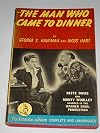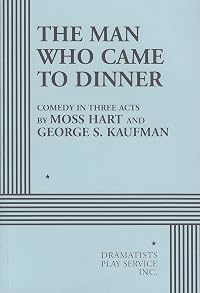
The Man Who Came to Dinner
by George S. Kaufman (Author), Moss Hart (Author)
On This Page
Description
A radio celebrity and his secretary have dinner with a Midwestern family, and end up staying as a disruptive force when he breaks his hip and has to stay to recuperate.Tags
Recommendations
























Member Reviews
I first read this when I was eleven. I don't think I quite understood everything, but I knew a good read when I saw it!
Years later I was able to attend the revival with Nathan Lane & Jean Smart (and a slightly miscast Harriet Harris)--what a delight to see these masters bringing the words to life. But this is one of those wonderful plays which read very, very well indeed. It's no doubt better with Nathan Lane, but just imagine Nathan Lane in your head and you will have a marvelous time reading the play yourself.
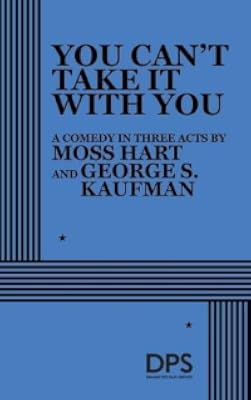
(And if you love it, then move on to You Can't Take It With You by the same authors, nearly as good, although it won the Pulitzer and this one didn't!)
The plot is genius: a horrible writer--I mean, a horrible person who writes show more well--is injured and forced to remain bedridden at a (wealthy) suburban home. Much of the play is his entertaining his famous friends, but there are subplots throughout that eventually pay off spectacularly.
A real treat, and aside from modern audiences being less and less able to recognize the allusions to then-current celebrity, it doesn't show its age one bit. show less
Years later I was able to attend the revival with Nathan Lane & Jean Smart (and a slightly miscast Harriet Harris)--what a delight to see these masters bringing the words to life. But this is one of those wonderful plays which read very, very well indeed. It's no doubt better with Nathan Lane, but just imagine Nathan Lane in your head and you will have a marvelous time reading the play yourself.
(And if you love it, then move on to You Can't Take It With You by the same authors, nearly as good, although it won the Pulitzer and this one didn't!)
The plot is genius: a horrible writer--I mean, a horrible person who writes show more well--is injured and forced to remain bedridden at a (wealthy) suburban home. Much of the play is his entertaining his famous friends, but there are subplots throughout that eventually pay off spectacularly.
A real treat, and aside from modern audiences being less and less able to recognize the allusions to then-current celebrity, it doesn't show its age one bit. show less
Great 30's screwball comedy with a cast of dozens. Not as good as You Can't Take It With You, but still solid. Really good women characters which is gratifying.
I'm sure this play would probably convey more delight if only the reader had some sense of who Alexander Woollcott (the personage who inspired the title character) was. Even so, there's plenty of good humor here and the middle class gets its just deserts. The 1942 film certainly brings a smile, but one only wishes that the character of Banjo (played by Jimmy Durante, good as he is) were acted by the original stage performer, Harpo Marx.
This play aged surprisingly well.
Ratings
Members
- Recently Added By
Lists

Plays I Like
230 works; 31 members

1930s
262 works; 5 members

Books Read in 2021
5,361 works; 114 members
1:28 p.m.'s 350 Stage Plays Challenge
94 works; 3 members
Essential/Recognized Stage Plays
115 works; 4 members
My Play Collection
769 works; 3 members

Next Plays / 2025
352 works; 1 member
Author Information

Kaufman, was born in Pittsburgh, attended law school for two years, failed as a business person, and became a humorist for Franklin P. Adams's column before joining the New York Times, whose drama editor he became in the 1920s. Kaufman was sole author of one long play and two one-act plays, including the popular The Butter and Egg Man (1926), but show more he collaborated on more than 25 plays, most importantly with Moss Hart, but also with Marc Connelly, Edna Ferber, and others, including Ring Lardner and John P. Marquand. These plays range from the hilarious madness of Cocoanuts (1929) and Animal Crackers (1928), two Marx Brothers shows that Kaufman worked on, to the comic pathos of Stage Door (1936) (with Edna Ferber). Commenting on why he did not write true satire, Kaufman said, "Satire is what closes Saturday night." Kaufman, Morris Ryskind, and Ira Gershwin won the Pulitzer Prize for drama for Of Thee I Sing (1932) and Kaufman and Hart for You Can't Take It with You (1937). (Bowker Author Biography) show less

Some Editions
Awards and Honors
Work Relationships
Is contained in
Has the adaptation
Is abridged in
Common Knowledge
- Canonical title
- The Man Who Came to Dinner
- Original publication date
- 1939
- People/Characters
- Sheridan Whiteside
- Important places
- Ohio, USA
- Important events
- Christmas
- Related movies
- The Man Who Came to Dinner (1942 | IMDb); The Man Who Came to Dinner (2000 | IMDb); Hallmark Hall of Fame: The Man Who Came to Dinner (1972 | IMDb)
- Dedication
- To Alexander Woollcott, for reasons that are nobody's business.
- First words
- Act One. Scene I. The curtain rises on the attractive living room in the home of Mr. and Mrs. Ernest W. Stanley, in a small town in Ohio.
- Last words
- (Click to show. Warning: May contain spoilers.)(Mr. Stanley throws up his hands in despair. Mrs. Stanley simply faints away.)
Curtain.
Classifications
Statistics
- Members
- 273
- Popularity
- 118,402
- Reviews
- 5
- Rating
- (3.78)
- Languages
- English, Russian
- Media
- Paper
- ISBNs
- 2
- ASINs
- 13