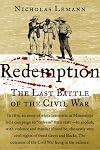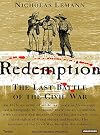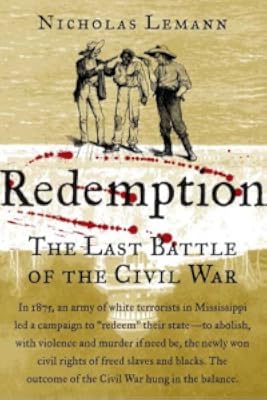
Redemption: The Last Battle of the Civil War
by Nicholas Lemann
On This Page
Description
A century after Appomattox, the civil rights movement won full citizenship for black Americans in the South. It should not have been necessary: by 1870 those rights were set in the Constitution. Journalist Lemann describes an insurgency that changed the course of American history: from 1873 to 1877 white Southern Democrats waged a campaign of political terrorism to create chaos and keep blacks from voting out of fear for their lives and livelihoods, aiming to overturn the Fourteenth and show more Fifteenth Amendments and challenge President Grant's support for the emergent structures of black political power. The remorseless strategy of well-financed "White Line" organizations culminated in a bloody, corrupt election in which Mississippi was "redeemed"--That is, returned to white control. This led to the death of Reconstruction--and of the constitutional rights of the former slaves. We are still living with the consequences.--From publisher description. show lessTags
Recommendations




















Member Reviews
This book shows how, in 1875, political power in Mississippi was wrested by violent means from the black-supported (and largely black-staffed) Republican government by what was essentially the pre-war white power structure. Many blacks were killed in the state in that year, and blacks were prevented from voting. Lemann's documentation of what happened, based on testimony in Congressional investigations and on other contemporary sources, is impeccable, and his conclusion is overwhelming. Local whites, with the covert and sometimes overt support of whites elsewhere in the South, carried out with extreme violence a successful rebellion against the authority of the U.S. central government. Its purpose -- and result -- was the show more disenfranchisement of the black population, which in turn led to black political powerlessness, black economic subordination, and Jim Crow. The process, or "Mississippi Plan" was adopted throughout the South in the wake of the Compromise of 1877, which gave the Republicans the Presidency and the Democrats a free hand in the south.
The book is fascinating in itself-- it shows more clearly than anything else I have read how we got from the Emancipation Proclamation to Jim Crow -- but it is also a compelling illustration of the power of political myth. In the latter part of his book, Lemann describes how the racist violence of 1875 was converted into the "Redemption" myth of a valiant Southern effort to oust corrupt carpet-baggers, and restore self-government in the south. This myth took hold not only of popular culture (viz "Birth of a Nation" and "Gone With the Wind") but of serious academic discussion, all the way into the second half of the 20th century. Myths like this can, and do, kill. show less
The book is fascinating in itself-- it shows more clearly than anything else I have read how we got from the Emancipation Proclamation to Jim Crow -- but it is also a compelling illustration of the power of political myth. In the latter part of his book, Lemann describes how the racist violence of 1875 was converted into the "Redemption" myth of a valiant Southern effort to oust corrupt carpet-baggers, and restore self-government in the south. This myth took hold not only of popular culture (viz "Birth of a Nation" and "Gone With the Wind") but of serious academic discussion, all the way into the second half of the 20th century. Myths like this can, and do, kill. show less
http://www.amazon.com/Redemption-Last-Battle-Civil-War/dp/0374248559/ref=cm_cr-m...
'Redemption: The Last Battle of the Civil War' is a short (207 pages) non-academic history aimed at the 'general reader' or 'popular audience'. The author is not an historian, but rather is Dean of the Columbia School of Journalism. I write these things not to denigrate the book in any way, but rather to alert the prospective reader to the nature of the book.
The book is well written and focuses on the collapse of reconstruction under the open violent assault of 'White Liners' in Mississippi. This tale is well known and nothing particularly new is added here, but the failure of reconstruction is a hugely important story in American history. You really can show more not understand 20th century America without understanding what happened in the South after the Civil War.
Ironically one of the better parts of the book comes near the end when Lemann reviews the way the story of Reconstruction was revised beyond all recognition beginning especially in the early 1900's.
Lemann's telling still lends too much credence to the role of so-called Northern carpetbaggers in Reconstruction. The Republican leaders of Reconstruction were not all cut from the same clothe.
Lemann gets off to an extraordinarily bad start with a real howler on the first page when he asserts that the Emancipation Proclamation freed slaves in the areas that the Union Army controlled. Of course, that is exactly incorrect. In fact, perhaps the biggest criticism of the Proclamation was that it freed no slaves because it did not apply in the areas then under Union control.
If you do not know about this crucial piece of history Redemption will give you a reasonably good examination, albeit focused on one state. However, there are far better accounts available, such as Eric Foner's 'A Short History of Reconstruction' (about 300 pages) and the much longer James M. McPherson's 'Ordeal By Fire: The Civil War and Reconstruction' or Foner's full scale treatment 'Reconstruction: America's Unfinished Revolution, 1863-1877'. show less
'Redemption: The Last Battle of the Civil War' is a short (207 pages) non-academic history aimed at the 'general reader' or 'popular audience'. The author is not an historian, but rather is Dean of the Columbia School of Journalism. I write these things not to denigrate the book in any way, but rather to alert the prospective reader to the nature of the book.
The book is well written and focuses on the collapse of reconstruction under the open violent assault of 'White Liners' in Mississippi. This tale is well known and nothing particularly new is added here, but the failure of reconstruction is a hugely important story in American history. You really can show more not understand 20th century America without understanding what happened in the South after the Civil War.
Ironically one of the better parts of the book comes near the end when Lemann reviews the way the story of Reconstruction was revised beyond all recognition beginning especially in the early 1900's.
Lemann's telling still lends too much credence to the role of so-called Northern carpetbaggers in Reconstruction. The Republican leaders of Reconstruction were not all cut from the same clothe.
Lemann gets off to an extraordinarily bad start with a real howler on the first page when he asserts that the Emancipation Proclamation freed slaves in the areas that the Union Army controlled. Of course, that is exactly incorrect. In fact, perhaps the biggest criticism of the Proclamation was that it freed no slaves because it did not apply in the areas then under Union control.
If you do not know about this crucial piece of history Redemption will give you a reasonably good examination, albeit focused on one state. However, there are far better accounts available, such as Eric Foner's 'A Short History of Reconstruction' (about 300 pages) and the much longer James M. McPherson's 'Ordeal By Fire: The Civil War and Reconstruction' or Foner's full scale treatment 'Reconstruction: America's Unfinished Revolution, 1863-1877'. show less
4262 Redemption The Last Battle of the Civil War, by Nicholas Lemann (read 20 Jan 2007) This book tells of the lawless way whites in the South subverted the legal right of the Negroes in the 1870s. Most of the book dwells on Mississippi, and Adelbert Ames, Republican governor of Mississippi and his effort to get President Grant to effectually aid the rule of law in the South. Murder and blatant use of economic power caused blacks not to vote and in 1876 whites regained control of the state. The extensiveness of the use of murder by whites was a surprise even though I knew that in those years the Civil War was won by the South, as to all but outright slavery. The last chapter relates how Reconstruction has been viewed by historians in show more the years since, and is the most interesting chapter in the book. show less
Review by on Amazon.com:
Mostly through the eyes of Adelbert Ames, the Civil War hero from Maine, who served as the Governor of Mississippi, the author tells about how the 14th and 15th Amendments were declared null and void. Through unremitting murder, brutality and terror by white vigilante groups, the weak kneed Northern occupiers eventually gave in to the southern brand of terror and insurrection, which the author refers to as the "last battle of the Civil War." Neighborhood and regional terror involving the most grotesque and inhuman violence was the motif that was spread across the region and led to a reversal of the Northern victory and a win of the Civil War for the South, a victory that still reverberates through American's show more race-based culture.
The subtext of the book is at least as important and as potent as are the details of the context. It makes clear that the real birth of the American nation occurred in the aftermath of the Civil War, when the South was Redeemed, in the ineptness and utter lack of commitment on the part of the Northern occupiers to protect what was important about the nation -- its laws and the Constitution against 911-styled terrorism. For the North, Reconstruction was just an overwhelming "mop-up" operation; for the South, it was existential, a matter of the survival of the white race and the southern way of life. show less
Mostly through the eyes of Adelbert Ames, the Civil War hero from Maine, who served as the Governor of Mississippi, the author tells about how the 14th and 15th Amendments were declared null and void. Through unremitting murder, brutality and terror by white vigilante groups, the weak kneed Northern occupiers eventually gave in to the southern brand of terror and insurrection, which the author refers to as the "last battle of the Civil War." Neighborhood and regional terror involving the most grotesque and inhuman violence was the motif that was spread across the region and led to a reversal of the Northern victory and a win of the Civil War for the South, a victory that still reverberates through American's show more race-based culture.
The subtext of the book is at least as important and as potent as are the details of the context. It makes clear that the real birth of the American nation occurred in the aftermath of the Civil War, when the South was Redeemed, in the ineptness and utter lack of commitment on the part of the Northern occupiers to protect what was important about the nation -- its laws and the Constitution against 911-styled terrorism. For the North, Reconstruction was just an overwhelming "mop-up" operation; for the South, it was existential, a matter of the survival of the white race and the southern way of life. show less
Ratings
Members
- Recently Added By
Author Information

13+ Works 1,520 Members
Nicholas Lemann, a native of New Orleans, developed an interest in journalism during his teenage years. This eagerness to write was coupled with a keen interest in United States history and literature. He pooled his curiosities, earning a degree in American literature and history from Harvard University in 1976. Journalism became Lemann's main show more occupation, as he built his writing career through working for the Washington Monthly, Texas Monthly, and the Washington Post. In 1983, he joined the Atlantic Monthly staff. His love for American history peaked with the publication of his commentary on the African-American migration to Chicago in search of jobs and a better life. Lemann's book, The Promised Land, captured the 1991 Los Angeles Times Book Prize in journalism. His articles span many interests, from book reviews and political topics to travel stories about the Catskill Mountains and other natural wonders. He contributes many articles, not only to the Atlantic Monthly but to several other magazines as well. Nicholas Lemann, his wife Dominique Browning, and their two sons live in New York City. (Bowker Author Biography) Nicholas Lemann was born in New Orleans in 1954. He has been a journalist for more than twenty years. His last book was the prizewinning The Promised Land: The Great Black Migration and How It Changed America. He lives in Pelham, New York. (Bowker Author Biography) show less
Awards and Honors
Distinctions
Classifications
- Genres
- History, Nonfiction, General Nonfiction, Politics and Government
- DDC/MDS
- 975.00496073 — History & geography History of North America Southeastern United States (South Atlantic states)
- LCC
- E185.61 .L517 — History of the United States United States Elements in the population Afro-Americans Status and development since emancipation
- BISAC
Statistics
- Members
- 354
- Popularity
- 89,030
- Reviews
- 4
- Rating
- (3.94)
- Languages
- English
- Media
- Paper, Audiobook, Ebook
- ISBNs
- 10
- ASINs
- 4