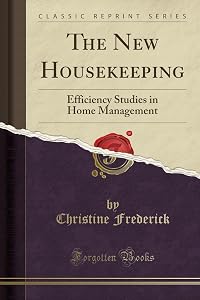
The New Housekeeping: Efficiency Studies in Home Management (Classic Reprint)
by Christine Frederick
On This Page
Description
Excerpt from The New Housekeeping: Efficiency Studies in Home Management A 'moderate income, two babies, and constant demands on my time, was the situation that faced me several years ago. I liked housework, and was especially fond of cooking; but the deadening point about the Whole situation was that I never seemed to finish my work, never seemed to get anywhere, and that I almost never had any leisure time to myself. About the Publisher Forgotten Books publishes hundreds of thousands of show more rare and classic books. Find more at www.forgottenbooks.com This book is a reproduction of an important historical work. Forgotten Books uses state-of-the-art technology to digitally reconstruct the work, preserving the original format whilst repairing imperfections present in the aged copy. In rare cases, an imperfection in the original, such as a blemish or missing page, may be replicated in our edition. We do, however, repair the vast majority of imperfections successfully; any imperfections that remain are intentionally left to preserve the state of such historical works. show lessTags
Member Reviews
Christine Frederick seems to have been a classic case of the intelligent, highly-educated middle-class American woman brought up to think of herself as a future leader of the nation only to find herself committed to a full-time career in laundry, cooking, cleaning, and child-care. Instead of rebelling against the expectations of society - or even asking her husband why he never washed the dishes - she decided to take a long hard look at what she was actually doing and how it could be improved. She hit upon the idea of taking the "business efficiency" techniques that were being used to improve workflow in factories and offices at the time and applying them to her own workplace. Her experiments allowed her to identify quite a number of show more areas where she could save time and effort by making simple changes in the arrangement of her kitchen or the scheduling of her tasks. She is generally credited with being the first to insist on things like standardised heights for kitchen worktops, the window over the sink and the draining board to the left of it (so annoying for those of us who happen to be left-handed!).
The new housekeeping (1913) sets out her basic methodology in a way that she obviously hopes any middle-class woman should be able to apply. Frederick points out that wealthy women don't have a problem with housework, they pay someone else to solve it for them; the poor, she considers, are brought up to hard work and have much simpler homes to run. She returned to the subject in 1919 with Household engineering, a more comprehensive look at how an understanding of housework should inform the design of homes.
The new housekeeping is less about solutions than about how women should see running a home as a business (in which the woman is the "junior partner" and the wage-earner the "senior"!). Amongst other things, she advocates keeping a good filing system and clear financial accounts, cost-benefit analysis for investments in equipment, time-and-motion studies for common tasks, scheduling of jobs to minimise the need for what we would call multi-tasking, and above all making the effort to think through why and how things are done. She's quite conscious that a lot of readers will be put off by the apparent complexity of all this, and she goes to some lengths to demonstrate simple ways she has found to implement these ideas in practice.
For women who keep a servant, she recommends establishing proper employment conditions - fixed hours and guaranteed free days, overtime payments, incentives for training, and if possible allowing the servant to live out. This sort of thing would have been completely unthinkable in Edwardian England - obviously the reason for books like this one in the USA was that servants were already becoming an unaffordable luxury for most middle-class families, a couple of generations before the same thing happened in most of Europe. Frederick's ideas don't seem to have had any noticeable impact in Britain, but the French (Paulette Bernège) were more interested.
Most of Frederick's attitudes come over as very rational and modern, but every now and then you have to do a double-take and remind yourself that this was written a century ago. The most striking thing, of course, is her unquestioning acceptance of gender-roles. She never for a moment suggests that married women might want to have a career or that their husbands might want to do anything in the home except eat, sleep and relax. Rather oddly, she doesn't see any contradiction in having a career herself - we gather from what she says that as well as looking after a home and two small children, she is on the editorial staff of a women's magazine and runs a test-kitchen where she evaluates equipment for manufacturers. Another thing that struck me is her evangelism for the giants of American capitalism. She repeatedly tells her readers to stick to name-brands, to have faith in their trade-marks and advertisements, to believe what it says on the list of ingredients, not to fall for price-cutting and "own brand" products, and so on. Could it be that the Fredericks had something to do with advertising before they moved into efficiency...?
Not all of her practical ideas have stood the test of time either: many things she advocates, like the "fuelless stove" (what we would call a haybox) and the "kitchen elevator" (an icebox made to sink through the kitchen floor into the cool basement) were made redundant by the sharp drop in the price of electricity shortly after The new housekeeping came out. And modern kitchen designers have evidently not followed her teaching that all frequently used tools should be within reach and nothing should be stored below waist level. show less
The new housekeeping (1913) sets out her basic methodology in a way that she obviously hopes any middle-class woman should be able to apply. Frederick points out that wealthy women don't have a problem with housework, they pay someone else to solve it for them; the poor, she considers, are brought up to hard work and have much simpler homes to run. She returned to the subject in 1919 with Household engineering, a more comprehensive look at how an understanding of housework should inform the design of homes.
The new housekeeping is less about solutions than about how women should see running a home as a business (in which the woman is the "junior partner" and the wage-earner the "senior"!). Amongst other things, she advocates keeping a good filing system and clear financial accounts, cost-benefit analysis for investments in equipment, time-and-motion studies for common tasks, scheduling of jobs to minimise the need for what we would call multi-tasking, and above all making the effort to think through why and how things are done. She's quite conscious that a lot of readers will be put off by the apparent complexity of all this, and she goes to some lengths to demonstrate simple ways she has found to implement these ideas in practice.
For women who keep a servant, she recommends establishing proper employment conditions - fixed hours and guaranteed free days, overtime payments, incentives for training, and if possible allowing the servant to live out. This sort of thing would have been completely unthinkable in Edwardian England - obviously the reason for books like this one in the USA was that servants were already becoming an unaffordable luxury for most middle-class families, a couple of generations before the same thing happened in most of Europe. Frederick's ideas don't seem to have had any noticeable impact in Britain, but the French (Paulette Bernège) were more interested.
Most of Frederick's attitudes come over as very rational and modern, but every now and then you have to do a double-take and remind yourself that this was written a century ago. The most striking thing, of course, is her unquestioning acceptance of gender-roles. She never for a moment suggests that married women might want to have a career or that their husbands might want to do anything in the home except eat, sleep and relax. Rather oddly, she doesn't see any contradiction in having a career herself - we gather from what she says that as well as looking after a home and two small children, she is on the editorial staff of a women's magazine and runs a test-kitchen where she evaluates equipment for manufacturers. Another thing that struck me is her evangelism for the giants of American capitalism. She repeatedly tells her readers to stick to name-brands, to have faith in their trade-marks and advertisements, to believe what it says on the list of ingredients, not to fall for price-cutting and "own brand" products, and so on. Could it be that the Fredericks had something to do with advertising before they moved into efficiency...?
Not all of her practical ideas have stood the test of time either: many things she advocates, like the "fuelless stove" (what we would call a haybox) and the "kitchen elevator" (an icebox made to sink through the kitchen floor into the cool basement) were made redundant by the sharp drop in the price of electricity shortly after The new housekeeping came out. And modern kitchen designers have evidently not followed her teaching that all frequently used tools should be within reach and nothing should be stored below waist level. show less
Print-on-demand reprint produced by UM Expresso Book Machine (sample)(free sample)
Members
- Recently Added By
Lists

Books Read in 2016
4,666 works; 199 members
Author Information
10 Works 28 Members
Classifications
- Genre
- History
- LCC
- TX145 .F7 — Technology Home economics Home economics
- BISAC
Statistics
- Members
- 6
- Popularity
- 3,050,337
- Reviews
- 2
- Rating
- (4.00)
- Languages
- English
- Media
- Paper
- ISBNs
- 2