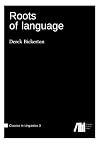
Roots of language
by Derek Bickerton
On This Page
Description
Roots of language was originally published in 1981 by Karoma Press (Ann Arbor). It was the first work to systematically develop a theory first suggested by Coelho in the late nineteenth century: that the creation of creole languages somehow reflected universal properties of language. The book also proposed that the same set of properties would be found to emerge in normal first-language acquisition and must have emerged in the original evolution of language. These proposals, some of which show more were elaborated in an article in Behavioral and Brain Sciences (1984), were immediately controversial and gave rise to a great deal of subsequent research in creoles, much of it aimed at rebutting the theory. The book also served to legitimize and stimulate research in language evolution, a topic regarded as off-limits by linguists for over a century. The present edition contains a foreword by the author bringing the theory up to date; a fuller exposition of many of its aspects can be found in the author ?s most recent work, More than nature needs (Harvard University Press, 2014). show lessTags
Recommendations







































Member Reviews
The linguist author develops a unified theory for "at least a partial answer" for the Origination of language -- taking creole and child language examples. This of course assumes that "Language has made our species what it is" [xi], that our world must be controlled, that we have to understand it to control it, and that baby-talk and pidgin provide "indispensable keys" to the knowledge of the Language required to engage the control.
Creole languages came into existence as a result of colonial expansion out of Europe 1500-1900. Speakers of different languages developed an auxiliary contact-language native to none of them (pidgin), and this tongue expanded to become a new native language of the community (creole).[2] Neither the results show more nor the origins were controlled or predicted.
Derek Bickerson shows that people have "innate knowledge" of the structure of language. This conclusion is drawn from the strong structural similarities of creole/pidgin languages no matter what their derivation. Also, children "expect" a grammar comparable to creole as they begin to learn a language. Bickerson leads with data, as compared to the Chomskians who lead with theory. At least the theory is not based on "gestural" origin. For some reason, however, since Panini began describing language 2500 years ago, linguists feel it is necessary to have a "theory" before they have collected the facts. But is it possible to gather "facts" of Origins? We are left with the debate on the "Paradox of Continuity" with theories of unitary opposed to discontinuous models, and "the approved political model of both sides hurling slogans".[217]
There are roughly 350 creole languages which developed around the globe. Bickerson shows they share almost identical grammatical structures. For instance, all known creoles use only three articles, they all indicate whether an act was accomplished, and they put negatives before subject. Once he showed a kind of bio-program for acquiring language, bickerton turned to the study of child language, which should also be guided by biology. Note they are similarly article-limited and negative happy. No question that Bickerson is digging up "fossils" of language. show less
Creole languages came into existence as a result of colonial expansion out of Europe 1500-1900. Speakers of different languages developed an auxiliary contact-language native to none of them (pidgin), and this tongue expanded to become a new native language of the community (creole).[2] Neither the results show more nor the origins were controlled or predicted.
Derek Bickerson shows that people have "innate knowledge" of the structure of language. This conclusion is drawn from the strong structural similarities of creole/pidgin languages no matter what their derivation. Also, children "expect" a grammar comparable to creole as they begin to learn a language. Bickerson leads with data, as compared to the Chomskians who lead with theory. At least the theory is not based on "gestural" origin. For some reason, however, since Panini began describing language 2500 years ago, linguists feel it is necessary to have a "theory" before they have collected the facts. But is it possible to gather "facts" of Origins? We are left with the debate on the "Paradox of Continuity" with theories of unitary opposed to discontinuous models, and "the approved political model of both sides hurling slogans".[217]
There are roughly 350 creole languages which developed around the globe. Bickerson shows they share almost identical grammatical structures. For instance, all known creoles use only three articles, they all indicate whether an act was accomplished, and they put negatives before subject. Once he showed a kind of bio-program for acquiring language, bickerton turned to the study of child language, which should also be guided by biology. Note they are similarly article-limited and negative happy. No question that Bickerson is digging up "fossils" of language. show less
Ratings
Members
- Recently Added By
Lists

Books in the Bibliography of The Mind in the Cave by David Lewis-Williams
257 works; 1 member
Author Information
18+ Works 775 Members
Series
Belongs to Publisher Series
Common Knowledge
- Original publication date
- 1981
Classifications
Statistics
- Members
- 27
- Popularity
- 977,111
- Reviews
- 1
- Rating
- (4.00)
- Languages
- English
- Media
- Paper, Ebook
- ISBNs
- 6