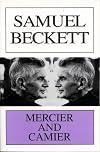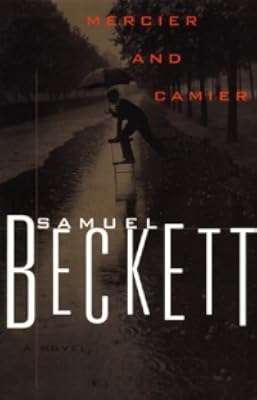
Mercier and Camier
by Samuel Beckett
On This Page
Description
One of the most accessible examples of Samuel Beckett's dark humor, Mercier and Camier is the hilarious chronicle of its two heroes' epic journey. While their travels are fraught with complications and intrigue, Mercier and Camier at least "did not remove from home, they had that good fortune."Tags
Recommendations























Member Recommendations
EMS_24 Two man, waiting, that doesn't 'succeed'. Absurdism, exentialism, repetition.
Member Reviews
Yet another work I feel conflicted about because although I am very partial to the ideas presented here, there’s something about Beckett's writing that throws me off and makes it hard for me to enjoy this short novel as much as I feel I should. I can’t blame it on the translation as Beckett himself translated it back to English from his original French text. Which is not to say I didn’t find humor in various passages. It’s just that the writing overall felt alienating in some way.
And yet I haven’t been able to stop thinking of Mercier and Camier because much like Bellow’s The Dangling Man the main ideas and thoughts that Beckett is trying to convey resonate with me on a deep level. Because much like The Dangling Man this show more seems to be a story about what happens when all assumptions and projects and beliefs that humans once held as given are seen to be non-existent. The basic anchor to hang this all on is Existentialism’s “God is Dead,” but this crisis in modern thought branches out to so much more than the strictly religious. This feels like Beckett’s absurd next step past Camus and Dostoevsky.
What happens to us when our drive to progress and proceed finds no solid direction to progress or proceed in?
At one time in our much distant past we must have felt perfectly alright to just exist without goals or beliefs or purpose, but this time is long gone. Religion and Science and Humanity’s Progress has ingrained in us a sense of purpose, enlightenment and drive, originally based on God, but then even on our own exalted sense of Humanism. And yet, what if the drive remains but no agreed upon or even discernible goal or foundation or "higher good” remains to be seen or believed in? What then?
Well, we might find ourselves wandering around aimlessly like Mercier and Camier! show less
And yet I haven’t been able to stop thinking of Mercier and Camier because much like Bellow’s The Dangling Man the main ideas and thoughts that Beckett is trying to convey resonate with me on a deep level. Because much like The Dangling Man this show more seems to be a story about what happens when all assumptions and projects and beliefs that humans once held as given are seen to be non-existent. The basic anchor to hang this all on is Existentialism’s “God is Dead,” but this crisis in modern thought branches out to so much more than the strictly religious. This feels like Beckett’s absurd next step past Camus and Dostoevsky.
What happens to us when our drive to progress and proceed finds no solid direction to progress or proceed in?
At one time in our much distant past we must have felt perfectly alright to just exist without goals or beliefs or purpose, but this time is long gone. Religion and Science and Humanity’s Progress has ingrained in us a sense of purpose, enlightenment and drive, originally based on God, but then even on our own exalted sense of Humanism. And yet, what if the drive remains but no agreed upon or even discernible goal or foundation or "higher good” remains to be seen or believed in? What then?
Well, we might find ourselves wandering around aimlessly like Mercier and Camier! show less
ياااه بقالى كتير مقرتش حاجه حلوه...حاجه ادب راقى فعلا...ادب مش بياخد دور المهرج اللى بيسلى..ادب مش تجاره ادب يخلينى احتوى كل تلك المتعه الذهنيه بنسخه ورقيه احتضنها لاقراها مره وراء المره ب2 جنيه يا بشر...ادب مش بياخد دور الواعظ و ينصح و يضربك على ايديك...ادب تانى من نوع فريد امضاء صامويل بيكت
ادب زى الورقه البيضا تكتب فيه اللى جواك...فى نهايه اللعبه خصوصا و فى اعمال بيكت عموما انت جزء من المسرحيه لا يقل عن اى عنصر show more اخر...الروايه نفسها مش بتقول حاجه اصلا لكن انت و انت بس اللى تحدد المسرحيه بتقول ايه
بيدخلك بيكت فى حاله شعوريه فى اعمال تجعلك تستسيغ اللا منطق اكثر من المنطق ذاته...يجعلك تتقبل انتظار جودو المطلق و لا تتقبل صياح جيرانك على المرتب...فى لحظات كتلك تستطيع فهم اللوحات السيراليه فتملا الفراغات بروحك القلقه و يتضح المعنى
كيف تتحدث طيله مئه صفحه دون ان تقول شئ؟؟ يبدو كسؤال صعب لكن لدى بيكت طريقه الخاصه..و احد تكنيك بيكت فى ذلك نظريه التكرار بطريقته المميزه كالمشهد التالى
و فى النهايه اترك نصيحتى الدائمه مع اعمال العبث...اترك عقلك بالخارج و لا تلوث فن العبث باعمال العقل البائس show less
show more 在工作当中,你会有以下的困惑吗:如何才能在世俗的工作中活出信仰?怎样与没有共同价值观和职业道德的人共事?如何与从事不道德商业活动的老板相处?当信仰与工作发生冲突时,你选择前者还是后者?
约翰·贝克特先生将带领你发现自己的天赋、认清天职,教会你如何将信仰和工作融为一体,让你在工作中荣神益人。
明白天职真义:不陷入成功学陷阱,不逃避现代商业社会的挑战和责任。
效法历史伟人:学习摩西,大卫,但以理,尼希米的管理智慧,借鉴现代商界领袖的成功典范,帮助你在工作中得胜,活出丰盛的生命。
打磨“五块光滑石子”:标竿式目标,合乎中道的价值观,爱人如己的管理,管家式的经营理念,仆人式的带领。
在工作中与上帝建立亲密的个人关系:以全面和深入的方式将圣经原则应用于商业情境,在工作场所彰显上帝的国。
目录:
前言
第一部分 我的个人历程
火窑中的试炼
融合两个世界
第二部分 旅途中的良伴
引言
最早的良友——从亚当到波阿斯
圣经智慧的今日应用——大卫和所罗门
世界级的领导——但以理和尼希米
新约中的工作与职场——耶稣及跟随者
文明的边沿
第三部分 蒙福的职场日程
引言
目标的力量
价值观
尊重个人
管家
事奉
后记 show less
约翰·贝克特先生将带领你发现自己的天赋、认清天职,教会你如何将信仰和工作融为一体,让你在工作中荣神益人。
明白天职真义:不陷入成功学陷阱,不逃避现代商业社会的挑战和责任。
效法历史伟人:学习摩西,大卫,但以理,尼希米的管理智慧,借鉴现代商界领袖的成功典范,帮助你在工作中得胜,活出丰盛的生命。
打磨“五块光滑石子”:标竿式目标,合乎中道的价值观,爱人如己的管理,管家式的经营理念,仆人式的带领。
在工作中与上帝建立亲密的个人关系:以全面和深入的方式将圣经原则应用于商业情境,在工作场所彰显上帝的国。
目录:
前言
第一部分 我的个人历程
火窑中的试炼
融合两个世界
第二部分 旅途中的良伴
引言
最早的良友——从亚当到波阿斯
圣经智慧的今日应用——大卫和所罗门
世界级的领导——但以理和尼希米
新约中的工作与职场——耶稣及跟随者
文明的边沿
第三部分 蒙福的职场日程
引言
目标的力量
价值观
尊重个人
管家
事奉
后记 show less
This is a great story peppered with humor, laughter and wink. A book that I can highly recommend.
[[Beckett]] proves his high linguistic ability. Mercier and Camier are on the move, constantly pondering on trifles such as who was at a meeting point first, about the sense and nonsense of an umbrella, about friendship and what happened to the bike. There is a steady language exchange between the two at the highest level, which often made me laugh.
[[Beckett]] proves his high linguistic ability. Mercier and Camier are on the move, constantly pondering on trifles such as who was at a meeting point first, about the sense and nonsense of an umbrella, about friendship and what happened to the bike. There is a steady language exchange between the two at the highest level, which often made me laugh.
Beckett's first complete work written in French, when Beckett was around forty, and translated by Beckett himself into English when he was 73, this book reads like nothing else. A literary god wallowing and splashing in the sweet mud of his genius.
This one was another miss from Beckett for me. There was not really anything stringing, and structuring, the narrative along and I felt that the entire thing lacked focus and refinement. Despite the aplomb dished out for this, I didn't quite care for it and felt that it did not have much to offer. It is not my type of book.
2 stars.
2 stars.
Easy to read and a great laugh. Lets be simplistic and say Mercier and Camier are a peripatetic Vladimir and Estragon.
Members
- Recently Added By
Lists

1001 Books You Must Read Before You Die
1,448 works; 1,133 members

Books with a Character's Name as the Title
130 works; 10 members
Author Information

532+ Works 43,171 Members
Nobel Prize winner (1969) Samuel Beckett was born on April 13, 1906 near Dublin, Ireland into a middle-class Protestant family. As a boy, he studied French and enjoyed cricket, tennis, and boxing. At Trinity College he continued his studies in French and Italian and became interested in theater and film, including American film. After graduation, show more Beckett taught English in Paris and traveled through France and Germany. While in Paris Beckett met Suzanne Deschevaus-Dusmesnil. During World War II when Paris was invaded, they joined the Resistance. They were later forced to flee Paris after being betrayed to the Gestapo, but returned in 1945. Beckett and Deschevaus-Dusmesnil married in 1961. Samuel Beckett's first novel was Dream of Fair to Middling Women. Among his many works are Murphy; Malone Dies; and The Unnameable. His plays include Endgame, Happy Days, Not I, That Time, and Krapp's Last Tape. In 1953, the production of Waiting For Godot in Paris by director and actor Roger Blin earned Beckett international fame. Beckett was awarded the Nobel Prize in Literature in 1969. His style was postmodern minimalist and some of his major themes were imprisonment in one's self, the failure of language, and moral conduct in a godless world. Despite his fame, Samuel Beckett led a secluded life. In his later years he suffered from cataracts and emphysema. His wife Suzanne died on July 17, 1989 and Beckett died on December 22nd of the same year. (Bowker Author Biography) show less
Some Editions
Awards and Honors
Notable Lists
Work Relationships
Common Knowledge
- Canonical title
- Mercier and Camier
- Original title
- Mercier et Camier
- Original publication date
- 1946 (redaction) (redaction); 1970; 1970 (French) (French); 1974 (English) (English)
- People/Characters
- Mercier; Camier
- First words
- The journey of Mercier and Camier is one i can tell, if I will, for I was with them all the time.
- Last words
- (Click to show. Warning: May contain spoilers.)And in the dark he could hear better too, he could hear the sounds the long day had kept from him, human murmurs for example, and the rain on the water.
- Original language
- French
Classifications
Statistics
- Members
- 599
- Popularity
- 48,966
- Reviews
- 10
- Rating
- (3.87)
- Languages
- 16 — Catalan, Chinese, Danish, Dutch, English, Finnish, French, German, Greek, Hebrew, Hungarian, Italian, Russian, Spanish, Swedish, Turkish
- Media
- Paper, Audiobook, Ebook
- ISBNs
- 40
- UPCs
- 1
- ASINs
- 11