On This Page
Description
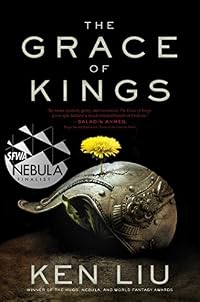
"The Grace of Kings, the first book in this epic series, tells the story of two men who become friends through rebelling against tyranny and then turn against each other in defense of irreconcilable ideals. Wily, charming Kuni Garu, a bandit, and stern, fearless Mata Zyndu, the son of a deposed duke, seem like polar opposites. Yet, in the uprising against the emperor, the two quickly become the best of friends after a series of adventures fighting against vast conscripted armies, silk-draped show more airships, soaring battle kites, underwater boats, magical books, shapeshifting gods, and scaled whales who seem to prophesy the future. Once the emperor has been overthrown, however, the two find themselves the leaders of two sides with very different ideas about how the world should be run and the meaning of justice"-- show lessTags
Recommendations







Member Reviews
Lost the library hold for a bit but managed to get it again and finished. Such a fantastic book. All the characters are written so well I found myself so invested in their relationships and felt so much emotion for some of their betrayals and the world building is fantastic. I was really pulled in. While I usually listen to audiobooks on the go from place to place, this book had me laying in bed just listening for hours. Themes of power, ambition, and the stark reality of revolution tie so well with ideas of friendship, loyalty and hope. The book ended really well and is satisfying as a standalone book but once I realized it was a series I couldn't hold my excitement. Overall would definitely reccomend for fans of the genre.
Genuinely epic. (Veronica Mars-style, spanning years and continents, lives ruined and blood shed, etc.) There's practically a whole trilogy of content in this one book, but it never feels too rushed (except maaaybe in some elements of the finale, but I think that might be a storytelling style difference) and gives us lots of time with the important details to understand these characters, these situations, these consequences. But even then, it's a pointed, succinct, efficient detailing that is a stark and exciting difference from the standard fantasy flab that can sometimes get a bit boggy in the genre these days. It's quite different in style from Western habits of storytelling, but it's good for us to get out of our comfortable show more habits.
And the characters are great. Flawed and faceted, they grow and develop through events and decisions, and their relationships shift and develop as well. Nothing about it, really, is easy - especially not doing the right thing, or even identifying what that might be. From a deceptively simple style of telling, this book builds up into a subtle and comprehensive complexity. And though I remain sad about the core POVs being a cockforest, the importance and exploration of the female characters and their roles in society and the story is really nicely done. show less
And the characters are great. Flawed and faceted, they grow and develop through events and decisions, and their relationships shift and develop as well. Nothing about it, really, is easy - especially not doing the right thing, or even identifying what that might be. From a deceptively simple style of telling, this book builds up into a subtle and comprehensive complexity. And though I remain sad about the core POVs being a cockforest, the importance and exploration of the female characters and their roles in society and the story is really nicely done. show less
Set in the islands of Dara, Grace of Kings is similar to Game of Thrones: epic fantasy, with internecine battles, but with less fantasy. I think it was overly ambitious, especially from an author recognized for his short fiction. Just too many characters, places, etc., and truly no need for the plotline with the Gods.
Kuni Garu is a charming, clever, and caring bandit, who grows from nothing to become a rebel leader and political force. Mata Zyndu is from a noble but humbled family, and a ruthless gargantuan warrior. Mata would rather be trusted and obeyed than loved and admired, like Kuni. The two leaders become "brothers," but the pressures of war, Mata's insecurities, and their differing visions for Dara, break them apart, pitting show more them against each other for supremacy.
The two highlights of the book for me were: (1) secondary characters and (2) Liu's philosophical notes on warfare, the nature of conflict, human relationships, gender roles, how expectations can twist people, etc. There are so many brilliant secondary characters, it's hard to know which to highlight.Mata's Aunt Soto was perhaps my favorite, playing a small but important role in supporting Kuni. Jia and Risana are so much more than just wives and mothers, they are women who help to shape the course of history. Brothers Ratho and Dafiro Miro, who survive incredible odds, only to become key figures for opposing sides. Luan Zya and Gin Mazoti are the most admirable of ordinary people, but brilliant strategists both: one scholarly and philosophical and the other a pragmatist. Despite their widely disparate backgrounds, especially Gin's most humble one, they come together to help bring about an end to the islands' war. show less
Kuni Garu is a charming, clever, and caring bandit, who grows from nothing to become a rebel leader and political force. Mata Zyndu is from a noble but humbled family, and a ruthless gargantuan warrior. Mata would rather be trusted and obeyed than loved and admired, like Kuni. The two leaders become "brothers," but the pressures of war, Mata's insecurities, and their differing visions for Dara, break them apart, pitting show more them against each other for supremacy.
The two highlights of the book for me were: (1) secondary characters and (2) Liu's philosophical notes on warfare, the nature of conflict, human relationships, gender roles, how expectations can twist people, etc. There are so many brilliant secondary characters, it's hard to know which to highlight.
Heroic conquerors do not always make for the best rulers, surprise surprise. While you can read this novel just for the story -- and it makes quite a good read in that regard -- you can also look at this book as an extended commentary on the differences between a good leader and good conqueror, on the difference between caring for honor and caring for people. The characters who, despite their flaws, end up as more effective are those who are willing to see the world as it is, not how they want it to be.
But what makes that contrast effective as a story is that there is no simplistic division into the "good" guys and the "bad" guys. All sides of the conflict have people who can see the world as it is and others who are stuck in their show more ideals.
My biggest issue with this book is all my own fault. I generally try not to read in-progress series (there are so many good complete series I haven't read). Yet here I went and started something whose second book isn't out until this fall. Thus is life. =) show less
But what makes that contrast effective as a story is that there is no simplistic division into the "good" guys and the "bad" guys. All sides of the conflict have people who can see the world as it is and others who are stuck in their show more ideals.
My biggest issue with this book is all my own fault. I generally try not to read in-progress series (there are so many good complete series I haven't read). Yet here I went and started something whose second book isn't out until this fall. Thus is life. =) show less
Someone might have recommended 'The Grace of Kings' to me, or the number of awards it picked up may have convinced me to read it. I can't remember. Either way, it is skillfully plotted military fantasy based on China's transformation from many kingdoms into a single state. The two main protagonists broadly personify conservatism and progress. The book begins in the reign of an emperor who united the various kingdoms by brutal force into an unstable empire. After his death, his son proves a much weaker ruler and growing rebellion turns into civil war. The politics of fantasy China are intriguing and cleverly crafted, although this is emphatically a war narrative and the plot is dominated by battles. Periods between battles are largely show more skipped over, so the wars overshadows the human characters and even the gods. There is in fact not much fantastical content, which surprised me. Possibly because the plot and themes reminded me so much of Avatar: The Last Airbender, which presumably drew on similar influences. I kept expecting people to have magical powers, while they merely had implausible characteristics. I mean, one guy is eight feet tall and has double pupils in his eyes, but most of the cast are just good at fighting or talking. The whales and fake-whale submarines were pretty awesome, I must admit. Again, strong similarities with A:TLA there!
I am definitely not the ideal audience for this novel, I should add, as it is firmly high fantasy and I generally prefer sci-fi. Fantasy only tends to really appeal to me if it's weird, mostly about women, and/or somewhere in the urban fantasy subgenre. An interesting female protagonist with agency does appear in 'The Grace of Kings', but you have to wait 467 pages and endure several disappointments first.As soon as I raised my hopes for Kikomi, she died. Gin was great, though, and I liked Kuni's refusal to be insulted by being called a woman. Nonetheless, I read most of the book in a day. I wanted to know what was going to happen, as it is very well plotted, but did not have much emotional investment in the underdeveloped characters. They move around rather like chess pieces and the motif of power corrupting is leaned on very heavily. While I found 'The Grace of Kings' worth reading, it wasn't involving enough for me to seek out the sequel. Interestingly, Ken Liu also translated two books in Cixin Liu's [b:The Three-Body Problem|20518872|The Three-Body Problem (Remembrance of Earth’s Past #1)|Liu Cixin|https://i.gr-assets.com/images/S/compressed.photo.goodreads.com/books/1415428227l/20518872._SY75_.jpg|25696480] and [b:Death's End|25451264|Death's End (Remembrance of Earth’s Past #3)|Liu Cixin|https://i.gr-assets.com/images/S/compressed.photo.goodreads.com/books/1430330507l/25451264._SY75_.jpg|18520265], which I absolutely adored. Some of their themes are not dissimilar, however 'The Grace of Kings' explores them in a much more constrained style and setting. show less
I am definitely not the ideal audience for this novel, I should add, as it is firmly high fantasy and I generally prefer sci-fi. Fantasy only tends to really appeal to me if it's weird, mostly about women, and/or somewhere in the urban fantasy subgenre. An interesting female protagonist with agency does appear in 'The Grace of Kings', but you have to wait 467 pages and endure several disappointments first.
There’s been a lot of anticipation about the release of THE GRACE OF KINGS, Ken Liu’s debut novel. If you haven’t heard of Ken Liu, he’s an accomplished writer of short fiction – his story, PAPER MENAGERIE, won the Hugo, the Nebula and the World Fantasy Award. I was very excited to get an advance review copy, and I’m glad to say that it didn’t disappoint.
Emperor Mapidéré has achieved the seemingly impossible dream unifying of the islands of Dara, but he’s dying, and his empire is buckling under the strain of his autocratic rule. In a time ripe for rebellion, Kuni Garu, a charismatic working-class rogue (the “Dandelion”), and Mata Zyndu, the proud son of a fallen aristrocratic family (the “Chrysanthemum”) are show more determined to see that dream through. At the brink of victory, though, their fast friendship suddenly turns into deadly enmity, and things aren’t quite so clear cut.
The writing style and narrative structure of THE GRACE OF KINGS is fairly unique – it is told simply but perceptively, with myth/folktale qualities. I read somewhere that it’s influenced by Chinese pingshu storytelling, but I know nothing about that. There’s no point of view character, instead we get the whole story from a variety of different points of view as the plot demands, sometimes switching to entirely new characters from across the continent from where our protagonists are. None of the scenes lasts very long, the dialogue is economical and direct (but not so much so as to be unrealistic/humorous like the Belgariad, for example) but still conveys immense subtlety.
I ended up comparing THE GRACE OF KINGS to THE LIONS OF AL-RASSAN by Guy Gavriel Kay, which I read only a few weeks ago, and it’s not really a fair comparison, but I’ll talk about it (no spoilers) since I’m sure it influences my review. Both books are about two larger than life men and the conflict that they are forced into, and both have extraordinary but different styles of prose. In THE LIONS OF AL-RASSAN, we’re firmly focused on the characters – Rodrigo Belmonte and Ammar ibn Khairan are truly larger than life, incredible, men through the force of their own personalities, representing the best a human can aim to be. The reader cannot help but love them. In THE GRACE OF KINGS, the focus is more on the tale that is being told – Kuni Garu and Mata Zyndu are more a product of their circumstances. Their personalities are very much evident, but much of what they do is because of advice, politics, the intervention of the gods. They are certainly extraordinary heroes within their world, but they still act in accordance with their natures, they don’t try to rise above them.
This makes complete sense if you look at it in terms of Western and Eastern philosophy – the Western tradition focused a lot on improving the self and the role of every individual (THE LIONS OF AL-RASSAN is a parallel of Moorish Spain), but Eastern philosophy emphasizes interconnectedness and inevitability (THE GRACE OF KINGS is inspired by ancient China). It’s a pretty minor distinction, but it made THE GRACE OF KINGS seem grimmer and not have as much heart, although it just comes from using a different storytelling tradition.
Okay, so this book is well-written, but it is also a lot of fun. Ken Liu calls it “silkpunk” – a riff on steampunk that is inspired by East Asian antiquity, and it features some fascinating takes on traditional steampunk technologies – airships, submarines, gliders, and other cool gadgets. There are multiple wars in this book, so there’s plenty of thrilling and often cinematic action. There’s a lot of unexpected humor, and some truly dramatic moments (the one where Mata Zyndu finds his horse, for instance), often aided by the gods.
Speaking of the gods, I loved how they were portrayed. Each of the countries has their own god, and they (of course) swear not to interfere in the affairs of mortals, and manage to sneak a whole bunch of interfering in while keeping to the letter of their agreement. They’re often not any wiser than the mortals, though, and although their motivations can be mysterious, sometimes they are quite petty. I’m familiar with spiteful, squabbling gods from Hindu mythology, and they heightened the mythological feel of the book.
Although the plot of the book was based loosely on the rise of the Han dynasty in ancient China, I appreciated the fact that the world was very different from ancient China. The Islands of Dara are an archipelago, for one, and their customs are not distinctly evocative of any one place. The world seemed organically built based on the geography and the cultural interplay, and that is the best kind of world.
The one thing that I didn’t enjoy about the book was how much of what happened happened because people were greedy and power-hungry. I think this goes back to the same kind of inevitability that I talked about earlier – it almost felt like many of the characters were the same kind of person, and the only reason they acted differently was because of their circumstances. Rebels replaced tyrants and became tyrants themselves, competent men and women let their competency go to their head and ended up destroying everything they’d worked for because they wanted more power. There were exceptions, but even they were tempted. It seemed like a world where ambition was expected, or maybe the story only focused on the ambitious people; I’m not sure – it is a book that’s about empires toppling, after all. I kept wishing for some nice characters, but they all ended up dead. If you’re a fan of A Song of Ice and Fire etc., this may be a feature, not a bug.
I’m uncertain about how I feel about the end of the book. It was a self-contained story, but the way everyone was acting made me uneasy for the future. It does make me excited to read the next book, though – especially because Ken Liu has said that each book will have a different theme, and the next one will focus more on historical misogyny. show less
Emperor Mapidéré has achieved the seemingly impossible dream unifying of the islands of Dara, but he’s dying, and his empire is buckling under the strain of his autocratic rule. In a time ripe for rebellion, Kuni Garu, a charismatic working-class rogue (the “Dandelion”), and Mata Zyndu, the proud son of a fallen aristrocratic family (the “Chrysanthemum”) are show more determined to see that dream through. At the brink of victory, though, their fast friendship suddenly turns into deadly enmity, and things aren’t quite so clear cut.
The writing style and narrative structure of THE GRACE OF KINGS is fairly unique – it is told simply but perceptively, with myth/folktale qualities. I read somewhere that it’s influenced by Chinese pingshu storytelling, but I know nothing about that. There’s no point of view character, instead we get the whole story from a variety of different points of view as the plot demands, sometimes switching to entirely new characters from across the continent from where our protagonists are. None of the scenes lasts very long, the dialogue is economical and direct (but not so much so as to be unrealistic/humorous like the Belgariad, for example) but still conveys immense subtlety.
I ended up comparing THE GRACE OF KINGS to THE LIONS OF AL-RASSAN by Guy Gavriel Kay, which I read only a few weeks ago, and it’s not really a fair comparison, but I’ll talk about it (no spoilers) since I’m sure it influences my review. Both books are about two larger than life men and the conflict that they are forced into, and both have extraordinary but different styles of prose. In THE LIONS OF AL-RASSAN, we’re firmly focused on the characters – Rodrigo Belmonte and Ammar ibn Khairan are truly larger than life, incredible, men through the force of their own personalities, representing the best a human can aim to be. The reader cannot help but love them. In THE GRACE OF KINGS, the focus is more on the tale that is being told – Kuni Garu and Mata Zyndu are more a product of their circumstances. Their personalities are very much evident, but much of what they do is because of advice, politics, the intervention of the gods. They are certainly extraordinary heroes within their world, but they still act in accordance with their natures, they don’t try to rise above them.
This makes complete sense if you look at it in terms of Western and Eastern philosophy – the Western tradition focused a lot on improving the self and the role of every individual (THE LIONS OF AL-RASSAN is a parallel of Moorish Spain), but Eastern philosophy emphasizes interconnectedness and inevitability (THE GRACE OF KINGS is inspired by ancient China). It’s a pretty minor distinction, but it made THE GRACE OF KINGS seem grimmer and not have as much heart, although it just comes from using a different storytelling tradition.
Okay, so this book is well-written, but it is also a lot of fun. Ken Liu calls it “silkpunk” – a riff on steampunk that is inspired by East Asian antiquity, and it features some fascinating takes on traditional steampunk technologies – airships, submarines, gliders, and other cool gadgets. There are multiple wars in this book, so there’s plenty of thrilling and often cinematic action. There’s a lot of unexpected humor, and some truly dramatic moments (the one where Mata Zyndu finds his horse, for instance), often aided by the gods.
Speaking of the gods, I loved how they were portrayed. Each of the countries has their own god, and they (of course) swear not to interfere in the affairs of mortals, and manage to sneak a whole bunch of interfering in while keeping to the letter of their agreement. They’re often not any wiser than the mortals, though, and although their motivations can be mysterious, sometimes they are quite petty. I’m familiar with spiteful, squabbling gods from Hindu mythology, and they heightened the mythological feel of the book.
Although the plot of the book was based loosely on the rise of the Han dynasty in ancient China, I appreciated the fact that the world was very different from ancient China. The Islands of Dara are an archipelago, for one, and their customs are not distinctly evocative of any one place. The world seemed organically built based on the geography and the cultural interplay, and that is the best kind of world.
The one thing that I didn’t enjoy about the book was how much of what happened happened because people were greedy and power-hungry. I think this goes back to the same kind of inevitability that I talked about earlier – it almost felt like many of the characters were the same kind of person, and the only reason they acted differently was because of their circumstances. Rebels replaced tyrants and became tyrants themselves, competent men and women let their competency go to their head and ended up destroying everything they’d worked for because they wanted more power. There were exceptions, but even they were tempted. It seemed like a world where ambition was expected, or maybe the story only focused on the ambitious people; I’m not sure – it is a book that’s about empires toppling, after all. I kept wishing for some nice characters, but they all ended up dead. If you’re a fan of A Song of Ice and Fire etc., this may be a feature, not a bug.
I’m uncertain about how I feel about the end of the book. It was a self-contained story, but the way everyone was acting made me uneasy for the future. It does make me excited to read the next book, though – especially because Ken Liu has said that each book will have a different theme, and the next one will focus more on historical misogyny. show less
4.5 ish.
The principal thing that will divide readers of this book is the mode of narration. The quasi-historical narrative mode adopted by the author will certainly alienate some readers, but it allows him to cover very large events over large distances as well as time periods. The author uses this narrative strategy very well in my opinion to tell a beautiful story.
One of the things I loved about this book is the way the author does character development. There truly are no characters who are totally good or totally bad. Characters change and evolve over time and I think the nuances of politics is captured quite well. The author believes more in telling rather than showing, but I do not think it detracts from the quality of the book.
The principal thing that will divide readers of this book is the mode of narration. The quasi-historical narrative mode adopted by the author will certainly alienate some readers, but it allows him to cover very large events over large distances as well as time periods. The author uses this narrative strategy very well in my opinion to tell a beautiful story.
One of the things I loved about this book is the way the author does character development. There truly are no characters who are totally good or totally bad. Characters change and evolve over time and I think the nuances of politics is captured quite well. The author believes more in telling rather than showing, but I do not think it detracts from the quality of the book.
Members
- Recently Added By
Lists

2016 Hugo Eligible Novels
90 works; 32 members

The 100 Best Fantasy Books of All Time
100 works; 15 members

LIBROS DE CIENCIA FICCIÓN Y FANTASIA
60 works; 1 member

io9 Book Club
70 works; 4 members

Books Read in 2015
3,298 works; 129 members

infjsarah's wishlist
408 works; 2 members

Top Five Books of 2015
811 works; 240 members
Books Read in 2016
4,666 works; 199 members

Recommend Fantasy Books
100 works; 1 member

Recommended Fantasy Books
77 works; 5 members

um actually
76 works; 3 members

Reading Glasses Podcast
410 works; 3 members
Author Information

121+ Works 9,301 Members
All Editions
Some Editions
Awards and Honors
Awards
Distinctions
Series

Work Relationships
Common Knowledge
- Canonical title
- The Grace of Kings
- Original title
- The Grace of Kings
- Alternate titles
- The Chrysanthemum and the Dandelion
- Original publication date
- 2015
- People/Characters
- Kuni Garu; Mata Zyndu; Jia Matiza; Cogo Yelu; Luan Zya; Gin Mazoti (show all 12); Rin Coda; Mun Cakri; Than Carucono; Lady Risana; Dafiro Miro; Soto
- Important places
- Dara
- Dedication
- For my grandmother, who introduced me to the great heroes of the Han Dynasty. I'll always remember the afternoons we spent together listening to pingshu storytellers on the radio.
And for Lisa, who saw Dara be... (show all)fore I did. - First words
- A white bird hung still in the clear western sky and flapped its wings sporadically.
- Quotations
- There is often no line between perfection and evil.
I cannot say that I'm a good man, only that I'm a man who tried to do good. - Last words
- (Click to show. Warning: May contain spoilers.)Luan sighed, raised his cup in turn, and drank.
- Publisher's editor
- Monti, Joe
- Blurbers
- Ahmed, Saladin; Elliott, Kate; Bear, Elizabeth; Chu, Wes
- Original language
- English
Classifications
Statistics
- Members
- 2,568
- Popularity
- 7,369
- Reviews
- 82
- Rating
- (3.64)
- Languages
- 8 — English, French, German, Italian, Polish, Russian, Spanish, Turkish
- Media
- Paper, Audiobook, Ebook
- ISBNs
- 27
- UPCs
- 1
- ASINs
- 8