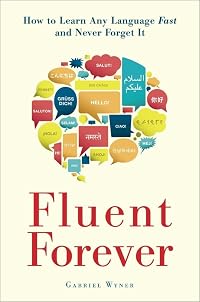
Fluent Forever: How to Learn Any Language Fast and Never Forget It
by Gabriel Wyner
On This Page
Description
NATIONAL BESTSELLER • For anyone who wants to learn a foreign language, this is the method that will finally make the words stick.“A brilliant and thoroughly modern guide to learning new languages.”—Gary Marcus, cognitive psychologist and author of the New York Times bestseller Guitar Zero
At thirty years old, Gabriel Wyner speaks six languages fluently. He didn’t learn them in school—who does? Rather, he learned them in the past few years, working on his own and show more practicing on the subway, using simple techniques and free online resources—and here he wants to show others what he’s discovered.
Starting with pronunciation, you’ll learn how to rewire your ears and turn foreign sounds into familiar sounds. You’ll retrain your tongue to produce those sounds accurately, using tricks from opera singers and actors. Next, you’ll begin to tackle words, and connect sounds and spellings to imagery rather than translations, which will enable you to think in a foreign language. And with the help of sophisticated spaced-repetition techniques, you’ll be able to memorize hundreds of words a month in minutes every day.
This is brain hacking at its most exciting, taking what we know about neuroscience and linguistics and using it to create the most efficient and enjoyable way to learn a foreign language in the spare minutes of your day. show less
Tags
Recommendations



Member Reviews
Gabriel Wyner is a polyglot who created fluent-forever.com, one of the most popular blog available when it comes to foreign language learning. His journey is interesting because, typically, he failed to learn any language at school, yet, being an opera singer, he later in life had to learn Italian, French, German, and Russian; which he did, successfully, using his own method! 'Fluent Forever' is an outline of this method, focusing particularly on memory - how to remember efficiently the load of vocabulary and grammar coming with learning another language.
'I am going to show you how to stop forgetting, so you can get to the actual game. And I am going to show you what to remember, so that once you start playing the game, you're good at show more it.'
His main trick (making flash cards and learning from them) might not seem revolutionary or surprising to whose used to learn efficiently. Indeed, the Spaced Repetition System based on recalling he is relying upon is far from new. For example, a variant has been successfully and famously been developed by Pimsleur. However, what sets him apart is his approach regarding how to make and use such flashcards depending on your level, putting a strong emphasis on personal multi-sensory experience. It might sounds odd, and the process of making such cards even dull and daunting, but it actually does fit in very well with our understanding of how the human brain works regarding memory, as he also takes the time to illustrate here in a very accessible way.
I have to admit, I personally haven't done much out of this book; as my own personal methods (relying on words and sounds alone) has been efficient enough for myself so far. However, who knows? Maybe his, involving images as well, will be of interest to you personally? After all, there is no miracle recipe to being a successful language learner. As he rightly puts it, it means, ultimately, taking control of your own learning journey by appropriating yourself your target language:
'One of the reasons why language programs and classes fail is that no one can give you a language; you have to take it for yourself. You are rewiring your own brain. To succeed, you need to actively participate. Each words in your language needs to become your word, each grammar rule your grammar rule.'
So give it a go! There's no harm in trying. Besides, beyond flashcards alone, his other tips are actually very relevant and useful. They range from tricks of actors and singers to help pronunciation (again, he's an opera singer) to the use of self-directed writing to develop fluency. Fun, witty, it also is a pleasure to go through, although very repetitive.
All in all then, here's a nice practical guide to learn fast and efficiently. Whether you feel motivated enough to make and use flashcards as he recommends is your own choice. Like it or not, spaced repetitions remains, however, the best way to learn. Recommended! show less
'I am going to show you how to stop forgetting, so you can get to the actual game. And I am going to show you what to remember, so that once you start playing the game, you're good at show more it.'
His main trick (making flash cards and learning from them) might not seem revolutionary or surprising to whose used to learn efficiently. Indeed, the Spaced Repetition System based on recalling he is relying upon is far from new. For example, a variant has been successfully and famously been developed by Pimsleur. However, what sets him apart is his approach regarding how to make and use such flashcards depending on your level, putting a strong emphasis on personal multi-sensory experience. It might sounds odd, and the process of making such cards even dull and daunting, but it actually does fit in very well with our understanding of how the human brain works regarding memory, as he also takes the time to illustrate here in a very accessible way.
I have to admit, I personally haven't done much out of this book; as my own personal methods (relying on words and sounds alone) has been efficient enough for myself so far. However, who knows? Maybe his, involving images as well, will be of interest to you personally? After all, there is no miracle recipe to being a successful language learner. As he rightly puts it, it means, ultimately, taking control of your own learning journey by appropriating yourself your target language:
'One of the reasons why language programs and classes fail is that no one can give you a language; you have to take it for yourself. You are rewiring your own brain. To succeed, you need to actively participate. Each words in your language needs to become your word, each grammar rule your grammar rule.'
So give it a go! There's no harm in trying. Besides, beyond flashcards alone, his other tips are actually very relevant and useful. They range from tricks of actors and singers to help pronunciation (again, he's an opera singer) to the use of self-directed writing to develop fluency. Fun, witty, it also is a pleasure to go through, although very repetitive.
All in all then, here's a nice practical guide to learn fast and efficiently. Whether you feel motivated enough to make and use flashcards as he recommends is your own choice. Like it or not, spaced repetitions remains, however, the best way to learn. Recommended! show less
Some genuinely good advice, tips, and tricks.
A little boasting, but not over the top as long as you don't try to compare yourself to the (apparent) wunderkind at languages the author is.
A little bit of selling what you can buy from his web store.
A lot of wordiness/filler—I guess that's par when trying to "thicken" a book for sale.
A bit cart-before-the-horse in organization ... the fact that earlier chapters needed clickable links (I read an ebook version) to later chapters kinda drives that point home.
In the end, I think it is worth reading if you're starting on a language. It's another set of tools you can decide to use or not based upon how they fit you. Personally, I like a lot of them, but then I was already using Anki, CI, show more etc., so I was a semi-convert before page 1.
I would have liked a little more content and a little less repetition of theory. Spend more time on building SRS cards for different purposes rather than just showing one type over and over. Discuss whether cloze deletions promote memorizing that "Sentence X + Picture Y" reflexively equals "Word Z" instead of true recall of a concept when you have neither Sentence X nor Picture Y. Delve into the question of whether getting something wrong all the time in early days actually builds some bad brain pathways when it comes to spitting out a sentence in real time; we aren't all little children with thousands of hours of immersion stretching before of us to retool something such as, "No, no, no. Subjunctive here, not what you've said the last 100 times until it's automatic." show less
A little boasting, but not over the top as long as you don't try to compare yourself to the (apparent) wunderkind at languages the author is.
A little bit of selling what you can buy from his web store.
A lot of wordiness/filler—I guess that's par when trying to "thicken" a book for sale.
A bit cart-before-the-horse in organization ... the fact that earlier chapters needed clickable links (I read an ebook version) to later chapters kinda drives that point home.
In the end, I think it is worth reading if you're starting on a language. It's another set of tools you can decide to use or not based upon how they fit you. Personally, I like a lot of them, but then I was already using Anki, CI, show more etc., so I was a semi-convert before page 1.
I would have liked a little more content and a little less repetition of theory. Spend more time on building SRS cards for different purposes rather than just showing one type over and over. Discuss whether cloze deletions promote memorizing that "Sentence X + Picture Y" reflexively equals "Word Z" instead of true recall of a concept when you have neither Sentence X nor Picture Y. Delve into the question of whether getting something wrong all the time in early days actually builds some bad brain pathways when it comes to spitting out a sentence in real time; we aren't all little children with thousands of hours of immersion stretching before of us to retool something such as, "No, no, no. Subjunctive here, not what you've said the last 100 times until it's automatic." show less
My family (two adults, an elementary-school aged child, and a toddler) is learning French together. I read this book looking less for A System (which it certainly offers, but not one that could suit a mixed-age group like mine, it's very much aimed at adults) than for new ideas I could borrow and perhaps further context about how language learning works. I found the book very helpful and thought-provoking. I've even been won over by the author's huge enthusiasm about Anki and am trying it for my personal studies.
Very clear and readable.
Very clear and readable.
One can probably just read through all the posts on fluent-forever.com and forgo the book. In the end, I rather enjoyed Wyner's writing style and found his explanation of the no-translation method of language learning inspiring.
As a professional linguist (first in academia, then in industry), I know a little something about language pedagogy and how languages work. Nevertheless, it seems I'm a sucker for any sources that claim to have tips for making language learning more effective. I can't resist browsing through them to see if I might find a new tip I haven't heard of before, and 99% of the time, I'm disappointed.
This book pleasantly surprised me: it does contain some techniques I haven't heard of before. A lot of it was old news for me (learn high-frequency words first, pay attention to pronunciation, etc.) and much of it is an advertisement for spaced repetition, but there are some more novel tips here that really show promise. I love the author's idea show more for learning grammatical gender/noun class! (Hint: make it visual to help remember it.) Simple but effective, and he presents good ideas for making visual aids for even the function words with abstract meanings that are often difficult to visualize. (What image would you use for "the", for example?)
I did find the organization of the book a bit strange, but if you're willing to jump around and grab the bits that are useful to you, I think it could be very helpful. show less
This book pleasantly surprised me: it does contain some techniques I haven't heard of before. A lot of it was old news for me (learn high-frequency words first, pay attention to pronunciation, etc.) and much of it is an advertisement for spaced repetition, but there are some more novel tips here that really show promise. I love the author's idea show more for learning grammatical gender/noun class! (Hint: make it visual to help remember it.) Simple but effective, and he presents good ideas for making visual aids for even the function words with abstract meanings that are often difficult to visualize. (What image would you use for "the", for example?)
I did find the organization of the book a bit strange, but if you're willing to jump around and grab the bits that are useful to you, I think it could be very helpful. show less
good book. I’m trying to learn a language that does not have many resources. A lot if his suggestions expected that either he has created resources for the language, on his pay garden website, or that there are plentiful resources out there. Not with the language I want to learn ( a Native American language)… but even without the ready resources there are really good ideas in this book to help you know what kinda of thing you *could* be doing… so its possible to think about how to creat your own resources for practice.
Good book -I’ll probably continue to use it as a reference
Good book -I’ll probably continue to use it as a reference
Lots of useful information and tips interspersed throughout way too much information about the author and his semi-related experiences. This book really didn't need to exist IMO because what he writes in here is basically available on his website (and now via the accompanying app as well). Unfortunately, I had no idea there was a website or app until I'd already purchased this book.
Probably the main takeaway here is to start using an SRS - spaced repetition system. If you're not familiar, it's basically fancy flash cards in a program (such as Anki) that, as you review, you see how difficult it is for you to recall information. Based on that, it will show you certain flash cards a set amount of time later when you're about to forget show more that info. By recalling it at that point, it supposedly gives a big boost to your long term memory and therefore fluency.
About half of the physical book is the actual book. The other half is a "toolbox" with very helpful tips for setting up your flash cards and vocab suggestions, and several appendices with general language learning tips and resources. I almost bumped the rating up to a 4 instead of 3 for this back half alone, but so much of this is available for free if you know where to look (I'm new to language learning outside of a school setting so I didn't).
This isn't a *bad* book and I appreciate the work the author has done here. Given the praise it receives, I guess I was just expecting more unique language learning insights from him and less of a recap of how SRS works. show less
Probably the main takeaway here is to start using an SRS - spaced repetition system. If you're not familiar, it's basically fancy flash cards in a program (such as Anki) that, as you review, you see how difficult it is for you to recall information. Based on that, it will show you certain flash cards a set amount of time later when you're about to forget show more that info. By recalling it at that point, it supposedly gives a big boost to your long term memory and therefore fluency.
About half of the physical book is the actual book. The other half is a "toolbox" with very helpful tips for setting up your flash cards and vocab suggestions, and several appendices with general language learning tips and resources. I almost bumped the rating up to a 4 instead of 3 for this back half alone, but so much of this is available for free if you know where to look (I'm new to language learning outside of a school setting so I didn't).
This isn't a *bad* book and I appreciate the work the author has done here. Given the praise it receives, I guess I was just expecting more unique language learning insights from him and less of a recap of how SRS works. show less
Members
- Recently Added By
Lists

Recommendations for Ezra
12 works; 1 member

Penguin Random House
458 works; 4 members
Author Information

4 Works 1,224 Members
Gabriel Wyner graduated summa cum laude at USC, where he won the school's Renaissance Award. His essay on language learning for Lifehaeker.com was one of the site's most read. His own language learning website. Fluent-Forever.com, is among the world's top ten.
Common Knowledge
- Canonical title
- Fluent Forever: How to Learn Any Language Fast and Never Forget It
- Original title
- Fluent Forever : How to Learn Any Language Fast and Never Forget It
- Alternate titles
- How to learn any language fast and never forget it
- Original publication date
- 2014-08-05
- Dedication*
- Voor alle taalavonturiers
- Original language*
- Engels
*Some information comes from Common Knowledge in other languages. Click "Edit" for more information.
Classifications
- Genres
- Nonfiction, General Nonfiction
- DDC/MDS
- 418.0071 — Language Linguistics Applied linguistics modified standard subdivisions and translating modified standard subdivisions Education, research, related topics Education; Second language teaching
- LCC
- P53.4115 .W96 — Language and Literature Philology. Linguistics General
- BISAC
Statistics
- Members
- 1,222
- Popularity
- 20,296
- Reviews
- 24
- Rating
- (4.01)
- Languages
- Czech, Dutch, English, Italian
- Media
- Paper, Audiobook, Ebook
- ISBNs
- 13
- ASINs
- 6