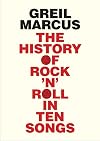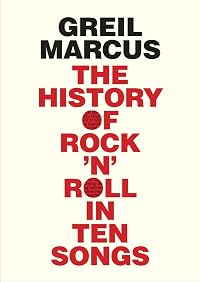
The History of Rock 'n' Roll in Ten Songs
by Greil Marcus
On This Page
Description
Selects ten songs recorded between 1956 and 2008 that embody rock and roll as a thing in itself--in the story each song tells, inhabits, and creates in its legacy.Tags
Recommendations











Member Reviews
Ringo Starr isn't in the R&R Hall of Fame as an individual? Who do I write to about that?
The reason I bought this book is the narrator, Henry Rollins. I'm not a fan of punk music, so I didn't know him from the band Black Flag (and – sorry, darlin' – still not a fan). My introduction to him was the History Channel's series Ten Things You Don't Know About. I started watching it because I took it as a challenge (I don't know these things? Yeah? Try me.)(They were often right.) I kept watching the show because he is awesome. There is nothing more attractive – in every sense of the word – than honest enthusiasm, and Henry has that by the truckload: he is genuinely, passionately, intelligently enthralled by US history. And it's show more marvelous. Watch the episode on presidential assassinations: his eyes are on fire, and his voice rises – he is honestly angry. I love it. I've become very fond indeed of Henry Rollins, a little to my surprise, and whither he goest and all that. (Except for his music. Sorry.)
If you can get past the introduction of this book, you should breeze through the rest. In that intro there is a six page sentence, and a lengthy roll call. It grows a bit tedious.
It's a bit odd; I followed along with the book on YouTube, looking for all the performances cited. (And they made me go watch Kelly Clarkson singing at the second Obama inauguration. Damn, girl.) And some of the conjunctions between the descriptions and the realities (or at least the videos of the realities) didn't always quite jibe, or in some cases a disconnect between his thinking and mine. A band that reunites for PBS is described as "all bald" – but one wears a hat throughout all the video I saw. Well, maybe he takes it off in later footage. Then the description of Beyonce at Obama's inauguration doesn't match footage (and boy does the author not like Beyonce). In "Money (that's what I want)", I definitely don't hear what the author hears. Maybe music interpretation and review is just not my forte. I know I would never have chosen to describe a song as "...A crawling version of Viva Las Vegas by Shawn Colvin singing as a hooker just after being pushed down the stairs from an escort service to the street."
But I learned a lot. The relationship between Bing Crosby and Robert Johnson was unexpected and kind of awesome. I watched videos and listened to songs I might not otherwise have sampled – the Flamin Groovies? Not my cuppa. And again I didn't always see what the author was talking about as he spoke about what he pulled from the videos.
One thing I absolutely did see eye to eye with him about: "Why is happiness considered shallow and worthless? Why does it have to be all about pain and loss?" I have always wondered that. All forms of art seems to abide by that philosophy: without conflict and pain there is nothing worth talking about. But every now and then isn't it nice to just celebrate?
But - seriously? No Ringo? I'm appalled. show less
The reason I bought this book is the narrator, Henry Rollins. I'm not a fan of punk music, so I didn't know him from the band Black Flag (and – sorry, darlin' – still not a fan). My introduction to him was the History Channel's series Ten Things You Don't Know About. I started watching it because I took it as a challenge (I don't know these things? Yeah? Try me.)(They were often right.) I kept watching the show because he is awesome. There is nothing more attractive – in every sense of the word – than honest enthusiasm, and Henry has that by the truckload: he is genuinely, passionately, intelligently enthralled by US history. And it's show more marvelous. Watch the episode on presidential assassinations: his eyes are on fire, and his voice rises – he is honestly angry. I love it. I've become very fond indeed of Henry Rollins, a little to my surprise, and whither he goest and all that. (Except for his music. Sorry.)
If you can get past the introduction of this book, you should breeze through the rest. In that intro there is a six page sentence, and a lengthy roll call. It grows a bit tedious.
It's a bit odd; I followed along with the book on YouTube, looking for all the performances cited. (And they made me go watch Kelly Clarkson singing at the second Obama inauguration. Damn, girl.) And some of the conjunctions between the descriptions and the realities (or at least the videos of the realities) didn't always quite jibe, or in some cases a disconnect between his thinking and mine. A band that reunites for PBS is described as "all bald" – but one wears a hat throughout all the video I saw. Well, maybe he takes it off in later footage. Then the description of Beyonce at Obama's inauguration doesn't match footage (and boy does the author not like Beyonce). In "Money (that's what I want)", I definitely don't hear what the author hears. Maybe music interpretation and review is just not my forte. I know I would never have chosen to describe a song as "...A crawling version of Viva Las Vegas by Shawn Colvin singing as a hooker just after being pushed down the stairs from an escort service to the street."
But I learned a lot. The relationship between Bing Crosby and Robert Johnson was unexpected and kind of awesome. I watched videos and listened to songs I might not otherwise have sampled – the Flamin Groovies? Not my cuppa. And again I didn't always see what the author was talking about as he spoke about what he pulled from the videos.
One thing I absolutely did see eye to eye with him about: "Why is happiness considered shallow and worthless? Why does it have to be all about pain and loss?" I have always wondered that. All forms of art seems to abide by that philosophy: without conflict and pain there is nothing worth talking about. But every now and then isn't it nice to just celebrate?
But - seriously? No Ringo? I'm appalled. show less
4.5 stars
What a fun ride!
I actually listened to this on Audible, read by Henry Rollins. There are a few extras at the end - Henry's thoughts on a couple of the chapters, and an interview of the author by Henry. It's always fun to hear a fan get excited and geek out with you.
This book is so much more than 10 songs, and so much more than a history of rock 'n roll. Marcus refers to hundreds of artists (naming all the inductees in the Rock n Roll Hall of Fame in the beginning), hundreds of songs, books, movies, and pivotal cultural flashpoints, weaving them all together to tell the history of the 20th century, really. Covering race, the rise of the teenager, class divides, the commoditization of music versus the purity of the poets and show more troubadours, this story sprawls through the heartland, up and down the Mississippi, from the beaches of Southern California to Tin Pan Alley and Harlem, across the pond to the Brits taking this artform in their own directions, and bringing it back across to the States. From the blues, through doo-wop, to post-punk, with nods to just about everything in between, Marcus covers it all, not just a mere 10 ditties that would comprise about an hour of listening time.
And he does so with poetic grace that does justice to the art he is describing. It is difficult to write about any art - the point, after all, is to see it, hear it, read it yourself, and form your own interpretation. You run the risk of sounding pretentious & coming off maudlin at every turn. It can be a trap. But Marcus avoids the snares along the way, leading you safely to heights from which you can see the beautiful vastness the music has travelled.
Marcus's choice of songs seems odd at first blush. Some are flat-out obscure in the great canon of rock 'n roll; others are by well-known artists, with catalogs of better-known hits. But put yourself in Marcus's capable hands - he knows of what he speaks.
On a personal note: My favorite chapters are the examinations of In the Still of the Night, Money Changes Everything, and Transmission.
The only complaints I have are specific to the audio version. First, the HOF roll call is long - over 6 minutes long. Listening to it read aloud was tedious and I had to skip ahead, like I would have if I was reading. Second, listening to this as an audiobook, it would have been a nice accompaniment to hear the tracks playing in the background. But these are really small, nitpicky things, I know.
If you have any interest in music and the way it ties us together, pick up this book, and enjoy it. show less
What a fun ride!
I actually listened to this on Audible, read by Henry Rollins. There are a few extras at the end - Henry's thoughts on a couple of the chapters, and an interview of the author by Henry. It's always fun to hear a fan get excited and geek out with you.
This book is so much more than 10 songs, and so much more than a history of rock 'n roll. Marcus refers to hundreds of artists (naming all the inductees in the Rock n Roll Hall of Fame in the beginning), hundreds of songs, books, movies, and pivotal cultural flashpoints, weaving them all together to tell the history of the 20th century, really. Covering race, the rise of the teenager, class divides, the commoditization of music versus the purity of the poets and show more troubadours, this story sprawls through the heartland, up and down the Mississippi, from the beaches of Southern California to Tin Pan Alley and Harlem, across the pond to the Brits taking this artform in their own directions, and bringing it back across to the States. From the blues, through doo-wop, to post-punk, with nods to just about everything in between, Marcus covers it all, not just a mere 10 ditties that would comprise about an hour of listening time.
And he does so with poetic grace that does justice to the art he is describing. It is difficult to write about any art - the point, after all, is to see it, hear it, read it yourself, and form your own interpretation. You run the risk of sounding pretentious & coming off maudlin at every turn. It can be a trap. But Marcus avoids the snares along the way, leading you safely to heights from which you can see the beautiful vastness the music has travelled.
Marcus's choice of songs seems odd at first blush. Some are flat-out obscure in the great canon of rock 'n roll; others are by well-known artists, with catalogs of better-known hits. But put yourself in Marcus's capable hands - he knows of what he speaks.
On a personal note: My favorite chapters are the examinations of In the Still of the Night, Money Changes Everything, and Transmission.
The only complaints I have are specific to the audio version. First, the HOF roll call is long - over 6 minutes long. Listening to it read aloud was tedious and I had to skip ahead, like I would have if I was reading. Second, listening to this as an audiobook, it would have been a nice accompaniment to hear the tracks playing in the background. But these are really small, nitpicky things, I know.
If you have any interest in music and the way it ties us together, pick up this book, and enjoy it. show less
Pick a song—any song
The History of Rock’n’Roll in Ten Songs by Greil Marcus (Yale University Press, $28).
While these are ten most excellent songs, in legendary music writer Greil Marcus’s hands any ten songs would probably do just as well. At least, that’s the sense one gets while reading The History of Rock’n’Roll in Ten Songs is Marcus’s long essay on the nature of rock itself. Oh, they’d need to be fairlygood songs, of course, with staying power, but when it comes to rock and pop, that’s not even such a high bar.
Marcus uses as an organizing principle for this survey of rock’s cultural history this quote from Neil Young: “Rock’n’roll is reckless abandon.” While some of the songs he chooses might seem to show more belie that statement—the Teddy Bears’ “To Know Him Is to Love Him,” for example—by the time Marcus is finished tracing the song’s trajectory through the dark Amy Winehouse cover, we see what he means.
What difference does it make if Etta James is singing “All I Could Do Was Cry,” or Beyoncé is? All the difference in the world, at least as far as the history of music is concerned.
And Marcus is big on following the musical genealogy of songs; it’s not just the original recording, it’s everything that came after. He helps us see that reception, covers, other uses (whether commercials or films) all combine to create a song’s legacy—and that ties in with the legacy of rock’n’roll in its entirety.
And that is why Greil Marcus is the premiere historian of rock’n’roll.
Reviewed on Lit/Rant: www.litrant.tumblr.com show less
The History of Rock’n’Roll in Ten Songs by Greil Marcus (Yale University Press, $28).
While these are ten most excellent songs, in legendary music writer Greil Marcus’s hands any ten songs would probably do just as well. At least, that’s the sense one gets while reading The History of Rock’n’Roll in Ten Songs is Marcus’s long essay on the nature of rock itself. Oh, they’d need to be fairlygood songs, of course, with staying power, but when it comes to rock and pop, that’s not even such a high bar.
Marcus uses as an organizing principle for this survey of rock’s cultural history this quote from Neil Young: “Rock’n’roll is reckless abandon.” While some of the songs he chooses might seem to show more belie that statement—the Teddy Bears’ “To Know Him Is to Love Him,” for example—by the time Marcus is finished tracing the song’s trajectory through the dark Amy Winehouse cover, we see what he means.
What difference does it make if Etta James is singing “All I Could Do Was Cry,” or Beyoncé is? All the difference in the world, at least as far as the history of music is concerned.
And Marcus is big on following the musical genealogy of songs; it’s not just the original recording, it’s everything that came after. He helps us see that reception, covers, other uses (whether commercials or films) all combine to create a song’s legacy—and that ties in with the legacy of rock’n’roll in its entirety.
And that is why Greil Marcus is the premiere historian of rock’n’roll.
Reviewed on Lit/Rant: www.litrant.tumblr.com show less
If you decide to read the Greil Marcus book, The History of Rock 'n' Roll in Ten Songs, I recommend the Audible Audio edition reverently and avidly red by Henry Rollins with over a half hour of added audio content. (Pause the audio book to listen to each song off a recording, please.) The additional content is a preface and afterward by Rollins on why he wanted to read and narrate the book and Rollins interviewing Marcus for a half hour. On selecting representative songs for that book, Marcus says, “I wanted to leave out everybody that you can't leave out. I wanted to stay away from anything that might be expected, that might be mandatory, that, you know, you have to talk about if you’re writing a history of rock ‘n’ roll." That show more should absolve from from complaints on the material which finds the anti-music industry spark lit by punk in Joy Division's "Transmission", social commentary in Christian Marclay's Guitar Drag while finding pivotal moments with more obvious points with Phil Spector, The Beatles, Ellie Greenwich, and more. This is all good, insightful, daring and enlightening. Why Greil the imagined biographies like Robert Johnson living to Obama's inauguration? I would rather have facts and insight, without the fiction. show less
Interesting choices, great writing & music history. For dedicated rock music & rock writing lovers. Read it with utube nearby; your own collection will fail you.
sample was enough
Members
- Recently Added By
Lists

Books Read By artturnerjr - 2015
27 works; 1 member
Author Information

41+ Works 5,649 Members
Greil Marcus is the author of "Invisible Republic," "Dead Elvis," "Lipstick Traces," & "Mystery Train." His pieces have appeared in a wide range of publications, including "Artforum," "Interview," "The New Yorker," "The New York Times," & "Esquire." He will be teaching at Princeton & Berkeley in fall 2000. (Publisher Provided) Greil Marcus was show more born in San Francisco, California in 1945. He received an undergraduate degree in American studies from the University of California, Berkeley. He has been a rock critic and columnist for Rolling Stone, Creem, The Village Voice, Artforum, and other publications. He has written several books including Mystery Train: Images of America in Rock 'n' Roll Music, Lipstick Traces: A Secret History of the 20th Century, Dead Elvis: A Chronicle of a Cultural Obsession, and When That Rough God Goes Riding: Listening to Van Morrison. (Bowker Author Biography) show less
Awards and Honors
Common Knowledge
- Canonical title*
- Storia del rock in dieci canzoni
- Original title
- The History of Rock 'n' Roll in Ten Songs
- Original publication date
- 2014
*Some information comes from Common Knowledge in other languages. Click "Edit" for more information.
Classifications
- Genres
- Music, Nonfiction, General Nonfiction, History
- DDC/MDS
- 782.4216609 — Arts & recreation Music Vocal music Secular forms of vocal music Songs General principles and musical forms Traditions of secular songs {genres} Rock songs modified standard subdivisions History, geographic treatment, biography
- LCC
- ML3534 .M356 — Music Literature on music Literature on music History and criticism Popular music
- BISAC
Statistics
- Members
- 222
- Popularity
- 146,596
- Reviews
- 7
- Rating
- (3.53)
- Languages
- English, German, Italian, Spanish
- Media
- Paper, Audiobook, Ebook
- ISBNs
- 7
- UPCs
- 1
- ASINs
- 2