
Greil Marcus
Author of Lipstick Traces: A Secret History of the Twentieth Century
About the Author
Greil Marcus is the author of "Invisible Republic," "Dead Elvis," "Lipstick Traces," & "Mystery Train." His pieces have appeared in a wide range of publications, including "Artforum," "Interview," "The New Yorker," "The New York Times," & "Esquire." He will be teaching at Princeton & Berkeley in show more fall 2000. (Publisher Provided) Greil Marcus was born in San Francisco, California in 1945. He received an undergraduate degree in American studies from the University of California, Berkeley. He has been a rock critic and columnist for Rolling Stone, Creem, The Village Voice, Artforum, and other publications. He has written several books including Mystery Train: Images of America in Rock 'n' Roll Music, Lipstick Traces: A Secret History of the 20th Century, Dead Elvis: A Chronicle of a Cultural Obsession, and When That Rough God Goes Riding: Listening to Van Morrison. (Bowker Author Biography) show less
Image credit: Experience Music Project Pop Conference, April 30, 2006.
Photo by Joe Mabel.
(Wikipedia)
Photo by Joe Mabel.
(Wikipedia)
Works by Greil Marcus
Associated Works
Designing Disney's Theme Parks: The Architecture of Reassurance (1997) — Contributor — 207 copies, 1 review
The Rolling Stone Book of the Beats: The Beat Generation and American Culture (1999) — Contributor — 181 copies, 2 reviews
The Dylan Companion: A Collection of Essential Writing About Bob Dylan (1990) — Contributor, some editions — 103 copies
The Basement Tapes Complete: The Bootleg Series, Vol. 11 [sound recording] (1975) — Liner Notes, some editions — 88 copies
Mid-life Confidential: The Rock Bottom Remainders Tour America with Three Chords and an Attitude (1994) — Contributor — 75 copies, 4 reviews
The Free Speech Movement: Reflections on Berkeley in the 1960s (2002) — Contributor — 45 copies, 1 review
Another Self Portrait (1969-1971) (The Bootleg Series Volume 10) (2013) — Liner Notes — 27 copies, 1 review
Tagged
Common Knowledge
- Canonical name
- Marcus, Greil
- Birthdate
- 1945-06-19
- Gender
- male
- Education
- University of California, Berkeley (BA | American Studies)
- Occupations
- magazine editor
cultural critic
music critic - Nationality
- USA
- Birthplace
- San Francisco, California, USA
- Places of residence
- San Francisco, California, USA
- Associated Place (for map)
- San Francisco, California, USA
Members
Reviews

Greil Marcus simultaneously invented and ruined rock criticism. He suffuses his work with literary references (Moby Dick, John Bunyan, et al), humor, and a depth of emotion that makes it both beautiful and gritty. His style is inimitable, and yet he has countless imitators who wish they could write like him, who possess neither his insight nor his instinct, and just end up writing boring pieces that sound like they are trying too hard.
But he cannot and should not be blamed for his imitators. show more Mystery Train is an American classic. I will be poring over the appendix and the discographies (twice as long as the actual book) for weeks to come. show less
But he cannot and should not be blamed for his imitators. show more Mystery Train is an American classic. I will be poring over the appendix and the discographies (twice as long as the actual book) for weeks to come. show less
Lipstick Traces: A Secret History of the Twentieth Century, Twentieth Anniversary Edition by Greil Marcus
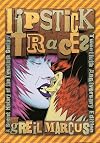
“The music came forth as a no that became a yes, then a no again, then again a yes:” and then the drums kicked in and “nothing is true except our conviction that the world we are asked to accept is false. If nothing is true, everything is possible.” (9)
Welcome to Lipstick Traces: A Secret History of the Twentieth Century, Greil Marcus’s collage-o-phonic booklike substance that rings with voices in a thousand registers.
“As I tried to follow this story [the one he perceives running show more through chapters filled with medieval heretics, Dadaists, Situationists, and the Sex Pistols: “I am an anti-christ,” sang Johnny Rotten]–the characters changing into each other’s clothes until I gave up trying to make them hold still–what appealed to me were its gaps. and those moments when the story that has lost its voice somehow recovers it, and what happens then…. [quoting an ad for Potlatch he found in a “slick-paper, Belgian neo-surrealist review” dated 1954:] ” ‘Everywhere, youth (as it calls itself) discovers a few blunted knives, a few defused bombs, under thirty years of dust and debris; shaking in its shoes, youth hurls them upon the consenting rabble, which salutes it with its oily laugh.’ ” (20)
Situationist gnome, 1963: “The moment of real poetry brings all the unsettled debts of history back into play.” (21) That’s getting personal: I’ve resisted reading this book for twenty years. Now that I have, and since you’ve read this far, I recommend you do, too. So much for the niceties of the book review. What follows is engagement with Lipstick Traces.
“For years that seemed like decades,” Marcus accurately notes, all you got on the radio was “Fire and Rain, “Stairway to Heaven,” “Behind Blue Eyes” and “Maggie May.” (44) That, and then one day in the 1980s, the music we heard on the radio in the 1970s became classic rock.
Everybody who gives a shit caps on Greil Marcus for what they perceive as a slight or jab at their own history of punk because he starts with the Sex Pistols. But, as he says, “If what is interesting about punk is something other than its function as a musical genre, there is no point in treating it like one.” (77) The whole point is the impossibility of pinpointing the origins of popular cultural phenomena: such things are subject to “blind inheritance,” presumably via memes floating in our shared mental marketplace, as punk inherited from British folk rocker Richard Thompson: “Take the sun from my heart / Let me learn to despise.”
Reading the film Five Millions Years to Earth, “a film make in England in 1967 under the title Quartermass and the Pitt” (80), Marcus writes:
They [the genocidal Martians] meant to perpetuate themselves on earth by making its history–by coding its end in its beginning. A passion for prophecy, it seems, is also a Martian trait: they loved drama as much as death. (81)
And of course it would be impossible to write a “secret history” of the 20th century without including Martians and Cro-Magnons, both of which are present at least in passing.
Really, though, Marcus is writing about “Spectacle,” and its as if he’s wrestling with a ghost or a being made of smoke: the ideas swirl and often slip away from him for pages at a time. The term ‘Spectacle’ had become a fashionable critical commonplace by the 1980s. It was a vague term, devoid of ideas. It simply meant that the image of a thing superseded the thing itself. Thus, “Rambo movies in the U.S.A. could win the Vietnam War backward, that consumers were being seduced by advertisement instead of choosing rationally among products” and “that citizens were voting for actors rather than issues.” In other words, something funny is happening in Lipstick Traces, though it never is exactly clear because Marcus is absolutely subject to epistemological uncertainty if for no other reason than a) not being there personally and b) eyewitness aren’t worth shit but you talk to them anyway.
For situationist Guy Debord, the spectacle was not merely a stoner-paranoid “collection of images, but a social relationship among people, mediated by images.” The spectacle really is a conspiracy of relationships that kept empires running (if rising and falling) just as an engine is a conspiracy of relationships that moves things down the road. The sense of going somewhere is just an illusion, though, as what spectacle gives spectacle also takes away: Anwar Sadat, for instance, “was a [spectacular] hero of the electronic revolution, but also its [spectacularly assassinated] victim.” (97)
But the other side of spectacle is seen in a point made by situationist Veneigem, where “objectivity… meant ‘I love that girl because she is beautiful’; subjectivity meant ‘That girl is beautiful because I love her.’” Such is the power of spectacle that it bends us most certainly to its cultural will but also gives us the power to believe we are able to bend the social fabric our way, and to desire “something different from everyone else.”
Capitalism benefits most from, is powered by, spectacle – and that makes it tricky business, “dangerous,” perhaps criminal. For the situationists, there was a double-edged sword in the thought that “comfort will never be comfortable enough for those who seek what is not on the market.” Therefore, Debord said years later, “Where there was fire, we carried gasoline.”
Punk and the rest of the major phenomena Marcus writes about in Lipstick Traces are basically forms of Sinopean skepticism. Diagnose of Sinope, like punks and situationists, the medieval Japanese poet Ikkyu and Chuang Tzu the aimless wanderer, refused to work, taking up sacred peregrination and (as Diagnose replied when asked what he was doing in Athens) “debasing the currency.”
The situationists practiced the dérive, the art of drifting lost through the streets, seeking “the Northwest passage” of a city, Paris most especially for years on end in the case of Guy Debord. Though they despised surrealism and especially its pope, André Breton, the situationists in their wanderings partook of the surrealists’ disponibilité, a state of existential availability – to anything, everything – an attitude of creative readiness and perpetual resistance to “the Society of the Spectacle.” As William S. Burroughs once said in a parallel context, Spectacle is a “vampiric process;” Burroughs advised resistance through the cultivation of good character.
The situationists, like the punks, “debased the currency”: punk “music” was (per the cliché) an oxymoron: those motherfuckers can’t play. The situations took “official” publications (cartoons that ran in newspapers were a popular target) and practiced détournment, doctoring texts or, like Burroughs, cutting up newspapers and magazines, then pasting them back together at will to new effect. Rock and punk designers took the technique as a signature for gig flyers.
For what if you really could warp reality? What if, through design, you could get people to come to a band’s show and drink too much? Wasn’t that, after all, the goal of every revolutionist? “What if you could really make it happen?” What if the man dreaming he was a butterfly woke up, finding himself a butterfly?
“The spectacle was itself a work of art, an economy of false needs elevated into a tableau of frozen desires, true desires reduced to a cartoon of twitching needs. Spreading the bad paper of détournment until it began to turn up everywhere, the SI [Situationist International] would devalue the currency of the spectacle, and the results would be total inflation.” (168)
As if; but somebody had to try.
Another technique for discovering “psychogeographic” highways and byways, methods for invoking the derive, include “gramologues’ or magical floating words and resonant sounds [that]… are irresistibly and hypnotically engraved on the memory, and they emerge again from the memory with just a little resistance and friction.” (206) Notice that gramologues don’t preclude semantic content and thus include a variety of gnomic utterances we call “catchy phrase”: tag lines, mottos and all manner of cursing would be included here. Gnomic utterances are noted for their suasive power as noted in their deployment in all campaigns of propaganda.
And that in turn points out the danger that rears its head occasionally throughout Marcus’s book: The danger is, per Nietzsche’s warning, that in fighting a monster one risks becoming one. (203) For capitalism and the spectacle are quite adept at détouring the détourners; after all, the practitioners (photographers, designers, writers) are ultimately the same people. Every dropout who tunes in while turning on others must also make a living, and PR is the default calling of every out-of-work revolutionary in need of a paycheck.
Then there’s the psychiatrists, also known as those who play both ends against the middle, who say (these are Richard Huelsenbeck the dadaist’s words, circa 1920 long after he’d switched practices): “Do you understand? We are psychiatrists; we are Germans; we have read Nietzsche; we know that to gaze too long at monsters is to become one – that’s what we get paid for!” (211) Huelsenbeck was always saying, “The dadaist is a man of reality who loves wine, women and advertising.” (213)
The punks couldn’t help but love the gramologues of advertising, even if they hated them, too, rejected their authority, and repelled them with taut fiber, venom and erosive sonic armies. They were born into an unavoidable and irresistible media milieu, so the only strategy left was to détourne the meaning of images of the spectacle: flyers for punk shows still stand as exemplars of graphic design.
The plasticity of meaning is why controlling it matters so much – to the dadaists, the lettrists, the situationists, the punks – who gets to words and gramologues first, who controls the language. Before Dada, there was an ad for Dada Shampoo. (213) And that’s why so many of marks of social identity are rallying cries: paralinguistic, animalistic, and naively musical – catchy, memorable, amusing, provoking things that work especially well when there are crowds of people willing to be entrained. And that’s why the punks stripped playing music down to its pragmatically emotional essentials: one is either wailing in pain or in ecstasy: “you only had to tell the right story, and turn up the volume.” (362)
“Dada!”
The potential energy of the individual in the crowd inspired Debord to remark, “the future belongs to the passerby.” Readiness, disponibilité, to make answer to a passing look, to make responsibility out of the flow of anonymity is what distinguishes psychogeography, “the science fiction of urban planning.” (362)
(In his tale of two cities, latter-day science fiction situationist China Miéville takes psychogeography to its logical extreme. The City and the City is a hard-boiled murder investigation in overlapping twin cities whose inhabitants practice cognitive blindness in order not to see across state lines and “unsee” the other side of the street and its passersby. The derive is co-opted by authoritarian ideology through a détournment of cultural norms and social codes.)
We will not be prisoners to the fiction of utility, say the punks through Marcus’s trace detection system. And Marcus is no prisoner to the utility of literary criticism, and so has fun, chews, digresses. (369) With Marcus, we are always at the crossroads, one of the great themes of popular music since about the time people first met up there and had a jam session, “and, instead of passing by with eyes averted,” we pause and recognize that “Now, damn the consequences, we have met,” as D.H. Lawrence put it. (366)
Originally published on Curled Up With A Good Book at www.curledup.com. © Brian Charles Clark, 2010 show less
Welcome to Lipstick Traces: A Secret History of the Twentieth Century, Greil Marcus’s collage-o-phonic booklike substance that rings with voices in a thousand registers.
“As I tried to follow this story [the one he perceives running show more through chapters filled with medieval heretics, Dadaists, Situationists, and the Sex Pistols: “I am an anti-christ,” sang Johnny Rotten]–the characters changing into each other’s clothes until I gave up trying to make them hold still–what appealed to me were its gaps. and those moments when the story that has lost its voice somehow recovers it, and what happens then…. [quoting an ad for Potlatch he found in a “slick-paper, Belgian neo-surrealist review” dated 1954:] ” ‘Everywhere, youth (as it calls itself) discovers a few blunted knives, a few defused bombs, under thirty years of dust and debris; shaking in its shoes, youth hurls them upon the consenting rabble, which salutes it with its oily laugh.’ ” (20)
Situationist gnome, 1963: “The moment of real poetry brings all the unsettled debts of history back into play.” (21) That’s getting personal: I’ve resisted reading this book for twenty years. Now that I have, and since you’ve read this far, I recommend you do, too. So much for the niceties of the book review. What follows is engagement with Lipstick Traces.
“For years that seemed like decades,” Marcus accurately notes, all you got on the radio was “Fire and Rain, “Stairway to Heaven,” “Behind Blue Eyes” and “Maggie May.” (44) That, and then one day in the 1980s, the music we heard on the radio in the 1970s became classic rock.
Everybody who gives a shit caps on Greil Marcus for what they perceive as a slight or jab at their own history of punk because he starts with the Sex Pistols. But, as he says, “If what is interesting about punk is something other than its function as a musical genre, there is no point in treating it like one.” (77) The whole point is the impossibility of pinpointing the origins of popular cultural phenomena: such things are subject to “blind inheritance,” presumably via memes floating in our shared mental marketplace, as punk inherited from British folk rocker Richard Thompson: “Take the sun from my heart / Let me learn to despise.”
Reading the film Five Millions Years to Earth, “a film make in England in 1967 under the title Quartermass and the Pitt” (80), Marcus writes:
They [the genocidal Martians] meant to perpetuate themselves on earth by making its history–by coding its end in its beginning. A passion for prophecy, it seems, is also a Martian trait: they loved drama as much as death. (81)
And of course it would be impossible to write a “secret history” of the 20th century without including Martians and Cro-Magnons, both of which are present at least in passing.
Really, though, Marcus is writing about “Spectacle,” and its as if he’s wrestling with a ghost or a being made of smoke: the ideas swirl and often slip away from him for pages at a time. The term ‘Spectacle’ had become a fashionable critical commonplace by the 1980s. It was a vague term, devoid of ideas. It simply meant that the image of a thing superseded the thing itself. Thus, “Rambo movies in the U.S.A. could win the Vietnam War backward, that consumers were being seduced by advertisement instead of choosing rationally among products” and “that citizens were voting for actors rather than issues.” In other words, something funny is happening in Lipstick Traces, though it never is exactly clear because Marcus is absolutely subject to epistemological uncertainty if for no other reason than a) not being there personally and b) eyewitness aren’t worth shit but you talk to them anyway.
For situationist Guy Debord, the spectacle was not merely a stoner-paranoid “collection of images, but a social relationship among people, mediated by images.” The spectacle really is a conspiracy of relationships that kept empires running (if rising and falling) just as an engine is a conspiracy of relationships that moves things down the road. The sense of going somewhere is just an illusion, though, as what spectacle gives spectacle also takes away: Anwar Sadat, for instance, “was a [spectacular] hero of the electronic revolution, but also its [spectacularly assassinated] victim.” (97)
But the other side of spectacle is seen in a point made by situationist Veneigem, where “objectivity… meant ‘I love that girl because she is beautiful’; subjectivity meant ‘That girl is beautiful because I love her.’” Such is the power of spectacle that it bends us most certainly to its cultural will but also gives us the power to believe we are able to bend the social fabric our way, and to desire “something different from everyone else.”
Capitalism benefits most from, is powered by, spectacle – and that makes it tricky business, “dangerous,” perhaps criminal. For the situationists, there was a double-edged sword in the thought that “comfort will never be comfortable enough for those who seek what is not on the market.” Therefore, Debord said years later, “Where there was fire, we carried gasoline.”
Punk and the rest of the major phenomena Marcus writes about in Lipstick Traces are basically forms of Sinopean skepticism. Diagnose of Sinope, like punks and situationists, the medieval Japanese poet Ikkyu and Chuang Tzu the aimless wanderer, refused to work, taking up sacred peregrination and (as Diagnose replied when asked what he was doing in Athens) “debasing the currency.”
The situationists practiced the dérive, the art of drifting lost through the streets, seeking “the Northwest passage” of a city, Paris most especially for years on end in the case of Guy Debord. Though they despised surrealism and especially its pope, André Breton, the situationists in their wanderings partook of the surrealists’ disponibilité, a state of existential availability – to anything, everything – an attitude of creative readiness and perpetual resistance to “the Society of the Spectacle.” As William S. Burroughs once said in a parallel context, Spectacle is a “vampiric process;” Burroughs advised resistance through the cultivation of good character.
The situationists, like the punks, “debased the currency”: punk “music” was (per the cliché) an oxymoron: those motherfuckers can’t play. The situations took “official” publications (cartoons that ran in newspapers were a popular target) and practiced détournment, doctoring texts or, like Burroughs, cutting up newspapers and magazines, then pasting them back together at will to new effect. Rock and punk designers took the technique as a signature for gig flyers.
For what if you really could warp reality? What if, through design, you could get people to come to a band’s show and drink too much? Wasn’t that, after all, the goal of every revolutionist? “What if you could really make it happen?” What if the man dreaming he was a butterfly woke up, finding himself a butterfly?
“The spectacle was itself a work of art, an economy of false needs elevated into a tableau of frozen desires, true desires reduced to a cartoon of twitching needs. Spreading the bad paper of détournment until it began to turn up everywhere, the SI [Situationist International] would devalue the currency of the spectacle, and the results would be total inflation.” (168)
As if; but somebody had to try.
Another technique for discovering “psychogeographic” highways and byways, methods for invoking the derive, include “gramologues’ or magical floating words and resonant sounds [that]… are irresistibly and hypnotically engraved on the memory, and they emerge again from the memory with just a little resistance and friction.” (206) Notice that gramologues don’t preclude semantic content and thus include a variety of gnomic utterances we call “catchy phrase”: tag lines, mottos and all manner of cursing would be included here. Gnomic utterances are noted for their suasive power as noted in their deployment in all campaigns of propaganda.
And that in turn points out the danger that rears its head occasionally throughout Marcus’s book: The danger is, per Nietzsche’s warning, that in fighting a monster one risks becoming one. (203) For capitalism and the spectacle are quite adept at détouring the détourners; after all, the practitioners (photographers, designers, writers) are ultimately the same people. Every dropout who tunes in while turning on others must also make a living, and PR is the default calling of every out-of-work revolutionary in need of a paycheck.
Then there’s the psychiatrists, also known as those who play both ends against the middle, who say (these are Richard Huelsenbeck the dadaist’s words, circa 1920 long after he’d switched practices): “Do you understand? We are psychiatrists; we are Germans; we have read Nietzsche; we know that to gaze too long at monsters is to become one – that’s what we get paid for!” (211) Huelsenbeck was always saying, “The dadaist is a man of reality who loves wine, women and advertising.” (213)
The punks couldn’t help but love the gramologues of advertising, even if they hated them, too, rejected their authority, and repelled them with taut fiber, venom and erosive sonic armies. They were born into an unavoidable and irresistible media milieu, so the only strategy left was to détourne the meaning of images of the spectacle: flyers for punk shows still stand as exemplars of graphic design.
The plasticity of meaning is why controlling it matters so much – to the dadaists, the lettrists, the situationists, the punks – who gets to words and gramologues first, who controls the language. Before Dada, there was an ad for Dada Shampoo. (213) And that’s why so many of marks of social identity are rallying cries: paralinguistic, animalistic, and naively musical – catchy, memorable, amusing, provoking things that work especially well when there are crowds of people willing to be entrained. And that’s why the punks stripped playing music down to its pragmatically emotional essentials: one is either wailing in pain or in ecstasy: “you only had to tell the right story, and turn up the volume.” (362)
“Dada!”
The potential energy of the individual in the crowd inspired Debord to remark, “the future belongs to the passerby.” Readiness, disponibilité, to make answer to a passing look, to make responsibility out of the flow of anonymity is what distinguishes psychogeography, “the science fiction of urban planning.” (362)
(In his tale of two cities, latter-day science fiction situationist China Miéville takes psychogeography to its logical extreme. The City and the City is a hard-boiled murder investigation in overlapping twin cities whose inhabitants practice cognitive blindness in order not to see across state lines and “unsee” the other side of the street and its passersby. The derive is co-opted by authoritarian ideology through a détournment of cultural norms and social codes.)
We will not be prisoners to the fiction of utility, say the punks through Marcus’s trace detection system. And Marcus is no prisoner to the utility of literary criticism, and so has fun, chews, digresses. (369) With Marcus, we are always at the crossroads, one of the great themes of popular music since about the time people first met up there and had a jam session, “and, instead of passing by with eyes averted,” we pause and recognize that “Now, damn the consequences, we have met,” as D.H. Lawrence put it. (366)
Originally published on Curled Up With A Good Book at www.curledup.com. © Brian Charles Clark, 2010 show less

Pick a song—any song
The History of Rock’n’Roll in Ten Songs by Greil Marcus (Yale University Press, $28).
While these are ten most excellent songs, in legendary music writer Greil Marcus’s hands any ten songs would probably do just as well. At least, that’s the sense one gets while reading The History of Rock’n’Roll in Ten Songs is Marcus’s long essay on the nature of rock itself. Oh, they’d need to be fairlygood songs, of course, with staying power, but when it comes to show more rock and pop, that’s not even such a high bar.
Marcus uses as an organizing principle for this survey of rock’s cultural history this quote from Neil Young: “Rock’n’roll is reckless abandon.” While some of the songs he chooses might seem to belie that statement—the Teddy Bears’ “To Know Him Is to Love Him,” for example—by the time Marcus is finished tracing the song’s trajectory through the dark Amy Winehouse cover, we see what he means.
What difference does it make if Etta James is singing “All I Could Do Was Cry,” or Beyoncé is? All the difference in the world, at least as far as the history of music is concerned.
And Marcus is big on following the musical genealogy of songs; it’s not just the original recording, it’s everything that came after. He helps us see that reception, covers, other uses (whether commercials or films) all combine to create a song’s legacy—and that ties in with the legacy of rock’n’roll in its entirety.
And that is why Greil Marcus is the premiere historian of rock’n’roll.
Reviewed on Lit/Rant: www.litrant.tumblr.com show less
The History of Rock’n’Roll in Ten Songs by Greil Marcus (Yale University Press, $28).
While these are ten most excellent songs, in legendary music writer Greil Marcus’s hands any ten songs would probably do just as well. At least, that’s the sense one gets while reading The History of Rock’n’Roll in Ten Songs is Marcus’s long essay on the nature of rock itself. Oh, they’d need to be fairlygood songs, of course, with staying power, but when it comes to show more rock and pop, that’s not even such a high bar.
Marcus uses as an organizing principle for this survey of rock’s cultural history this quote from Neil Young: “Rock’n’roll is reckless abandon.” While some of the songs he chooses might seem to belie that statement—the Teddy Bears’ “To Know Him Is to Love Him,” for example—by the time Marcus is finished tracing the song’s trajectory through the dark Amy Winehouse cover, we see what he means.
What difference does it make if Etta James is singing “All I Could Do Was Cry,” or Beyoncé is? All the difference in the world, at least as far as the history of music is concerned.
And Marcus is big on following the musical genealogy of songs; it’s not just the original recording, it’s everything that came after. He helps us see that reception, covers, other uses (whether commercials or films) all combine to create a song’s legacy—and that ties in with the legacy of rock’n’roll in its entirety.
And that is why Greil Marcus is the premiere historian of rock’n’roll.
Reviewed on Lit/Rant: www.litrant.tumblr.com show less
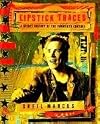
How does one write a history of the 20th century? Greil Marcus’s starting point was the Sex Pistols last show at the Winterland Ballroom in 1978. The show was a spectacular flameout of chaotic, confused rage, as the negation that punk rock stood for was swallowed up, pressed onto vinyl and sold back to people for the privilege of paying to consume that rage as if it were their own. The Winterland show is fitting as an apotheosis of an entire century concerned with the alienating experience show more of living in a world that is homogeneously organized by the uncompromising logic of capitalism. It was a century in which “[t]he exchange of a guarantee of dying of boredom for a guarantee of not dying of hunger was a good deal—the only game in town” (47). Negation was the century’s response, articulated in the early part of the 20th century and refined throughout the decades.
At moments, the focus on negation appears to describe a kind of nihilism, but I don’t know that it is. Nihilism might be served by negation as a means of undoing purpose and belief, but the negation practiced by the Dadas, the Lettrists, the Situationists, and by the Punks was in the service of belief and purpose or at least the possibility of those things. I saw in Marcus’s treatment of negation a disruption akin to Descartes’ extreme form of doubt that he made in pursuit of a bedrock rational foundation. Where Descartes asked what is true beyond this world of potentially deceptive experience, the 20th century movements that Marcus chronicled didn’t propose what must be at the bedrock level of human experience, they proposed a way to find out: shock the system out of rhythm and see where you end up. Negation was about claiming agency beyond the ability to choose what brands one will buy or shows one will consume. It is about having experience rather than consuming a “spectacle” of that experience.
The Dadas tried nonsense poetry and art as a way of subverting overarching narratives of interpretation. When that form of negation became its own mode of production and significance, the Lettrists formed and tried further negation. They dove into the syllables and down to the letters, smashing narratives further, seeking the place where experiences are not guided and nudged. The Situationists embraced negation as well, subverting dominant narratives pushed on us through media, architecture, city planning, education, work, etc., but their approach was more strategic, choosing to subvert messaging through techniques like “détournement,” running counter messaging, or denying the narrative pull of city architecture by wandering through the streets in a “dérive.” They sought enlightenment through boredom achieved through negation. They sought to creation of “situations” or moments of rupture and acceleration, “microclimates” in the city as unmarked zones of feeling (361).
The forces of negation manifested as avant-garde art, performances, media production, and discussion but also grew to include work stoppages, occupying buildings, seizing public stages, movements, protests, riots, violence. But that, too, gets packaged up and sold back to us; negation becomes the narrative once again. Where the Sex Pistols’ rage and irreverence might have shocked the system out of its rhythm, momentarily, it settled back into a commodity soon enough, sold back to us, soon after 1978 and continuously since as commemorative t-shirts and nostalgia that we can consume at our workstations. Arguably the forces of negation continue to the modern day with moments like Occupy Wall Street and the Great Resignation showing momentary disruption that give a glimpse of something different.
What makes this a history is that it draws together moments and events and figures that we might recognize in a conventional historical narrative, but Marcus’s work is non-linear, indirect. It is poetry at times more than it is prose. Toward the end of the book he notes about his historicizing process that “I have tried to make the ethos […] into a narrative, to fill in the gaps, to make it at least half as clear as it was to Debord, Wolman, Bernstein, and the rest—inevitably, to make their old papers into something fit for rational consumption. They didn’t.” (398).
Well worth your time. show less
At moments, the focus on negation appears to describe a kind of nihilism, but I don’t know that it is. Nihilism might be served by negation as a means of undoing purpose and belief, but the negation practiced by the Dadas, the Lettrists, the Situationists, and by the Punks was in the service of belief and purpose or at least the possibility of those things. I saw in Marcus’s treatment of negation a disruption akin to Descartes’ extreme form of doubt that he made in pursuit of a bedrock rational foundation. Where Descartes asked what is true beyond this world of potentially deceptive experience, the 20th century movements that Marcus chronicled didn’t propose what must be at the bedrock level of human experience, they proposed a way to find out: shock the system out of rhythm and see where you end up. Negation was about claiming agency beyond the ability to choose what brands one will buy or shows one will consume. It is about having experience rather than consuming a “spectacle” of that experience.
The Dadas tried nonsense poetry and art as a way of subverting overarching narratives of interpretation. When that form of negation became its own mode of production and significance, the Lettrists formed and tried further negation. They dove into the syllables and down to the letters, smashing narratives further, seeking the place where experiences are not guided and nudged. The Situationists embraced negation as well, subverting dominant narratives pushed on us through media, architecture, city planning, education, work, etc., but their approach was more strategic, choosing to subvert messaging through techniques like “détournement,” running counter messaging, or denying the narrative pull of city architecture by wandering through the streets in a “dérive.” They sought enlightenment through boredom achieved through negation. They sought to creation of “situations” or moments of rupture and acceleration, “microclimates” in the city as unmarked zones of feeling (361).
The forces of negation manifested as avant-garde art, performances, media production, and discussion but also grew to include work stoppages, occupying buildings, seizing public stages, movements, protests, riots, violence. But that, too, gets packaged up and sold back to us; negation becomes the narrative once again. Where the Sex Pistols’ rage and irreverence might have shocked the system out of its rhythm, momentarily, it settled back into a commodity soon enough, sold back to us, soon after 1978 and continuously since as commemorative t-shirts and nostalgia that we can consume at our workstations. Arguably the forces of negation continue to the modern day with moments like Occupy Wall Street and the Great Resignation showing momentary disruption that give a glimpse of something different.
What makes this a history is that it draws together moments and events and figures that we might recognize in a conventional historical narrative, but Marcus’s work is non-linear, indirect. It is poetry at times more than it is prose. Toward the end of the book he notes about his historicizing process that “I have tried to make the ethos […] into a narrative, to fill in the gaps, to make it at least half as clear as it was to Debord, Wolman, Bernstein, and the rest—inevitably, to make their old papers into something fit for rational consumption. They didn’t.” (398).
Well worth your time. show less
Lists
Awards


You May Also Like


Associated Authors
Statistics
- Works
- 40
- Also by
- 23
- Members
- 5,619
- Popularity
- #4,412
- Rating
- 3.8
- Reviews
- 79
- ISBNs
- 197
- Languages
- 7
- Favorited
- 21