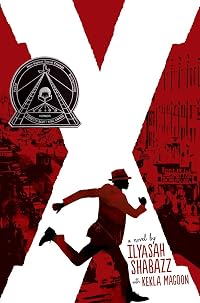
X: A Novel
by Ilyasah Shabazz, Kekla Magoon
On This Page
Description
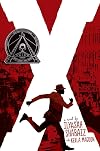
A 2016 Coretta Scott King Author Honor BookCowritten by Malcolm X's daughter, this riveting and revealing novel follows the formative years of the man whose words and actions shook the world.
Malcolm Little's parents have always told him that he can achieve anything, but from what he can tell, that's a pack of lies—after all, his father's been murdered, his mother's been taken away, and his dreams of becoming a lawyer have gotten him laughed out of school. There's no point in trying, he show more figures, and lured by the nightlife of Boston and New York, he escapes into a world of fancy suits, jazz, girls, and reefer. But Malcolm's efforts to leave the past behind lead him into increasingly dangerous territory. Deep down, he knows that the freedom he's found is only an illusion—and that he can't run forever.
X follows Malcolm from his childhood to his imprisonment for theft at age twenty, when he found the faith that would lead him to forge a new path and command a voice that still resonates today.
. show less
Tags
Recommendations




Member Reviews
This book is in no way deficient when it comes to textual construction. My criticism stems more from a complete lack of understanding as to why it was written. Malcolm X is a controversial historical figure. With so many people seeking to vilify this complicated man, why would any author (his daughter no less) write a fictional biography that paints him as nothing more than a villain? I've rarely come across a book that featured a more unlikable protagonist. The Malcolm in this book is an awful human being. He elicits no sympathy from the reader. After hundreds of pages detailing an endless barrage of crimes, I found myself rooting for the police to finally catch him and throw him in jail. Was that the author's intention? I can't show more imagine it was, and yet that's how this book was written. It's as if she's saying, to all of her father's critics, "You were right!" show less
You know, at the beginning, I wasn't totally taken by this book. Part of it might have been that the time hopping didn't work for me so much, though I appreciated its purpose, but I've also been pretty overwhelmed by the rest of my life which has provided ample distraction. However, by the time everything was going pretty much in straight chronological order, I was bummed to put it down, and by the end, it was nearly impossible to even pause reading. By the end, I was totally bowled over. Shabazz and Magoon paint such a thorough picture of Malcolm's complex youth, and even though it's a fictionalized biography, it gives a deeper context to his life and legacy. It's been a while since I've read such a beautifully crafted character, fact show more or fiction--there is some incredible artistry going on in the authors' collaboration. I want this to get into as many hands--teens and adults--as possible.
A great effect, as I'm sure is one of the main intentions of this book, is that I really want to read The Autobiography of Malcolm X for real now. I tried reading it several years ago, but I found it difficult to dig in...I was probably too immature. So I read a lot *about* him instead, and watched the movies and documentaries and all, but it's high time get back to it.
Read it. show less
A great effect, as I'm sure is one of the main intentions of this book, is that I really want to read The Autobiography of Malcolm X for real now. I tried reading it several years ago, but I found it difficult to dig in...I was probably too immature. So I read a lot *about* him instead, and watched the movies and documentaries and all, but it's high time get back to it.
Read it. show less
This is an excellent fictionalized biography of Malcolm X's early years, but it's also a great book on the struggles engendered by violence, poverty, racism, even just adolescence. It started slowly, despite the fact that we seemed to be in the midst of a life-and-death chase. I didn't know the characters, so it was hard to care. But right away the beauty of the language caught me. Malcolm, on the run, thinks "I want to slip the skin of this life, to be new and clean again" (5). That sentence, and many others like it, kept me reading. And the prose had to work hard for me because the next scene is one from years earlier, another pivotal moment, but, once again, I didn't know the characters or their circumstances and so didn't really show more care.
After the first twenty or so pages, though, the book started to knit together and became, as a reviewer below says, unputdownable. The violence and poverty of Malcolm's childhood serves to strengthen family ties, so even while the children eat dandelion green soup for dinner, their mother schools them on literature and history. "We could recite passages from Shakespeare and legends about African kingdoms going back thousands of years. We could share facts about the Trans-Atlantic slave trade, the largest forced migration of a people in the history of humankind, and about the great military strategist Queen Nzingah, who defended the nation of Angola against Portug[u]ese invaders" (22).
Family remains central in this book, even as the adolescent Malcolm tries to shed its responsibilities. He works at Roseland, a Boston ballroom that hosts "Negro" nights. His job gives the authors the chance to write about the amazing jazz scene of the interwar era. Swing dancing to Duke Ellington, listening to Billie Holliday sing "Strange Fruit," the reader is almost as seduced by this world as Malcolm is. And so his descent into selling reefer, shoplifting, running numbers, narrated from Malcolm's point of view, seems almost reasonable, even unavoidable.
Alas, the end of the book, when Malcolm is in prison and about to convert to Islam, is rushed. There's none of the detail of the Boston and Harlem scenes. Everything happens too fast and seems arbitrary. By then Malcolm has done some terrible things, profoundly hurt people who've been good to him. He's also been betrayed by the woman he loved. One expects some agony, some soul searching, but the book never delves deep at this point. If you've read Malcolm X on why and how he started to read in prison, you know that it was a gradual, desperate process. In the book it feels like he has nothing better to do. The result is that our protagonist, who has been an introspective, intelligent person, now seems shallow and unreflective and the heretofore irreligious Malcolm's looming conversion feels inexplicable.
Nevertheless, despite the slow start and the much-too-fast end, I highly recommend this book. As others have said, it's being sold as a Young Adult book but works, except for the ending, as a book for older readers, too. I was riveted, moved, hungry for more: I ordered more books by each of the two authors the day I finished this one. show less
After the first twenty or so pages, though, the book started to knit together and became, as a reviewer below says, unputdownable. The violence and poverty of Malcolm's childhood serves to strengthen family ties, so even while the children eat dandelion green soup for dinner, their mother schools them on literature and history. "We could recite passages from Shakespeare and legends about African kingdoms going back thousands of years. We could share facts about the Trans-Atlantic slave trade, the largest forced migration of a people in the history of humankind, and about the great military strategist Queen Nzingah, who defended the nation of Angola against Portug[u]ese invaders" (22).
Family remains central in this book, even as the adolescent Malcolm tries to shed its responsibilities. He works at Roseland, a Boston ballroom that hosts "Negro" nights. His job gives the authors the chance to write about the amazing jazz scene of the interwar era. Swing dancing to Duke Ellington, listening to Billie Holliday sing "Strange Fruit," the reader is almost as seduced by this world as Malcolm is. And so his descent into selling reefer, shoplifting, running numbers, narrated from Malcolm's point of view, seems almost reasonable, even unavoidable.
Alas, the end of the book, when Malcolm is in prison and about to convert to Islam, is rushed. There's none of the detail of the Boston and Harlem scenes. Everything happens too fast and seems arbitrary. By then Malcolm has done some terrible things, profoundly hurt people who've been good to him. He's also been betrayed by the woman he loved. One expects some agony, some soul searching, but the book never delves deep at this point. If you've read Malcolm X on why and how he started to read in prison, you know that it was a gradual, desperate process. In the book it feels like he has nothing better to do. The result is that our protagonist, who has been an introspective, intelligent person, now seems shallow and unreflective and the heretofore irreligious Malcolm's looming conversion feels inexplicable.
Nevertheless, despite the slow start and the much-too-fast end, I highly recommend this book. As others have said, it's being sold as a Young Adult book but works, except for the ending, as a book for older readers, too. I was riveted, moved, hungry for more: I ordered more books by each of the two authors the day I finished this one. show less
 This review was written for LibraryThing Early Reviewers.
The book focuses on the early life of Malcolm X, when he was known as Malcolm Little. It's a fictionalized account so there is some artistic license and filling in of gaps in his biography in order to make a story. My favorite part is the way the words of his father haunt him throughout his early life in this account. The impact his father had begun to have on him is offset by both his death and the words of a teacher which seemed to embody the way the people in power saw him, they way they treated his father. I appreciated that he had both a positive and negative influence to rebel against, it was interesting to see the way those influences interacted to inform his decisions.
Malcolm Little's road to becoming Malcolm X was not at all show more what I would have expected. While he had never tried to be a "model minority", as I had been erroneously taught about other Civil Rights leaders, I hadn't expected him to be so disillusioned about the fight so young. I would have just as well assumed that he had always been in the thick of it.
I loved the shifting names alongside the developing identities. It made sense out of why he would choose to officially change and take off the Little when he did, despite the influence of his father. There's more to a name and what it means than the closest relative who shared it with you.
I'm so glad I made the change to read this book instead. It was entertaining and made me want to read his actual biography. There's a note at the end that specifies which characters were made up, which simply had pseudonyms, and some composites. It also explains some scenes that were filled in and segments specifically mentioned by Malcolm X in his own writing. As mentioned above, Shabazz is his daughter and had been told stories that wouldn't have been publicly available, which she shares here. To assume that there is no bias or justifications would likely be erroneous, but so would an assumption that she was particularly attempting some sort of good will or rewriting of the facts. As it is, I'm going to be reading a biography in my future to get the rest of the story too. show less
Malcolm Little's road to becoming Malcolm X was not at all show more what I would have expected. While he had never tried to be a "model minority", as I had been erroneously taught about other Civil Rights leaders, I hadn't expected him to be so disillusioned about the fight so young. I would have just as well assumed that he had always been in the thick of it.
I loved the shifting names alongside the developing identities. It made sense out of why he would choose to officially change and take off the Little when he did, despite the influence of his father. There's more to a name and what it means than the closest relative who shared it with you.
I'm so glad I made the change to read this book instead. It was entertaining and made me want to read his actual biography. There's a note at the end that specifies which characters were made up, which simply had pseudonyms, and some composites. It also explains some scenes that were filled in and segments specifically mentioned by Malcolm X in his own writing. As mentioned above, Shabazz is his daughter and had been told stories that wouldn't have been publicly available, which she shares here. To assume that there is no bias or justifications would likely be erroneous, but so would an assumption that she was particularly attempting some sort of good will or rewriting of the facts. As it is, I'm going to be reading a biography in my future to get the rest of the story too. show less
Another nonfiction novel! This book was co-written by Malcolm X's daughter Ilyasah Shabazz and is based on anecdotes of family & friends as well as the written accounts (letters, diaries, etc.) about how Malcolm Little became Malcolm X.
For those fans of nonfiction, the 'appendix' at the end in which Shabazz describes what exactly was fact, what was composite and what was fiction will be appreciated. I also liked getting the background timeline and historical perspective provided in the second 'appendix'.
Dion Graham was excellent narrating this audiobook. I found the story compelling although I had some difficulty relating to young Malcolm's feeling that life hustling was 'keeping it real'. However, I think that difficulty is personal show more rather than any fault in the book & I am now much more curious about learning more about Malcolm X. show less
For those fans of nonfiction, the 'appendix' at the end in which Shabazz describes what exactly was fact, what was composite and what was fiction will be appreciated. I also liked getting the background timeline and historical perspective provided in the second 'appendix'.
Dion Graham was excellent narrating this audiobook. I found the story compelling although I had some difficulty relating to young Malcolm's feeling that life hustling was 'keeping it real'. However, I think that difficulty is personal show more rather than any fault in the book & I am now much more curious about learning more about Malcolm X. show less
This title is marketed as a young adult novel, but it is really as close to an authorized biography of civil rights activist Malcolm X as could be written.
The author takes her father’s chosen name, Shabazz. Her book tells of him as Malcolm Little, himself the son of a murdered civil rights activist. She tells the story Malcolm glossed over in his Autobiography--the story of Detroit Red. And though she was only three when her father was killed, Ms. Shabazz has a large, close, and proud family full of stories and correspondence to draw from. With Magoon’s help, she brings a brash fifteen-year-old runaway in the 1940’s into focus. She doesn’t ignore her character’s imperfections or the allure of the big-city life-style that show more brings him low, but uses a concluding author note to explain that Malcolm’s troubles were what allowed him to be such an effective leader--he knew the temptations, the indignities, and the injustice his brothers faced; they knew he could relate to their lives, and they to his. Even without this note, though, Shabazz closes the story with an image of Malcolm taking on his new name, X, and with it his new calling. It’s an uplifting tale of redemption, never mind how important the redeemed would become, and a good fit for any middle- or high-school library. show less
The author takes her father’s chosen name, Shabazz. Her book tells of him as Malcolm Little, himself the son of a murdered civil rights activist. She tells the story Malcolm glossed over in his Autobiography--the story of Detroit Red. And though she was only three when her father was killed, Ms. Shabazz has a large, close, and proud family full of stories and correspondence to draw from. With Magoon’s help, she brings a brash fifteen-year-old runaway in the 1940’s into focus. She doesn’t ignore her character’s imperfections or the allure of the big-city life-style that show more brings him low, but uses a concluding author note to explain that Malcolm’s troubles were what allowed him to be such an effective leader--he knew the temptations, the indignities, and the injustice his brothers faced; they knew he could relate to their lives, and they to his. Even without this note, though, Shabazz closes the story with an image of Malcolm taking on his new name, X, and with it his new calling. It’s an uplifting tale of redemption, never mind how important the redeemed would become, and a good fit for any middle- or high-school library. show less
This review was written for LibraryThing Early Reviewers.A novelization of the formative years of Malcolm X, written by the middle of his five children with Betty Shabazz and co-authored by the talented Kekla Magoon, following Malcolm from his birth in Omaha to his childhood in Flint & Lansing to his teenage years in Boston's Roxbury neighborhood and Harlem, and finally to prison. The book's strengths are its raw honesty, authentic speech, and reflections of oppression and pervasive racism, the destabilizing and destructive effects on Malcolm of a murdered father and depressed mother, who was eventually institutionalized. On the other hand, I think that daughter Ilyasah, who was three when her father was assassinated and who forged a compelling story from anecdotes of relatives, has idealized show more some of Malcolm's actions and decisions, most especially his conversion to Islam. It is crystal clear that Malcolm had no guiding force in his early life, other than narcissism.
The substantive endnotes are an excellent resource, helping to sort out facts from fiction. I actually skipped back to them in the middle of the book, and in retrospect, would have liked to read them first. show less
The substantive endnotes are an excellent resource, helping to sort out facts from fiction. I actually skipped back to them in the middle of the book, and in retrospect, would have liked to read them first. show less
Members
- Recently Added By
Lists

One Letter Titles
31 works; 4 members
One Letter Books
26 works; 1 member

Titles beginning with X
72 works; 3 members
Author Information

8 Works 1,480 Members

35+ Works 4,168 Members
Kekla Magoon is a writer, editor, speaker, and educator. She is the author of Camo Girl, 37 Things I Love (in No Particular Order), How It Went Down, and numerous non-fiction titles for the education market. Her book, The Rock and the River, won the Coretta Scott King/John Steptoe Award. She also leads writing workshops for youth and adults and is show more the co-editor of YA and Children's Literature for Hunger Mountain, the arts journal of Vermont College. (Bowker Author Biography) show less
Some Editions
Awards and Honors
Awards
Distinctions
Notable Lists
Common Knowledge
- Original publication date
- 2015-01-06
- People/Characters
- Malcolm X; Sophia; Malcolm "Shorty" Jarvis; Philbert; Ella Little
- Important places
- Lansing, Michigan, USA; Boston, Massachusetts, USA; Harlem, New York, New York, USA; Charlestown State Prison, Boston, Massachusetts, USA; Massachusetts Correctional Institution – Norfolk, Norfolk, Massachusetts, USA
- Dedication
- In memory of my loving nephew, Malcolm - I.S.
For my dad - K.M. - First words
- Friends tell me trouble's coming.
Classifications
Statistics
- Members
- 659
- Popularity
- 43,797
- Reviews
- 37
- Rating
- (3.91)
- Languages
- English
- Media
- Paper, Audiobook, Ebook
- ISBNs
- 19
- UPCs
- 1
- ASINs
- 3