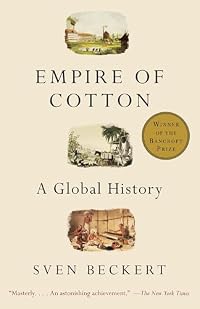
Empire of Cotton: A Global History
by Sven Beckert
On This Page
Description
"The epic story of the rise and fall of the empire of cotton, its centrality in the world economy, and its making and remaking of global capitalism. Sven Beckert's rich, fascinating book tells the story of how, in a remarkably brief period, European entrepreneurs and powerful statesmen recast the world's most significant manufacturing industry combining imperial expansion and slave labor with new machines and wage workers to change the world. Here is the story of how, beginning well before show more the advent of machine production in 1780, these men created a potent innovation (Beckert calls it war capitalism, capitalism based on unrestrained actions of private individuals; the domination of masters over slaves, of colonial capitalists over indigenous inhabitants), and crucially affected the disparate realms of cotton that had existed for millennia. We see how this thing called war capitalism shaped the rise of cotton, and then was used as a lever to transform the world. The empire of cotton was, from the beginning, a fulcrum of constant global struggle between slaves and planters, merchants and statesmen, farmers and merchants, workers and factory owners. In this as in so many other ways, Beckert makes clear how these forces ushered in the modern world. The result is a book as unsettling and disturbing as it is enlightening: a book that brilliantly weaves together the story of cotton with how the present global world came to exist"-- show lessTags
Recommendations
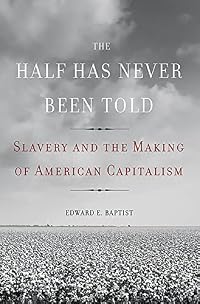


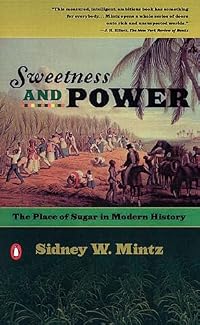

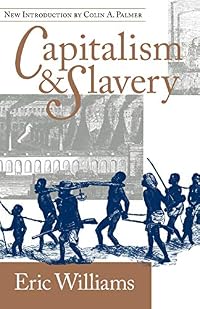















Member Recommendations

Member Reviews
It is both fitting and pleasantly ironic that Empire of Cotton: A Global History, by Sven Beckert, was not only the final book I read in 2015 but arguably the most consequential. Every now and again, I encounter a work of a magnitude such as this which offers a truly fresh perspective that compels a reevaluation of core concepts. This was the case, for example, with Guns, Germs and Steel, by Jared Diamond, Maps of Time, by David Christian, and 1491, by Charles C. Mann. Books like these transcend historical scholarship and move in a greater intellectual arena that not only challenges accepted wisdom but literally annihilates it and thereby forces the construction of an entirely new narrative. Empire of Cotton, an epic in the genre “Big show more History,” does all of that and does it with penetrating insight.
In some four hundred fifty pages of tightly compressed and often dense but readable text, Harvard Professor of History Sven Beckert demolishes the myth of capitalism as it has been traditionally understood. In that model, which Beckert in nearly a single stroke brilliantly renders obsolete, we have long been taught that the industrial revolution, a European triumph, was the product of technology fueled by free markets, liberal democracy and the Protestant work ethic to create the economic miracle of capitalist growth and progress that has literally defined the modern west. But Beckert, a social, political and economic historian, peels back cherished notions to reveal that in fact neither the industrial revolution nor capitalism as we know it could have evolved without state coercion – nor could it have existed without the central staple crop that made it all possible: cotton, the central element that weaves (pun fully intended!) it all together.
Of course, the myth of European exceptionalism has long been dented and bruised by more recent historiography. Only a couple of centuries prior to its ascent to global dominance, Europe was kind of a backwater to the Arab Middle East and China, until the Columbian Experience brought vast wealth and exotic new products that literally shifted the global epicenter from the Mediterranean and the east to the Atlantic trade and the west. Yet, one of those new exotic products was decidedly not cotton, which apparently had been cultivated, spun and woven for thousands of years in geographies as disparate as Egypt, the Indus valley and Peru. Europe was one of the places highly-prized textiles made from cotton were not at all common. As Beckert argues in his complex but persuasive thesis, cotton proved to be the key ingredient that was to change everything, and from the very beginning it was cooked into a stock vigorously stirred by violence and often brutal state coercion that he calls “war capitalism,” amply seasoned by healthy doses of state investment and protectionism. Set aside steel and other more familiar totems of the industrial revolution for the moment: none of it would have been possible without cotton.
Before there was an industrial revolution, there was of course industry, or rather the technology that made mills possible to create great volumes of textiles made from cotton. But cotton does not grow in temperate European climes. Prior to this, the finest cotton textiles originated in the east and especially in India, the very center of global cotton dominance. The first stop for war capitalism, Beckert tells us, was British imperialism and the roots of colonialism that aggressively sought the raw material for its mills at the lowest possible cost. British economic interests propped up by British military might began to transform centuries of Indian cotton cultivation and production, spinning and weaving, and the marketing of the finished product through middlemen and merchants. Britain forcefully remade India as a supplier of raw materials to its mills in a heavy-handed process that over decades transformed it from a powerful vendor to world markets to an almost helpless customer of the British who relied upon state investment and protectionism to dominate cotton textile production. As Beckert notes: “India’s cotton industry was decimated … In the wake of the Industrial Revolution … India lost its once central position in the global cotton industry and, in a great historical irony, eventually became the world’s largest market for British cotton exports.” [p172] So much for free markets and free enterprise …
The central tenet to European textile production was cheap cotton, which meant cheap labor to cultivate the cotton crop. For cheap labor, you cannot beat slave labor, which is why slavery became absolutely central to cotton production and the industrial revolution. The windfall of the Columbian Experience had gifted European overlords with vast territories in the Americas favored with the kind of warm climates conducive to cotton cultivation, but the near annihilation of its pre-contact population due to old world pandemics created a dearth of labor. African slavery had already proved a successful if brutally inhumane solution for sugar and tobacco plantations in the New World. Now that the Industrial Revolution had turned cotton into “white gold,” the availability of high quality cotton textiles proved in a cruel irony to be valuable tender for slave traders as payment for the human chattel who would cultivate new raw materials later turned into the finished products that were the very price of their purchase.
War capitalism – through colonialism, expropriation of territory and slavery – created the empire of cotton and thereby bred its next critical phase, “industrial capitalism,” which created wage laborers: an entirely new phenomenon for vast numbers of people that for a variety of factors were forced to abandon a traditional agricultural lifestyle and become workers in the mills, for long hours, little compensation and often in grueling conditions. But here too state coercion continued to play a significant role, as the power of the state generally aligned with the moneyed interests against the ill-treated factory proletariat, enforcing one-sided contracts, instituting compulsory work laws, and blocking any attempts at reform.
Interestingly, as Beckert points out in his study of the United States, while war capitalism was essential for the foundation of industrial capitalism, the two typically remained mutually exclusive. For instance, the plantation south of the antebellum years hosted very few mills, while textile production flourished in the north. “A society dominated by slavery was not conducive to cotton industrialization,” Beckert insists. “Slave states were notoriously late and feeble in supporting the political and economic interests of domestic industrializers. This was also the case in the slave territories within the United States, the only country in the world divided between war and industrial capitalism, a unique characteristic that would eventually spark an unprecedentedly destructive civil war.” [p171]
Students of the American Civil War are well-familiar with the Confederacy’s unshakeable confidence that Europe could not endure without their cotton, so much so that the CSA withheld cotton shipments early on. Panic and economic depression did indeed ensue in Britain and elsewhere, but rather than the recognition and aid Richmond had anticipated, the shortage of cotton prompted a renewal of war capitalism to seek alternate sources of supply. This persisted long after Appomattox and the result was an even greater commitment to colonialism. Parts of India, for instance, were completely refashioned to force a monopoly for cotton cultivation over all other kinds of agriculture. Railroads and telegraphs, later products of the industrial revolution, permitted the British to penetrate deeper into the interior for such purposes. When cotton prices fell and food grain prices rose in the 1870s, some six to ten million Indians died of famine in the Berar province alone, although there was plenty of food available but economically out of reach to the affected population. This was repeated in the 1890s, when another nineteen million people perished of famine in that same geography in similar circumstances.
Empire of Cotton contains many horrific episodes such as this to reveal the grim realities of both industrialization and capitalism, elements of which persist to this day – something that will no doubt provoke chagrin and loud cries of revisionism by outraged “heritage” historians who hurl the invective of “political correctness” against any new historiography that challenges their more rosy enshrined narrative. And we can expect similar fury to be sparked in the camps of contemporary free market ideologues, as Beckert reminds us that even now: “Violence and coercion, in turn, are as adaptive as the capitalism they enable, and they continue to play an important role in the empire of cot¬ton to this day. Cotton growers are still forced to grow the crop; workers are still held as virtual prisoners in factories. Moreover, the fruits of their activities continue to be distributed in radically unequal way – with cot¬ton growers in Benin, for example, making a dollar a day or less, while the owners of [otherwise unprofitable] cotton growing businesses in the United States have collectively received government subsidies of more than $35 billion between 1995 and 2010. Workers in Bangladesh stitch together clothing under absurdly dangerous conditions for very low wages, while consumers in the United States and Europe can purchase those pieces with abandon, at prices that often seem impossibly low.” [p442]
Empire of Cotton is a remarkable and extremely thought-provocative book, although it can be a difficult read, since Beckert the careful historian includes many details and much statistical information that occasionally bogs down the text – in addition to some 135 pages of endnotes. Yet, Beckert’s thesis remains convincing, aptly demonstrating throughout this long, complicated work that cotton industrialization is vitally dependent in all phases upon extremely cheap labor, and concluding with a chilling reminder that: “For the past several decades, Walmart and other retail giants have continually moved their production from one poor country to a slightly poorer one, lured by the promise of workers even more eager and even more inexpensive. Even Chinese production is now threatened by lower-wage producers. The empire of cotton has continued to facilitate a giant race to the bottom …” [p440] This is a very important book, in my estimation, and despite the difficulty I highly recommend it.
My review of "Empire of Cotton: A Global History" by Sven Beckert, a most consequential work, is live on my book blog http://wp.me/p5Hb6f-5L show less
In some four hundred fifty pages of tightly compressed and often dense but readable text, Harvard Professor of History Sven Beckert demolishes the myth of capitalism as it has been traditionally understood. In that model, which Beckert in nearly a single stroke brilliantly renders obsolete, we have long been taught that the industrial revolution, a European triumph, was the product of technology fueled by free markets, liberal democracy and the Protestant work ethic to create the economic miracle of capitalist growth and progress that has literally defined the modern west. But Beckert, a social, political and economic historian, peels back cherished notions to reveal that in fact neither the industrial revolution nor capitalism as we know it could have evolved without state coercion – nor could it have existed without the central staple crop that made it all possible: cotton, the central element that weaves (pun fully intended!) it all together.
Of course, the myth of European exceptionalism has long been dented and bruised by more recent historiography. Only a couple of centuries prior to its ascent to global dominance, Europe was kind of a backwater to the Arab Middle East and China, until the Columbian Experience brought vast wealth and exotic new products that literally shifted the global epicenter from the Mediterranean and the east to the Atlantic trade and the west. Yet, one of those new exotic products was decidedly not cotton, which apparently had been cultivated, spun and woven for thousands of years in geographies as disparate as Egypt, the Indus valley and Peru. Europe was one of the places highly-prized textiles made from cotton were not at all common. As Beckert argues in his complex but persuasive thesis, cotton proved to be the key ingredient that was to change everything, and from the very beginning it was cooked into a stock vigorously stirred by violence and often brutal state coercion that he calls “war capitalism,” amply seasoned by healthy doses of state investment and protectionism. Set aside steel and other more familiar totems of the industrial revolution for the moment: none of it would have been possible without cotton.
Before there was an industrial revolution, there was of course industry, or rather the technology that made mills possible to create great volumes of textiles made from cotton. But cotton does not grow in temperate European climes. Prior to this, the finest cotton textiles originated in the east and especially in India, the very center of global cotton dominance. The first stop for war capitalism, Beckert tells us, was British imperialism and the roots of colonialism that aggressively sought the raw material for its mills at the lowest possible cost. British economic interests propped up by British military might began to transform centuries of Indian cotton cultivation and production, spinning and weaving, and the marketing of the finished product through middlemen and merchants. Britain forcefully remade India as a supplier of raw materials to its mills in a heavy-handed process that over decades transformed it from a powerful vendor to world markets to an almost helpless customer of the British who relied upon state investment and protectionism to dominate cotton textile production. As Beckert notes: “India’s cotton industry was decimated … In the wake of the Industrial Revolution … India lost its once central position in the global cotton industry and, in a great historical irony, eventually became the world’s largest market for British cotton exports.” [p172] So much for free markets and free enterprise …
The central tenet to European textile production was cheap cotton, which meant cheap labor to cultivate the cotton crop. For cheap labor, you cannot beat slave labor, which is why slavery became absolutely central to cotton production and the industrial revolution. The windfall of the Columbian Experience had gifted European overlords with vast territories in the Americas favored with the kind of warm climates conducive to cotton cultivation, but the near annihilation of its pre-contact population due to old world pandemics created a dearth of labor. African slavery had already proved a successful if brutally inhumane solution for sugar and tobacco plantations in the New World. Now that the Industrial Revolution had turned cotton into “white gold,” the availability of high quality cotton textiles proved in a cruel irony to be valuable tender for slave traders as payment for the human chattel who would cultivate new raw materials later turned into the finished products that were the very price of their purchase.
War capitalism – through colonialism, expropriation of territory and slavery – created the empire of cotton and thereby bred its next critical phase, “industrial capitalism,” which created wage laborers: an entirely new phenomenon for vast numbers of people that for a variety of factors were forced to abandon a traditional agricultural lifestyle and become workers in the mills, for long hours, little compensation and often in grueling conditions. But here too state coercion continued to play a significant role, as the power of the state generally aligned with the moneyed interests against the ill-treated factory proletariat, enforcing one-sided contracts, instituting compulsory work laws, and blocking any attempts at reform.
Interestingly, as Beckert points out in his study of the United States, while war capitalism was essential for the foundation of industrial capitalism, the two typically remained mutually exclusive. For instance, the plantation south of the antebellum years hosted very few mills, while textile production flourished in the north. “A society dominated by slavery was not conducive to cotton industrialization,” Beckert insists. “Slave states were notoriously late and feeble in supporting the political and economic interests of domestic industrializers. This was also the case in the slave territories within the United States, the only country in the world divided between war and industrial capitalism, a unique characteristic that would eventually spark an unprecedentedly destructive civil war.” [p171]
Students of the American Civil War are well-familiar with the Confederacy’s unshakeable confidence that Europe could not endure without their cotton, so much so that the CSA withheld cotton shipments early on. Panic and economic depression did indeed ensue in Britain and elsewhere, but rather than the recognition and aid Richmond had anticipated, the shortage of cotton prompted a renewal of war capitalism to seek alternate sources of supply. This persisted long after Appomattox and the result was an even greater commitment to colonialism. Parts of India, for instance, were completely refashioned to force a monopoly for cotton cultivation over all other kinds of agriculture. Railroads and telegraphs, later products of the industrial revolution, permitted the British to penetrate deeper into the interior for such purposes. When cotton prices fell and food grain prices rose in the 1870s, some six to ten million Indians died of famine in the Berar province alone, although there was plenty of food available but economically out of reach to the affected population. This was repeated in the 1890s, when another nineteen million people perished of famine in that same geography in similar circumstances.
Empire of Cotton contains many horrific episodes such as this to reveal the grim realities of both industrialization and capitalism, elements of which persist to this day – something that will no doubt provoke chagrin and loud cries of revisionism by outraged “heritage” historians who hurl the invective of “political correctness” against any new historiography that challenges their more rosy enshrined narrative. And we can expect similar fury to be sparked in the camps of contemporary free market ideologues, as Beckert reminds us that even now: “Violence and coercion, in turn, are as adaptive as the capitalism they enable, and they continue to play an important role in the empire of cot¬ton to this day. Cotton growers are still forced to grow the crop; workers are still held as virtual prisoners in factories. Moreover, the fruits of their activities continue to be distributed in radically unequal way – with cot¬ton growers in Benin, for example, making a dollar a day or less, while the owners of [otherwise unprofitable] cotton growing businesses in the United States have collectively received government subsidies of more than $35 billion between 1995 and 2010. Workers in Bangladesh stitch together clothing under absurdly dangerous conditions for very low wages, while consumers in the United States and Europe can purchase those pieces with abandon, at prices that often seem impossibly low.” [p442]
Empire of Cotton is a remarkable and extremely thought-provocative book, although it can be a difficult read, since Beckert the careful historian includes many details and much statistical information that occasionally bogs down the text – in addition to some 135 pages of endnotes. Yet, Beckert’s thesis remains convincing, aptly demonstrating throughout this long, complicated work that cotton industrialization is vitally dependent in all phases upon extremely cheap labor, and concluding with a chilling reminder that: “For the past several decades, Walmart and other retail giants have continually moved their production from one poor country to a slightly poorer one, lured by the promise of workers even more eager and even more inexpensive. Even Chinese production is now threatened by lower-wage producers. The empire of cotton has continued to facilitate a giant race to the bottom …” [p440] This is a very important book, in my estimation, and despite the difficulty I highly recommend it.
My review of "Empire of Cotton: A Global History" by Sven Beckert, a most consequential work, is live on my book blog http://wp.me/p5Hb6f-5L show less
As I was finishing this book I checked the price of cotton: about 60-cents a pound. 60-cents! Then I looked up an advertisement for a new suit in a discount circular dropped on my front door: $150. I’m guessing at the most one pound of cotton made its way into that suit. After the cotton was picked, wound into thread, loomed into fabric, cut and sewn into that suit, all the profit along the way, so little was left for the cotton picker. Almost all of the work — including the picking — may be automated. Not the design, although with scale of production the cost of design is minimal. Much higher, I understand, are the subsidies which make Texas cotton the most sought-after in the world. I learned this from another work: “The show more Travels of a T-Shirt in the Global Economy” by Pietra Rivoli. In this work we are taken back in time to the beginnings of the Industrial Revolution and the conversion of manual labour to industrial production. I found this so instructive. How war capitalism shaped the spread of industrial production, and how the model of slave labour in one corner of the world drove manufacturers to alter the production globally. Not only was cotton produced in the American South profitable, it was fabulously profitable and corrosive to the societies it touched directly and indirectly. But slavery did not end with Appomattox. As we know, capital finds a way to find the weakest in society — and in societies that may not be our own — and harness them for markets: the rich Western markets, or the hungry markets for knock-off merch flowing through Italian ports and guided by organized crime into European and world markets (See Roberto Saviano’s great “Gomorrah: A Personal Journey Into The Violent International Empire of Naples’ Organized Crime System.”) This book tells as much about how oligopolies of trade and trade policies favour capital first and labour last. And how England weaponized global trade. show less
A brilliant historical journey of capitalism focusing on its first global iteration: the complex organization of the cotton trade in Lancashire and its eventual decline.
A first rate history with a tenth rate index. The author uses the phrase "war capitalism" to refer (mostly) to the US
and its use of slavery, violence and eliminating the native population to allow cotton to grow, and the phrase "industrial
capitalism" to refer to the developments with which we are more familiar. He is correct. The history is quite broad and detailed, but in his use of many specifics he ignores the fact that in 1860 60% of America's millionaires lived in Natchez, a small town in Mississippi, and 75% of the nation's millionaires lived on the Mississippi River Road between Natchez and New Orleans, due to the fact that they owned huge plantations with many slaves. The value of slaves in 1860 exceeded all of the value of the show more factories and wealth of the North by a huge factor- seven or eight times.
As a history this book is wonderful, but he suggests that only in the US was there a war capitalist society in the South and an industrial capitalism in the North, and that is why we had the Civil War. He does point out the strange and wild growth of the industry -multiplying by twenty or thirty times in a few decades- and he does state that America owed its emergence as a country to the sale of cotton and slavery. The index is awful and the publisher should be ashamed of himself. show less
and its use of slavery, violence and eliminating the native population to allow cotton to grow, and the phrase "industrial
capitalism" to refer to the developments with which we are more familiar. He is correct. The history is quite broad and detailed, but in his use of many specifics he ignores the fact that in 1860 60% of America's millionaires lived in Natchez, a small town in Mississippi, and 75% of the nation's millionaires lived on the Mississippi River Road between Natchez and New Orleans, due to the fact that they owned huge plantations with many slaves. The value of slaves in 1860 exceeded all of the value of the show more factories and wealth of the North by a huge factor- seven or eight times.
As a history this book is wonderful, but he suggests that only in the US was there a war capitalist society in the South and an industrial capitalism in the North, and that is why we had the Civil War. He does point out the strange and wild growth of the industry -multiplying by twenty or thirty times in a few decades- and he does state that America owed its emergence as a country to the sale of cotton and slavery. The index is awful and the publisher should be ashamed of himself. show less
The author tells the story of cotton cultivation and manufacturing through history as the market for cotton became a global network with massive impacts on people around the world. The significance of the cotton market was more profound than I had imagined and was much more globally connected as well. Sven Beckert tells the story of this interconnectivity by explaining what is happening in every corner of the world. When he does this within the same paragraph, the book can become confusing. The book is nevertheless very readable.
The book provides essential lessons for people interested in the history of capitalism, slavery, colonialism, business, and international trade.
The book provides essential lessons for people interested in the history of capitalism, slavery, colonialism, business, and international trade.
Really ambitious attempt to track the rise of cotton and its role in the global economy and imperialism. I would have benefited from some clearer definition of what Beckert meant exactly when he discussed “war capitalism”—which basically seemed to mean conquering territories or opening them to trade by force in order to find new markets for goods. He also emphasizes that western industrialization corresponded with deindustrialization in places like India, where spinning and cloth production had been well established at the household level and then was displaced by growing cotton for market—a change that contributed to the death by famine of millions when prices collapsed. And he contends that countries that successfully show more industrialized were those that managed to protect their nascent factories with tariffs until their production could compete with cheaper versions. The West, almost literally, pulled the ladder up behind it. show less
"The Empire of Cotton" by Sven Beckert is an eye opener, a tour de force, a detailed account of human exploitation on a gargantuan scale.
# The eBook of fully indexed with umpteen endnotes from original sources. It comes with excellent photos, charts and diagrams. Readers who have 96 dpi monitors (or less) will need a magnifying glass to make out the small print on some of the graphics. (Someday I hope Kindle will support zoom functions for embedded graphics.) I would not recommend reading this eBook with an iPhone or minimum-definition eReader.
# Beckert documents the origins of cotton in India and China. Indian cotton was a luxury item for aristocrats of the Roman Empire.
# The British East India Company introduced cotton to Europeans show more and adopted technological improvements for spinning and weaving. Soon British merchants around Liverpool open sweat-shop factories and employed children from orphanages who worked 13-hour shifts in cramped, unsavory conditions. Meanwhile, the East Indian Company bought yarns and cloths from Indian cotton producers. These they sold to Africans in exchange for slaves who were sent to the Western Hemisphere to work the cotton fields. In the USA the cotton gin enabled easier cotton harvesting and processing. Soon cotton plantations in the USA supplied Europe with 90% of the raw cotton for mills.
# The cotton industry has always been a government sanctioned Ponzi scheme that provides cotton clothing to well-heeled consumers at rock-bottom prices. It went hand-in-hand with colonialism of the 18th- & 19th-centuries. Beckert coins a new phrase for the cotton enterprise. He calls it WAR CAPITALISM.
# Government laws have enabled the cotton industry, which has used slavery, land grabs, wage slavery, violence, rape and even genocide to further its aims. The global cotton racket throughout its history has used the same methods as do drug cartels. Yet, cotton vendors are perfectly licensed and legal. Today the USA government spends more on its own cotton producers than it gives to foreign aid.
# This eBook wonderfully written and produced. I recommend it for anyone who dares to face the facts. The dark truth of human capitalism. show less
# The eBook of fully indexed with umpteen endnotes from original sources. It comes with excellent photos, charts and diagrams. Readers who have 96 dpi monitors (or less) will need a magnifying glass to make out the small print on some of the graphics. (Someday I hope Kindle will support zoom functions for embedded graphics.) I would not recommend reading this eBook with an iPhone or minimum-definition eReader.
# Beckert documents the origins of cotton in India and China. Indian cotton was a luxury item for aristocrats of the Roman Empire.
# The British East India Company introduced cotton to Europeans show more and adopted technological improvements for spinning and weaving. Soon British merchants around Liverpool open sweat-shop factories and employed children from orphanages who worked 13-hour shifts in cramped, unsavory conditions. Meanwhile, the East Indian Company bought yarns and cloths from Indian cotton producers. These they sold to Africans in exchange for slaves who were sent to the Western Hemisphere to work the cotton fields. In the USA the cotton gin enabled easier cotton harvesting and processing. Soon cotton plantations in the USA supplied Europe with 90% of the raw cotton for mills.
# The cotton industry has always been a government sanctioned Ponzi scheme that provides cotton clothing to well-heeled consumers at rock-bottom prices. It went hand-in-hand with colonialism of the 18th- & 19th-centuries. Beckert coins a new phrase for the cotton enterprise. He calls it WAR CAPITALISM.
# Government laws have enabled the cotton industry, which has used slavery, land grabs, wage slavery, violence, rape and even genocide to further its aims. The global cotton racket throughout its history has used the same methods as do drug cartels. Yet, cotton vendors are perfectly licensed and legal. Today the USA government spends more on its own cotton producers than it gives to foreign aid.
# This eBook wonderfully written and produced. I recommend it for anyone who dares to face the facts. The dark truth of human capitalism. show less
Members
- Recently Added By
Lists

Slavery and Capitalism
24 works; 1 member

Bibliography of How the Old World Ended by Jonathan Scott
308 works; 1 member
Author Information

12+ Works 1,627 Members
Sven Beckert was a finalist for the 2015 Pulitzer Prize in History with his title Empire of Cotton: A Global History. (Bowker Author Biography)
Awards and Honors
Awards
Distinctions
Notable Lists
Common Knowledge
- Canonical title
- Empire of Cotton: A Global History
- Original publication date
- 2014
- Important events
- American Civil War
Classifications
Statistics
- Members
- 1,140
- Popularity
- 21,971
- Reviews
- 20
- Rating
- (3.66)
- Languages
- 5 — Dutch, English, German, Italian, Spanish
- Media
- Paper, Audiobook, Ebook
- ISBNs
- 22
- ASINs
- 12