On This Page
Description
On the eve of his marriage, the Counselor makes a risky decision to dealve into the cocaine trade along the Texas-Mexico border. His hope is that this one-time deal will set him and his fiancée on a path to financial freedom, but instead he ends up in a brutal game that threatens to destroy everything and everyone he loves.Tags
Recommendations

































Member Reviews
Now this was a slog of deep reading. Over 1,000 pages and one year of keeping this book on the porch and reading 5-20 pages at a time, and this is just the first volume. I see its novelty, it's depth, and it's Europeaness. I read Cervantes' Don Quixote in a similar manner but at least that had a semblance of a plot. Once you can see through the exponential self-involvement of Proust you realize his flourish of prose and some of his descriptions and insights of people and his world and time are what make the reading worthwhile. I will try and finish the other two volumes before I die.
For a long time, I remember not being sure (afraid to ask my mamma or any of my dear friends, lest I fall in their regard) of the pronounciation of "Proust". Surely, it would seem to rhyme with "oust", and yet what, short of say, glockenspiel, or sauerkraut, could sound more Teutonic? It must then, I reasoned, be as if it were spelled "proost"? Avec an accent on the "ooh". Yet this was a time, when I was yet quite young, and the Internet, as such, was a gleam in the eye of a tumescent DARPA. Who could I ask? How could I research this delicate matter? I was several years away from my first class in French. And somehow this hero, this Milton of the corklined boudoir, why would he not choose a nom de plume of more aristocratic panache, show more like Marquis de Combray, or of resonant consonant force, like Comte Twainn, why would he risk a tenuous immortality and despoil a set of leather bound, gilt embossed volumes - containing the very essence of fin de siecle Fr-ON-ce - with a squishy, escargot evoking, oh-so-emo patronym, however genuine, as "prooost". Yuck.
Who'd da thunk it?
So here I am. Many years later. In the winter of our Amerikan discontent (although really, are we any more divided now than the French were over Dreyfus) -finally proceding, at times at a trudge, at times gliding, but each day, every day, stealing a march, peu by pew, through the Re: church of Tom's per Dieu. It's a B4Udie thing, for sure.
I suffer at times from social anxiety disorder. I suffer at times from boredom. Not to mention, narcissism, irritable bowel syndrome, allergies, and laziness. So it is so wonderful that Proust, like Christ, died on a thousand settees so that I might be forgiven, redeemed, ascended and enter the Paradise of the parlor, the distingue dimensions of the drawing room, the serious mysteries of Society, whose depths I would never, on my own, consider probing - not with a titanium bathyscope, would I in normal life, chance coming near a doyenne, a creature as exotic and horrifying and enticing as a luminescent Irish Lord fished from the depths, with eyeballs on stalks and a translucent skull. I can see myself; I would approach to investigate a facial tidbit, a tasty appearing tic, with a naif temerity, and be swallowed, like Jonah, in a gulp, only to be puked up in disgust, as bourgeois, as dull, as profane as in my darkest awkward nightmares.
So thank you, Marcel (mar-SELL) for all these books. But for now, like Gilberte, I must leave - just for a bit - and dunk my cookies in some tea.
I shall return and recherche. show less
Who'd da thunk it?
So here I am. Many years later. In the winter of our Amerikan discontent (although really, are we any more divided now than the French were over Dreyfus) -finally proceding, at times at a trudge, at times gliding, but each day, every day, stealing a march, peu by pew, through the Re: church of Tom's per Dieu. It's a B4Udie thing, for sure.
I suffer at times from social anxiety disorder. I suffer at times from boredom. Not to mention, narcissism, irritable bowel syndrome, allergies, and laziness. So it is so wonderful that Proust, like Christ, died on a thousand settees so that I might be forgiven, redeemed, ascended and enter the Paradise of the parlor, the distingue dimensions of the drawing room, the serious mysteries of Society, whose depths I would never, on my own, consider probing - not with a titanium bathyscope, would I in normal life, chance coming near a doyenne, a creature as exotic and horrifying and enticing as a luminescent Irish Lord fished from the depths, with eyeballs on stalks and a translucent skull. I can see myself; I would approach to investigate a facial tidbit, a tasty appearing tic, with a naif temerity, and be swallowed, like Jonah, in a gulp, only to be puked up in disgust, as bourgeois, as dull, as profane as in my darkest awkward nightmares.
So thank you, Marcel (mar-SELL) for all these books. But for now, like Gilberte, I must leave - just for a bit - and dunk my cookies in some tea.
I shall return and recherche. show less
Hard to explain why Proust is so mesmerizing, as he drills down deeper into every way our minds consider every experience, place, person. Amazingly, the longer and more protracted it gets, the more you get drawn in. I can already foresee the day that I finish the final volume, and wish there were more.
It took me an inordinate amount of time to finish this first volume of "Remembrance of Things Past". I just wanted to savor Proust's eloquent verbosity! His prose is exquisite. This first volume consists entirely of the internal monologue of a man reviewing his life since the time of his youth. The protagonist shares the minutiae of his every thought and feeling as he matures from a sickly, isolated child to an adolescent. The reader becomes one with his perceptions, fantasies, anticipated joys, and disappointing realities. The reader is witness to his recollections of those losses of innocence which constitute the rites of passage from childhood to adolescence and young adulthood.
Additionally, Proust manages to convey the social show more milieu, the changing social structure consisting of the rise of the bourgeoisie and decline of the aristocracy in France.
I very much look forward to the next volume in this series! show less
Additionally, Proust manages to convey the social show more milieu, the changing social structure consisting of the rise of the bourgeoisie and decline of the aristocracy in France.
I very much look forward to the next volume in this series! show less
The smell of varnish, or the taste of a madeleine tea-cake, Mama's kiss at bedtime: each holds within it pages of memories for the narrator. I read some in French in a room where both the poet Elizabeth Bishop and the novelist Mary McCarthy stayed, including the hostess in her The Group. While not a spoiler, Bishop's sexuality changes Odette for Swan late in the novel.
Proust illustrates Plato: I used to say in Humanities surveys how the Real Chair is the Chair in the mind...others fall apart, spindles and seat. Proust returns every couple pages to his Platonism early on, "Even the simple act of 'seeing someone we know', is, to some extent, an intellectual process"(25).
Swann objects to journalism, with its "fresh trivialities...Suppose show more that every morning we tore the wrapper off our paper with fevered hands, and we were to find inside--oh! I don't know, say Pascal's Pensées?"(35).
The real in the mind sometimes fades, "He could not explore the idea further, for a sudden access of that mental lethargy which was, with him, congenital, intermittent, and providential--happened, at that moment, to extinguish every particle of light in his brain, as instantaneously as in a later period with electric lighting, it became possible to cut off the supply of light by fingering a switch"(386).
I'm not sure the same mental permanence can be said for Americans with our Cheerios of chilldhood, our memories of new car smell. And our newspapers, our TV fresh trivialities. Maybe.
Proust evokes the sensibility--with an emphasis on "senses"--, he evokes the richness of the mind in a new way. The senses lock on memories tied to sight and sound, such as early songs--for me, some late 50s Rock and Roll, Little Richard, Elvis, Chuck Berry, Fats Domino. Most everybody can recall when they heard a specific song, "Oh, Don-an-na," or "I found my thrill/ On Blueberry Hil...."
An aside, how much this may lose to be classed as "gay lit," though the author was certainly gay.
Read in Modern Library hardback, 1956. I have not read volume II. show less
Proust illustrates Plato: I used to say in Humanities surveys how the Real Chair is the Chair in the mind...others fall apart, spindles and seat. Proust returns every couple pages to his Platonism early on, "Even the simple act of 'seeing someone we know', is, to some extent, an intellectual process"(25).
Swann objects to journalism, with its "fresh trivialities...Suppose show more that every morning we tore the wrapper off our paper with fevered hands, and we were to find inside--oh! I don't know, say Pascal's Pensées?"(35).
The real in the mind sometimes fades, "He could not explore the idea further, for a sudden access of that mental lethargy which was, with him, congenital, intermittent, and providential--happened, at that moment, to extinguish every particle of light in his brain, as instantaneously as in a later period with electric lighting, it became possible to cut off the supply of light by fingering a switch"(386).
I'm not sure the same mental permanence can be said for Americans with our Cheerios of chilldhood, our memories of new car smell. And our newspapers, our TV fresh trivialities. Maybe.
Proust evokes the sensibility--with an emphasis on "senses"--, he evokes the richness of the mind in a new way. The senses lock on memories tied to sight and sound, such as early songs--for me, some late 50s Rock and Roll, Little Richard, Elvis, Chuck Berry, Fats Domino. Most everybody can recall when they heard a specific song, "Oh, Don-an-na," or "I found my thrill/ On Blueberry Hil...."
An aside, how much this may lose to be classed as "gay lit," though the author was certainly gay.
Read in Modern Library hardback, 1956. I have not read volume II. show less
Nope, nah, uh uh, no. I'm sorry, but I just can't get my head around high Modernism. I have tried Woolf, Joyce and now Proust and they have all left me feeling bored and uninterested. There's something about an entirely internal book that I just don't get. Surely what's interesting about fiction is that it can be about both what's inside us and the world around us?
In retrospect, this book was especially unlikely to appeal to me, as it is French and I have had my struggles with French literature in the past (apart from [b:Les Miserables|36377471|Les Miserables|Victor Hugo|https://i.gr-assets.com/images/S/compressed.photo.goodreads.com/books/1509394980l/36377471._SY75_.jpg|3208463], which I remember enjoying).
It's also very hard to read. show more The numerous, and seemingly endless, run- , or even ramble-, on sentences just make it hard to read. I often found a verb following a comma and had to comb back through the sentence to figure out what it referred to. That's annoying, but to make it worse, I mostly wished I hadn't bothered. There certainly wasn't enough profundity to justify all that obfuscation and complexity, although the book was occasionally quite funny. But I just couldn't find the right way to read it. I tried powering through and not minding if I missed some of the nuance, but that made it boring. So I slowed right down and carefully read every sentence so I could appreciate it as it arrived. But that was also boring.
In fact, on reflection, I think high Modernism might represent the limits of my tolerance for experimental fiction. I have never had much time for books like [b:Gravity's Rainbow|415|Gravity's Rainbow|Thomas Pynchon|https://i.gr-assets.com/images/S/compressed.photo.goodreads.com/books/1657594227l/415._SY75_.jpg|866393], so I guess I'm quite traditional when it comes to novels.
Anyway, just in case I want to pick it up again in the future, I'll have to remember that I got up the bit where the narrator had another feeling. show less
In retrospect, this book was especially unlikely to appeal to me, as it is French and I have had my struggles with French literature in the past (apart from [b:Les Miserables|36377471|Les Miserables|Victor Hugo|https://i.gr-assets.com/images/S/compressed.photo.goodreads.com/books/1509394980l/36377471._SY75_.jpg|3208463], which I remember enjoying).
It's also very hard to read. show more The numerous, and seemingly endless, run- , or even ramble-, on sentences just make it hard to read. I often found a verb following a comma and had to comb back through the sentence to figure out what it referred to. That's annoying, but to make it worse, I mostly wished I hadn't bothered. There certainly wasn't enough profundity to justify all that obfuscation and complexity, although the book was occasionally quite funny. But I just couldn't find the right way to read it. I tried powering through and not minding if I missed some of the nuance, but that made it boring. So I slowed right down and carefully read every sentence so I could appreciate it as it arrived. But that was also boring.
In fact, on reflection, I think high Modernism might represent the limits of my tolerance for experimental fiction. I have never had much time for books like [b:Gravity's Rainbow|415|Gravity's Rainbow|Thomas Pynchon|https://i.gr-assets.com/images/S/compressed.photo.goodreads.com/books/1657594227l/415._SY75_.jpg|866393], so I guess I'm quite traditional when it comes to novels.
Anyway, just in case I want to pick it up again in the future, I'll have to remember that I got up the bit where the narrator had another feeling. show less
Deft and detailed portrait of French society at the turn of the last century, as the aristocracy gives way socially to the bourgeoisie that has already supplanted it economically? That's the boilerplate, but I dunno, dude. Bourgeois pathology, maybe. What Proust does really, really well - the obvious comparison is of course Ulysses, and I'd contend that even if Joyce is a better entertainer and all-round more interesting guy, Proust is the more talented writer - is take you on this Family Circus-style "Billy wander" - the sentences that twist and turn and yet remain so, yes, cartoonishly level and followable like a well-laid row of bricks (bourgeois novel indeed!), or to complete the Billy analogy and get it off my back, like those show more dotted lines that fall out of his backpack and you can follow them forward and back - in and out through the self and the landscape and the great genius here, or one of the geniuses, is the way Proust captures the effect of impressions of the world around him on the self, and the way they can create permanent change in a body as well as fleeting change that, in its (fleeting) impact, seems like permanency too. Maybe that's why he's so good at people when he treats them like landscape - the extended meditation on Albertine's cheeks and so on, the stock fixture of Françoise who manages generically to make his (nasty but no doubt not entirely invalid) case about the servant classes.
And then sometimes the narrator starts to palpitate and get worked up enough, his feewıngs about a girl or actually often just a paintng or whatever which shows that it is still really just the feelings, the self, not the people, but leave that aside - sometimes the narrator decides to try to treat people like people and it gets him, and Proust, ınto trouble. A lot of it is just France, I suppose - I'm no freedom-fries-surrender-monkeying American knee jerk, but it occurs to me that outside of Tintin and le Petit Prince (and weren't they Belgian?), every French novel I have ever read in my life has been about nasty people doing unlovely things to each other and then being smug about it later. (And every French person I have ever met in real life has been alternately sneering and preciously sentimental, but let it pass - we'll trust that is just chance). And where Balzac and Zola just bring it, and Flaubert with all his genius and crossdresslust gives it so much pathos, and Sartre uses it to get right into the nitty-gritty of the self-loathing that one hopes underlies most or all of these people really - Proust just drops you into the decadence; and like, not the sex, that would at least give this some blood and vigour, but into the decadent, minute-gradations-in-social-status-and-hypernervous-aestheticism mental state of his narrator, which doesn't interfere with the swoony beauty of the walks along Swann's way, but does, when you get into his relations with his boys who are all closeted and his girls - Albertine, Gilberte, Andree - who are all boys - you just want to have a wash. And that's before his creepy insinuating lesbian fixation pops up. And now all of a sudden the proper comparison ıs Humbert Humbert, except that
1. almost everybody in this book has a tinge of Humbert to them, not just Our Narrator. Humbert ıs European snobbery withering in '50s America - this is it in full flower, and makes you want to go "Guys, you're just France, not semidivine beings of pure critical judgment" and also raises the intriguing possibility that I will see a lot of this in new light if I ever get to the next volume and the humiliation of the Great War;
2. for all the biographical reasons, and because he is nameless, we are encouraged to identify the narrator a lot more with the author, making Proust kind of icky himself;
3. against the odds, a teenage Humbert is even creepier than an old one, because like, at least we know how an old guy can get that creepy but for a young kid it is a feat - maybe possible only for a 'sickly' one like our hero;
4. We have to spend a lot longer in Proust's company.
And that's the thing too - around 2/3 through (page 685 for me) you start to get a bit, or a lot, "Okay dude, I getcha. Move on," not because of the abovementioned yuck factor, but because he's just spinning his wheels - repeating, not developing anymore. This certainly is the kind of book a sickly bourgeois with a lot of time on his hands would write. And the sad thing is, it buries the playful glory of his genius, which comes through when he is a kid (because you don't know he sucks yet) and in the charming Swann story in the same way as the beauties of Chopin which he sketches so neatly - but imagine a hundred-hour Chopin nocturne.
And so yeah - tonnes of talent in this warped masterpiece, which I could never have conceived if it did not exist - but hey, Proust was a weird guy. A weird bourgeois guy, and don't you forget it. It would just be easıer to take if he told us at less length. show less
And then sometimes the narrator starts to palpitate and get worked up enough, his feewıngs about a girl or actually often just a paintng or whatever which shows that it is still really just the feelings, the self, not the people, but leave that aside - sometimes the narrator decides to try to treat people like people and it gets him, and Proust, ınto trouble. A lot of it is just France, I suppose - I'm no freedom-fries-surrender-monkeying American knee jerk, but it occurs to me that outside of Tintin and le Petit Prince (and weren't they Belgian?), every French novel I have ever read in my life has been about nasty people doing unlovely things to each other and then being smug about it later. (And every French person I have ever met in real life has been alternately sneering and preciously sentimental, but let it pass - we'll trust that is just chance). And where Balzac and Zola just bring it, and Flaubert with all his genius and crossdresslust gives it so much pathos, and Sartre uses it to get right into the nitty-gritty of the self-loathing that one hopes underlies most or all of these people really - Proust just drops you into the decadence; and like, not the sex, that would at least give this some blood and vigour, but into the decadent, minute-gradations-in-social-status-and-hypernervous-aestheticism mental state of his narrator, which doesn't interfere with the swoony beauty of the walks along Swann's way, but does, when you get into his relations with his boys who are all closeted and his girls - Albertine, Gilberte, Andree - who are all boys - you just want to have a wash. And that's before his creepy insinuating lesbian fixation pops up. And now all of a sudden the proper comparison ıs Humbert Humbert, except that
1. almost everybody in this book has a tinge of Humbert to them, not just Our Narrator. Humbert ıs European snobbery withering in '50s America - this is it in full flower, and makes you want to go "Guys, you're just France, not semidivine beings of pure critical judgment" and also raises the intriguing possibility that I will see a lot of this in new light if I ever get to the next volume and the humiliation of the Great War;
2. for all the biographical reasons, and because he is nameless, we are encouraged to identify the narrator a lot more with the author, making Proust kind of icky himself;
3. against the odds, a teenage Humbert is even creepier than an old one, because like, at least we know how an old guy can get that creepy but for a young kid it is a feat - maybe possible only for a 'sickly' one like our hero;
4. We have to spend a lot longer in Proust's company.
And that's the thing too - around 2/3 through (page 685 for me) you start to get a bit, or a lot, "Okay dude, I getcha. Move on," not because of the abovementioned yuck factor, but because he's just spinning his wheels - repeating, not developing anymore. This certainly is the kind of book a sickly bourgeois with a lot of time on his hands would write. And the sad thing is, it buries the playful glory of his genius, which comes through when he is a kid (because you don't know he sucks yet) and in the charming Swann story in the same way as the beauties of Chopin which he sketches so neatly - but imagine a hundred-hour Chopin nocturne.
And so yeah - tonnes of talent in this warped masterpiece, which I could never have conceived if it did not exist - but hey, Proust was a weird guy. A weird bourgeois guy, and don't you forget it. It would just be easıer to take if he told us at less length. show less
Members
- Recently Added By
Author Information

871+ Works 48,015 Members
Proust is one of the seminal figures in modern literature, matched only in stature by Joyce, Woolf, Mann and Kafka. By the last decade of the 19th century, the charming and ambitious Proust, born into a wealthy bourgeois family, was already a famous Paris socialite who attended the most fashionable salons of the day. The death of his parents in show more the early years of the 20th century, coupled with his own increasingly ill health, made of Proust a recluse who confined himself to his cork-lined bedroom on the Boulevard Haussmann. There he concentrated on the composition of his great masterpiece, Remembrance of Things Past (1913-27). In recent years, it was discovered that he had already prepared a first draft of the work in the 1890s in Jean Santeuil, which was only published posthumously in 1952. Remembrance of Things Past resists summary. Seeming at turns to be fiction, autobiography, and essay, Remembrance is a vast meditation on the relationship between time, memory, and art. In it the narrator, who bears the same first name as the author, attempts to reconstruct his life from early childhood to middle age. In the process, he surveys French society at the turn of the century and describes the eventual decline of the aristocracy in the face of the rising middle class. The process of reconstruction of Marcel's past life is made possible by the psychological device of involuntary memory; according to this theory, all of our past lies hidden within us only to be rediscovered and brought to the surface by some unexpected sense perception. In the final volume of the work, the narrator, who has succeeded in recapturing his past, resolves to preserve it through the Work of Art, his novel. He died of pneumonia and a pulmonary abscess in 1922. He was buried in the Père Lachaise Cemetery in Paris. (Bowker Author Biography) show less
Some Editions
Series

Belongs to Publisher Series
Penguin Clothbound Classics (2016)
Work Relationships
Contains
Common Knowledge
- Canonical title
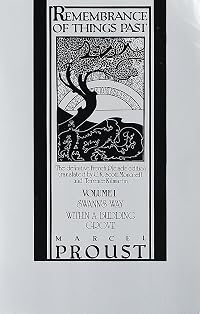
- Remembrance of Things Past: Volume One
- Original title
- Du côté de chez Swann; À l'ombre des jeunes filles en fleurs
- Alternate titles
- Remembrance of Things Past: Volume One - Swann's Way - Within A Budding Grove
- Original publication date
- 1913 (Du côté de chez Swann) (Du cô | té | de chez Swann); 1919 (À l'ombre des jeunes filles en fleur) (À | l'ombre des jeunes filles en fleur)
- People/Characters
- Albertine Simonet; Marcel, The Narrator
- Blurbers
- Nabokov, Vladimir; Quennell, Peter; Wilson, Angus; Moss, Howard; Kilmartin, Terence
- Original language
- French
Classifications
Statistics
- Members
- 1,631
- Popularity
- 13,864
- Reviews
- 20
- Rating
- (4.41)
- Languages
- 6 — English, French, Italian, Japanese, Polish, Spanish
- Media
- Paper, Audiobook, Ebook
- ISBNs
- 22
- ASINs
- 6