On This Page
Description
Davy thinks he's alone...what if he isn't? When Davy was a young teen, he discovered that he was capable of teleportation. At first, it was only when he was terrified and in horrible danger. Later, he learned to control his ability, and went to work for a secret government agency. Now, a mysterious group of people has taken Davy captive. They don't want to hire him, and they don't have any hope of appealing to him to help them. What they want is to own him. They want to use his abilities for show more their own purposes, whether Davy agrees to it or not. And so they set about brainwashing him and conditioning him, and they have found a way to keep a teleport captive. But there's one thing that they don't know. No one knows it, not even Davy. The secret is that experiencing teleportation, over and over again, can teach a person how to do it. Davy's wife Millie is the only person on Earth who has teleported nearly as often as he has. She discovered her new talent the same way Davy did -- in mortal danger, facing imminent death, she suddenly found herself in her own apartment. Now, if she can learn to control this ability, and fast, she may be able to rescue Davy. show lessTags
Recommendations














































Member Recommendations

Member Reviews
Well, crap! I just realized that I have read almost all of the Jumper material, and I'm addicted. Reflex is the first published sequel in the series, and is a major improvement on pacing, action and character depiction from book 1. Riveting, almost impossible to put down. I guess I'll have to try Gould's other non-Jumper books.
The experiments that Davy and Conley come up with are fascinating.
The experiments that Davy and Conley come up with are fascinating.
[This review also appears on FingerFlow.com, a site for review and discussion of creative works.]
Although it took a while, it's a good thing that Reflex, the sequel to Steven Gould's Jumper, came along. The main problem with the first book, despite the appealing premise, was the lack of a plot-moving conflict until late in the story. Reflex redeems the series (can it be called that?) by getting the action started very early on and the book thrills almost until the last page. Like the first book, Gould spends a considerable amount of time on speculation and experimentation concerning Davy's teleportation ability, but unlike Jumper, it doesn't become the main concern of the book.
Reflex opens ten years after the end of the last book. Davy show more and Millie are married and the former is doing occasional work for the NSA, sticking to ethically acceptable missions. Davy is drugged and kidnapped to a secret location by a shadowy organization that appears to have great influence in political and economic affairs, and ties to the NSA. They chain him to a wall to prevent him from teleporting and implant a device in his chest that is used to both torture him and condition him to do their bidding. Gould does a great job coming up with a method for his seedy antagonists to stop Davy from teleporting away when unchained, and at the same time, forcing Davy to cooperate with them. The more you learn about the system, the more ingenious it seems.
Meanwhile, Millie uses her newfound teleportation power to search for Davy. Through contacts in the NSA, FBI and witnesses of Davy's kidnapping, Millie pieces together many clues that lead her very close to where Davy actually is and put her in danger as well.
Gould's writing in this sequel seems to have grown up along with his characters. Gone are the angst-filled moments that Davy frequently had in Jumper and the writing style is generally more reader-friendly and less cringe-inducing (Jumper was definitely Young Adult, while Reflex seems a bit more mature). For some reason, I particularly enjoyed that the chapters alternated between Davy and Millie's point-of-view. Whereas Jumper lacked any well-developed antagonists, Reflex has a few, most notably Hyacinth Pope, the femme fatale that kidnapped Davy and antagonizes him with threats of abuse and seduction. All in all, Reflex was an exciting read. The polish and development of this book makes Jumper seem like it was written solely for the purpose of getting Reflex made. Although I haven't seen the movie Jumper, it's pretty clear they made major changes to give the story a better plot and more action than the first book had. Instead of going to all that trouble, I think they should have skipped Jumper and made a movie from Reflex. It would have been more of a spy thriller than a sci-fi blockbuster, but there are plenty of moments for action and CGI effects (and it would have been truer to the source material). The experimentation with teleportation, the human element of Millie searching for her husband, the interesting baddies to root against and the solid plot of Reflex would have made a much better choice for movie adaptation, just as these elements made Reflex a much better book than Jumper. show less
Although it took a while, it's a good thing that Reflex, the sequel to Steven Gould's Jumper, came along. The main problem with the first book, despite the appealing premise, was the lack of a plot-moving conflict until late in the story. Reflex redeems the series (can it be called that?) by getting the action started very early on and the book thrills almost until the last page. Like the first book, Gould spends a considerable amount of time on speculation and experimentation concerning Davy's teleportation ability, but unlike Jumper, it doesn't become the main concern of the book.
Reflex opens ten years after the end of the last book. Davy show more and Millie are married and the former is doing occasional work for the NSA, sticking to ethically acceptable missions. Davy is drugged and kidnapped to a secret location by a shadowy organization that appears to have great influence in political and economic affairs, and ties to the NSA. They chain him to a wall to prevent him from teleporting and implant a device in his chest that is used to both torture him and condition him to do their bidding. Gould does a great job coming up with a method for his seedy antagonists to stop Davy from teleporting away when unchained, and at the same time, forcing Davy to cooperate with them. The more you learn about the system, the more ingenious it seems.
Meanwhile, Millie uses her newfound teleportation power to search for Davy. Through contacts in the NSA, FBI and witnesses of Davy's kidnapping, Millie pieces together many clues that lead her very close to where Davy actually is and put her in danger as well.
Gould's writing in this sequel seems to have grown up along with his characters. Gone are the angst-filled moments that Davy frequently had in Jumper and the writing style is generally more reader-friendly and less cringe-inducing (Jumper was definitely Young Adult, while Reflex seems a bit more mature). For some reason, I particularly enjoyed that the chapters alternated between Davy and Millie's point-of-view. Whereas Jumper lacked any well-developed antagonists, Reflex has a few, most notably Hyacinth Pope, the femme fatale that kidnapped Davy and antagonizes him with threats of abuse and seduction. All in all, Reflex was an exciting read. The polish and development of this book makes Jumper seem like it was written solely for the purpose of getting Reflex made. Although I haven't seen the movie Jumper, it's pretty clear they made major changes to give the story a better plot and more action than the first book had. Instead of going to all that trouble, I think they should have skipped Jumper and made a movie from Reflex. It would have been more of a spy thriller than a sci-fi blockbuster, but there are plenty of moments for action and CGI effects (and it would have been truer to the source material). The experimentation with teleportation, the human element of Millie searching for her husband, the interesting baddies to root against and the solid plot of Reflex would have made a much better choice for movie adaptation, just as these elements made Reflex a much better book than Jumper. show less
I found the imprisonment and torture scenes incredibly disturbing. This book created a really horrifying sense of helplessness. To see Davy overcome it felt like overcoming it myself. Pretty haunting.
Very intense and suspenseful book, and more enjoyable than the first one. Without giving too much away, I am particularly sensitive to stories (real or fictional) in which somebody is bullied or treated unjustly, and that was the theme for this book. It made me feel very connected to the protagonists and made the book something very difficult to take a break from.
Audiobook notes: the narrator was very good here, with a good variation in his voices (including the female voices). I didn't notice any glaring mispronounciations, and he read at a good pace.
Audiobook notes: the narrator was very good here, with a good variation in his voices (including the female voices). I didn't notice any glaring mispronounciations, and he read at a good pace.
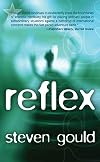
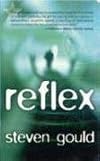
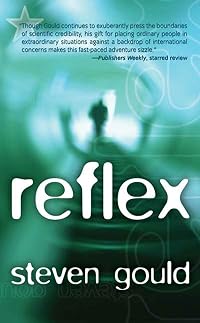
Back in 1993 I picked up Jumper, the first novel featuring Davy Rice. It had a queer-looking cover but I bought it anyway on the strength of the premise. Davy Rice is a teenager who learns how to teleport himself instantaneously from one location to any other location he has fixed in memory or can see. It was okay, other people liked it more than I did. Last year I read Helm by the same author and really enjoyed that one. And now Reflex continues the story of Davy Rice ten years later. (It's got a much less embarrassing cover too.) It's a fun read and an improvement over Jumper. This time some baddies figure how how to imprison a teleport and they capture Davy with the intent of conditioning him and using his talents for their own show more nefarious ends. But what no one realizes is that after being countlessly teleported by her husband over the years, Davy's wife Millie stumbles upon the ability to jump as well. And she wants her husband back. It's a pretty cool little story and a fast read. show less
Very strong, thriller, our heroes are very human and relatable but also inspiring and noble.
A more mature Davy and his wife go through a horrifying ordeal.
This was a fully thought out novel, with the consequences mapped out for someone who is a teleport like Davy.
It rang true, not over the top comic book style, and held my attention. Definitely be reading the third book.
This was a fully thought out novel, with the consequences mapped out for someone who is a teleport like Davy.
It rang true, not over the top comic book style, and held my attention. Definitely be reading the third book.
Members
- Recently Added By
Lists

Books Read in 2013
1,630 works; 51 members
Author Information

18+ Works 5,660 Members

Steven Gould is a LibraryThing Author, an author who lists their personal library on LibraryThing.
Some Editions
Awards and Honors
Awards
Series

Work Relationships
Is contained in
Common Knowledge
- Canonical title
- Reflex
- Original title
- Reflex
- Original publication date
- 2004
- People/Characters
- David Rice; Millicent Harrison-Rice; Sojourner Truth Johnson (Sojee); Hyacinth Pope; Brian Cox (NSA); Thomas P. Anders (NSA) (show all 10); Becca Martingale (FBI); Lawrence Simons; Conley; Padgett
- Related movies
- Jumper (2008 | IMDb)
- Dedication
- For Emma and Carita,
Sequels in their own right,
But also stand-alone treasures.
(And no, Emma, you can't read this yet.) - First words
- The first time was like this.
- Last words
- (Click to show. Warning: May contain spoilers.)In more ways than one.
- Publisher's editor
- Meacham, Beth
- Blurbers
- McMaster Bujold, Lois; Card, Orson Scott
Classifications
Statistics
- Members
- 938
- Popularity
- 28,314
- Reviews
- 24
- Rating
- (3.86)
- Languages
- English, Romanian
- Media
- Paper, Audiobook, Ebook
- ISBNs
- 7
- ASINs
- 7